
Support Our Project ❤️
Creating the content you enjoy every day takes constant work, research, and dedication.
Our team of collaborators puts in countless hours, all without any compensation, to keep these channels active, useful, and inspiring.
If you appreciate what we do and want to help us keep the project alive and growing, even a small donation makes a real difference. Your support allows us to continue producing quality content for everyone.
Thank you for being part of this community and for considering a contribution.
Creating the content you enjoy every day takes constant work, research, and dedication.
Our team of collaborators puts in countless hours, all without any compensation, to keep these channels active, useful, and inspiring.
If you appreciate what we do and want to help us keep the project alive and growing, even a small donation makes a real difference. Your support allows us to continue producing quality content for everyone.
Thank you for being part of this community and for considering a contribution.
Please open Telegram to view this post
VIEW IN TELEGRAM
💸🤖FINTECH 3.0: AI AGENTS REPLACE BANKING APPS
The financial services landscape is undergoing its most radical transformation since the internet. AI agents aren't just assisting bankers — they're becoming the bankers themselves.
Q1 2026 saw $45B flow into AI-first fintech startups, with agentic systems capturing 60% of all fintech funding. The era of human-mediated finance is ending.
---
🧠 The Agent Revolution
• Autonomous Trading: AI agents now execute $2T in daily transactions without human intervention
• Personalized Banking: Hyper-personalized financial advisors available 24/7 for every user
• Risk Assessment: Real-time credit scoring with 99.8% accuracy using behavioral AI
---
📊 Market Shift
Traditional banks are facing existential pressure:
• Customer acquisition costs dropped 80% for AI-native neobanks
• Transaction processing times reduced from days to milliseconds
• Fraud detection improved by 300% using multi-agent systems
---
⚠️ Regulatory Challenges
• Transparency Gap: How do you audit an AI agent's decision-making?
• Systemic Risk: Interconnected AI agents could create cascade failures
• Consumer Protection: Who's liable when an AI agent makes a bad investment?
---
🧩 Expert Perspective
"We're not building better banking apps. We're building autonomous financial entities that learn, adapt, and optimize in real-time."
— Marcus Chen, CEO of Agentic Finance
---
🔮 The Next Phase
Expect consolidation as legacy banks acquire AI fintech startups, emergence of decentralized AI financial networks, and regulatory frameworks specifically designed for autonomous financial agents.
The battleground shifts from user interfaces to agent intelligence.
---
🔗 Sources
[https://www.forbes.com]
[https://www.bloomberg.com]
[https://www.ft.com]
[https://www.wsj.com]
#Fintech #AI #Banking #Finance #Innovation #Technology #Startups #VC
The financial services landscape is undergoing its most radical transformation since the internet. AI agents aren't just assisting bankers — they're becoming the bankers themselves.
Q1 2026 saw $45B flow into AI-first fintech startups, with agentic systems capturing 60% of all fintech funding. The era of human-mediated finance is ending.
---
🧠 The Agent Revolution
• Autonomous Trading: AI agents now execute $2T in daily transactions without human intervention
• Personalized Banking: Hyper-personalized financial advisors available 24/7 for every user
• Risk Assessment: Real-time credit scoring with 99.8% accuracy using behavioral AI
---
📊 Market Shift
Traditional banks are facing existential pressure:
• Customer acquisition costs dropped 80% for AI-native neobanks
• Transaction processing times reduced from days to milliseconds
• Fraud detection improved by 300% using multi-agent systems
---
⚠️ Regulatory Challenges
• Transparency Gap: How do you audit an AI agent's decision-making?
• Systemic Risk: Interconnected AI agents could create cascade failures
• Consumer Protection: Who's liable when an AI agent makes a bad investment?
---
🧩 Expert Perspective
"We're not building better banking apps. We're building autonomous financial entities that learn, adapt, and optimize in real-time."
— Marcus Chen, CEO of Agentic Finance
---
🔮 The Next Phase
Expect consolidation as legacy banks acquire AI fintech startups, emergence of decentralized AI financial networks, and regulatory frameworks specifically designed for autonomous financial agents.
The battleground shifts from user interfaces to agent intelligence.
---
🔗 Sources
[https://www.forbes.com]
[https://www.bloomberg.com]
[https://www.ft.com]
[https://www.wsj.com]
#Fintech #AI #Banking #Finance #Innovation #Technology #Startups #VC
This media is not supported in your browser
VIEW IN TELEGRAM
Market Snapshot
!💰 Prices on everything are about to go up. #inflation #oil #iran
Why it matters: sentiment can move before headlines. This is not financial advice. !✅
!#️⃣ #inflation #oil #iran
!💰 Prices on everything are about to go up. #inflation #oil #iran
Why it matters: sentiment can move before headlines. This is not financial advice. !✅
!#️⃣ #inflation #oil #iran
📈🚀EUROPE'S AI FINANCE BOOM: THE Q1 2026 TURNING POINT
While Silicon Valley dominates headlines, Europe is quietly building the world's most sophisticated AI finance ecosystem. Q1 2026 data reveals a continent undergoing radical transformation.
European AI fintech funding doubled compared to Q1 2025, reaching $28B across 450 startups. This isn't just growth — it's structural repositioning.
---
🧠 Where Europe Excels
• Regulatory-First AI: GDPR-compliant AI systems becoming global standards
• B2B Focus: 70% of funding goes to enterprise AI solutions vs. consumer apps
• Cross-Border Integration: AI-powered payment systems connecting fragmented markets
---
📊 The Numbers Behind the Shift
• London remains the capital with $12B in AI fintech funding
• Berlin emerges as the regulatory tech hub with 40% YoY growth
• Paris leads in AI-driven asset management innovation
• Stockholm dominates in sustainable finance AI
---
⚠️ Unique European Challenges
• Fragmented Markets: 27 regulatory regimes vs. one in the US
• Talent Competition: Brain drain to US tech giants remains a concern
• Scale Limitations: Smaller domestic markets require immediate internationalization
---
🧩 Expert Perspective
"Europe isn't trying to replicate Silicon Valley. It's building something different: AI finance that's sustainable, regulated, and integrated with traditional banking from day one."
— Klaus Schmidt, European Investment Bank
---
🔮 Strategic Implications
Expect accelerated M&A activity as US giants acquire European AI fintech specialists, emergence of pan-European AI financial infrastructure, and regulatory frameworks that become de facto global standards.
The next battle: who defines the rules of AI finance.
---
🔗 Sources
[https://www.ft.com]
[https://www.bloomberg.com]
[https://www.eib.org]
[https://techcrunch.com]
#Europe #AI #Fintech #Finance #VC #Startups #Innovation #Banking
While Silicon Valley dominates headlines, Europe is quietly building the world's most sophisticated AI finance ecosystem. Q1 2026 data reveals a continent undergoing radical transformation.
European AI fintech funding doubled compared to Q1 2025, reaching $28B across 450 startups. This isn't just growth — it's structural repositioning.
---
🧠 Where Europe Excels
• Regulatory-First AI: GDPR-compliant AI systems becoming global standards
• B2B Focus: 70% of funding goes to enterprise AI solutions vs. consumer apps
• Cross-Border Integration: AI-powered payment systems connecting fragmented markets
---
📊 The Numbers Behind the Shift
• London remains the capital with $12B in AI fintech funding
• Berlin emerges as the regulatory tech hub with 40% YoY growth
• Paris leads in AI-driven asset management innovation
• Stockholm dominates in sustainable finance AI
---
⚠️ Unique European Challenges
• Fragmented Markets: 27 regulatory regimes vs. one in the US
• Talent Competition: Brain drain to US tech giants remains a concern
• Scale Limitations: Smaller domestic markets require immediate internationalization
---
🧩 Expert Perspective
"Europe isn't trying to replicate Silicon Valley. It's building something different: AI finance that's sustainable, regulated, and integrated with traditional banking from day one."
— Klaus Schmidt, European Investment Bank
---
🔮 Strategic Implications
Expect accelerated M&A activity as US giants acquire European AI fintech specialists, emergence of pan-European AI financial infrastructure, and regulatory frameworks that become de facto global standards.
The next battle: who defines the rules of AI finance.
---
🔗 Sources
[https://www.ft.com]
[https://www.bloomberg.com]
[https://www.eib.org]
[https://techcrunch.com]
#Europe #AI #Fintech #Finance #VC #Startups #Innovation #Banking
❤1
🚀⚡AI INFRASTRUCTURE WARS: CHIP SUPPLY BECOMES THE NEW OIL
The AI boom has created a new geopolitical battleground: semiconductor supply chains. While software grabs headlines, hardware is where the real power struggle unfolds.
According to TechCrunch, AI infrastructure investments reached $120B in Q1 2026 alone — more than the entire global semiconductor industry's revenue in 2020. This isn't just growth; it's a complete reconfiguration of technological sovereignty.
---
🧠 The New Strategic Assets
• Compute Clusters: Hyperscalers are building AI-specific data centers that consume more power than small countries
• Specialized Chips: Custom AI processors now command 300% premiums over general-purpose GPUs
• Data Pipelines: Real-time data ingestion systems are becoming critical infrastructure
---
📊 Market Implications
The infrastructure layer is creating unprecedented moats. Companies controlling compute access are effectively gatekeepers to the AI revolution. This has led to:
• Vertical integration: AI labs acquiring chip design teams
• Strategic partnerships: Cloud providers locking in AI startups with compute credits
• Geopolitical tensions: Export controls on advanced AI chips
---
⚠️ Hidden Risks
• Supply Chain Fragility: 80% of advanced chips come from a single region
• Energy Constraints: AI data centers now consume 4% of global electricity
• Regulatory Pressure: Governments are scrutinizing AI infrastructure as critical national assets
---
🧩 Expert Perspective
"Control the compute, control the AI revolution. We're witnessing the birth of a new industrial complex."
— Dr. Elena Rodriguez, MIT Technology Review
---
🔮 What Comes Next
Expect consolidation among chip designers, emergence of AI-native cloud providers, and increased government intervention in semiconductor supply chains.
The next frontier: quantum-AI hybrid systems and photonic computing.
---
🔗 Sources
[https://techcrunch.com]
[https://www.ft.com]
[https://www.wsj.com]
[https://www.bloomberg.com]
#AI #Infrastructure #Semiconductors #VentureCapital #TechNews #Hardware #Compute #Innovation
The AI boom has created a new geopolitical battleground: semiconductor supply chains. While software grabs headlines, hardware is where the real power struggle unfolds.
According to TechCrunch, AI infrastructure investments reached $120B in Q1 2026 alone — more than the entire global semiconductor industry's revenue in 2020. This isn't just growth; it's a complete reconfiguration of technological sovereignty.
---
🧠 The New Strategic Assets
• Compute Clusters: Hyperscalers are building AI-specific data centers that consume more power than small countries
• Specialized Chips: Custom AI processors now command 300% premiums over general-purpose GPUs
• Data Pipelines: Real-time data ingestion systems are becoming critical infrastructure
---
📊 Market Implications
The infrastructure layer is creating unprecedented moats. Companies controlling compute access are effectively gatekeepers to the AI revolution. This has led to:
• Vertical integration: AI labs acquiring chip design teams
• Strategic partnerships: Cloud providers locking in AI startups with compute credits
• Geopolitical tensions: Export controls on advanced AI chips
---
⚠️ Hidden Risks
• Supply Chain Fragility: 80% of advanced chips come from a single region
• Energy Constraints: AI data centers now consume 4% of global electricity
• Regulatory Pressure: Governments are scrutinizing AI infrastructure as critical national assets
---
🧩 Expert Perspective
"Control the compute, control the AI revolution. We're witnessing the birth of a new industrial complex."
— Dr. Elena Rodriguez, MIT Technology Review
---
🔮 What Comes Next
Expect consolidation among chip designers, emergence of AI-native cloud providers, and increased government intervention in semiconductor supply chains.
The next frontier: quantum-AI hybrid systems and photonic computing.
---
🔗 Sources
[https://techcrunch.com]
[https://www.ft.com]
[https://www.wsj.com]
[https://www.bloomberg.com]
#AI #Infrastructure #Semiconductors #VentureCapital #TechNews #Hardware #Compute #Innovation
TechCrunch
TechCrunch | Startup and Technology News
TechCrunch | Reporting on the business of technology, startups, venture capital funding, and Silicon Valley
🔥1
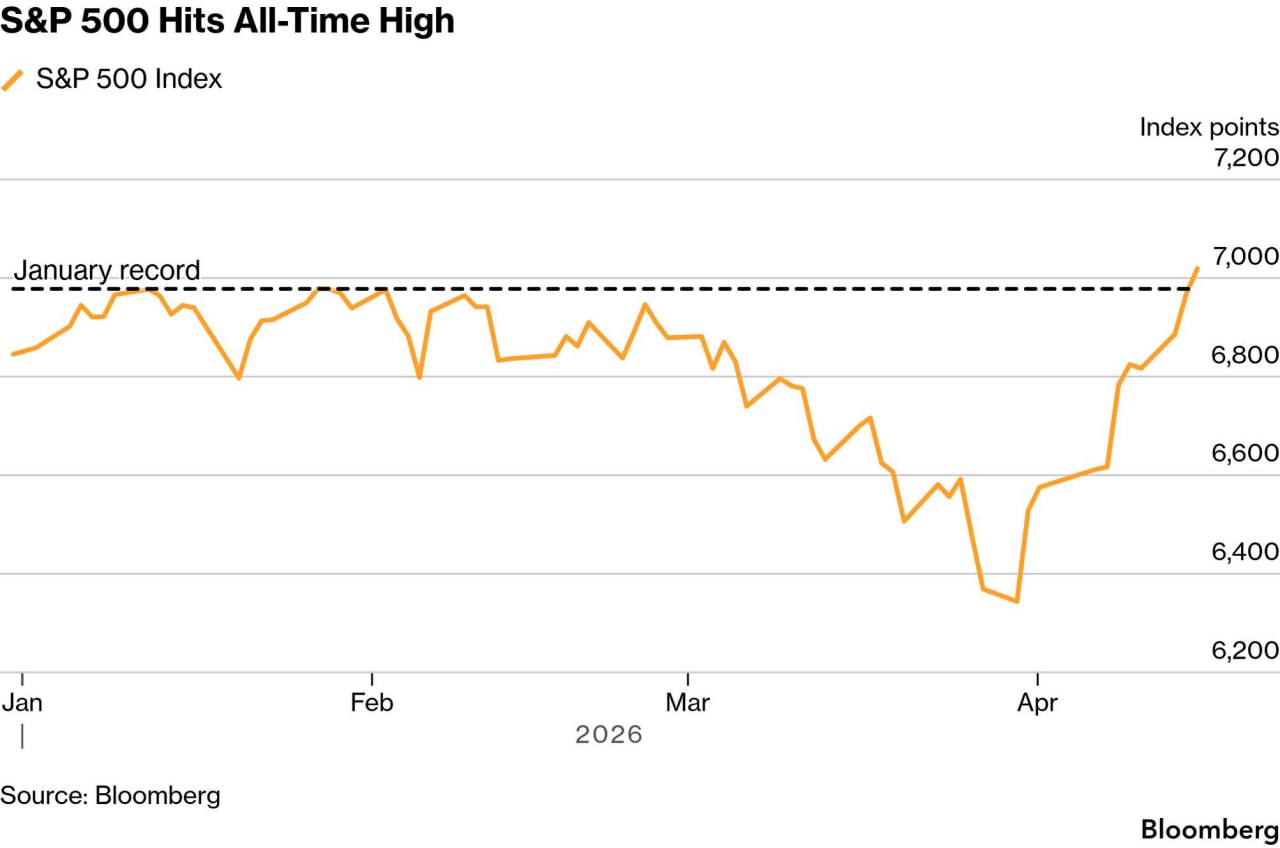
📡 S&P 500 Hits Record High as Ceasefire Rally Accelerates
📌 What’s happening
The S&P 500 has surged to a new all-time high above 7,000, driven by growing optimism around a potential ceasefire and renewed talks in the Middle East.
The rally marks a full recovery from the sharp selloff triggered by the US–Iran conflict just weeks ago.
🔎 What’s driving the rally
Markets are shifting back into risk-on mode, supported by:
• Expectations of de-escalation in the conflict
• Strong corporate earnings outlook
• Continued strength in tech and consumer sectors
Even during an active geopolitical crisis, investors are pricing in a lower probability of escalation.
💡 Key insight
This is a classic market dynamic:
markets don’t wait for certainty — they move on expectations.
Right now, the dominant narrative is:
👉 conflict will not spiral
👉 economic impact will be contained
⚠️ What’s being ignored
The rally is fragile.
Risks still include:
• Oil shocks from Hormuz tensions
• Sudden geopolitical escalation
• Inflation returning via energy markets
Markets are effectively betting on peace before it happens.
📝 In brief
The S&P 500 hitting new highs in the middle of a geopolitical crisis tells you one thing:
liquidity + expectations > current reality
If the ceasefire holds → upside continues
If it breaks → volatility returns fast
🔗 Source
#Markets #SP500 #Macro #Investing #Geopolitics #Finance
The S&P 500 has surged to a new all-time high above 7,000, driven by growing optimism around a potential ceasefire and renewed talks in the Middle East.
The rally marks a full recovery from the sharp selloff triggered by the US–Iran conflict just weeks ago.
Markets are shifting back into risk-on mode, supported by:
• Expectations of de-escalation in the conflict
• Strong corporate earnings outlook
• Continued strength in tech and consumer sectors
Even during an active geopolitical crisis, investors are pricing in a lower probability of escalation.
This is a classic market dynamic:
markets don’t wait for certainty — they move on expectations.
Right now, the dominant narrative is:
👉 conflict will not spiral
👉 economic impact will be contained
The rally is fragile.
Risks still include:
• Oil shocks from Hormuz tensions
• Sudden geopolitical escalation
• Inflation returning via energy markets
Markets are effectively betting on peace before it happens.
📝 In brief
The S&P 500 hitting new highs in the middle of a geopolitical crisis tells you one thing:
liquidity + expectations > current reality
If the ceasefire holds → upside continues
If it breaks → volatility returns fast
🔗 Source
#Markets #SP500 #Macro #Investing #Geopolitics #Finance
Please open Telegram to view this post
VIEW IN TELEGRAM
🛢 Oil Volatility & Positioning
🔗 https://www.bloomberg.com/news
Inventory shock: -0.91M vs +2.1M expected
→ Signals tightening supply + unusual pre-policy trades
🇨🇳 China Growth Surprise
GDP (Q1): 5.0% vs 4.8% expected
→ Supports global risk sentiment and commodities
🇺🇸 US Inflation (PPI)
PPI (MoM): 0.5% vs 1.1% expected
→ Cooling inflation reduces short-term rate pressure
🇺🇸 Labor Market (Claims)
Initial Jobless Claims: 213K expected vs 219K prior
→ Labor still strong → key Fed signal
🏭 Manufacturing Activity
Philly Fed Index: 10.3 expected vs 18.1 prior
→ Early signs of industrial slowdown
🏛 Trump & Geopolitics
🔗 https://www.bloomberg.com/politics
→ Markets reacting in real time to policy tone
🇬🇧 UK Growth Rebound
GDP (MoM): 0.5% vs 0.1% expected
→ Short-term economic strength
🇪🇺 Eurozone Inflation
CPI (YoY): 2.6% vs 2.5% expected
→ Sticky inflation → ECB remains cautious
🏦 Wall Street Trading Boom
🔗 https://www.bloomberg.com/finance
→ Volatility = higher trading revenues
⚡️ North Sea Oil Imbalance
🔗 https://www.bloomberg.com/energy
→ More sellers than buyers → correction risk
Please open Telegram to view this post
VIEW IN TELEGRAM
Bloomberg.com
Politics - Bloomberg
Bloomberg delivers business and markets news, data, analysis, and video to the world, featuring stories from Businessweek and Bloomberg News on everything pertaining to politics
📈 **Bitcoin ETF Inflows Surge**
BlackRock's iShares Bitcoin Trust (IBIT) saw record inflows of $612 million in a single day, the largest since its launch. This brings total net inflows to over $15 billion, signaling strong institutional demand for crypto exposure.
#bitcoin #etf #crypto #finance #investing
BlackRock's iShares Bitcoin Trust (IBIT) saw record inflows of $612 million in a single day, the largest since its launch. This brings total net inflows to over $15 billion, signaling strong institutional demand for crypto exposure.
#bitcoin #etf #crypto #finance #investing
💼 **Fed Rate Cut Expectations Shift**
The Federal Reserve is now expected to cut interest rates only once in 2026, down from previous forecasts of three cuts. Strong economic data and persistent inflation are forcing policymakers to maintain higher rates for longer.
#fed #interestrates #economy #inflation #finance
The Federal Reserve is now expected to cut interest rates only once in 2026, down from previous forecasts of three cuts. Strong economic data and persistent inflation are forcing policymakers to maintain higher rates for longer.
#fed #interestrates #economy #inflation #finance
🌍 **EU Carbon Border Tax Takes Effect**
The EU's Carbon Border Adjustment Mechanism (CBAM) is now fully operational, imposing tariffs on carbon-intensive imports like steel, cement, and aluminum. This could reshape global trade patterns and accelerate green industrial policies worldwide.
#eu #carbon #climate #trade #finance
The EU's Carbon Border Adjustment Mechanism (CBAM) is now fully operational, imposing tariffs on carbon-intensive imports like steel, cement, and aluminum. This could reshape global trade patterns and accelerate green industrial policies worldwide.
#eu #carbon #climate #trade #finance
📡 Private Credit Under Pressure: Wall Street Starts Pulling Back
For years, private credit funds have been one of the most profitable corners of finance. Cheap leverage from major banks allowed these funds to scale aggressively and deliver high returns.
Now that dynamic is starting to break.
👉 Source
---
📌 What’s happening
Major banks like JPMorgan, Goldman Sachs, and Barclays are tightening lending conditions for private credit funds.
They are:
• Increasing interest rates on leveraged facilities
• Marking down loan collateral
• Forcing funds to replace weaker assets in their portfolios
At the same time, investors are pulling capital, putting additional pressure on the sector.
---
🔎 Why this matters
Private credit has grown into a trillion-dollar market, largely outside traditional regulatory scrutiny.
Its success depended on one key factor:
👉 easy leverage
Now that leverage is becoming:
• more expensive
• more selective
• more risk-sensitive
→ the entire return structure of the industry is at risk.
---
💡 Key insight
This is not just a sector issue.
Private credit has been acting as a shadow banking system, funding companies that traditional banks avoided.
If conditions tighten:
• refinancing becomes harder
• default risk increases
• liquidity dries up
This creates a potential credit cycle turning point.
---
⚠️ What could happen next
If the trend continues:
• weaker funds may face forced deleveraging
• asset prices could be repriced downward
• spillover into broader credit markets becomes possible
This is how stress typically propagates:
from niche → to systemic.
---
🧠 Bigger picture
At the same time, markets are dealing with:
• rising geopolitical risk (oil, Middle East)
• interest rate uncertainty
• tightening financial conditions
Private credit was one of the last “easy return” pockets.
That era may be ending.
---
📝 In brief
Wall Street is no longer fueling private credit —
it’s starting to protect itself from it.
And when leverage gets pulled,
everything reprices.
---
#Finance #PrivateCredit #Markets #WallStreet #Macro #Investing #Risk
For years, private credit funds have been one of the most profitable corners of finance. Cheap leverage from major banks allowed these funds to scale aggressively and deliver high returns.
Now that dynamic is starting to break.
👉 Source
---
Major banks like JPMorgan, Goldman Sachs, and Barclays are tightening lending conditions for private credit funds.
They are:
• Increasing interest rates on leveraged facilities
• Marking down loan collateral
• Forcing funds to replace weaker assets in their portfolios
At the same time, investors are pulling capital, putting additional pressure on the sector.
---
Private credit has grown into a trillion-dollar market, largely outside traditional regulatory scrutiny.
Its success depended on one key factor:
👉 easy leverage
Now that leverage is becoming:
• more expensive
• more selective
• more risk-sensitive
→ the entire return structure of the industry is at risk.
---
This is not just a sector issue.
Private credit has been acting as a shadow banking system, funding companies that traditional banks avoided.
If conditions tighten:
• refinancing becomes harder
• default risk increases
• liquidity dries up
This creates a potential credit cycle turning point.
---
If the trend continues:
• weaker funds may face forced deleveraging
• asset prices could be repriced downward
• spillover into broader credit markets becomes possible
This is how stress typically propagates:
from niche → to systemic.
---
🧠 Bigger picture
At the same time, markets are dealing with:
• rising geopolitical risk (oil, Middle East)
• interest rate uncertainty
• tightening financial conditions
Private credit was one of the last “easy return” pockets.
That era may be ending.
---
📝 In brief
Wall Street is no longer fueling private credit —
it’s starting to protect itself from it.
And when leverage gets pulled,
everything reprices.
---
#Finance #PrivateCredit #Markets #WallStreet #Macro #Investing #Risk
Please open Telegram to view this post
VIEW IN TELEGRAM

📊 What to Watch Tomorrow — Markets & Macro
📈 Stocks Holding Highs
Markets remain near record levels despite Middle East tensions
→ Risk-on sentiment is holding… for now
🛢 Oil & Geopolitics
Crude inventories: -0.91M vs +2.1M expected
→ Supply tightening + war risk = upside pressure on oil
🇨🇳 China Growth Strength
GDP (Q1): 5.0% vs 4.8% expected
→ Supports global demand + commodities
🇺🇸 Inflation Cooling (PPI)
PPI (MoM): 0.5% vs 1.1% expected
→ Reduces immediate pressure on Fed tightening
🇺🇸 Labor Market Still Strong
Jobless Claims: 207K vs 213K expected
→ Labor resilience remains intact
🏭 Manufacturing Surprise (Strong)
Philly Fed Index: 26.7 vs 10.3 expected
→ Industrial activity rebounding sharply
🏛 Trump Speeches = Market Catalyst
Multiple appearances impacting:
→ oil expectations
→ geopolitical risk
→ market direction
🚀 SpaceX IPO Incoming
Potential largest IPO ever
→ Major liquidity + tech sector impact
⚡️ Allbirds AI Hype Reversal
Stock drops after +582% surge
→ AI speculation starting to unwind
🌍 Global Deals & Capital Flows
• Europe: potential mega-deal emerging
• South America: $270B untapped market attracting banks
🏙 US Fiscal & Policy Signals
• NYC second-home tax debate
• NY tax revenue above expectations (+$2.3B)
✈️ Airline Consolidation Risk
United + American potential tie-up
→ Less competition → higher prices
#Markets #Macro #SP500 #Oil #Investing #Finance
📈 Stocks Holding Highs
Markets remain near record levels despite Middle East tensions
→ Risk-on sentiment is holding… for now
🛢 Oil & Geopolitics
Crude inventories: -0.91M vs +2.1M expected
→ Supply tightening + war risk = upside pressure on oil
🇨🇳 China Growth Strength
GDP (Q1): 5.0% vs 4.8% expected
→ Supports global demand + commodities
🇺🇸 Inflation Cooling (PPI)
PPI (MoM): 0.5% vs 1.1% expected
→ Reduces immediate pressure on Fed tightening
🇺🇸 Labor Market Still Strong
Jobless Claims: 207K vs 213K expected
→ Labor resilience remains intact
🏭 Manufacturing Surprise (Strong)
Philly Fed Index: 26.7 vs 10.3 expected
→ Industrial activity rebounding sharply
🏛 Trump Speeches = Market Catalyst
Multiple appearances impacting:
→ oil expectations
→ geopolitical risk
→ market direction
🚀 SpaceX IPO Incoming
Potential largest IPO ever
→ Major liquidity + tech sector impact
⚡️ Allbirds AI Hype Reversal
Stock drops after +582% surge
→ AI speculation starting to unwind
🌍 Global Deals & Capital Flows
• Europe: potential mega-deal emerging
• South America: $270B untapped market attracting banks
🏙 US Fiscal & Policy Signals
• NYC second-home tax debate
• NY tax revenue above expectations (+$2.3B)
✈️ Airline Consolidation Risk
United + American potential tie-up
→ Less competition → higher prices
#Markets #Macro #SP500 #Oil #Investing #Finance
👏4❤2🔥2🎉2👍1💯1
✨ Fact #1
The 'Inverted Yield Curve' Predicts Recessions
When short-term government bonds pay more than long-term ones, it's called an inverted yield curve. This unusual event has preceded every U.S. recession since 1955, with a lag of 6-24 months.
Is the curve inverted now? Check and share!
#finance #economics #recession #bonds #investing
The 'Inverted Yield Curve' Predicts Recessions
When short-term government bonds pay more than long-term ones, it's called an inverted yield curve. This unusual event has preceded every U.S. recession since 1955, with a lag of 6-24 months.
Is the curve inverted now? Check and share!
#finance #economics #recession #bonds #investing
👍1🔥1
✨ Fact #2
Central Banks Create Money From Nothing
Through Quantitative Easing (QE), central banks like the Fed create new digital money to buy bonds. This 'printing' aims to stimulate the economy but can fuel asset bubbles and inflation.
Understand monetary policy to protect your wealth!
#centralbanks #monetarypolicy #inflation #economy #QE
Central Banks Create Money From Nothing
Through Quantitative Easing (QE), central banks like the Fed create new digital money to buy bonds. This 'printing' aims to stimulate the economy but can fuel asset bubbles and inflation.
Understand monetary policy to protect your wealth!
#centralbanks #monetarypolicy #inflation #economy #QE
👍3💯3👏2🎉2🔥1
✨ Fact #3
Stock Markets Often Rise During Inflation
While high inflation hurts bonds, stocks can be a hedge. Companies can raise prices, protecting profits. Historically, equities have outperformed during moderate inflationary periods.
Review your portfolio for inflation protection.
#stockmarket #inflation #investing #hedge #markets
Stock Markets Often Rise During Inflation
While high inflation hurts bonds, stocks can be a hedge. Companies can raise prices, protecting profits. Historically, equities have outperformed during moderate inflationary periods.
Review your portfolio for inflation protection.
#stockmarket #inflation #investing #hedge #markets
✨ Fact #4
Cash is a Risky Long-Term Investment
Holding cash feels safe, but inflation erodes its purchasing power. With 3% annual inflation, $100 today will be worth only about $74 in 10 years, a guaranteed loss in real terms.
Don't let inflation eat your savings—invest wisely!
#riskmanagement #inflation #investment #finance #money
Cash is a Risky Long-Term Investment
Holding cash feels safe, but inflation erodes its purchasing power. With 3% annual inflation, $100 today will be worth only about $74 in 10 years, a guaranteed loss in real terms.
Don't let inflation eat your savings—invest wisely!
#riskmanagement #inflation #investment #finance #money
🔥1
✨ Fact #5
The 'Fear Index' (VIX) Moves Opposite Stocks
The VIX measures expected stock market volatility. It spikes when investors panic and sell, and falls when they are calm. It's often called the market's 'fear gauge'.
Watch the VIX for market sentiment clues!
#VIX #stockmarket #volatility #risk #trading
The 'Fear Index' (VIX) Moves Opposite Stocks
The VIX measures expected stock market volatility. It spikes when investors panic and sell, and falls when they are calm. It's often called the market's 'fear gauge'.
Watch the VIX for market sentiment clues!
#VIX #stockmarket #volatility #risk #trading
❤1
🏦 **Deutsche Bank's $1.5B Restructuring**
Deutsche Bank announces a major restructuring plan, cutting 3,500 jobs and exiting several non-core businesses. The move aims to boost profitability and focus on corporate banking and wealth management.
#deutschebank #banking #restructuring #finance #europe
Deutsche Bank announces a major restructuring plan, cutting 3,500 jobs and exiting several non-core businesses. The move aims to boost profitability and focus on corporate banking and wealth management.
#deutschebank #banking #restructuring #finance #europe
❤1
---
The Strait of Hormuz is not just a geopolitical hotspot.
It is one of the most critical financial transmission nodes in the world.
~20% of global oil supply passes through it.
This means:
→ any disruption is not local
→ it is immediately global
---
📊 2. From ships to inflation (mechanism)
The chain reaction is precise:
1. Tension or blockade risk
2. Oil supply uncertainty
3. Oil prices rise
4. Energy costs increase globally
5. Inflation expectations increase
6. Central banks delay rate cuts
7. Financial conditions tighten
→ Equity markets weaken
→ Bond yields rise
This is the standard inflation shock loop
---
In the latest move, we saw the opposite:
• Oil dropped ~9%
• Gas prices fell
• Bonds rallied
Why?
Because markets priced future de-escalation, not present risk.
---
🧠 4. The key disconnect
There are now two parallel realities:
Market reality
→ “conflict will resolve”
→ risk premium decreasing
Operational reality (shipping, logistics)
→ “situation unclear”
→ actors remain cautious
This divergence is dangerous.
Markets move on expectations.
Real economy moves on certainty.
---
If the market is wrong:
• Oil can spike violently
• Inflation expectations reset upward
• Rate cuts get delayed or canceled
• Equities reprice quickly
This creates a non-linear risk event.
Not gradual. Sudden.
---
🔁 6. The feedback loop (core insight)
Hormuz is not just about oil.
It creates a macro feedback loop:
Geopolitics → Energy → Inflation → Rates → Asset Prices → Capital Flows
Break one link → entire system adjusts.
---
Right now, markets are effectively betting on:
👉 diplomacy winning
But positioning is asymmetric:
Upside (peace): gradual
Downside (escalation): sharp and fast
---
📝 In brief
Hormuz is a leverage point over the entire global economy.
When uncertainty increases:
→ markets guess
→ real systems pause
And when those two diverge,
volatility is inevitable.
#Macro #Oil #Geopolitics #Inflation #Markets #Finance #Investing
Please open Telegram to view this post
VIEW IN TELEGRAM
👍10🎉6❤5💯5🔥4👏3