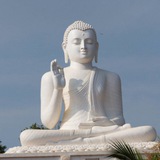
The Four Highest Emotions
Ayya Khema on cultivating loving-kindness, compassion, sympathetic joy, and equanimity.
Part 2 of 3
The Buddha called this kind of love metta, which is not identical to what we call love. “Craving” in Pali is lobha, which sounds rather like the English word for love; and because the entire world revolves around wanting-to-have, we also interpret love this way. But that’s not love, because love is the will to give. Wanting to have is absurd, when we think of love and yet degrade it to this level. Although a loving heart without wishes and limits opens up the world in its purity and beauty, we have made little or no use of this inherent capacity.
The far enemy of love is obviously hatred. The near enemy of love is clinging. Clinging means that we’re not standing on our own two feet and giving love; we’re holding on to someone. It often happens that the person we cling to doesn’t find it especially pleasant and would be glad to get rid of this clinger, because he or she can be a burden. And then comes the great surprise that the love affair isn’t working—but we clung so devotedly! Clinging is thus called the near enemy, because it looks like real love. The big difference between the two is the possessiveness that marks clinging.
When no one is there to whom we can give love, that doesn’t in the least mean that no love exists. The love that fills one’s own heart is the foundation of self-confidence and security, which helps us not to be afraid of anyone.
Such possessiveness proves, time and time again, to be the end of love. True, pure love, so famed in song and story, means that we can pass it on and give it away from the heart without evaluation. Here we have to be on the lookout to recognize the negativity within us. We’re always searching for its causes outside ourselves, but they’re not there. They always lie in our gut and darken our heart. So the point is: Recognize, don’t blame, change! We must keep replacing the negative with the positive. When no one is there to whom we can give love, that doesn’t in the least mean that no love exists. The love that fills one’s own heart is the foundation of self-confidence and security, which helps us not to be afraid of anyone. This fear can be traced back to our not being sure of our own reactions.
If we meet someone who has no good feelings to bring our way, then we already fear a corresponding reaction on our side, and so we prefer to avoid such situations in advance. But if the heart is full of love, then nothing will happen to us, because we know that our reaction will be completely loving. Anxiety becomes unnecessary when we’ve realized that everyone is the creator of his or her own karma. This feeling of love, which is aimed not at only one person, but forms a basis for our whole interior life, is an important aid in meditation, because only through it is real devotion possible.
The second of the four divine abodes—the highest emotions—is compassion, whose far enemy is cruelty and whose near enemy is pity. Pity can’t give others any help. If someone pours out her heart to us and we pity her, then two people are suffering instead of one. If by contrast we give her our compassion, we help her through her trouble.
It’s very important to develop compassion for oneself, because it’s the precondition for being able to do so for others. If someone doesn’t meet us lovingly, it will be easier for us to give this person compassion instead of love. It’s easier because now we know that this person who comes to meet us unlovingly is angry or enraged, is most definitely unhappy. If she were happy, she wouldn’t be angry or enraged. Knowing about the other’s unhappiness makes it easier for us to summon up compassion, especially when we’ve already done so with respect to our own unhappiness.
Telegram
Buddha
Buddha dharma teachings from the suttas and commentaries
✍1🙏1🕊1
Unfortunately we often deal with our own suffering in the wrong way. Instead of acknowledging it and meeting ourselves with compassion, we try to escape our trouble as quickly as possible by developing self-pity or getting distracted or making someone else responsible for it.
Here compassion is the only possibility for meeting our difficulties. We experience exactly what the Buddha teaches: in this world suffering exists. That’s the first Noble Truth. Then we can try to acknowledge what we really want to have or get rid of, and thus make suffering our teacher. There is no better one, and the more we listen to it and find a way into what it’s trying to make us understand, the easier the spiritual path will prove. This path aims to change us so emphatically that in the end we may not even recognize ourselves.
Suffering is a part of our existence, and only when we accept that and stop running away from it, when we’ve learned that suffering belongs to life, can we let go—and then the suffering stops. With this knowledge it’s much easier to develop compassion for others, for suffering strikes everyone, without exception. Even the so-called badness of others can’t bother us, because it only arises out of ignorance and suffering. All the evil in this world is based on these two things.
The third of the four highest emotions is sympathetic joy, whose far enemy is envy, consisting of greed and hatred. The near enemy is hypocrisy, pretending to oneself and others, which we believe is sometimes necessary. We think: these are just little white lies that can readily be forgiven.
Sympathetic joy is rightly understood when we see that there’s no difference between people, that we’re all a part of whatever is momentarily existing in the world. So if one of these parts experiences joy, then its joy has come into the world and we all have reason to share in it. The universal will replace the individual when we have experienced and tasted it in meditation. Our problems won’t let up as long as we try to support and secure the “me.” Only when we begin to put the universal over the individual and to see our purification as more important than the wish to have and get, will we find peace in our hearts.
===
Part 1 of 3:
https://t.me/lorddivinebuddha/5087
Part 2 of 3:
https://t.me/dhammapadas/4570
Part 3 of 3:
https://t.me/wordsofbuddha/6375
===
Buddha dharma teachings channel:
https://t.me/lorddivinebuddha
===
Telegram
Buddha
Buddha dharma teachings from the suttas and commentaries
⚡1💯1😇1
Forwarded from Buddha Dharma books
Free Buddha Dharma ebook
The Lost Caves of the Pacceka Buddhas
By Bhante Shravasti Dhammika
Free download available:
https://budblooms.org/the-lost-caves-of-the-pacceka/
===
The Lost Caves of the Pacceka Buddhas
By Bhante Shravasti Dhammika
Free download available:
https://budblooms.org/the-lost-caves-of-the-pacceka/
===
🥰1👏1🏆1
Forwarded from Buddha Dharma books
Free Buddha Dharma ebook
The Lost Caves of the Pacceka Buddhas
By Bhante Shravasti Dhammika
We usually associate the Himalayas with Hindu saints, not with Buddhist monks. But in the Jataka we are often told that the Bodhisattva became a swami or a rishi and went to live in the Himalayas. Unfortunately, now, many centuries later, it is impossible to identify any of the caves, forests or other landmarks where the Bodhisattva made his abode. In fact, it is difficult to identify any of the locations mentioned in the Jatakas. There is however, two exception to this – the Nandamula Cave and the Nanda Pabbata.
Free download available:
https://budblooms.org/the-lost-caves-of-the-pacceka/
===
👏1🙏1🍓1
Forwarded from Words of the Buddha
The Four Highest Emotions
Ayya Khema on cultivating loving-kindness, compassion, sympathetic joy, and equanimity.
Part 3 of 3
The Buddha called the fourth and last of these emotions the greatest jewel of all: equanimity. It’s the seventh factor of enlightenment, and its far enemy is excitement. The near enemy is indifference, which is based on intentional unconcern. By nature we take an interest in everything. We would like to see, hear, taste and experience everything. But since we have often been disappointed by our incapacity to love, we build an armor of indifference around us, to protect us from further disappointment.
But that only protects us from loving and opening ourselves to the world of love and compassion. What clearly distinguishes equanimity from indifference is love, for in equanimity love is brought to a higher development, while in indifference love is not felt at all or cannot be shown. Equanimity means that we already have enough insight so that nothing seems worth getting worked up over anymore.
How did we reach this understanding? We’ve learned that everything—above all ourselves—comes into being and then passes away. When we get too excited, instead of recognizing the fullness of life, we don’t yet have a loving heart. Only a loving heart can realize the fullness of existence. The understanding we get through meditation clearly shows us that the end of this life is constantly before us. Teresa of Avila said: “Not so much thinking—more loving!” Where does thinking get us? To be sure, it landed us on the moon. But if we have developed love in our hearts, we can accept men and women with all their problems and peculiarities. Then we’ll have built up a world where happiness, harmony, and peace are in control. This world can’t be thought up; it must be felt. Only meditation can present us with this ideal world, in which it is absolutely necessary to give up thinking. This heals us and gives us the capacity to turn more to our heart.
Loving-kindness, compassion, sympathetic joy, and equanimity are the four highest emotions, the only ones worth having.
Since equanimity is a factor of enlightenment, it is based on understanding, above all on the realization that everything that takes place also passes away again. So what do I lose? The worst that can happen is the loss of my life. But I’ll lose that in any event—so what’s all the excitement about? In general, the people who cause problems for us don’t exactly want to kill us. They just want to confirm their ego. But that’s not our business; it’s wholly and entirely theirs. So long as we meditate and win new insights, it will always be simpler to recognize that all desire for self-affirmation, all aggression, all claims for power, all wanting to have and be are intertwined with conflict. So we have to keep trying to let go of willing and wishing, in order to return to equanimity. You can’t meditate at all without equanimity. If we are excited or absolutely want to get or get rid of something, we can’t come to rest. Equanimity makes both everyday life and meditation easier.
That doesn’t mean that conscience should simply be set aside. We need only understand that this judge in our own heart creates nothing but conflict. If we really want to have peace, then we have to strive to develop love and compassion in our heart. Everyone can achieve this, because ultimately the heart is there to love, as the mind is there to think. If we renounce thinking in meditation, then we sense a feeling of purity. We develop purity on the spiritual path. If only one person develops it in himself or herself, the whole world will be the better for it. And the more people purify their hearts, the greater the gain for everyone. We can do this work every day from morning to night, because we are constantly confronted with ourselves—with all our reactions and with the mulishness that keeps us busy, because it has such a solid hold on our inner life.
Telegram
Dhammapada - Buddha Dharma Teachings
Daily teachings of the Dhammapada, beloved and favorite teachings of the Buddha
✍1❤1👌1🏆1
Forwarded from Words of the Buddha
The more observant we are, the easier we’ll find it to let go, until the stubbornness has disappeared, and we’ve become peaceful and happy.
This work compensates us with great profit and with a security that can be found nowhere else. At bottom we all know about the factors that make up the spiritual life, but acting in accordance with them is very hard. Loving-kindness, compassion, sympathetic joy, and equanimity are the four highest emotions, the only ones worth having. They bring us to a level on which life gains breadth, greatness, and beauty and on which we stop trying to make it run the way we want it to—on which we even learn to love something that we may not have wanted at all.
The Buddha spoke about a love that knows no distinctions. It’s simply the quality of the heart. If we have it, we’ll find a completely new path in life.
From “Visible Here and Now: The Buddha’s Teachings on the Rewards of Spiritual Practice”, by Ayya Khema.
===
Ayya Khema, born Ilse Ledermann in Berlin in 1923, was a pioneering Buddhist nun in the Theravada tradition from her ordination in 1979 to her death in 1997. The author of more than two dozen books, she established Buddhist centers in Australia, Sri Lanka and Germany, and was instrumental in the creation of Sakyadhita, a worldwide Buddhist women’s organization.
===
Part 1 of 3:
https://t.me/lorddivinebuddha/5087
Part 2 of 3:
https://t.me/dhammapadas/4570
Part 3 of 3:
https://t.me/wordsofbuddha/6375
===
Dhammapada, beloved and favorite teachings of the Buddha channel:
https://t.me/dhammapadas
===
Telegram
Dhammapada - Buddha Dharma Teachings
Daily teachings of the Dhammapada, beloved and favorite teachings of the Buddha
☃1👏1🆒1
13. Pamsukuladharam jantum
kisam dhamanisanthatam
Ekam vanasmim jhàyantam
tam aham brumi brahmanam. 395.
WHO MEDITATES ALONE IN THE FOREST IS A BRAHMANA
13. The person who wears dust-heap robes, 22 who is lean, whose veins stand out, who meditates alone in the forest - him I call a brahmana. 395.
Story
The Venerable Kisà Gotamã, who was meditating alone in the forest, wearing dust-heap robes, came through the air to salute the Buddha. Seeing Sakka, King of the gods, she turned back after saluting. Sakka wished to know who she was. The Buddha uttered this verse in reply.
===
Buddha dharma teachings channel:
https://invite.viber.com/?g2=AQAKw1y3rv%2F6sk61PI2W4izuIiaEZj8YZujhY1tSzL%2B07s7rFnVFDAd0bAYFaMLw
===
Viber
Buddha
Buddha dharma teachings from the suttas and commentaries from Theravada tradition
🙏1🏆1😇1