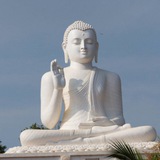
Forwarded from Words of the Buddha
Breathing in heavily/lightly they know: ‘I’m breathing in heavily/lightly.’ Breathing out heavily/lightly they know: ‘I’m breathing out heavily/lightly.’
They practice like this: ‘I’ll breathe in experiencing the whole body.’ They practice like this: ‘I’ll breathe out experiencing the whole body.
They practice like this: ‘I’ll breathe in stilling the physical process.’ They practice like this: ‘I’ll breathe out stilling the physical process.’
And so they meditate observing an aspect of the body internally, externally, and both internally and externally. They meditate observing the body as liable to originate, as liable to fall, and as liable to both originate and vanish. Or mindfulness is established that the body exists, to the extent necessary for knowledge and mindfulness. They meditate independent, not grasping at anything in the world.
That’s how a mendicant meditates by observing an aspect of the body
Partial excerpts from MN 10: Mahasatipatthanasutta
❤1🙏1🕊1😇1🤝1
Free Buddha Dharma ebook
A Culture of Awakening
The Life and Times of the Buddha-Sasana
By Bhikkhu Cintita
Free download available:
https://www.lotuslibrary.com/wp-content/uploads/2024/07/1885-culture-of-awakening_Cintita.pdf
===
A Culture of Awakening
The Life and Times of the Buddha-Sasana
By Bhikkhu Cintita
Free download available:
https://www.lotuslibrary.com/wp-content/uploads/2024/07/1885-culture-of-awakening_Cintita.pdf
===
👍1👏1😎1
Free Buddha Dharma ebook
A Culture of Awakening
The Life and Times of the Buddha-Sasana
By Bhikkhu Cintita
The Buddha-Sāsana, is the living Dharma, that is, Buddhism in its personal, cultural, social and historical dimensions, something organic, located in time and space, that can grow, thrive, self-regulate, propagate, uphold authenticity, and brighten any landscape with its civilizing influence. It was explicitly propounded in the early teachings of the Buddha and set in motion in a form and functionality that it has maintained surprisingly well over a span of a hundred generations. The Buddha-Sasana is the source of the malleability and resilience that once made Buddhism the first world religion and that is characteristic of Buddhism to this day. It has been the basis of a culture of Awakening in many Asian lands.
This rather unique book lays bare the inner life of the Buddha-Sasana to reveal why Buddhism has proved so adaptable to cultural influences yet so faithful to its original message. Significantly, it explores the condition of the Buddha-Sasana as it is taking root in the West. It will be an aid in developing healthy and inclusive Buddhist communities, in instilling a sense of responsibility for upholding the Sasana, in understanding and navigating the many varieties of Buddhist doctrine, and in making sense of the variety of “religious accretions” in Buddhism.
Free download available:
https://www.lotuslibrary.com/wp-content/uploads/2024/07/1885-culture-of-awakening_Cintita.pdf
===
👍1👏1🎉1🙏1🏆1
11. Na jañàhi na gottena
na jaccà hoti bràhmano
Yamhi saccañ ca dhammo ca
so sucã so ca bràhmano. 393.
PURE IS HE WHO IS TRUTHFUL AND RIGHTEOUS
11. Not by matted hair, nor by family, nor by birth does one become a brahmana. But in whom there exist both truth 19 and righteousness, 20 pure is he, a brahmana is he. 393.
Story
A brahmin by birth approached the Buddha and requested Him to address him as "brahmana" just as the monks were addressed. Thereupon the Buddha uttered this verse.
===
Dhammapada, beloved and favorite teachings of the Buddha channel:
https://t.me/dhammapadas
===
Telegram
Dhammapada - Buddha Dharma Teachings
Daily teachings of the Dhammapada, beloved and favorite teachings of the Buddha
🙏2👌2🫡1
Forwarded from Words of the Buddha
It would be more fruitful to go for refuge to the Buddha, the teaching, and the Saṅgha with a confident heart than to build a dwelling for the Saṅgha of the four quarters.
It would be more fruitful to undertake the training rules—not to kill living creatures, steal, commit sexual misconduct, lie, or consume beer, wine, and liquor intoxicants—than to go for refuge to the Buddha, the teaching, and the Saṅgha with a confident heart.
It would be more fruitful to develop a heart of love—even just as long as it takes to pull a cow’s udder—than to undertake the training rules.
It would be more fruitful to develop the perception of impermanence—even for as long as a finger-snap—than to do all of these things, including developing a heart of love for as long as it takes to pull a cow’s udder.”
Partial excerpts from AN 9.20 : Velama Sutta
🙏1🕊1💯1
Furthermore, when a mendicant is walking they know: ‘I am walking.’ When standing they know: ‘I am standing.’ When sitting they know: ‘I am sitting.’ And when lying down they know: ‘I am lying down.’ Whatever posture their body is in, they know it.
And so they meditate observing an aspect of the body internally, externally, and both internally and externally. They meditate observing the body as liable to originate, as liable to fall, and as liable to both originate and vanish. Or mindfulness is established that the body exists, to the extent necessary for knowledge and mindfulness. They meditate independent, not grasping at anything in the world.
That too is how a mendicant meditates by observing an aspect of the body.
Partial excerpts from MN 10: Mahasatipatthanasutta
❤1🥰1🙏1🕊1💯1😇1🤝1
Forwarded from Words of the Buddha
So I have heard. At Sāvatthī.
“Mendicants, form, feeling, perception, choices, and consciousness are impermanent.
Seeing this, a learned noble disciple grows disillusioned with form, feeling, perception, choices, and consciousness. Being disillusioned, desire fades away. When desire fades away they’re freed. When they’re freed, they know they’re freed.
They understand: ‘Rebirth is ended, the spiritual journey has been completed, what had to be done has been done, there is nothing further for this place.’”
SN 22.12 : Aniccasutta
👏1🙏1👌1🕊1🏆1😇1
Forwarded from Buddha
The Four Highest Emotions
Ayya Khema on cultivating loving-kindness, compassion, sympathetic joy, and equanimity.
Part 1 of 3
When we think of love, we have ideas that are purely personal and, on the whole, quite fanciful. They are based in general on our desire to be loved, from which we expect fulfillment.
In reality love fulfills only the one who loves. If we understand love as a quality of the heart, just as intelligence is a quality of the mind, then we won’t deal with love as people customarily do. As a rule, we divide our hearts into different compartments, for lovable, neutral and unlovable people. With that sort of divided heart, there’s no way we can feel good. We can be “whole” only with a heart united in love.
Every moment we spend on the training of our hearts is valuable and brings us a step further along the path of purification.
True love exists when the heart is so broadly trained that it can embrace all human beings and all living creatures. This requires a learning process that is sometimes hard, above all when someone turns out to be very unfriendly or unpleasant. But this condition can be reached by everyone, because we all have the capacity for love within us.
Every moment we spend on the training of our hearts is valuable and brings us a step further along the path of purification. The more often we remember that all our heart has to do is love, the easier it will be to distance ourselves from judgments and condemnations. But that doesn’t mean we can no longer distinguish between good and evil. Naturally we know what is evil, but hatred of evil needn’t forever be stirring in our heart. On the contrary, we have compassion for those who act in a way that does harm.
Most of our problems are concerned with interpersonal relations. To address these, we can direct our view to the teachings on the four highest emotions. These are called in Pali the brahmaviharas; or four divine abodes. They are loving-kindness, compassion, sympathetic joy and equanimity.
If we had only these four emotions at our disposal, we would have paradise on earth. Unfortunately that’s not how it is, and so we rarely experience any paradisiacal feelings. Most of the time we torment ourselves with difficulties in the family, in our circle of friends, and on the job. Our mind constantly tells us about all the things that don’t suit it; and it usually fingers the guilty party, the person who’s bothering us, who doesn’t want things the way we want them. But let’s remember: whenever somebody else says or does something, it’s a matter of his or her karma alone. Only a negative reaction on our side creates our own karma.
This is what we absolutely have to understand: who is doing the loving—myself or the other? If I myself love, then I have a certain purity of heart. But if the love is dependent on this or that person or situation, then I’m passing judgment and dividing people into those I think lovable and those I don’t. We’re all looking for an ideal world, but it can exist only in our own heart, and for this we have to develop our heart’s capacity so that we learn to love independently. This means that we increasingly purify our heart, free it from negativity, and fill it with more and more love. The more love a heart contains, the more love it can pour out. The one and only thing that holds us back is our thinking, judging mind.
We’re all looking for an ideal world, but it can exist only in our own heart, and for this we have to develop our heart’s capacity so that we learn to love independently.
So the only thing that matters is to incline one’s own heart to love, because the person who loves is by nature lovable too. Yet if we love only because we want to be endearing, we succumb to the error of expecting results for our efforts. If an action is worth doing, then it doesn’t lose this value, whether we get results or not. We don’t love as a favor to another or to get something. We love for the sake of love, and so we succeed in filling our hearts with love. And the fuller it gets, the less room there is for negatives.
Telegram
Words of the Buddha
Daily teachings of Buddha Dharma
👏1🎉1🙏1
Forwarded from Buddha
The Buddha recommended looking upon all people as one’s own children. Loving all men and women as if one were their mother is a high ideal. But every little step toward this goal helps us to purify our hearts. The Buddha also explained that it was quite possible that we already were mothers to all the many men and women. If we keep this fact before our eyes, it’ll be much easier to get along with people, even those who don’t strike us as lovable.
If we observe ourselves very carefully—and that’s the point of mindfulness—we will find that we ourselves are not one hundred percent lovable. We will also observe that we find more people unlovable than otherwise. That too can bring no happiness. So we should try to turn this around, and find more and more people lovable. We have to act like every mother: she loves her children even though they sometimes behave very badly. We can make this sort of approach our goal and recognize it as our way of practice.
===
Words of the Buddha channel:
https://t.me/wordsofbuddha
===
Telegram
Words of the Buddha
Daily teachings of Buddha Dharma
👌1💯1🏆1
12. Kim te jañàhi dummedha
kim te ajinasàñiyà
Abbhantaram te gahauam
bàhiram parimajjasi. 394.
BE PURE WITHIN
12. What is the use of your matted hair, O witless man? What is the use of your antelope skin garment? Within, you are full of passions; without, you embellish yourself. 21 394.
Story
The Buddha uttered this verse in connection with an ascetic who attempted to kill a lizard.
===
Vajrayana Tantrayana Buddhism channel:
https://t.me/tantrayanabuddhism
Tibetan Buddhism - Vajrayana, Tantrayana and esoteric Buddhism channel:
https://t.me/tibetanbuddha
===
Telegram
Vajrayana Tantrayana Buddhism
Buddha teachings from the Vajrayana, esoteric, secret or Tantrayana vehicle
❤🔥1🔥1🙏1💯1
Forwarded from Words of the Buddha
I say that knowledge & freedom are fueled by something, they’re not unfueled. And what is the fuel for knowledge & freedom? ‘The 7 awakening factors.’ I say that the 7 awakening factors are fueled by something, they’re not unfueled. And what is the fuel for the 7 awakening factors? ‘The four kinds of mindfulness meditation.’ And what is the fuel for the four kinds of mindfulness meditation? ‘The three kinds of good conduct.’ And what is the fuel for the three kinds of good conduct? ‘Sense restraint.’ And what is the fuel for sense restraint? ‘Mindfulness & situational awareness.’ And what is the fuel for mindfulness & situational awareness? ‘Rational application of mind.’ And what is the fuel for rational application of mind? ‘Faith.’ And what is the fuel for faith? ‘Listening to the true teaching.’ And what is the fuel for listening to the true teaching? ‘Associating with true persons.’
Partial excerpts from AN 10.61 : Avijja Sutta
Partial excerpts from AN 10.61 : Avijja Sutta
✍1🎉1🙏1🏆1
The Chatra (or Chhatra) is the "umbrella" or parasol-like structure found at the very top of a Buddhist Stupa. It is one of the most recognizable features of Buddhist architecture, serving as a powerful symbolic crown for the monument.
Symbolic Significance
In ancient Indian culture, the umbrella was a symbol of royalty and protection. When placed atop a stupa, it signifies the Buddha’s status as a "Universal Monarch" (Chakravartin) of the spiritual realm.
Three stacked chatras represent the Triratna while seven stacked chatras represent the seven factors of enlightenment.
👏1🎉1🙏1
The Four Highest Emotions
Ayya Khema on cultivating loving-kindness, compassion, sympathetic joy, and equanimity.
Part 2 of 3
The Buddha called this kind of love metta, which is not identical to what we call love. “Craving” in Pali is lobha, which sounds rather like the English word for love; and because the entire world revolves around wanting-to-have, we also interpret love this way. But that’s not love, because love is the will to give. Wanting to have is absurd, when we think of love and yet degrade it to this level. Although a loving heart without wishes and limits opens up the world in its purity and beauty, we have made little or no use of this inherent capacity.
The far enemy of love is obviously hatred. The near enemy of love is clinging. Clinging means that we’re not standing on our own two feet and giving love; we’re holding on to someone. It often happens that the person we cling to doesn’t find it especially pleasant and would be glad to get rid of this clinger, because he or she can be a burden. And then comes the great surprise that the love affair isn’t working—but we clung so devotedly! Clinging is thus called the near enemy, because it looks like real love. The big difference between the two is the possessiveness that marks clinging.
When no one is there to whom we can give love, that doesn’t in the least mean that no love exists. The love that fills one’s own heart is the foundation of self-confidence and security, which helps us not to be afraid of anyone.
Such possessiveness proves, time and time again, to be the end of love. True, pure love, so famed in song and story, means that we can pass it on and give it away from the heart without evaluation. Here we have to be on the lookout to recognize the negativity within us. We’re always searching for its causes outside ourselves, but they’re not there. They always lie in our gut and darken our heart. So the point is: Recognize, don’t blame, change! We must keep replacing the negative with the positive. When no one is there to whom we can give love, that doesn’t in the least mean that no love exists. The love that fills one’s own heart is the foundation of self-confidence and security, which helps us not to be afraid of anyone. This fear can be traced back to our not being sure of our own reactions.
If we meet someone who has no good feelings to bring our way, then we already fear a corresponding reaction on our side, and so we prefer to avoid such situations in advance. But if the heart is full of love, then nothing will happen to us, because we know that our reaction will be completely loving. Anxiety becomes unnecessary when we’ve realized that everyone is the creator of his or her own karma. This feeling of love, which is aimed not at only one person, but forms a basis for our whole interior life, is an important aid in meditation, because only through it is real devotion possible.
The second of the four divine abodes—the highest emotions—is compassion, whose far enemy is cruelty and whose near enemy is pity. Pity can’t give others any help. If someone pours out her heart to us and we pity her, then two people are suffering instead of one. If by contrast we give her our compassion, we help her through her trouble.
It’s very important to develop compassion for oneself, because it’s the precondition for being able to do so for others. If someone doesn’t meet us lovingly, it will be easier for us to give this person compassion instead of love. It’s easier because now we know that this person who comes to meet us unlovingly is angry or enraged, is most definitely unhappy. If she were happy, she wouldn’t be angry or enraged. Knowing about the other’s unhappiness makes it easier for us to summon up compassion, especially when we’ve already done so with respect to our own unhappiness.
Telegram
Buddha
Buddha dharma teachings from the suttas and commentaries
✍1🙏1🕊1
Unfortunately we often deal with our own suffering in the wrong way. Instead of acknowledging it and meeting ourselves with compassion, we try to escape our trouble as quickly as possible by developing self-pity or getting distracted or making someone else responsible for it.
Here compassion is the only possibility for meeting our difficulties. We experience exactly what the Buddha teaches: in this world suffering exists. That’s the first Noble Truth. Then we can try to acknowledge what we really want to have or get rid of, and thus make suffering our teacher. There is no better one, and the more we listen to it and find a way into what it’s trying to make us understand, the easier the spiritual path will prove. This path aims to change us so emphatically that in the end we may not even recognize ourselves.
Suffering is a part of our existence, and only when we accept that and stop running away from it, when we’ve learned that suffering belongs to life, can we let go—and then the suffering stops. With this knowledge it’s much easier to develop compassion for others, for suffering strikes everyone, without exception. Even the so-called badness of others can’t bother us, because it only arises out of ignorance and suffering. All the evil in this world is based on these two things.
The third of the four highest emotions is sympathetic joy, whose far enemy is envy, consisting of greed and hatred. The near enemy is hypocrisy, pretending to oneself and others, which we believe is sometimes necessary. We think: these are just little white lies that can readily be forgiven.
Sympathetic joy is rightly understood when we see that there’s no difference between people, that we’re all a part of whatever is momentarily existing in the world. So if one of these parts experiences joy, then its joy has come into the world and we all have reason to share in it. The universal will replace the individual when we have experienced and tasted it in meditation. Our problems won’t let up as long as we try to support and secure the “me.” Only when we begin to put the universal over the individual and to see our purification as more important than the wish to have and get, will we find peace in our hearts.
===
Part 1 of 3:
https://t.me/lorddivinebuddha/5087
Part 2 of 3:
https://t.me/dhammapadas/4570
Part 3 of 3:
https://t.me/wordsofbuddha/6375
===
Buddha dharma teachings channel:
https://t.me/lorddivinebuddha
===
Telegram
Buddha
Buddha dharma teachings from the suttas and commentaries
⚡1💯1😇1
Forwarded from Buddha Dharma books
Free Buddha Dharma ebook
The Lost Caves of the Pacceka Buddhas
By Bhante Shravasti Dhammika
Free download available:
https://budblooms.org/the-lost-caves-of-the-pacceka/
===
The Lost Caves of the Pacceka Buddhas
By Bhante Shravasti Dhammika
Free download available:
https://budblooms.org/the-lost-caves-of-the-pacceka/
===
🥰1👏1🏆1
Forwarded from Buddha Dharma books
Free Buddha Dharma ebook
The Lost Caves of the Pacceka Buddhas
By Bhante Shravasti Dhammika
We usually associate the Himalayas with Hindu saints, not with Buddhist monks. But in the Jataka we are often told that the Bodhisattva became a swami or a rishi and went to live in the Himalayas. Unfortunately, now, many centuries later, it is impossible to identify any of the caves, forests or other landmarks where the Bodhisattva made his abode. In fact, it is difficult to identify any of the locations mentioned in the Jatakas. There is however, two exception to this – the Nandamula Cave and the Nanda Pabbata.
Free download available:
https://budblooms.org/the-lost-caves-of-the-pacceka/
===
👏1🙏1🍓1