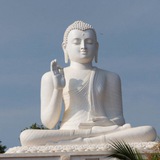
In Buddhism, a stupa is a sacred structure that typically contains relics, such as the remains of the Buddha or other revered figures, as well as sacred texts or objects. It is an important symbol of enlightenment and a place of meditation and worship for practitioners.
The word "stupa" comes from the Sanskrit word meaning "heap" or "mound," reflecting its traditional dome-shaped structure. Stupas represent the Buddha’s mind and the path to enlightenment, symbolizing key elements of Buddhist cosmology, such as the five elements (earth, water, fire, air, and space).
Practitioners often walk around a stupa in a clockwise direction, a practice known as circumambulation, as an act of devotion and to accumulate merit. Stupas vary in design and size across different Buddhist traditions, but they universally serve as focal points for spiritual inspiration.
The word "stupa" comes from the Sanskrit word meaning "heap" or "mound," reflecting its traditional dome-shaped structure. Stupas represent the Buddha’s mind and the path to enlightenment, symbolizing key elements of Buddhist cosmology, such as the five elements (earth, water, fire, air, and space).
Practitioners often walk around a stupa in a clockwise direction, a practice known as circumambulation, as an act of devotion and to accumulate merit. Stupas vary in design and size across different Buddhist traditions, but they universally serve as focal points for spiritual inspiration.
🙏2👏1👌1
Chapter 23
Nàga Vagga
The Elephant
(Text and Translation by Ven. Nàrada)
1. Aham nàgo' va saïgàme
càpàto patitam saram
Ativàkyam titikkhissam
dussãlo hi bahujjano. 320.
2. Dantam nayanti samitim
dantam ràjàbhiruhati
Danto seññho manussesu
yo' tivàkyam titikkhati. 321.
3. Varam assatarà dantà
àjànãyà ca sindhavà
Kuñjarà ca mahànàgà
attadanto tato varam. 322.
THE MAJORITY ARE UNDISCIPLINED
1. As an elephant in the battlefield withstands the arrows shot from a bow, even so will I endure abuse; verily most people are undisciplined. 320.
THE CULTURED ENDURE ABUSE
2. They lead the trained (horses or elephants) to an assembly. The king mounts the trained animal. Best among men are the trained who endure abuse. 321.
BLESSED IS HE WHO CONTROLS HIMSELF
3. Excellent are trained mules, so are thoroughbred horses of Sindh and noble tusked elephants; but far better is he who has trained himself. 322.
Story
Bribed by a lady of the court who had a grudge against the Buddha, many people severely abused the Buddha. The Venerable ânanda, unable to endure such abuse, suggested to the Buddha that He leave the place and go to another city. But the Buddha advised him to practise patience and compared Himself to an elephant who had entered the battlefield prepared to endure all attacks.
===
Ajahn Chah, Buddhist teacher of Thai forest meditation of Theravada Buddhism channel:
https://t.me/ajahnchah_buddhism
===
Nàga Vagga
The Elephant
(Text and Translation by Ven. Nàrada)
1. Aham nàgo' va saïgàme
càpàto patitam saram
Ativàkyam titikkhissam
dussãlo hi bahujjano. 320.
2. Dantam nayanti samitim
dantam ràjàbhiruhati
Danto seññho manussesu
yo' tivàkyam titikkhati. 321.
3. Varam assatarà dantà
àjànãyà ca sindhavà
Kuñjarà ca mahànàgà
attadanto tato varam. 322.
THE MAJORITY ARE UNDISCIPLINED
1. As an elephant in the battlefield withstands the arrows shot from a bow, even so will I endure abuse; verily most people are undisciplined. 320.
THE CULTURED ENDURE ABUSE
2. They lead the trained (horses or elephants) to an assembly. The king mounts the trained animal. Best among men are the trained who endure abuse. 321.
BLESSED IS HE WHO CONTROLS HIMSELF
3. Excellent are trained mules, so are thoroughbred horses of Sindh and noble tusked elephants; but far better is he who has trained himself. 322.
Story
Bribed by a lady of the court who had a grudge against the Buddha, many people severely abused the Buddha. The Venerable ânanda, unable to endure such abuse, suggested to the Buddha that He leave the place and go to another city. But the Buddha advised him to practise patience and compared Himself to an elephant who had entered the battlefield prepared to endure all attacks.
===
Ajahn Chah, Buddhist teacher of Thai forest meditation of Theravada Buddhism channel:
https://t.me/ajahnchah_buddhism
===
Telegram
Ajahn Chah - Theravada Thailand Buddhism
Collection of teachings of Venerable Ajahn Chah, a foremost meditation and Buddhist teacher from Thailand
🙏2❤1💯1🏆1
Forwarded from Words of the Buddha
Abhinhapaccavekkhana
Buddha's teachings to think over again and again
Jarā-dhammomhi
jaram anatīto.
Byādhi-dhammomhi
byādhim anatīto.
Maraṇa-dhammomhi
maraṇam anatīto.
Sabbehi me piyehi manāpehi nānā-bhāvo vinā-bhāvo.
Kammassakomhi
kamma-dāyādo
kamma-yoni
kamma-bandhu
kamma-paṭisaraṇo.
Yam kammam karissāmi kalyāṇam vā pāpakam vā tassa dāyādo
bhavissāmi.
Evam amhehi abhiṇham paccavekkhitabbam.
I am subject to aging;
I have not gone beyond aging.
I am subject to illness;
I have not gone beyond illness.
I am subject to death;
I have not gone beyond death.
I must be separated and parted from all that is dear and pleasing to me.
I am the owner of my karma,
the heir to my karma,
born of my karma,
related to my karma,
and supported by my karma.
Whatever karma I shall do, whether good or bad,
of those I shall be the heir.
Buddha's teachings to think over again and again
Jarā-dhammomhi
jaram anatīto.
Byādhi-dhammomhi
byādhim anatīto.
Maraṇa-dhammomhi
maraṇam anatīto.
Sabbehi me piyehi manāpehi nānā-bhāvo vinā-bhāvo.
Kammassakomhi
kamma-dāyādo
kamma-yoni
kamma-bandhu
kamma-paṭisaraṇo.
Yam kammam karissāmi kalyāṇam vā pāpakam vā tassa dāyādo
bhavissāmi.
Evam amhehi abhiṇham paccavekkhitabbam.
I am subject to aging;
I have not gone beyond aging.
I am subject to illness;
I have not gone beyond illness.
I am subject to death;
I have not gone beyond death.
I must be separated and parted from all that is dear and pleasing to me.
I am the owner of my karma,
the heir to my karma,
born of my karma,
related to my karma,
and supported by my karma.
Whatever karma I shall do, whether good or bad,
of those I shall be the heir.
🙏2🕊1
“When your harp’s strings were tuned too tight, was it resonant and playable?”
“No, sir.”
“When your harp’s strings were tuned too slack, was it resonant and playable?”
“No, sir.”
“But when your harp’s strings were tuned neither too tight nor too slack, but fixed at an even tension, was it resonant and playable?”
“Yes, sir.”
“In the same way, Soṇa, when energy is too forceful it leads to restlessness. When energy is too slack it leads to laziness. So, Soṇa, you should focus on energy and serenity, find a balance of the faculties, and learn the pattern of this situation.”
[...] Then Soṇa, living alone, withdrawn, diligent, keen, and resolute, soon realized the supreme culmination of the spiritual path in this very life.[...]
He understood: “Rebirth is ended; the spiritual journey has been completed; what had to be done has been done; there is nothing further for this place.” And Venerable Soṇa became one of the perfected.
Partial excerpts from AN 6.55 : Sonasutta
“No, sir.”
“When your harp’s strings were tuned too slack, was it resonant and playable?”
“No, sir.”
“But when your harp’s strings were tuned neither too tight nor too slack, but fixed at an even tension, was it resonant and playable?”
“Yes, sir.”
“In the same way, Soṇa, when energy is too forceful it leads to restlessness. When energy is too slack it leads to laziness. So, Soṇa, you should focus on energy and serenity, find a balance of the faculties, and learn the pattern of this situation.”
[...] Then Soṇa, living alone, withdrawn, diligent, keen, and resolute, soon realized the supreme culmination of the spiritual path in this very life.[...]
He understood: “Rebirth is ended; the spiritual journey has been completed; what had to be done has been done; there is nothing further for this place.” And Venerable Soṇa became one of the perfected.
Partial excerpts from AN 6.55 : Sonasutta
🔥1🙏1😇1🤝1
Forwarded from Buddha Dharma books
Free Buddha Dharma ebook
The Lotus, Buddhism’s Favourite Flower
By Bhante Shravasti Dhammika
Free download available:
https://budblooms.org/the-lotus-buddhisms-favourite-flower/
===
The Lotus, Buddhism’s Favourite Flower
By Bhante Shravasti Dhammika
Free download available:
https://budblooms.org/the-lotus-buddhisms-favourite-flower/
===
❤1👏1🍓1😘1
Forwarded from Buddha Dharma books
Free Buddha Dharma ebook
The Lotus, Buddhism’s Favourite Flower
By Bhante Shravasti Dhammika
It is said that the world’s most beloved flower is the rose and the second-most loved is the lotus. Found from northern China and Korea all the way through south, south-east and east Asia and down to northern Australia, the lotus plant has influenced all the fine arts, culinary science, medicine, horticulture, poetry and even architecture (e.g. the lotus bath in Polonnaruwa). It is an aquatic plant growing best in bodies of water with thick muddy bottoms and being a hardy plant it tends to dominate the lakes, ponds and reservoirs where it grows.
Free download available:
https://budblooms.org/the-lotus-buddhisms-favourite-flower/
===
The Lotus, Buddhism’s Favourite Flower
By Bhante Shravasti Dhammika
It is said that the world’s most beloved flower is the rose and the second-most loved is the lotus. Found from northern China and Korea all the way through south, south-east and east Asia and down to northern Australia, the lotus plant has influenced all the fine arts, culinary science, medicine, horticulture, poetry and even architecture (e.g. the lotus bath in Polonnaruwa). It is an aquatic plant growing best in bodies of water with thick muddy bottoms and being a hardy plant it tends to dominate the lakes, ponds and reservoirs where it grows.
Free download available:
https://budblooms.org/the-lotus-buddhisms-favourite-flower/
===
🙏1🕊1🎃1
Forwarded from Words of the Buddha
Suppose there was a mountain that was one solid mass of rock, without cracks or holes. Even if violent storms were to blow up out of the east, the west, the north, and the south, they couldn’t make it shake or rock or tremble.
In the same way, when a mendicant’s mind is rightly freed like this [...] Their mind is quite untainted. [...]
When you’re dedicated to renunciation and seclusion of the heart; when you’re dedicated to kindness and the end of grasping;
when you’re dedicated to the ending of craving and clarity of heart; and you’ve seen the arising of the senses, your mind is rightly freed.
For that one, rightly freed, a mendicant with peaceful mind, there’s nothing to be improved, and nothing more to do.
As the wind cannot stir a solid mass of rock, so too sights, tastes, sounds, smells, and touches—the lot—
and ideas, whether liked or disliked, don’t disturb the unaffected one. Their mind is steady and free as they observe fall.”
Partial excerpts from AN 6.55 : Sonasutta
In the same way, when a mendicant’s mind is rightly freed like this [...] Their mind is quite untainted. [...]
When you’re dedicated to renunciation and seclusion of the heart; when you’re dedicated to kindness and the end of grasping;
when you’re dedicated to the ending of craving and clarity of heart; and you’ve seen the arising of the senses, your mind is rightly freed.
For that one, rightly freed, a mendicant with peaceful mind, there’s nothing to be improved, and nothing more to do.
As the wind cannot stir a solid mass of rock, so too sights, tastes, sounds, smells, and touches—the lot—
and ideas, whether liked or disliked, don’t disturb the unaffected one. Their mind is steady and free as they observe fall.”
Partial excerpts from AN 6.55 : Sonasutta
🙏2🔥1👏1
4. Na hi etehi yànehi
gaccheyya agatam disam
Yathà' ttanà sudantena
danto dantena gacchati. 323.
SELF-CONTROL LEADS TO ONE'S GOAL
4. Surely never by those vehicles would one go to the untrodden land (Nibbàna) as does one who is controlled through his subdued 1 and well-trained 2 self. 323.
Story
A monk who had been an elephant-trainer was watching an elephant-trainer failing to control the animal. He made a suggestion to another monk. The elephant-trainer overheard it and, adopting the suggestion, succeeded. When this matter was reported to the Buddha, the monk was advised to train himself to reach his ultimate goal.
===
Free Buddhism books, teachings, podcasts and videos from Theravada, Mahayana and Vajrayana traditions:
https://t.me/buddha_ebooks
===
gaccheyya agatam disam
Yathà' ttanà sudantena
danto dantena gacchati. 323.
SELF-CONTROL LEADS TO ONE'S GOAL
4. Surely never by those vehicles would one go to the untrodden land (Nibbàna) as does one who is controlled through his subdued 1 and well-trained 2 self. 323.
Story
A monk who had been an elephant-trainer was watching an elephant-trainer failing to control the animal. He made a suggestion to another monk. The elephant-trainer overheard it and, adopting the suggestion, succeeded. When this matter was reported to the Buddha, the monk was advised to train himself to reach his ultimate goal.
===
Free Buddhism books, teachings, podcasts and videos from Theravada, Mahayana and Vajrayana traditions:
https://t.me/buddha_ebooks
===
Telegram
Buddha Dharma books
Free Buddhism books, teachings, podcasts and videos from Theravada, Mahayana and Vajrayana traditions
❤1👍1👏1🙏1
Forwarded from Words of the Buddha
“There are four persons, ananda, worthy of a stupa. Who are the four? A Tathagata, a Fully Awakened Buddha; a Paccekabuddha; a disciple of the Tathagata who is an Arahant; and a universal monarch (Chakravartin).”
“And why, Ananda, is a stupa for the Tathagata worthy of a stupa? At the thought: ‘This is the stupa of the Tathagata, the Arahant, the Fully Awakened Buddha,’ the hearts of many people are inspired, and they gain in happiness and faith, leading to a good rebirth.”
“And likewise with regard to the other three: a Paccekabuddha, an Arahant disciple of the Tathagata, and a universal monarch. That is why, ananda, there are four persons worthy of a stupa.”
Digha Nikaya, Sutta 16 : Mahaparinibbana Sutta
“And why, Ananda, is a stupa for the Tathagata worthy of a stupa? At the thought: ‘This is the stupa of the Tathagata, the Arahant, the Fully Awakened Buddha,’ the hearts of many people are inspired, and they gain in happiness and faith, leading to a good rebirth.”
“And likewise with regard to the other three: a Paccekabuddha, an Arahant disciple of the Tathagata, and a universal monarch. That is why, ananda, there are four persons worthy of a stupa.”
Digha Nikaya, Sutta 16 : Mahaparinibbana Sutta
💯2👏1🙏1👌1
The Task in Relation to Suffering
How we can learn to see things as they are—and, in the process, find freedom
By Ajahn Pramote | Translated by Bruce Evans
Part 1 of 2
Keep practicing. Don’t be discouraged. The reward of meditation practice awaits us if we keep up the practice. People are searching for happiness in the world, but it’s never full or satiated, this worldly happiness. It’s always lacking and imperfect. It’s like a drug. You take it, inject it, or inhale it, and you feel good momentarily. Then suffering arises again. Then you get hungry. There is no real happiness in the world.
When we come to practice meditation, we aren’t aiming for happiness. We are aiming to learn suffering. Make sure you have the right objective. If you’re practicing for happiness, you won’t find it. Happiness is an illusion. When suffering is reduced, you feel happy. When suffering increases, then you feel suffering. But if we have the proper aim in practicing meditation, we will be practicing to learn suffering. When we learn suffering, then our mind lets go of suffering. The mind transcends suffering. When the mind has transcended suffering, we don’t have to talk about happiness. That’s just a freebie. Simply not having suffering—that’s happiness.
But if you aim for happiness, you will have even more wanting. When there is no happiness, you want it, and when there is happiness, you want it to last forever. But in reality, there will soon be suffering. You can’t have happiness all the time. When the mind has desire, wanting arises. The mind struggles, and suffering arises again. The worldly way is to feed desire all the time. We want, and we try to constantly feed our wants. We hope that by feeding our wants we will be happy, but the happiness only arises momentarily. Then you want something else. There is no fulfilment or satisfaction with worldly happiness.
If we know suffering, we know that the task in relation to suffering is not to get rid of it. The Buddha did not teach us to get rid of suffering. He taught us to know suffering. Once we know suffering as it is, seeing the truth as it really is, we see that this body is itself suffering and the mind is itself suffering. When you see suffering clearly, the mind will unwind its attachment.
To see suffering is to see things as they are. The Buddha said that, through seeing the truth, seeing the body and mind, seeing physicality and mentality as they really are, there will arise disenchantment. With disenchantment, clinging is released; with the release of clinging, there is liberation. When there is liberation, there is the knowledge that one is liberated. Birth—the action of the mind clinging to eyes, ears, nose, tongue, body, and mind—is ended. The holy life—that is, the practice of the dhamma—has been completed. There is no further task to be done for purity and liberation.
Worldly work is never completed. For instance, today you cook a meal to eat; tomorrow you have to find something to eat again. Today you have a shower; tomorrow you have to shower again. You buy a house, then you have to repair it. There’s no end to it. But knowing suffering, knowing the body and the mind as they really are, leads to the end of the tasks of our mind.
The science of the Buddha is an amazing science. Others searched for ways to resolve suffering. Some of them could see that if you had wanting, you would have suffering. They were clever. They searched for ways to destroy wanting by tormenting it: If you want to eat, don’t eat; if you want to lie down, don’t lie down. But they were only half clever. They knew that wanting was the cause of suffering, but they did not know how to deal with things in order to get rid of wanting. They used the method of denying it.
Another group sought to get rid of suffering by satisfying desires: If you want to eat, eat. If you want to lie down, lie down. If you want to travel around, then travel around. Whatever you desire, satisfy it. Whenever you satisfy a desire, the desire goes away and you feel comfortable.
How we can learn to see things as they are—and, in the process, find freedom
By Ajahn Pramote | Translated by Bruce Evans
Part 1 of 2
Keep practicing. Don’t be discouraged. The reward of meditation practice awaits us if we keep up the practice. People are searching for happiness in the world, but it’s never full or satiated, this worldly happiness. It’s always lacking and imperfect. It’s like a drug. You take it, inject it, or inhale it, and you feel good momentarily. Then suffering arises again. Then you get hungry. There is no real happiness in the world.
When we come to practice meditation, we aren’t aiming for happiness. We are aiming to learn suffering. Make sure you have the right objective. If you’re practicing for happiness, you won’t find it. Happiness is an illusion. When suffering is reduced, you feel happy. When suffering increases, then you feel suffering. But if we have the proper aim in practicing meditation, we will be practicing to learn suffering. When we learn suffering, then our mind lets go of suffering. The mind transcends suffering. When the mind has transcended suffering, we don’t have to talk about happiness. That’s just a freebie. Simply not having suffering—that’s happiness.
But if you aim for happiness, you will have even more wanting. When there is no happiness, you want it, and when there is happiness, you want it to last forever. But in reality, there will soon be suffering. You can’t have happiness all the time. When the mind has desire, wanting arises. The mind struggles, and suffering arises again. The worldly way is to feed desire all the time. We want, and we try to constantly feed our wants. We hope that by feeding our wants we will be happy, but the happiness only arises momentarily. Then you want something else. There is no fulfilment or satisfaction with worldly happiness.
If we know suffering, we know that the task in relation to suffering is not to get rid of it. The Buddha did not teach us to get rid of suffering. He taught us to know suffering. Once we know suffering as it is, seeing the truth as it really is, we see that this body is itself suffering and the mind is itself suffering. When you see suffering clearly, the mind will unwind its attachment.
To see suffering is to see things as they are. The Buddha said that, through seeing the truth, seeing the body and mind, seeing physicality and mentality as they really are, there will arise disenchantment. With disenchantment, clinging is released; with the release of clinging, there is liberation. When there is liberation, there is the knowledge that one is liberated. Birth—the action of the mind clinging to eyes, ears, nose, tongue, body, and mind—is ended. The holy life—that is, the practice of the dhamma—has been completed. There is no further task to be done for purity and liberation.
Worldly work is never completed. For instance, today you cook a meal to eat; tomorrow you have to find something to eat again. Today you have a shower; tomorrow you have to shower again. You buy a house, then you have to repair it. There’s no end to it. But knowing suffering, knowing the body and the mind as they really are, leads to the end of the tasks of our mind.
The science of the Buddha is an amazing science. Others searched for ways to resolve suffering. Some of them could see that if you had wanting, you would have suffering. They were clever. They searched for ways to destroy wanting by tormenting it: If you want to eat, don’t eat; if you want to lie down, don’t lie down. But they were only half clever. They knew that wanting was the cause of suffering, but they did not know how to deal with things in order to get rid of wanting. They used the method of denying it.
Another group sought to get rid of suffering by satisfying desires: If you want to eat, eat. If you want to lie down, lie down. If you want to travel around, then travel around. Whatever you desire, satisfy it. Whenever you satisfy a desire, the desire goes away and you feel comfortable.
Telegram
Dhammapada - Buddha Dharma Teachings
Daily teachings of the Dhammapada, beloved and favorite teachings of the Buddha
👍1😇1🆒1
But in no long time suffering arises again. There is no end to it.
The Buddha taught us to know suffering. As soon as you know suffering clearly as it is, then samudaya, the cause of suffering, will be automatically abandoned. As soon as the cause is given up, cessation (nirodha)—that is, nibbana—will automatically appear. You don’t have to go searching for nibbana anywhere else. Nibbana isn’t in the temples; it isn’t at Wat Suan Santidham; it’s not with me; it isn’t with the Buddha. Nibbana lies in front of us, but wanting (tanha) obscures it. Our eye, our dhamma eye, is closed off by wanting. So we don’t see nibbana, even though it is right in front of us.
Our eye, our dhamma eye, is closed off by wanting. So we don’t see nibbana, even though it is right in front of us.
You must learn suffering, learn the truth of the body, learn the truth of the mind, and keep on with it. If you have a lot of good accumulated perfections, you could attain arahantship in only one day, seeing the truth of the body and mind in full. If your merit is a little less than that, it might be three days or seven days, seven months or seven years. If your merit is less than that, it might be seven lifetimes. Keep on practicing.
The Buddha taught that we attain purity through wisdom. This wisdom is not worldly cleverness. True wisdom is knowing the truth of suffering (dukkha). When you clearly know suffering, you give up the cause (samudaya), and you realize and attain cessation (nirodha), which is nibbana. And at that moment when you touch nibbana, the noble path (magga) arises.
Suffering—know it; the cause—relinquish it; cessation, nibbana—realize it; the path—develop it. All these four tasks are performed at once. We complete them all at once, in the one moment. When we see suffering, we relinquish the cause; when we relinquish the cause, we realize cessation; when we realize cessation, then we have developed the path. These four tasks are completed at the one place in the one moment. At the one place: That is at this very mind, in only one mind moment.
===
Part 1 of 2:
https://t.me/dhammapadas/4278
Part 2 of 2:
https://t.me/lorddivinebuddha/4804
===
Dhammapada, beloved and favorite teachings of the Buddha channel:
https://t.me/dhammapadas
===
The Buddha taught us to know suffering. As soon as you know suffering clearly as it is, then samudaya, the cause of suffering, will be automatically abandoned. As soon as the cause is given up, cessation (nirodha)—that is, nibbana—will automatically appear. You don’t have to go searching for nibbana anywhere else. Nibbana isn’t in the temples; it isn’t at Wat Suan Santidham; it’s not with me; it isn’t with the Buddha. Nibbana lies in front of us, but wanting (tanha) obscures it. Our eye, our dhamma eye, is closed off by wanting. So we don’t see nibbana, even though it is right in front of us.
Our eye, our dhamma eye, is closed off by wanting. So we don’t see nibbana, even though it is right in front of us.
You must learn suffering, learn the truth of the body, learn the truth of the mind, and keep on with it. If you have a lot of good accumulated perfections, you could attain arahantship in only one day, seeing the truth of the body and mind in full. If your merit is a little less than that, it might be three days or seven days, seven months or seven years. If your merit is less than that, it might be seven lifetimes. Keep on practicing.
The Buddha taught that we attain purity through wisdom. This wisdom is not worldly cleverness. True wisdom is knowing the truth of suffering (dukkha). When you clearly know suffering, you give up the cause (samudaya), and you realize and attain cessation (nirodha), which is nibbana. And at that moment when you touch nibbana, the noble path (magga) arises.
Suffering—know it; the cause—relinquish it; cessation, nibbana—realize it; the path—develop it. All these four tasks are performed at once. We complete them all at once, in the one moment. When we see suffering, we relinquish the cause; when we relinquish the cause, we realize cessation; when we realize cessation, then we have developed the path. These four tasks are completed at the one place in the one moment. At the one place: That is at this very mind, in only one mind moment.
===
Part 1 of 2:
https://t.me/dhammapadas/4278
Part 2 of 2:
https://t.me/lorddivinebuddha/4804
===
Dhammapada, beloved and favorite teachings of the Buddha channel:
https://t.me/dhammapadas
===
Telegram
Dhammapada - Buddha Dharma Teachings
Daily teachings of the Dhammapada, beloved and favorite teachings of the Buddha
💯1🏆1🦄1
Forwarded from Words of the Buddha
“Mendicants, towards evening the lion, king of beasts, emerges from his den, yawns, looks all around the four quarters, and roars his lion’s roar three times. Then he sets out on the hunt. If he strikes an elephant, he does it carefully, not carelessly. If he strikes a buffalo … a cow … a leopard … or any smaller creatures—even a hare or a cat—he does it carefully, not carelessly. Why is that? Thinking: ‘May I not lose my way.’
‘Lion’ is a term for the Realized One, the perfected one, the fully awakened Buddha. When the Realized One teaches Dhamma to an assembly, this is his lion’s roar. When the Realized One teaches the monks … nuns … laymen … laywomen … or ordinary people—even food-carriers and hunters—he teaches them carefully, not carelessly. Why is that? Because the Realized One has respect and reverence for the teaching.”
AN 5.99 Sīhasutta: The Lion
===
‘Lion’ is a term for the Realized One, the perfected one, the fully awakened Buddha. When the Realized One teaches Dhamma to an assembly, this is his lion’s roar. When the Realized One teaches the monks … nuns … laymen … laywomen … or ordinary people—even food-carriers and hunters—he teaches them carefully, not carelessly. Why is that? Because the Realized One has respect and reverence for the teaching.”
AN 5.99 Sīhasutta: The Lion
===
🥰1👏1🙏1🫡1
Forwarded from Buddha
The Task in Relation to Suffering
How we can learn to see things as they are—and, in the process, find freedom
By Ajahn Pramote | Translated by Bruce Evans
Part 2 of 2
Our task is to know suffering. Get it done, know suffering: Know the body as it is, know the mind as it is. This is the science of the Buddha. What do you get from it? First, the end of desire. This is called viraga. The end of suffering, liberation from suffering: This is called vimutti. There’s the end of mental struggle, which is called visankhara. When you reach nibbana, it’s santi, peace. These are all names for nibbana. We can experience nibbana, see nibbana, when we clearly see suffering. There is no other option. You must know suffering; you must know the body and the mind. Know them as they are.
How can we know the body and the mind as they are? The important tools are right mindfulness and right concentration. Mindfulness is not just the worldly kind of mindfulness. All skillful mental states contain mindfulness, but the mindfulness that enables us to attain the path and fruit is the four foundations of mindfulness: kayanupassana, or mindfulness of the body; vedananupassana, or mindfulness of the feelings, which is mindfulness of mentality; cittanupassana, or mindfulness of the mind (citta), which is mindfulness of mental volitional activities (sankhara); and dhammanupassana, or mindfulness of dhammas, which includes both physicality and mentality, both skillful (kusala) conditions and unskillful (akusala) conditions, and both causal and resultant conditions.
Try to learn your own body and mind. They have many, many forms. You don’t have to learn them all. Just do what you can do. For instance, if you are watching and being mindful of the body with out-breaths and in-breaths, you can use this breathing body to practice meditation. We observe the changes within the body through the breathing. The body that breathes out is one thing; the body that breathes in is another. The body that breathes out is impermanent; the body that breathes in is impermanent. The body that breathes out is merely a physical element; it is not our self. The body that breathes in is merely a physical element; it is not our self.
If you don’t like watching the breath, you could observe the bodily positions: standing, walking, sitting, and reclining. This is another kind of kayanupassana. The body standing is impermanent. The body that walks, sits, and reclines is impermanent. The body that stands, walks, sits, and reclines is merely a material object. This material object stands, walks, sits, and reclines. It is not our self that stands, walks, sits, and reclines. The body that stands is impermanent; the body that walks is impermanent; the body that sits is impermanent; the body that reclines is impermanent. Observe like this, and you will see that all physicality is impermanent.
So we know the body standing, walking, sitting, and reclining, the body breathing out and breathing in, full of impermanence, full of suffering, being oppressed, full of not-self, just a material object. It is a lump of elements. It is not ours; it belongs to the world. When you see this, you will be done with clinging to the body.
If you see the truth of physicality and mentality, you don’t cling. When you don’t cling, you don’t want. The mind does not delight in or despise happiness and suffering. It stops struggling. There is no wanting, no mental hunger. The mind is free of defilements and desire. It experiences a unique kind of happiness. When you want happiness, you struggle almost to death and don’t obtain it. You get it only for an instant, then it is lost. When you no longer desire happiness, when you just observe suffering, [seeing that] the body is suffering, the mind is suffering, when you let go of the body and mind, you obtain an incomparable kind of happiness. That’s the happiness of nibbana. It is a happiness that will cause tears to flow. “Oh, there is such a happiness like this?” It is a really powerful kind of happiness.
How we can learn to see things as they are—and, in the process, find freedom
By Ajahn Pramote | Translated by Bruce Evans
Part 2 of 2
Our task is to know suffering. Get it done, know suffering: Know the body as it is, know the mind as it is. This is the science of the Buddha. What do you get from it? First, the end of desire. This is called viraga. The end of suffering, liberation from suffering: This is called vimutti. There’s the end of mental struggle, which is called visankhara. When you reach nibbana, it’s santi, peace. These are all names for nibbana. We can experience nibbana, see nibbana, when we clearly see suffering. There is no other option. You must know suffering; you must know the body and the mind. Know them as they are.
How can we know the body and the mind as they are? The important tools are right mindfulness and right concentration. Mindfulness is not just the worldly kind of mindfulness. All skillful mental states contain mindfulness, but the mindfulness that enables us to attain the path and fruit is the four foundations of mindfulness: kayanupassana, or mindfulness of the body; vedananupassana, or mindfulness of the feelings, which is mindfulness of mentality; cittanupassana, or mindfulness of the mind (citta), which is mindfulness of mental volitional activities (sankhara); and dhammanupassana, or mindfulness of dhammas, which includes both physicality and mentality, both skillful (kusala) conditions and unskillful (akusala) conditions, and both causal and resultant conditions.
Try to learn your own body and mind. They have many, many forms. You don’t have to learn them all. Just do what you can do. For instance, if you are watching and being mindful of the body with out-breaths and in-breaths, you can use this breathing body to practice meditation. We observe the changes within the body through the breathing. The body that breathes out is one thing; the body that breathes in is another. The body that breathes out is impermanent; the body that breathes in is impermanent. The body that breathes out is merely a physical element; it is not our self. The body that breathes in is merely a physical element; it is not our self.
If you don’t like watching the breath, you could observe the bodily positions: standing, walking, sitting, and reclining. This is another kind of kayanupassana. The body standing is impermanent. The body that walks, sits, and reclines is impermanent. The body that stands, walks, sits, and reclines is merely a material object. This material object stands, walks, sits, and reclines. It is not our self that stands, walks, sits, and reclines. The body that stands is impermanent; the body that walks is impermanent; the body that sits is impermanent; the body that reclines is impermanent. Observe like this, and you will see that all physicality is impermanent.
So we know the body standing, walking, sitting, and reclining, the body breathing out and breathing in, full of impermanence, full of suffering, being oppressed, full of not-self, just a material object. It is a lump of elements. It is not ours; it belongs to the world. When you see this, you will be done with clinging to the body.
If you see the truth of physicality and mentality, you don’t cling. When you don’t cling, you don’t want. The mind does not delight in or despise happiness and suffering. It stops struggling. There is no wanting, no mental hunger. The mind is free of defilements and desire. It experiences a unique kind of happiness. When you want happiness, you struggle almost to death and don’t obtain it. You get it only for an instant, then it is lost. When you no longer desire happiness, when you just observe suffering, [seeing that] the body is suffering, the mind is suffering, when you let go of the body and mind, you obtain an incomparable kind of happiness. That’s the happiness of nibbana. It is a happiness that will cause tears to flow. “Oh, there is such a happiness like this?” It is a really powerful kind of happiness.
Telegram
Buddha
Buddha dharma teachings from the suttas and commentaries
⚡1👏1🤝1
Forwarded from Buddha
When wanting and clinging are gone, the struggle is gone, and you are liberated from suffering. When you are liberated from suffering, you have an incomparable kind of happiness.
Observe suffering; look at the body and the mind. This is the reason that we must watch our body and our mind. If you know the body and mind as they really are, you see the three characteristics of body and mind. When you see the truth of them, you become disillusioned with them and release your clinging. When wanting and clinging are gone, the struggle is gone, and you are liberated from suffering. When you are liberated from suffering, you have an incomparable kind of happiness. It is a happiness that doesn’t change in response to sights, sounds, smells, tastes, bodily feelings, and thoughts. It is a happiness that is independent of sights, sounds, smells, tastes, bodily feelings, and thoughts. It is independent of things that are uncertain. Sights are uncertain; sounds, smells, tastes, bodily feelings, and thoughts are uncertain. As long as you are dependent on things that are uncertain, then your happiness is uncertain. When you don’t rely on things that are uncertain, when you don’t rely on anything in the world, then you attain the true, perfect happiness.
So keep practicing. Today it might be difficult. In the future it will be easy. Just keep watching the body and the mind. Today there are many defilements. In the future there will be fewer. Today there is a lot of suffering, and it lasts a long time. In the future there will be little suffering, and for a shorter amount of time, until eventually suffering comes to an end. Whoever does it will attain it. But you have to do it properly. Don’t use the methods that the Buddha didn’t teach, such as the method of feeding desires. This doesn’t work. The method of denying desires, that doesn’t work either. The method of knowing suffering until you automatically relinquish desire: That’s the method that works.
Adapted from Voices of Siam 2025 compiled and translated by Bruce Evans.
===
Ajahn Pramote took bhikkhu ordination in 2001 and went on to establish his own monastery at Wat Suan Santidham in Chon Buri Province, where he currently lives and teaches.
===
Part 1 of 2:
https://t.me/dhammapadas/4278
Part 2 of 2:
https://t.me/lorddivinebuddha/4804
===
Buddha dharma teachings channel:
https://t.me/lorddivinebuddha
===
Observe suffering; look at the body and the mind. This is the reason that we must watch our body and our mind. If you know the body and mind as they really are, you see the three characteristics of body and mind. When you see the truth of them, you become disillusioned with them and release your clinging. When wanting and clinging are gone, the struggle is gone, and you are liberated from suffering. When you are liberated from suffering, you have an incomparable kind of happiness. It is a happiness that doesn’t change in response to sights, sounds, smells, tastes, bodily feelings, and thoughts. It is a happiness that is independent of sights, sounds, smells, tastes, bodily feelings, and thoughts. It is independent of things that are uncertain. Sights are uncertain; sounds, smells, tastes, bodily feelings, and thoughts are uncertain. As long as you are dependent on things that are uncertain, then your happiness is uncertain. When you don’t rely on things that are uncertain, when you don’t rely on anything in the world, then you attain the true, perfect happiness.
So keep practicing. Today it might be difficult. In the future it will be easy. Just keep watching the body and the mind. Today there are many defilements. In the future there will be fewer. Today there is a lot of suffering, and it lasts a long time. In the future there will be little suffering, and for a shorter amount of time, until eventually suffering comes to an end. Whoever does it will attain it. But you have to do it properly. Don’t use the methods that the Buddha didn’t teach, such as the method of feeding desires. This doesn’t work. The method of denying desires, that doesn’t work either. The method of knowing suffering until you automatically relinquish desire: That’s the method that works.
Adapted from Voices of Siam 2025 compiled and translated by Bruce Evans.
===
Ajahn Pramote took bhikkhu ordination in 2001 and went on to establish his own monastery at Wat Suan Santidham in Chon Buri Province, where he currently lives and teaches.
===
Part 1 of 2:
https://t.me/dhammapadas/4278
Part 2 of 2:
https://t.me/lorddivinebuddha/4804
===
Buddha dharma teachings channel:
https://t.me/lorddivinebuddha
===
Telegram
Dhammapada - Buddha Dharma Teachings
The Task in Relation to Suffering
How we can learn to see things as they are—and, in the process, find freedom
By Ajahn Pramote | Translated by Bruce Evans
Part 1 of 2
Keep practicing. Don’t be discouraged. The reward of meditation practice awaits us…
How we can learn to see things as they are—and, in the process, find freedom
By Ajahn Pramote | Translated by Bruce Evans
Part 1 of 2
Keep practicing. Don’t be discouraged. The reward of meditation practice awaits us…
✍1👍1😇1
5. Dhanapàlako nàma kuñjaro
kañukappabhedano dunnivàrayo
Baddho kabalam na bhuñjati
sumarati nàgavanassa kuñjaro. 324.
AN ELEPHANT CARED FOR HIS MOTHER
5. The uncontrollable, captive tusker named Dhanapàlaka, with pungent juice flowing, eats no morsel; the tusker calls to mind the elephant forest. 324.
Story
An old man was neglected by his children. One day he went to see the Buddha, who made a suggestion to him which proved very successful. Later, the children tenderly cared for their father. Commenting on their attention, the Buddha uttered this verse to show the loving care of a captive elephant towards its mother.
===
Buddha dharma teachings channel:
https://t.me/lorddivinebuddha
===
kañukappabhedano dunnivàrayo
Baddho kabalam na bhuñjati
sumarati nàgavanassa kuñjaro. 324.
AN ELEPHANT CARED FOR HIS MOTHER
5. The uncontrollable, captive tusker named Dhanapàlaka, with pungent juice flowing, eats no morsel; the tusker calls to mind the elephant forest. 324.
Story
An old man was neglected by his children. One day he went to see the Buddha, who made a suggestion to him which proved very successful. Later, the children tenderly cared for their father. Commenting on their attention, the Buddha uttered this verse to show the loving care of a captive elephant towards its mother.
===
Buddha dharma teachings channel:
https://t.me/lorddivinebuddha
===
Telegram
Buddha
Buddha dharma teachings from the suttas and commentaries
👍1🙏1🤝1