
🇩🇪Useful phrases and expressions with the word "gut"
🔥Important: in German, the word “gut” can be either an adjective or an adverb.
eine gute Idee - a good idea
gute Arbeit - good job
ein guter Mensch - a good person
ein gutes Herz haben - have a good heart
so gut wie nie - almost never
also gut - Oh well!
mach’s gut! - until! (goodbye)
schon gut! - nothing! (in response to an apology)
möglichst gut - the best you can
er ist in seiner Art gut - he is a good person in his own way
gute Augen haben - good to see
eine gute Angelegenheit - a good opportunity
das hört sich gut an - it's good to hear
es trifft sich gut - very handy
alles wird gut - everything will be fine
gut - besser - am besten - good - better - best
gut eingerichtet - comfortable
gut gemacht! - well done!
gut beraten - give good advice
Ende gut, alles gut - All is well that ends well
❤1👍1
🙏🏻 Express gratitude in German!
📌Today we will analyze stylistically elevated forms of gratitude
Officially Germans use a short adjective “grateful” - zu Dank verpflichtet sein:
I am very (so deeply, extremely) grateful to you! Ich bin Ihnen sehr zu Dank (so zu Dank, zu tiefem Dank, zu äußerstem Dank) verpflichtet!
How grateful to you! Ich bin Ihnen zutiefst dankbar!
👉🏻 For example:
You have done a lot for me. I am deeply grateful to you. - Sie haben sehr viel für mich getan. Ich bin Ihnen zu tiefem Dank verpflichtet.
The same can be expressed in a complex sentence indicating the causal justification of gratitude:
I thank you for ... Ich bin Ihnen für noun. in Akk. (zu Dank verpflichtet)
I am grateful to you that ... Ich bin Ihnen dankbar (zu Dank verpflichtet) dafür, dass ... / Ich bin Ihnen dankbar (zu Dank verpflichtet), weil ...
👉🏻 For example:
- I am very grateful to you for the provided help. - Ich bin Ihnen sehr dankbar für die erwiesene Hilfe.
- I am very grateful to you for reading my article. - Ich bin Ihnen sehr zu Dank verpflichtet, weil Sie meinen Artikel gelesen haben.
🌸 Statements with the word “grateful” - dankbar sein, as stylistically elevated, are applicable in a formal communication environment.
👍1
📌 Use of German prepositions with the question "Wann?" (When?)
We will analyze the most important points so as not to get confused:
✅ The preposition um is used when you call time:
Wann treffen wir uns? - Um 19 Uhr.
When will we meet? - At 19 o’clock.
✅ The preposition am (an + dem) - if we are talking about the time of day, the days of the week and the date:
Wann geht ihr ins Kino? - Am Nachmittag. / Am Freitag. / Am 8. (achten) März.
When do you go to the movies? - After noon. / On Friday. / Eighth of March.
✅ Preposition im (in + dem) - time of year, name of months, indication of year.
Wann ist es passiert? - Im Herbst. / Im September. / Im Jahr (e) 2005.
When did it happen? - In the fall. / In September. / In 2005.
🔥 BUT! There are some exceptions:
in der Nacht (die Nacht) - at night
in der Früh (die Früh) - at dawn (early in the morning)
in der Woche (die Woche) - in the week
am Wochenende (das Wochenende) - weekend
👩🍳🇩🇪 Cooking in German!
Cooking in German is a healthy thing!
Let's go:
brechen - break
schlagen - beat
gießen - pour
kochen - cook
zerschneiden - cut
schälen - peel
schneiden - chop
zerkleinern - shred
kochen - to boil
hinzufügen - add
köcheln - boil
brutzeln - sizzle
braten - fry
grillen - to grill
pfannenrühren - stir-fry
hacken - chop
dünsten - steam
reiben - rub
mischen - mix
backen - bake
🍝🎂 Find your favorite recipe in German, and combine enjoyablity with pleasure
Do you like to cook?
📌Lets learn synonyms and replenish our vocabulary
Today we will take the words: schön - beautiful
👦 About people:
attraktiv - attractive
bezaubernd - bewitching, charming
gut aussehend - good looking
hübsch- cute, pretty
📚 About products:
ästhetisch - aesthetic
stillvoll - stylish
geschmackvoll - tastefully
🌴 About the landscape:
idyllisch - idyllic
malerisch - picturesque
pittoresk - picturesque
✨ gut - good
👦 About people:
edel - noble
gutherzig - kind
gütig - amiable
🥨 About food:
frisch - fresh
lecker - delicious
schmackhaft - delicious
📺 About news:
erfreulich - joyful
positiv - positive
🎬 About books / movies:
bewegend - exciting
fesselnd - fascinating
spannungsvoll - breathtaking
👍1
🇩🇪⏰German words for "Time / die Uhrzeit"
Wie spät ist es? - What time is it? What time is it now?
Es ist 10 Uhr. / Es ist 10. - 10 hours.
Es ist 5 Minuten nach 10. - 5 minutes past ten.
Es ist viertel nach 10. - A quarter past ten.
Es ist 5 Minuten vor halb 11. - 25 minutes past ten (10.25).
Es ist halb 11. - Half past ten.
Es ist viertel vor 11. - Quarter to eleven.
Es ist 11 (Uhr). - Eleven o'clock.
13 Uhr (= 1 Uhr nachmittags) - thirteen hours (1 pm)
20 Uhr (= 8 Uhrabends) - twenty hours (8 pm)
Wann treffen wir uns? - When will we meet?
- Um 11 Uhr. - - At eleven o'clock.
Wann fahrt der Zug ab? - When does the train leave?
- Um 20.15 Uhr. (20 Uhr 15) - - At twenty hours 15 minutes.
Jetzt ist es 8 Uhr. - It's 8 o'clock now.
Wann kommen Sie? - When will you come?
- Sofort. - Now, this minute, immediately.
- Gleich. - Now (a little later).
-Später. - Later.
🇩🇪 Colloquial expressions in modern German!
We learn German, memorize dialogues, topics and words by topic, and then we come to Berlin for the weekend - and we cannot make out half of the words. Why?
Because a lively spoken language is very different from what we see in textbooks.
Today we will learn 20 phrases - important, relevant and often used in modern spoken German.
Ich weiß Bescheid - I'm in the know
Den Tatsachen ins Gesicht sehen - face the truth
Um keinen Preis - no way in the world
Um jeden Preis - at any cost
Und ob - still
Von mir aus - I don't mind
Na und? - So what's next?
Das kommt nicht in Frage - this is out of the question
Genug des Guten - a little good
Nichts zu machen - there's nothing you can do
Das geht mir auf die Nerven - it gets on my nerves
Als ob nichts geschehen wäre - as if nothing had happened
Ich bin völlig blank - I don't have a penny
Was auch immer ... - whatever ...
Keine Lebendige Seele - No (One) Living Soul
In der Tat - really
Unter vier Augen - alone (eye to eye)
So ein Mist! - Pancake!/Shit💩
Reg dich ab! - Take it easy!
Na klar - clear
Click the 💩 if you enjoyed reading
😎👍🏻Let's get to know German youth slang
🇩🇪German progressive youth quite actively uses slang: sometimes these are rude expressions and incomprehensible abbreviations, sometimes very interesting borrowings and unusual derivatives from other words. Let's get to know them better!
✅Slang words
Mensch! Ach Mensch! - Oh man!
Krass! - Awesome!
geil / cool / super - cool
Doof! - Stupid! / Degenerate!
Ne / nö (from nein) - Nope! / No!
Siehste!? (= siehst du?) - You see!?
das Selfie - Selfie
Hallöchen! - Hi!
Hau ab! - Get out of here!
Hä / hö? - What? (surprise)
Alter! - Old man! / Buddy!
Cao! - Until!
Gönn dir! - Come off to the fullest!
der Bierzeps (= Bier + Bizeps) - beer biceps (beer "tummy")
✅ Slang phrases and expressions
So ein Mist! - Pancake!
Das ist abgefahren! - Wow!
dumm wie Brot sein- to be dumb like a tree(bread)
Das passt schon! - It'll do!
Her damit! - Come on already!
Komm mal klar! - Take it easy!
Heraus damit! - Spread it out! Speak!
Was laberst du da? - What nonsense are you talking about?
Das weiß nur der liebe Gott! - This is only God knows!
Scher dich zum Teufel! - Go to hell!
Du kannst mich mal! - Fuck you!
Der Typ war total assi drauf! - This guy was absolutely crazy!
Ich bin am Ende. - I'm exhausted.
Nein, danke! Ich bin voll! - No thanks! I'm full!
Ich muss für kleine Mädchen. - I need to go to the toilet.
Ich bin so sauer! - I'm so angry!
Das ist kein Grund zum Trübsal blasen! - This is not a reason for whining / blues!
Ich bin ja nicht auf den Kopf gefallen! - I'm far from being a fool!
Lass mich doch! - Get off (get away) from me!
Er hat den ganzen Tag verpennt! - He slept all day
Es geht ihr dreckig! - She's all bad! She's not doing well!
Jetzt steht ihr das Wasser bis zum Hals. - She is now on the verge (in critical condition).
über den Durst trinken - get drunk (to hell)
Das Wetter ist heute total beschissen. - The weather today is absolutely disgusting.
Bist du bescheuert? - What are you completely nuts?
😉Do not be surprised that you will have to replenish your stock of slang words and expressions every year, because young people constantly come up with something, and new realities appear in the world.
Do you often use slang?
👍2❤1
🚂🚉 About train stations, trains and railways ...
abfahren - to go (to depart)
ankommen - to arrive
das Abteil - coupe
das Fundbüro - lost and found office
das Nichtraucheabteil - non-smoking compartment
der Bahnhof - train station
der Bahnsteig - platform
der Beamte - employee
der Imbiß - buffet (snack bar, takeaway)
der Kurswagen - direct train car
der Liegewagen - carriage with lying places
der Platz - location
der Reisende - traveler (passenger)
der Schlafwagen - sleeper car
der Speisewagen - dining car
der Wartesaal - waiting room
der Zug - train
der Zuschlag - surcharge
die Bahn - railway (tracks)
die Fahrkarte - Ticket
die Klasse - class
die Reise - trip
einfach - one way
erster Klasse - in first class (ride first class)
Gute Reise! - Bon Voyage!
hin und zurück - there and back
umsteigen - make a transfer
Wann fährt der nächste Zug nach Berlin? - When is the next train to Berlin?
Welche Station kommt als nächste? - What is the next station?
Wie lange fährt man bis Köln? - How long does the train take to Cologne?
Wie lange hält der Zug hier? - How long does the train cost?
Wo ist der Fahrplan? - Where is the train schedule?
🚈Do you like to ride trains?
👍1
📍Most important prepositional phrases
💥 Prepositional phrases in German are innumerable. Not being a subject of grammar study, not part of lexical explanatory dictionaries, they pose a huge problem for all German learners. How to choose the right preposition? Let's see!
🤯 What kind of beast is this "prepositional phrase"?
Let's recall the main points: firstly, a prepositional phrase is a phrase, the connection between the parts of which is carried out through a certain preposition.
Secondly, often it doesn’t work to come up with something intuitively here, you just need to learn all the prepositional phrases, and only this will ease your torment in choosing the very preposition or the correct form of the article.
☝🏻It is important to note that such phrases are constantly used in speech, so do not postpone their study on the back burner, start today!
⚡️ A selection of the most popular prepositional phrases!
As mentioned earlier, it is not so easy to find a certain source of such phrases, but I have selected a useful list of basic phrases that will definitely come in handy:
auf der Autobahn - on the Autobahn
auf der Versammlung - at a meeting
in der Vorlesung - at the lecture
auf der Toilette - in the toilet
zu Gast (sein) - (to be) away
im Stadion - at the stadium
in der Oper - at the opera
im öffentlichen Dienst - in public service
unter Stress (stehen) - (to be) in a state of stress
in Gefahr - under threat
mit dem Auto - by car
auf Befehl - by order
auf Kosten (des Unternehmens) - at the expense of (the firm)
in Erinnerung an Merkel - in memory of Merkel
bei hoher Geschwindigkeit - at high speed
vor Freude - with joy
nach Berlin - to Berlin
vor Sehnsucht - from longing
aus Anlass - about
an der Grenze - on the border
an der Wand - on the wall
am Tisch (sitzen) - (sit) at the table
auf dem Tisch (stehen) - (to stand) on the table
in der Küche - in the kitchen (where?)
in die Küche - to the kitchen (where?)
am Bahnhof - at the train station (where?)
zum Bahnhof - to the train station (where?)
am Strand - on the beach (where?)
an den Strand - to the beach (where?)
auf das Konzert (gehen) - (go) to the concert
Dollar in Euro (umtauschen) - (change) dollars to euro
By learning some phrases from my selection, you will definitely enrich your vocabulary and thereby improve your German! Good luck! ✨
👍2
🇩🇪 Useful phrases for everyday communication!
📌 Read, memorize, practice in speech!
Ich habe kein (en) Bock darauf! = I don't want that! / No mood for this!
Das ist echt Spitze! = This is super!
Gott sei Dank! = Thank God!
Es ist mir Wurst / egal. = I don't care.
Wann treffen wir uns? = When will we meet?
Was sagen Sie dazu? = What do you say to that?
Das macht aber nichts! = But it's okay!
Es tut mir Leid. = I'm sorry.
Wie schade! = What a pity!
Leider nicht. = Sorry, no.
Alles Gute! = Good luck!
Schämen Sie sich! = Be ashamed!
Was ist los? = What happened?
Lassen Sie mich in Ruhe. = Leave me alone.
Kennen wir uns nicht? = Looks like we know each other?
Einen Augenblick bitte. = Wait a second, please.
Meine besten Glückwünsche. = Please accept my best wishes.
Fahren Sie so schnell Sie können. = Come as soon as possible.
Kein Problem. = No problem.
Was du nicht sagst! = What are you!
Das ist ja eine Überraschung! = What a surprise!
Kommt nicht in Frage! = This is out of the question!
Hast du etwas dagegen? = Do you have anything against it?
Ich habe nichts dagegen. = I have nothing against it.
Ich drück dir die Daumen! = I hold my fists for you!
Viel Spaß! = Have a good time! / Good luck!
Gute Reise! = Bon voyage!
Gute Besserung! = Get well soon!
Lass dir schmecken! = Help yourself!
Gut geschlafen? = How did you sleep?
Mach's gut! = Good luck!
Alles Gute! = Good luck!
Gleichfalls! = Mutually! / And the same to you (to you)!
All these phrases are simple and easy to remember, try to use some of them more often in your speech, and you will quickly reach the level of confident spoken German 💪
⚡️ VERB WERDEN AND ITS MEANINGS
I have compiled for you a small selection of the main meanings of the important German verb werden, and all these simple words and phrases can be learned right now!
werden - to become
anders werden - to change
erwachsen werden - to grow up
ohnmächtig werden - to lose consciousness
teuer werden - rise in price
alt werden - get old
Arzt werden - become a doctor
besser werden - to get better
betrunken werden - get drunk
dunkel werden - darken
kindisch werden - to fall into childhood
berühmt werden - become famous
böse werden - get angry
💥 25 useful phrases and expressions with the word "das Glück" = happiness
To unwind this evening, we invite you to learn useful expressions with the well-known (often even for those who do not learn the language 😅) German word - Glück!
📌 Let's go:
Glück auf den Weg! - Bon Voyage! good hour!
Glück ab! - have a good flight! happy landing! (for pilots)
Bon Voyage!
Glück auf! - I wish you good luck!, happy return!, happy to the mountain! (miners' greeting)
Glück zu! - I wish you good luck!, More luck!
das Glück im Winkel - humble happiness
ein Schoßkind ein Kind des Glücks sein - to be a darling of fate
das Glück ist ihm hold gnädig, gewogen, ihm lacht das Glück - happiness smiles at him
das Glück hat ihn verlassen im Stich gelassen, das Glück hat ihm den Rücken gekehrt - happiness left him, happiness turned away from him
er hat Glück - he's lucky
er hat kein Glück, er hat weder Glück noch Stern - he's unlucky
damit hast du bei mir kein Glück - you won't get anything from me
sein Glück machen - to achieve happiness success
sein Glück versäumen - miss your happiness; miss a lucky break
sein Glück verscherzen - (frivolously) miss your happiness
j-m Glück wünschen - to wish smb. happiness; congratulate smb.
j-s Glück im Wege stehen - to interfere with smb. fortunately
etw. auf gut Glück versuchen - to try smth. at random
in Glück und Unglück zusammenhalten - to share joy and sorrow
du kannst von Glück sagen - you're in luck; you got off easy
vom Glück begünstigt sein - to be a darling of fate
zum Glück - fortunately
er hat mehr Glück als Verstand, dumm hat's meiste Glück ≈ talk. fools are lucky
Glück im Unglück haben - successfully get out of trouble (cf. there would be no happiness, but misfortune helped)
Glück und Unglück wandern auf einem Steig ≈ last. happiness with misfortune
some sleigh ride
Glück und Unglück sind zwei Nachbarn, Glück und Unglück wohnen unter einem Dach - happiness and unhappiness live under one roof
⭐️🇩🇪 9 verbs that are often confused by German learners:
ändern - verändern - wechseln- verwechseln mit - tauschen - austauschen - umtauschen - vertauschen
(Change, exchange, swap)
📌 CONSUMPTION
✅1 - ändern + A
- change (meaning: to do differently - it was one thing, it became another - anders machen)
Wir haben unsere Pläne geändert. - We changed our plans (there were one, but there were others)
Er hat seine Meinung geändert. - he changed his mind (it was one thing, but now it is another)
✅2 - sich ändern - to change (to become different - anders werden)
Das Wetter ändert sich. - The weather is changing
✅3 - verändern (sich) - to change
A rather complicated verb in everyday use, if you are just learning to speak German, use the verb ändern + A.
One of the situations where 100% will use the verb verändern (sich) is when you see someone after a long separation and say:
Sie haben sich gar nicht (kaum, sehr, stark) verändert. - You have not (barely, very, much) changed at all.
✅4 - wechseln + A - change
Wechseln is used when there are at least two items (main and for exchange)
Der Kinobesucher wechselt den Platz. - the visitor to the cinema changes the place (from one to another - 2 places)
Können Sie mir 20 € wechseln? - Can you change me 20 euros? (From euros to dollars, or from one piece of paper to smaller money - several items)
✅5 - tauschen - change (used in the economic sense and business etiquette)
Die Philatelisten tauschen Briefmarken. - Philatelists change postage stamps (deal)
4-Zimmer-Wohnung gegen 3-Zimmer-Wohnung zu tauschen gesucht - We are looking for an exchange of a four-room apartment for a three-room apartment (deal)
One person can only wechseln his place in the cinema; two people can place either wechseln or tauschen, if one place is offered and given to the other (etiquette, bargain).
✅6 - austauschen - exchange (very polite / very formal)
Freunde tauschen ihre Gedanken aus. - Friends exchange thoughts
Die Ländern tauschen Botschafter und Gesandte aus. - Countries exchange ambassadors
✅7 - umtauschen - to exchange (mainly about something received or bought)
Gestern habe ich diesen Schirm bei Ihnen gekauft und möchte ihn gern umtauschen. - Yesterday I bought this umbrella from you and would like to exchange it.
✅8 - verwechseln + A mit D- confuse (something with something), take one for another
Verwechseln Sie nicht “wechseln” und “ändern”! - do not confuse the verbs “wechseln” and “ändern”!
✅9 - vertauschen + A - exchange, confuse (by oversight or intentionally)
Jemand hat meinen Mantel vertauscht. - Someone took my coat (mixed up in the wardrobe, accidentally or intentionally)
❓ Are you confused about these verbs?
👍1
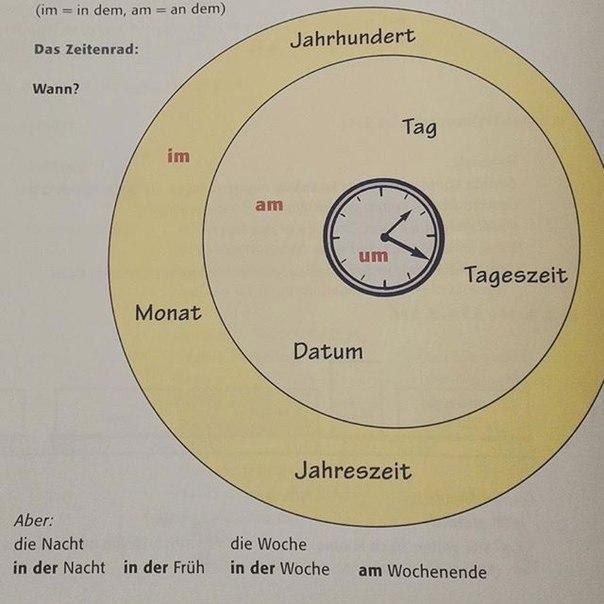
❗️ Using German prepositions when asked "Wann?" (When?) ❓
✅ The preposition um is used when you say the time:
Wann treffen wir uns? - Um 19 Uhr.
When will we meet? - At 19 o'clock.
✅Preposition am (an + dem) - when it comes to time of day, days of the week and date:
Wann geht ihr ins Kino? - Am Nachmittag. / Am Freitag. / Am 8. (achten) März.
When do you go to the cinema? - After noon. / On Friday. / Eighth of March.
✅Preposition im (in + dem) - season, name of months, indication of the year.
Wann ist es passiert? - Im Herbst. / Im September. / Im Jahr (e) 2005.
When did it happen? - In the autumn. / In September. / In 2005.
📌But! There are some exceptions:
in der Nacht (die Nacht)
in der Früh (die Früh)
in der Woche (die Woche)
am Wochenende (das Wochenende)
❓ Are you confused about this topic?
👍1
⚡️ A selection of the most popular prepositional phrases!
Finding one specific source of such phrases is not easy, but I have compiled a useful list of basic phrases that will definitely come in handy:
auf der Autobahn - on the Autobahn
auf der Versammlung - at a meeting
in der Vorlesung - at the lecture
auf der Toilette - in the toilet
zu Gast (sein) - (to be) away
im Stadion - at the stadium
in der Oper - at the opera
im öffentlichen Dienst - in public service
unter Stress (stehen) - (to be) in a state of stress
in Gefahr - under threat
mit dem Auto - by car
auf Befehl - by order
auf Kosten (des Unternehmens) - at the expense of (the firm)
in Erinnerung an Gagarin - in memory of Gagarin
bei hoher Geschwindigkeit - at high speed
vor Freude - with joy
nach Berlin - to Berlin
vor Sehnsucht - from longing
aus Anlass - about
an der Grenze - on the border
an der Wand - on the wall
am Tisch (sitzen) - (sit) at the table
auf dem Tisch (stehen) - (to stand) on the table
in der Küche - in the kitchen (where?)
in die Küche - to the kitchen (where?)
am Bahnhof - at the train station (where?)
zum Bahnhof - to the train station (where?)
am Strand - on the beach (where?)
an den Strand - to the beach (where?)
auf das Konzert (gehen) - (go) to the concert
Dollar in Euro (umtauschen) - (change) dollar to euro
By learning some phrases from our selection, you will definitely enrich your vocabulary and thereby improve your German! Good luck! ✨
👍2
📌Most Important German Verbs (Part 1)
💥 Yes, you must know these verbs, so don't postpone it until tomorrow!
1. The verbs HABEN (to have) and SEIN (to be)
"To have" and "to be" are the most important verbs of any language, as they convey two important meanings:
- I am, this is ... - existence
- I have, he has ... - belonging
Examples:
er hat viele Freunde - he has many friends
was wollen Sie haben? - what do you want?
er ist zu Hause - he is at home
es ist kalt - it's cold
2. The verbs MACHEN and TUN (to do)
The most important expressions:
was machst du? - what are you doing?
das macht nichts - is nothing, nothing at all (answer to "thank you")
einen Antrag machen - to propose (to marry)
es tut mir leid - I'm sorry
viel zu tun haben - to be very busy
3. Modal and related verbs
Modality is a complex category that expresses the desire to do something, the obligation, the permission. Here they are:
können - can (to have a physical ability)
dürfen - allowed to (to have permission, permission)
mögen (möchten) - to wish (to like)
wollen - to want (exactly and categorically)
sollen - should (mild, recommendation)
müssen– have to (order)
Modal verbs differ from ordinary verbs in all respects:
- by their non-standard temporary forms;
- those that are not used with zu (in infinitive constructions).
4. The verb of becoming WERDEN
It is necessary to know it without thinking twice, since it forms the future tense with the infinitive of any semantic verb.
Ich werde Deutsch lernen - I will learn German.
Future tense is very important, isn't it? In addition to the future, WERDEN shows the process of changing one to another, or rather becoming:
Es wird dunkel - It's getting dark
die Tage werden länger kürzer - days get longer and shorter
was will er werden? - what does he want to be?
And with the help of this verb, Passiv is formed:
das Haus wird gebaut - the house is under construction
5. The verb GEBEN (to give)
What is so special about it, you ask, because this is an ordinary semantic verb. Not really! In the meaning of GIVING, this is really just a useful semantic verb. But there is a peculiarity: GEBEN forms a special linguistic form Es gibt - exists / exist, which is why I isolated it.
🔥The Es gibt construction is extremely important! It is used in relation to everything that "is", that is, "exists":
Es gibt viel interessantes - there are many interesting things
Gut, dass es dich gibt - it's good that you are
🔥 IMPORTANT TO REMEMBER: Es gibt + Akkusativ - that is, the addition will always be in the accusative case, and in addition, it is important to understand that even if there are many objects, the form of the verb will still be gibt (since the subject is es anyway):
Es gibt einen Mann - There is one person
es gibt viel zu tun - a lot of work
was gibt es da zu lachen? - what's so funny?
📌 Learn these important verbs today!
👍2
😄👍🏻 Wie geht's? - How are you?
📌20 easy answers (according to the degree of positivity)
🔥👍🏻 (++)
sehr gut - very good
ausgezeichnet - great
fantastisch - fantastic
toll - class
prima - super
😄 (+)
ganz gut - pretty good
gut - good
normal - normal
😉 (+/-)
so-so - so-so, 50/50
nicht schlecht - not bad
nicht besonders gut - not so good
Es geht. - Nothing (go).
leidlich - more or less
😟 (-)
nicht gut - not good
schlecht - bad
😖😢 (-)
sehr schlecht - very bad
miserabel - disgusting, bad
mies - lousy
erbärmlich - deplorable
scheußlich - disgusting, disgusting
❓How are you doing?
❤1
🇩🇪 Particles in German
1️⃣ amplifying particles 💪🏻
doch - yet,
sogar - the same / even,
so - so(English one), zu - too,
selbst - even;
2️⃣ excretory particles: ❗️
gerade / eben / ausgerechnet - exactly / just;
3️⃣ bounding particles 🚫
nur / bloß / erst / allein - only,
noch - more;
4️⃣ negative particles ⛔️
nicht - not,
nicht einmal - not even;
5️⃣ emotionally modal particles 😃
denn / etwa - maybe / only,
mal - once,
nun - well.
Dazu ist es schon zu spät - Besides, it's too late (particle "zu").
So früh habe ich dich nicht erwartet - I did not expect you so early (particle "so").
Selbst das Einfachste wußte sie nicht - She did not know even the simplest (particle "selbst").
Es war doch herrlich hier, in der kleine Siedlung am Waldrand - After all, here, in a small village at the edge of the forest, it was wonderful (particle "doch").
✅ You should pay attention to the fact that in their appearance particles can be similar to:
- adjectives / adverbs - bloß, eben, gerade, mal, nun, so, schon;
- pronouns - allein, es, etwa, selbst;
- Word unions- denn, doch.
☝🏻Not forget about the syntactic function of particles and other parts of speech:
👉🏻 Particle doch:
Wo habe ich doch diese Frau gesehen? - Where have I seen this woman?
👉🏻 Union doch:
Zuweilen bekommen wir Nachrichten von ihm, doch nicht oft - Sometimes we hear from him, but not often.
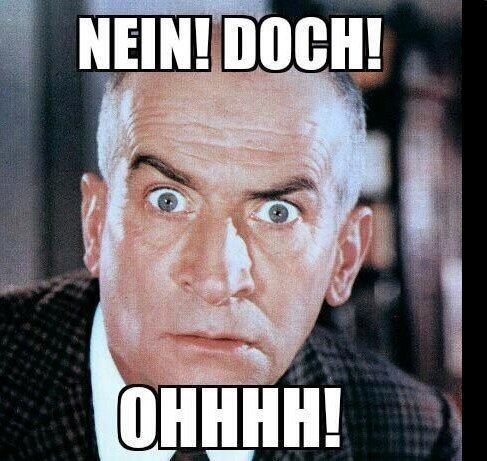
✔️ Express admiration in German!
1. Fein! - Great! Wonderful!
2. Klasse! Cool! Super! - Great! Super!
3. Prima! - Excellent! Sumptuously!
4. Toll! - well!
5. Das finde ich gut / prima! - This I find good, magnificent!
6. Das wäre gut, prima, schön! - That would be good, great, great!
7. Das wäre fein, nicht schlecht, herrlich! - That would be great, not bad, great!
8. Ich bin einfach sprachlos! Mir fehlen die Worte! - I just can't find the words! No words!
9. Das liegt auf der Hand! - It's perfectly clear, obvious!
10. Das ist mir sehr recht! - It suits me very much!
11. Da schweigen alle Geigen! - No words! Dumb delight!
👍2❤1
🙏🏻🌷15 WAYS TO EXPRESS THANKS IN GERMAN
Danke sehr! - Thank you so much!
Danke schön! - Thank you so much!
Vielen Dank! - Many thanks!
Tausend Dank! - A thousand thanks!
Herzlichen Dank! - Thank you very much!
Danke! - Thank
Danke dir! - Thank you!
Danke euch! - Thanks you!
Danke Ihnen! - Thanks you! (respect.)
Danke vielmals! - Thank you many times!
Ich bin dir / Ihnen sehr dankbar! - I am / thank you!
Das ist nett von dir! - Very nice of you!
Danke, dass es dich gibt! - Thank you for being there!
Das ist sehr freundlich von Ihnen! - Very friendly on your part
Herzlichen Dank für deine / Ihre Hilfe! - Thank you very much for your / your help!
Yes, and thank you for 36,000 followers on Instagram ☝️