
🤝 PREPOSITION MIT
The preposition mit often denotes means or a way.
❗️This preposition always requires the dative case.
🌟 Some expressions with mit:
mit Anlauf - with a start
mit Ausdruck - with expression
mit Auszeichnung - with honors
mit Freude - with joy
mit Mühe - with difficulty
mit Sachkenntnis - with expertise
mit äußerster Strenge - with all severity
mit allem Comfort - with all the comforts
mit einem Absatz - from the red line
mit jmds. Einwilligung - from someone's consent
mit jmds. Erlaubnis - from someone's permission
mit einem Schlag - with one blow
mit einem Schwung - with a run / with a swing
mit dem Verstand - with the mind
mit einem Wort - in one word
mit der Zeit - with time
mit Vergnügen - with pleasure
mit Verspätung - with delay
mit Vorbehalt - with reservation
mit allen Mitteln - by any means
👍29❤16🔥2👏1
⭐️ The Preposition NACH - Primary Meanings
📌 Today, let's delve into the preposition "nach," which can be translated into English using the following prepositions:
🔹 To, In:
/ indicates direction /
nach Deutschland — to Germany
nach der Heimat — to the homeland
nach Hause — home
🔹 After:
/ indicates a sequence in time or a period of time in the past /
nach der Arbeit — after work
nach dem Essen — after eating
nach dem Krieg — after the war
nach langem Warten — after a long wait
nach dem Unterricht gehe ich zu meinem Freund — after class, I will go to my friend's place
🔹 According to, Following:
/ indicates compliance or adherence /
meiner Meinung nach — in my opinion
der Reihe nach — in sequence
nach Vorschrift — according to regulations
nach Ihrem Wunsch — according to your desire
⚡️These are the fundamental meanings of the preposition "nach" that you should definitely know!
🔶 Additionally, many verbs require the use of "nach," for example:
fragen nach etw. — to ask about something
suchen nach etw. — to search for something
❗️And finally, two phrases that you will often hear in spoken language:
nach und nach — gradually, bit by bit
nach wie vor — still, as before
👍19❤15🥰2🎉1
🔥 As you dive deeper into these essential elements, I'm thrilled to present the German Preposition Master Pack to guide you through every facet of German prepositions. If you're determined to get a firm grasp on this vital component of the language, this is an opportunity you can't miss—especially with a 🎁 20% discount awaiting!
Inside the Master Pack 🤔:
1️⃣ Ebook: 137 German Prepositions 📘:
Comprehensive insights into German prepositions with examples.
Precise, straightforward explanations.
Handy tips to prevent usual pitfalls.
Exercises to test and embed your newfound knowledge.
2️⃣ Ebook: Intensive Trainer - German Prepositions 📗:
A whopping 200+ pages of worksheets and exercises.
An ideal companion to the "137 German Prepositions" ebook.
Catering to both novice and adept German learners.
🌐 And for global learners, I've made sure it's available in translations from English-German, Turkish-German, Hungarian-German, and even a dedicated German-only version.
🕒 This blend of knowledge and practice is available for a limited window. So why wait?
💰 Confident in the quality, I'm offering a 14-day money-back guarantee. Elevate your German, grasp the nuances of prepositions, and see the results for yourself.
To embark on this journey and snag your 20% discount, 🌟 click the link below 🌟. Master the German Prepositions, one place at a time!
👍9❤3🥰1
🏆 Impersonal Pronoun "es"
📍You've likely come across the pronoun "es" in sentences like "es geht um…; es regnet" and others. When is it used?
🔺 When referring to natural phenomena:
Es regnet draußen. - It's raining outside.
🔺 In impersonal constructions where the acting person is not named or unknown:
Es klopft an der Tür. - Someone is knocking on the door.
🔺 In fixed expressions like "es gibt" (there is/there are), "es geht" (it's about/it's said), "es fehlt" (it's missing), etc.:
Es geht um Ökologie. - It's about ecology.
🔺 When talking about physical sensations and mood:
Es ist mir übel. - I feel nauseous.
🔺 With "event-related" verbs:
Es hat gut geklappt. - It worked out well.
👍25❤18🥰1
🇩🇪 Useful expressions
◾ Expressing your opinion
Ich denke (nicht), dass... - I (don't) think that...
Ich finde (nicht), dass... - I (don't) find that...
Ich glaube, dass... - I believe that...
Meiner Meinung nach ... - In my opinion (my view) / From my point of view...
Ich bin mir (nicht) sicher,.... - I am not not sure that....
◾ Expressing surprise
Na so was! - Wow! Well so what!
Das kann doch nicht wahr sein! - That can't be true! / It can't be!
Wirklich? - Really?
So eine Überraschung! - What a surprise!!!
Ist das möglich!? - Is it possible?!
◾ Commenting on new information
Ich finde es (nicht) interessant, weil... - I find the article (not) interesting because...
Mich wundert, dass.../ Mich überrascht, dass.... - I am surprised/impressed by the fact that...
Ich hätte nicht gedacht, dass... - I would not have thought that...
Es war klar, dass... - It was clear/obvious that...
◾ Commenting on the situation
Das ist aber peinlich / ärgerlich / unerfreulich! - It is still unpleasant / annoying / disappointing!
Dumm gelaufen! - Gone stupid!
So ein Pech! - What a misfortune!
Diese Situation ist mir echt (you can also ziemlich/total) peinlich (or unangenehm). - This situation really (quite, absolutely) displeases me.
Das hätte mir auch passieren können! - This could also happen to me.
Ich finde es gar nicht peinlich, wenn... - I don't find it embarrassing at all when ...
Das möchte ich nicht erleben! - I wouldn't want to go through this!
Das wäre mir nicht passiert! - I wish it had never happened to me!
👍22❤9🤔1
📚 Unlock the Power of German with EasyDeutsch's Exclusive Bundle!
Are you struggling with German grammar? Feel like those cases and prepositions are a never-ending maze?
EasyDeutsch has the perfect solution for you!
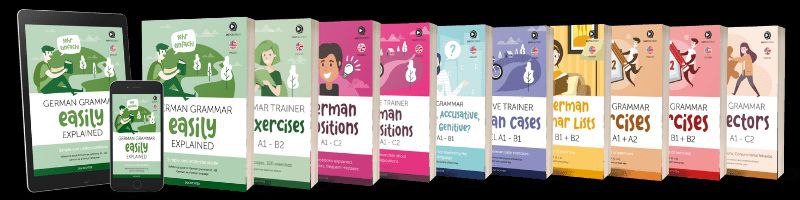
Introducing the "5 + 5 + X - Grammar Superstar" Pack, a comprehensive collection of 10 ebooks designed to elevate your German language skills to new heights.
Whether you're a self-learner or a teacher looking for homework resources, this bundle is your key to success!
🌟 What's Inside? 🌟
120+ Lessons: Simple, compact explanations with the special 95% trick to make German grammar a breeze!
300+ Exercises: Practice what you learn with engaging activities.
40+ Grammar Lists: Organized from level A1 to C2, with colorful visuals.
Intensive Trainers: Over 190 pages of practice for German cases and prepositions.
German Connectors Guide: Learn the right linking words with ease.
Bonus X: 100+ Grammar Units – Video, PDF, Exercises – Perfect for Homework and Self-Study.
🎁 Buy 5 Ebooks, Get 5 for FREE! 🎁
That's right! Purchase 5 ebooks and receive 5 more, absolutely free. It's a treasure trove of German language mastery waiting to be explored.
🛑 Avoid the Common Pitfalls!
With expert guidance from Jan Richter, you'll not only learn German grammar but also avoid common mistakes from the beginning. The practice activities and examples will ensure you use what you learn effectively.
💬 What Others Say:
"Sehr große Hilfe beim Deutsch lernen!" - Giovanni
"Ein tolles Buch und verständliches Werkzeug!" - Dave
🔒 100% Risk-Free Guarantee!
Your purchase comes with Jan Richter’s 14-day money-back guarantee. If you're not satisfied, you'll get a full refund.
🕒 Hurry, Offer Ends Soon!
Don't miss this limited-time opportunity to become a German Grammar Superstar.
Worauf wartest du denn noch? 🇩🇪
👍15🥰4❤2
😀😡 Expressing emotions and feelings
✳️ Expression of delight and joy:
Wie schön! = How beautiful!
Wie nett! = How nice!
Es ist ja toll! = It's great!
Das freut mich sehr! = It makes me so happy!
Fantastisch! = Fantastic!
Großartig! = Wonderful!
Prima! = Perfect!
✳️ Negative emotion:
Unsinn! = Nonsense!
Quatsch! = Ridiculousness!
So ein Mist! = It's rubbish!
Scheiße! = Shit!
Donnerwetter! = Damn it!
Was für ein Pech! = What a misfortune!
Wie schrecklich! = What a horror!
Zum Teufel! = To hell with it!
❤35👍19🥰2💯2
🔥 🇩🇪 Expressions in First Person
Ich habe keinen Bock darauf! – I'm not up for this!
Ich habe mir unsere Zukunft ganz anders vorgestellt. – I imagined our future completely differently.
Ich halte es nicht mehr aus. – I can't take it anymore.
Ich hoffe, dass es klappt. – I hope it works out.
Ich bin enttäuscht. – I am disappointed.
Ich bin mir (nicht) sicher. – I am (not) sure.
Ich bin mit dir (nicht) einverstanden – I (dis)agree with you.
Ich teile diese Meinung (nicht). – I (don't) share this opinion.
Ich werde das nie mehr tun. – I will never do that again.
Ich weiß es nicht. – I don't know.
Ich bin nicht in der Stimmung — I am not in the mood.
Ich bin sehr dankbar für Ihre Hilfe. – I am very grateful for your help.
Ich drück dir die Daumen! – I'm keeping my fingers crossed for you!
Ich freue mich wirklich darauf zu … – I'm really looking forward to...
Ich interessiere mich für … – I am interested in...
Ich kann nicht mehr. – I can't take it anymore.
Ich schreibe, um zu sagen … – I write to say...
Ich hab' Schnauze voll! – I've had enough!
👍29❤10💯7
💥 Cheat Sheet for PERFEKT
❓ How it's formed:
Auxiliary verb "haben/sein" (conjugated in Präsens) + Participle II of the main verb.
🔸 Ich habe die ganze Woche gearbeitet - I worked the whole week.
🔸 Er ist nach Berlin geflogen - He flew to Berlin.
🔸 When to use Perfekt:
Indicates an action that is already completed, and the result is relevant in the present.
Example:
Ich habe ein neues Auto gekauft.
I bought a new car.
⚡️Haben vs. sein: when to use which?
Haben is used with most verbs.
Sein is used with the following:
🔺 Intransitive verbs of motion (e.g., fahren, gehen)
🔺 Intransitive verbs of change of state (e.g., aufwachen, einschlafen)
🔺 Verbs: sein, werden, bleiben, begegnen
✔️What to remember:
🔻 The main verb (in Participle II form) always remains unchanged; only the auxiliary verb changes.
🔻 The verb "schwimmen" can be used with both "haben" and "sein" depending on the context. Compare:
🔸Sie sind ans Ufer geschwommen.
They swam to the shore (movement towards a specific goal).
🔸Sie hat mehr als eine Stunde im Pool geschwommen.
She swam in the pool for more than an hour (emphasis on the action itself, without a specific goal)
👍28❤9
🔄 Top 10 reflexive verbs
🤓 Reflexive verbs are formed from the verb itself and the reflexive pronoun "sich". But some of them you just have to remember!
🔴 Let's look at the 10 most important reflexive verbs:
1️⃣ sich interessieren - to be interested in
Surprisingly, this is probably the first reflexive verb we learn from teachers and textbooks. It can be useful in almost any situation!
Ich interessiere mich für Geschichte. - I am interested in history.
2️⃣ sich treffen / sich sehen - to meet / see
These two verbs rightly share the second place. They are mainly used for agreements, although they can be used at any time.
Wir werden uns morgen treffen. - We shall meet tomorrow.
Sie sehen sich jeden Tag. - They see each other every day.
3️⃣ sich erholen / sich ausruhen - to rest / relax
These are some of the nicest reflexive verbs, because they are talking about relaxation, which we all need! When you're relaxing, remember that in German it's a reflexive verb, and don't lose the sich!
Hast du dich erholt? - Have you had a rest?
Er ruht sich gerade aus. - He is now relaxing/resting.
4️⃣ sich freuen - to rejoice
Also a very nice verb. But there is a complication with it - its control. It's dual: you can say auf + Akk (to rejoice in something present and coming), or you can say über + Akk (something past or present).
Er hat sich über das Geschenk gefreut. - He was very excited about the gift.
5️⃣ sich kümmern - to care
If about someone, then: sich um + Akk kümmern!
Ich kann mich um dich kümmern. - I can take care of you.
6️⃣ sich bemühen - to try
That's what we do when we learn German!
Ich werde mich sehr bemühen! - I will try hard!
7️⃣ sich beschäftigen - to do
If anything, then: mit + Dativ! The verb is used with almost any kind of activity!
Sie beschäftigt sich gerne mit Kindern. - She is very eager to take care of the children.
8️⃣ sich entscheiden - to decide
For example, to finally decide to learn German.
Ich konnte mich nicht entscheiden - I could not make up my mind
9️⃣ sich gewöhnen - to get used to
This is also a reflexive verb. When we get used to something, the control appears: an + Akk
Habt ihr euch schon an das Leben in Deutschland gewöhnt? - Are you already used to life in Germany?
🔟 sich erinnern - to remember / recall
Yes, that's a reflexive verb too. You have to remember that it's used with: an+Akk
Ich erinnere mich gerne an meinen letzten Urlaub. - I eagerly remember my last holiday.
👍33❤13
🚀 Limited Time Offer! Elevate Your German Skills - A1 to B2.2= 🇩🇪
Ready to conquer German fluency? Whether you're starting fresh or refining your skills, our range of courses, from A1 to B2.2, has got you covered! Dive into Interactive-Communicative Learning (IKL) for confident speaking, writing, reading, and listening.
Tailored for:
Beginners (A1)
Intermediate learners (B1/B2.1)
Advanced learners (B2.2)
By course end, you'll:
1️⃣ Communicate seamlessly
2️⃣ Master grammar intricacies
3️⃣ Form sophisticated sentences
4️⃣ Expand your vocabulary
5️⃣ Understand complex texts
📚 Each course includes:
Interactive modules & integrated workbooks
Audio exercises & video explanations
Speech training & vocabulary sets
Meet Natalia, your dedicated German teacher with a proven track record. Join our community at an unbeatable rate - as low as 3,33€ per day! 🌟
🔥 Act fast! Offer ends soon. Embrace the German language journey now! 🌐
❤7🥰2👍1
🌟 Discovering Key Aspects of the German Language! 🇩🇪
1️⃣ Nouns: The Capital Wonders In German, every noun is adorned with a capital letter, giving them a regal presence within the language.
2️⃣ Der, Die, Das: The Trio of Genders German, like many languages, classifies nouns into three genders: masculine, feminine, and neuter. Memorize words with their respective articles for fluent expression.
3️⃣ Navigating Negation: Nicht vs. Kein Negation in German manifests through two forms: nicht and kein. Each has specific rules of usage, a puzzle to solve for language learners.❓
What peculiarities of the German language fascinate you? Share your thoughts in the comments!
🎓 Ready to conquer the intricacies of German grammar?
Explore the "5 + 5 + X - Grammar Superstar" Pack for a comprehensive learning experience:
https://boost.deutsch.wtf/superstar/s/grammatik/
👍9🥰3
💥GEBEN and it's prefixes
📌 You know that the verb geben means "to give" and many other things. But what if you add prefixes to this verb? That's exactly what we're going to talk about today.
🔺angeben - to indicate, to name, to inform.
It can refer to an address or a place (time) of a meeting:
Geben Sie bitte Ihre Adresse an - Give me your address, please
🔺aufgeben - to hand over (luggage), to give.
This verb can also be used in the sense of "submit", e.g:
Ich möchte eine Anzeige in der Zeitung aufgeben - I want to submit an ad to a newspaper.
🔺ausgeben - to give out, release, issue (order)
In addition, this verb can also mean "to spend (money)" and "to treat":
Da muss ich dir ein Bier ausgeben. - I'm the one who should treat you to a beer.
🔺(sich) begeben - to go somewhere.
Schließlich, hatte er sich in die nahe gelegene Stadt begeben. - Finally, he went to the nearest town.
🔺ergeben - to reveal, to show, to give
This verb is used to show the results of some action, for example:
Vor kurzem hat eine Umfrage ergeben... - A recent survey showed...
🔺(sich) ergeben - to turn out, to give up
Sonst hätte ich mich Ihnen kaum ergeben. - Otherwise I wouldn't have surrendered to you.
🔺nachgeben - to add, to surrender, to yield
Er gibt nie nach - He never gives up.
🔺vorgeben - to pretend, to falsely assert
Ich werde einfach vorgeben, dass mir jemand geschrieben hat. - I simply pretend that someone wrote to me.
🔺vergeben - to forgive, to provide (for example, a report)
Zunächst einmal musst du mir vergeben. - To begin with, you must forgive me.
🔺zugeben - to give in addition, to add to, to admit (guilt)
Ich muss zugeben, ich bin ein wenig eifersüchtig. - I have to admit that I am a little jealous.
❤42👍16🥰4
🌟 How to Learn German Words? 🤓
📌 There are numerous ways to immerse yourself in a language: surround yourself with sticky notes with words, continuously watch movies in German, and listen to music. There's another method - incorporate German into your daily life. How to do it?
🔺 First and foremost - learn the names of items around you in German. For example, every day you may see das Laptop (the laptop) on your desk. Nearby, there could be das Buch (book), die Handcreme (hand cream), die Brille (glasses).
🔺 After that, you can move on to other items. Suppose every morning you go to the kitchen (die Küche) and turn on the kettle (der Wasserkocher). You can add a few verbs and phrases: essen, trinken - Ich trinke jeden Morgen Kaffee. Later, when all these phrases and words settle in your mind, add emotions and feelings: Ich fühle mich heute müde, so werde ich den Kaffee stärker machen. - Today, I feel tired, so I'll make the coffee stronger.
🔺 This way, you can practice in various situations: on the way to work, in the car, at work (especially if you need to learn specific vocabulary). This will not only help you learn new words but also gradually integrate German into your life and overcome the language barrier. 💪🏻
😲 Ready to boost your German language skills?
Explore our "5 + 5 + X - Grammar Superstar" Pack and take your German vocabulary to the next level! 🌟
Click the button below to learn more 👇
❤25👍10🥰2
🇩🇪 Separable Prefixes
📌Today, we will go over 4 simple rules for using separable prefixes. To do this, we will take the following verbs:
anmachen - to turn on
ausmachen - to turn off
aufmachen - to open
zumachen - to close
⚡️Rule #1: In a simple declarative sentence, the separable prefix goes to the very end (in the place of the second part of the predicate). This applies to all simple tenses (Präsens, Präteritum) as well as the imperative mood.
▫️Ich mache das Licht an - I turn on the light.
▫️Ich machte das Licht an - I turned on the light.
▫️Mach das Licht an! - Turn on the light!
❗️In compound tenses like Futur, Perfekt, Plusquamperfekt, etc., the prefix is not separated from the verb and remains in its place in the infinitive or Partizip (II).
⚡️Rule #2: In verbs with separable prefixes, the Partizip II is formed as follows: prefix + GE + part of the verb.
▫️Ich habe das Licht angemacht - I turned on the light.
⚡️Rule #3: When using a modal verb, the main verb is placed at the end in the infinitive form, and the prefix is not separated. This rule applies to both questions and declarative sentences.
▫️Kannst du die Flasche aufmachen? - Can you open the bottle?
▫️Ich kann die Flasche nicht aufmachen - I can't open the bottle.
⚡️Rule #4: Separation of the prefix depends on the tense used. If the tense is compound (meaning it uses an auxiliary verb), the prefix is either not separated (Infinitiv) or "drags" ge behind it (Partizip II).
▫️Wann wirst du die Flasche aufmachen? - Futur - When will you open the bottle?
▫️Hast du schon die Flasche aufgemacht? - Have you already opened the bottle?
⚡️If there's no need for an auxiliary verb in the tense, the prefix is separated in the question and placed at the end.
▫️Wer macht das Fenster zu? - Who will close the window?
👍27❤23
🇬🇧 The Suffix "<-los>" in the German Language: 20 Important Adjectives
📍 When the word-forming unit "-los" is added to the base of a noun, it forms an adjective with the meaning of absence, similar to the English suffix "-less."
anstandslos — unquestionably
arbeitslos — unemployed
atemlos — breathless, holding one's breath
beispiellos — unprecedented, unheard of
willenlos — powerless, without will
endlos — endless
fensterlos — windowless
formlos — shapeless, free from form
geräuschlos — noiseless
geschmacklos — tasteless
gewaltlos — nonviolent
gewissenlos — unscrupulous
grenzenlos — boundless
herzlos — heartless
hilflos — helpless
sinnlos — senseless
kinderlos — childless
kostenlos — free, costless
lieblos — loveless
namenlos — nameless
👍30❤16💯1
🥞 Interjections in the German Language
Interjections (Interjektionen) are widely used in modern German, adding emotional vividness and liveliness to speech. Let's explore some of the most popular interjections:
Hurra! – Hooray!
Ach! – Oh!
Ach so! – Ah, I see!
Mist! – Darn!
Oh! – Oh!
Ah! – Ah!
Aha! – Aha!
Pfui!/ Igitt! – Yuck!
Au!/ Aua! Autsch! – Ouch!
Ups!/ Huch!/ Hoppla! – Oops!
Oje! – Oh, my God!
Mein Gott! – My God!
Wow!/ Guck an! – Wow!
Das gibt’s doch nicht! – You can't be serious!
Verdammt nochmal! – Damn it!
Na so was! – Well, well!
Na und? – So what?
Na gut!/ Also gut! – Alright!
Hatschi! – Achoo!
Und ob! – You bet!
Eсht?! — Really?!
Ach du meine Güte! — Oh my goodness!
Bravo! — Bravo!
Zum Teufel! — To hell with it!
Let's practice these German interjections with my bot!
agmi.co
German with Leo
Master German one conversation at a time
👍34❤16👏3🤔2
🏆 Adjectives in German
Charming, azure, intelligent, imaginative, oval... Adjectives provide form, character, hues, and various qualities to the concepts in our minds. They add enjoyment to narratives and distinctiveness to nouns. Let's hone our skills with them!
Charming, azure, intelligent, imaginative, oval... Adjectives provide form, character, hues, and various qualities to the concepts in our minds. They add enjoyment to narratives and distinctiveness to nouns. Let's hone our skills with them!
❤12
👍7❤2