
💣 Important Phrases for Expressing Agreement
In conversation, it's often necessary to express our opinion on what someone else has said. Instead of simply nodding and saying "Yes, yes!", let's learn something more interesting:
Ich bin einverstanden – I agree
Du hast Recht – You are right
Genau! – Exactly!
Ich habe nichts dagegen – I have nothing against it
Das stimmt – That's true
Ich glaube dir – I believe you
Ich bin deiner (Ihrer) Meinung – I share your opinion
Super! – Great!
Ich stimme dir zu – I agree with you
Natürlich! – Of course!
Selbstverständlich! – Naturally!
Abgemacht – Agreed
Da hast du (haben Sie) völlig Recht – You are absolutely right there
Ja, das sehe ich auch so – Yes, I see it that way too
Das klingt überzeugend – That sounds convincing
Ich teile deine (Ihre) Ansicht – I share your view
🎉 These phrases can make your conversations in German more engaging and expressive. Happy speaking!
👍35❤14💯2💩1
📚 Suffixes of Feminine Nouns in German Language
📍 Formation Using the Suffix –in:
Feminine gender nouns are often formed using the suffix –in, which is added to masculine nouns:
der Lehrer – die Lehrerin / teacher – female teacher
der Schüler – die Schülerin / student – female student
der Löwe – die Löwin / lion – lioness
📍 Remember These Specific Suffixes:
If you remember that the suffixes –ung, –heit, –keit, –schaft, and –ei are always feminine, you'll easily identify feminine nouns:
die Übung – exercise
die Gesundheit – health
die Tätigkeit – activity
die Meisterschaft – championship
die Konditorei – confectionery
📍 The Interesting Suffixes –t and –st:
The feminine gender also includes interesting suffixes –t and –st, often derived from verbs:
fahren – die Fahrt / to travel – journey
📍 Feminine Nouns with Foreign-Origin Suffixes:
Nouns with suffixes of foreign origin such as –ie, –ik, –ion, –tät, –(a)tion, and –ur are also feminine:
die Historie – story, history
die Grammatik – grammar
die Diskussion – discussion
die Fakultät – faculty
die Demonstration – demonstration
die Literatur – literature
🙌 We've just enriched our understanding of the German language a bit!
👍25❤12🥰2
🔥 German Adverbs of Place: A Handy Guide
Have you learned some new words today? If not, it's the perfect time to start with simple and short words that are quickly and easily remembered - the German adverbs of place. These small but mighty words are integral to understanding directions and locations in the German language.
In and Around a Location:
hier: here
da: there
dort: over there
draußen: outside
drinnen: inside
innen: inside
außen: outside
Directions and Orientations:
rechts: right
links: left
oben: above
unten: below
überall: everywhere
Indefinite and Specific Places:
irgendwo: somewhere
nirgendwo: nowhere
nirgends: nowhere
wo: where
vorne: in front
hinten: behind
Additional Expressions:
obenan: in the first place
obenauf: on top
nebenan: next to
auswärts: outside
Learning German can seem daunting, but breaking it down into smaller parts like this makes it more approachable. By mastering these adverbs of place, you're one step closer to fluent communication in German. 🇩🇪
So grab your notebook 📓 and start practicing these essential words. Whether you're a beginner or looking to refresh your skills, understanding these adverbs is a stepping stone to success in German. Keep up the great work, and happy learning! 🎉
❤39👍8🥰2
🇩🇪👍🏻 Important phrases to express agreement!
📌 In a conversation, we often have to express our attitude to what the interlocutor said. We don’t want to just nod and say "Ja-ja!" - it's time to learn something more interesting:
Ich bin einverstanden - I agree
Du hast Recht - you're right
Genau! - exactly!
Ich habe nichts dagegen - I have nothing against
Das stimmt - right
Ich glaube dir - I believe you
Ich bin deiner (Ihrer) Meinung - I am of the same opinion as you
Super! - super!
Ich stimme dir zu - I agree with you
Natürlich! - of course!
Selbstverständlich! - obviously!
Abgemacht - agreed
Da hast du (haben Sie) völlig Recht - here you are absolutely right
Ja, das sehe ich auch so - yes, I have the same opinion
Das klingt überzeugend - it sounds convincing
Ich teile deine (Ihre) Ansicht - I share your (your) point of view
❤33👍5🥰2
📚 German Prepositions: How Well Do You Know Them?
In the German language, there are prepositions with fixed cases, and then there are those with dual cases. The case they govern depends on the question that stems from the verb. Sound intriguing? Let's dive in!
Dual-case prepositions include: an, auf, vor, zwischen, über, in, unter, hinter, and neben. The case following these prepositions is determined by the question posed from the verb. When the question is "Wohin?" (Where to?), we use the accusative case. If the question is "Wo?" (Where?), it's the dative case. Let's look at a couple of examples for clarity:
"Er geht heute Abend ins Kino." 🚶♂️🎦 translates to "He's going to the cinema tonight" (where to?).
"Wir sind schon im Kino." 🍿🎥 means "We are already in the cinema" (where?).
Feeling ready? It's time for a quick challenge. Dive into our quiz that has only 10 questions. Test your knowledge now! ➡️ Click here to start the quiz
👍22❤5🥰2
🔥 🇩🇪 Ich... was?
FIRST-PERSON EXPRESSIONS
Ich habe keinen Bock darauf! - I don't feel like it!
Ich habe mir unsere Zukunft ganz anders vorgestellt. - I imagined our future quite differently.
Ich halte es nicht mehr aus. - I can't take it anymore.
Ich hoffe, dass es klappt. - I hope it will work out.
Ich bin enttäuscht. - I am disappointed.
Ich bin mir (nicht) sicher. - I am (not) sure
Ich bin mit dir (nicht) einverstanden - I (don't) agree with you.
Ich teile diese Meinung (nicht). - I (do not) share this opinion.
Ich werde das nie mehr tun. - I will never do this again.
Ich weiß es nicht. - I do not know.
Ich bin nicht in der Stimmung - I am not in the mood.
Ich bin sehr dankbar für Ihre Hilfe. - I am very grateful for your help.
Ich drück dir die Daumen! - I keep my fingers crossed for you!
Ich freue mich wirklich darauf zu ... - I am really glad ...
Ich interessiere mich für ... - I am interested...
Ich kann nicht mehr. - I am not able any more.
Ich schreibe, um zu sagen ... - I write to say ...
Ich hab' Schnauze voll! - I'm fed up!
👍34❤14🥰2👏2
🤯 A collection of misconceptions, or typical mistakes that many German language learners make.
👉🏻1. Different exits - der Ausgang oder der Ausweg
Remember that the word der Ausgang is used in the sense of 'exit' (from the room), while the word der Ausweg is used in the sense of 'exit' (from the situation).
☝🏻2. groß oder hoch
Remember that the adjectives 'groß' or 'klein' must be used when describing people's height.
The adjective hoch, on the other hand, is used for inanimate objects: mountains, houses, trees etc.
❗️3. schaffen (u, a) oder schaffen (te, t)
Remember that in German the verb schaffen-schuf-geschaffen (create) and the verb schaffen-schaffte-geschafft (cope, be able) are homonyms, so pay attention!
📞4. Remember that the verbs "rufen" and "anrufen" have slightly different meanings
The verb anrufen means 'to call someone on the phone', whereas the verb rufen means 'to call, to summon'. There are, of course, cases where it also means "to call", e.g,
die Polizei, den Arzt rufen,
However, this connotation of its meaning is secondary, it is primarily meant "(to) call".
😍5. The German verbs fühlen ('to feel') and füllen ('to fill') are related in the same way as the English verbs to feel and to fill (with the same meanings respectively)
❤23🥰6👍1
💥GEBEN and it's prefixes
📌 You know that the verb geben means "to give" and many other things. But what if you add prefixes to this verb? That's exactly what we're going to talk about today.
🔺angeben - to indicate, to name, to inform.
It can refer to an address or a place (time) of a meeting:
Geben Sie bitte Ihre Adresse an - Give me your address, please
🔺aufgeben - to hand over (luggage), to give.
This verb can also be used in the sense of "submit", e.g:
Ich möchte eine Anzeige in der Zeitung aufgeben - I want to submit an ad to a newspaper.
🔺ausgeben - to give out, release, issue (order)
In addition, this verb can also mean "to spend (money)" and "to treat":
Da muss ich dir ein Bier ausgeben. - I'm the one who should treat you to a beer.
🔺(sich) begeben - to go somewhere.
Schließlich, hatte er sich in die nahe gelegene Stadt begeben. - Finally, he went to the nearest town.
🔺ergeben - to reveal, to show, to give
This verb is used to show the results of some action, for example:
Vor kurzem hat eine Umfrage ergeben... - A recent survey showed...
🔺(sich) ergeben - to turn out, to give up
Sonst hätte ich mich Ihnen kaum ergeben. - Otherwise I wouldn't have surrendered to you.
🔺nachgeben - to add, to surrender, to yield
Er gibt nie nach - He never gives up.
🔺vorgeben - to pretend, to falsely assert
Ich werde einfach vorgeben, dass mir jemand geschrieben hat. - I simply pretend that someone wrote to me.
🔺vergeben - to forgive, to provide (for example, a report)
Zunächst einmal musst du mir vergeben. - To begin with, you must forgive me.
🔺zugeben - to give in addition, to add to, to admit (guilt)
Ich muss zugeben, ich bin ein wenig eifersüchtig. - I have to admit that I am a little jealous.
To practice your German and get instant feedback, don't forget to check out Leo the Tutor here. 📚
❤19👍10🎉3👏1😱1
🐶🐈 Our little brothers
📌Today let's talk about pets! Not everyone has them, so immediately the phrase for those who prefer not to have cats or dogs or anything else at home: 'Keine Haustiere haben (not having pets)':
Ich habe keine Haustiere, da ich allergisch bin - I have no pets as I am allergic 🤷
📍 What kind of pets are there? In Germany, for example, for 2022 the most popular pet was the cat (die Katze), followed by the dog (der Hund), then the so-called Kleintiere - hamsters (der Hamster), rabbits (das Kaninchen), chinchillas (der Chinchilla) and mice (die Maus). In addition to these, they are popular in Germany:
Ziervögel - ornamental birds (parrots, canaries, etc.)
Aquarien - aquarium animals (fish (der Fisch) and turtles (die Schildkröte))
Terrarien - various reptiles, e.g. die Schlange - snake
🧐What do we need for our pets?
🔺Die Haustiere brauchen viel Aufmerksamkeit - Pets need a lot of attention
🔺Jedes Haustier hat unterschiedliche Ansprüche - Every pet has different needs
🔺Die Fütterung - Feeding
🔺Die Pflege - care
🔺Einen Hund ausführen - to take a dog out for a walk
🔺Das Gehege zwei oder dreimal pro Woche reinigen - to clean the cage (aviary) 2-3 times a week
🔺Das Katzenklo säubern - clean (clean) the cat litter box
🔺Fress- und Wassernäpfe - food and water containers
Do you have any pets? 😄
❤25👍12💯1
😝 A bit about character
📍Today I have collected some expressions that will help you accurately describe the character of another person.
🔸 Er/sie ist...
ein alter Fuchs - a cunning person
treulose Tomate - unreliable person
ein Mann der Tat - a man of action
ein Mann von Wort - man of the word
ein Mensch aus Eisen - a man of iron will
📍Er ist ein Mann von Wort - he is a man of his word.
🔸 Er/sie + verb in the correct form...
den Mund voll nehmen - to show off, boast
am Buchstaben kleben - to be pedantic, petty
einen langen Atem haben - to be enduring
das grosse Wort führen - to show off
gleich Feuer im Dach haben - to be quick-tempered
❤26👍18😱1
🥰 EXPRESSING EMOTIONS AND FEELINGS
Oh wie schön! - Oh, how wonderful!
Das ist einfach toll! - It's just great!
Das ist aber schön! - This is wonderful!
Ich bin sehr froh, dass… - I am very glad that…
Ich freue mich, dass… - I am glad that…
Das wundert/überrascht mich. - This surprises/amaze me.
Ist schon gut… - Enough already…
Das macht nichts. - It's OK!
Nothing so schlimm. - Not so bad.
Ich habe das nicht so gemeint. - That's not what I meant.
Komisch! - Strange!
Ich mache mir Sorgen. - I'm worrying.
Ich habe Angst. - I'm scared.
Das macht mir Angst. - It scares me.
Das macht mir Sorgen. - That worries me.
Ich furchte, dass... - I'm afraid that...
Ich bin sehr traurig. - I am very sad.
Ich bin enttäuscht. - I am disappointed.
Es tut mir Leid. - I'm sorry.
Das ist aber schade! - What a pity!
Das war ein Missverständnis. - It was a misunderstanding.
Wenn ich das gewusst hätte! - If only I knew!
Das kann jedem passieren. - It can happen to anyone.
📌 Save and learn!
❤33👍20🥰2
🤝 PREPOSITION MIT
The preposition mit often denotes means or a way.
❗️This preposition always requires the dative case.
🌟 Some expressions with mit:
mit Anlauf - with a start
mit Ausdruck - with expression
mit Auszeichnung - with honors
mit Freude - with joy
mit Mühe - with difficulty
mit Sachkenntnis - with expertise
mit äußerster Strenge - with all severity
mit allem Comfort - with all the comforts
mit einem Absatz - from the red line
mit jmds. Einwilligung - from someone's consent
mit jmds. Erlaubnis - from someone's permission
mit einem Schlag - with one blow
mit einem Schwung - with a run / with a swing
mit dem Verstand - with the mind
mit einem Wort - in one word
mit der Zeit - with time
mit Vergnügen - with pleasure
mit Verspätung - with delay
mit Vorbehalt - with reservation
mit allen Mitteln - by any means
👍29❤16🔥2👏1
⭐️ The Preposition NACH - Primary Meanings
📌 Today, let's delve into the preposition "nach," which can be translated into English using the following prepositions:
🔹 To, In:
/ indicates direction /
nach Deutschland — to Germany
nach der Heimat — to the homeland
nach Hause — home
🔹 After:
/ indicates a sequence in time or a period of time in the past /
nach der Arbeit — after work
nach dem Essen — after eating
nach dem Krieg — after the war
nach langem Warten — after a long wait
nach dem Unterricht gehe ich zu meinem Freund — after class, I will go to my friend's place
🔹 According to, Following:
/ indicates compliance or adherence /
meiner Meinung nach — in my opinion
der Reihe nach — in sequence
nach Vorschrift — according to regulations
nach Ihrem Wunsch — according to your desire
⚡️These are the fundamental meanings of the preposition "nach" that you should definitely know!
🔶 Additionally, many verbs require the use of "nach," for example:
fragen nach etw. — to ask about something
suchen nach etw. — to search for something
❗️And finally, two phrases that you will often hear in spoken language:
nach und nach — gradually, bit by bit
nach wie vor — still, as before
👍19❤15🥰2🎉1
🔥 As you dive deeper into these essential elements, I'm thrilled to present the German Preposition Master Pack to guide you through every facet of German prepositions. If you're determined to get a firm grasp on this vital component of the language, this is an opportunity you can't miss—especially with a 🎁 20% discount awaiting!
Inside the Master Pack 🤔:
1️⃣ Ebook: 137 German Prepositions 📘:
Comprehensive insights into German prepositions with examples.
Precise, straightforward explanations.
Handy tips to prevent usual pitfalls.
Exercises to test and embed your newfound knowledge.
2️⃣ Ebook: Intensive Trainer - German Prepositions 📗:
A whopping 200+ pages of worksheets and exercises.
An ideal companion to the "137 German Prepositions" ebook.
Catering to both novice and adept German learners.
🌐 And for global learners, I've made sure it's available in translations from English-German, Turkish-German, Hungarian-German, and even a dedicated German-only version.
🕒 This blend of knowledge and practice is available for a limited window. So why wait?
💰 Confident in the quality, I'm offering a 14-day money-back guarantee. Elevate your German, grasp the nuances of prepositions, and see the results for yourself.
To embark on this journey and snag your 20% discount, 🌟 click the link below 🌟. Master the German Prepositions, one place at a time!
👍9❤3🥰1
🏆 Impersonal Pronoun "es"
📍You've likely come across the pronoun "es" in sentences like "es geht um…; es regnet" and others. When is it used?
🔺 When referring to natural phenomena:
Es regnet draußen. - It's raining outside.
🔺 In impersonal constructions where the acting person is not named or unknown:
Es klopft an der Tür. - Someone is knocking on the door.
🔺 In fixed expressions like "es gibt" (there is/there are), "es geht" (it's about/it's said), "es fehlt" (it's missing), etc.:
Es geht um Ökologie. - It's about ecology.
🔺 When talking about physical sensations and mood:
Es ist mir übel. - I feel nauseous.
🔺 With "event-related" verbs:
Es hat gut geklappt. - It worked out well.
👍25❤18🥰1
🇩🇪 Useful expressions
◾ Expressing your opinion
Ich denke (nicht), dass... - I (don't) think that...
Ich finde (nicht), dass... - I (don't) find that...
Ich glaube, dass... - I believe that...
Meiner Meinung nach ... - In my opinion (my view) / From my point of view...
Ich bin mir (nicht) sicher,.... - I am not not sure that....
◾ Expressing surprise
Na so was! - Wow! Well so what!
Das kann doch nicht wahr sein! - That can't be true! / It can't be!
Wirklich? - Really?
So eine Überraschung! - What a surprise!!!
Ist das möglich!? - Is it possible?!
◾ Commenting on new information
Ich finde es (nicht) interessant, weil... - I find the article (not) interesting because...
Mich wundert, dass.../ Mich überrascht, dass.... - I am surprised/impressed by the fact that...
Ich hätte nicht gedacht, dass... - I would not have thought that...
Es war klar, dass... - It was clear/obvious that...
◾ Commenting on the situation
Das ist aber peinlich / ärgerlich / unerfreulich! - It is still unpleasant / annoying / disappointing!
Dumm gelaufen! - Gone stupid!
So ein Pech! - What a misfortune!
Diese Situation ist mir echt (you can also ziemlich/total) peinlich (or unangenehm). - This situation really (quite, absolutely) displeases me.
Das hätte mir auch passieren können! - This could also happen to me.
Ich finde es gar nicht peinlich, wenn... - I don't find it embarrassing at all when ...
Das möchte ich nicht erleben! - I wouldn't want to go through this!
Das wäre mir nicht passiert! - I wish it had never happened to me!
👍22❤9🤔1
📚 Unlock the Power of German with EasyDeutsch's Exclusive Bundle!
Are you struggling with German grammar? Feel like those cases and prepositions are a never-ending maze?
EasyDeutsch has the perfect solution for you!
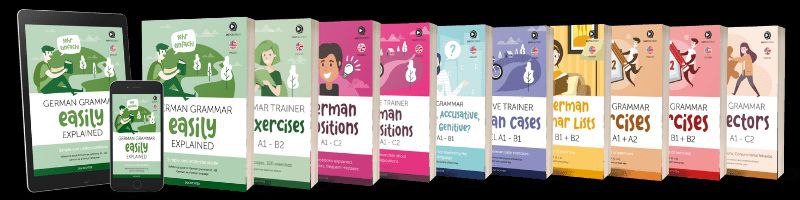
Introducing the "5 + 5 + X - Grammar Superstar" Pack, a comprehensive collection of 10 ebooks designed to elevate your German language skills to new heights.
Whether you're a self-learner or a teacher looking for homework resources, this bundle is your key to success!
🌟 What's Inside? 🌟
120+ Lessons: Simple, compact explanations with the special 95% trick to make German grammar a breeze!
300+ Exercises: Practice what you learn with engaging activities.
40+ Grammar Lists: Organized from level A1 to C2, with colorful visuals.
Intensive Trainers: Over 190 pages of practice for German cases and prepositions.
German Connectors Guide: Learn the right linking words with ease.
Bonus X: 100+ Grammar Units – Video, PDF, Exercises – Perfect for Homework and Self-Study.
🎁 Buy 5 Ebooks, Get 5 for FREE! 🎁
That's right! Purchase 5 ebooks and receive 5 more, absolutely free. It's a treasure trove of German language mastery waiting to be explored.
🛑 Avoid the Common Pitfalls!
With expert guidance from Jan Richter, you'll not only learn German grammar but also avoid common mistakes from the beginning. The practice activities and examples will ensure you use what you learn effectively.
💬 What Others Say:
"Sehr große Hilfe beim Deutsch lernen!" - Giovanni
"Ein tolles Buch und verständliches Werkzeug!" - Dave
🔒 100% Risk-Free Guarantee!
Your purchase comes with Jan Richter’s 14-day money-back guarantee. If you're not satisfied, you'll get a full refund.
🕒 Hurry, Offer Ends Soon!
Don't miss this limited-time opportunity to become a German Grammar Superstar.
Worauf wartest du denn noch? 🇩🇪
👍15🥰4❤2
😀😡 Expressing emotions and feelings
✳️ Expression of delight and joy:
Wie schön! = How beautiful!
Wie nett! = How nice!
Es ist ja toll! = It's great!
Das freut mich sehr! = It makes me so happy!
Fantastisch! = Fantastic!
Großartig! = Wonderful!
Prima! = Perfect!
✳️ Negative emotion:
Unsinn! = Nonsense!
Quatsch! = Ridiculousness!
So ein Mist! = It's rubbish!
Scheiße! = Shit!
Donnerwetter! = Damn it!
Was für ein Pech! = What a misfortune!
Wie schrecklich! = What a horror!
Zum Teufel! = To hell with it!
❤35👍19🥰2💯2
🔥 🇩🇪 Expressions in First Person
Ich habe keinen Bock darauf! – I'm not up for this!
Ich habe mir unsere Zukunft ganz anders vorgestellt. – I imagined our future completely differently.
Ich halte es nicht mehr aus. – I can't take it anymore.
Ich hoffe, dass es klappt. – I hope it works out.
Ich bin enttäuscht. – I am disappointed.
Ich bin mir (nicht) sicher. – I am (not) sure.
Ich bin mit dir (nicht) einverstanden – I (dis)agree with you.
Ich teile diese Meinung (nicht). – I (don't) share this opinion.
Ich werde das nie mehr tun. – I will never do that again.
Ich weiß es nicht. – I don't know.
Ich bin nicht in der Stimmung — I am not in the mood.
Ich bin sehr dankbar für Ihre Hilfe. – I am very grateful for your help.
Ich drück dir die Daumen! – I'm keeping my fingers crossed for you!
Ich freue mich wirklich darauf zu … – I'm really looking forward to...
Ich interessiere mich für … – I am interested in...
Ich kann nicht mehr. – I can't take it anymore.
Ich schreibe, um zu sagen … – I write to say...
Ich hab' Schnauze voll! – I've had enough!
👍29❤10💯7
💥 Cheat Sheet for PERFEKT
❓ How it's formed:
Auxiliary verb "haben/sein" (conjugated in Präsens) + Participle II of the main verb.
🔸 Ich habe die ganze Woche gearbeitet - I worked the whole week.
🔸 Er ist nach Berlin geflogen - He flew to Berlin.
🔸 When to use Perfekt:
Indicates an action that is already completed, and the result is relevant in the present.
Example:
Ich habe ein neues Auto gekauft.
I bought a new car.
⚡️Haben vs. sein: when to use which?
Haben is used with most verbs.
Sein is used with the following:
🔺 Intransitive verbs of motion (e.g., fahren, gehen)
🔺 Intransitive verbs of change of state (e.g., aufwachen, einschlafen)
🔺 Verbs: sein, werden, bleiben, begegnen
✔️What to remember:
🔻 The main verb (in Participle II form) always remains unchanged; only the auxiliary verb changes.
🔻 The verb "schwimmen" can be used with both "haben" and "sein" depending on the context. Compare:
🔸Sie sind ans Ufer geschwommen.
They swam to the shore (movement towards a specific goal).
🔸Sie hat mehr als eine Stunde im Pool geschwommen.
She swam in the pool for more than an hour (emphasis on the action itself, without a specific goal)
👍28❤9
🔄 Top 10 reflexive verbs
🤓 Reflexive verbs are formed from the verb itself and the reflexive pronoun "sich". But some of them you just have to remember!
🔴 Let's look at the 10 most important reflexive verbs:
1️⃣ sich interessieren - to be interested in
Surprisingly, this is probably the first reflexive verb we learn from teachers and textbooks. It can be useful in almost any situation!
Ich interessiere mich für Geschichte. - I am interested in history.
2️⃣ sich treffen / sich sehen - to meet / see
These two verbs rightly share the second place. They are mainly used for agreements, although they can be used at any time.
Wir werden uns morgen treffen. - We shall meet tomorrow.
Sie sehen sich jeden Tag. - They see each other every day.
3️⃣ sich erholen / sich ausruhen - to rest / relax
These are some of the nicest reflexive verbs, because they are talking about relaxation, which we all need! When you're relaxing, remember that in German it's a reflexive verb, and don't lose the sich!
Hast du dich erholt? - Have you had a rest?
Er ruht sich gerade aus. - He is now relaxing/resting.
4️⃣ sich freuen - to rejoice
Also a very nice verb. But there is a complication with it - its control. It's dual: you can say auf + Akk (to rejoice in something present and coming), or you can say über + Akk (something past or present).
Er hat sich über das Geschenk gefreut. - He was very excited about the gift.
5️⃣ sich kümmern - to care
If about someone, then: sich um + Akk kümmern!
Ich kann mich um dich kümmern. - I can take care of you.
6️⃣ sich bemühen - to try
That's what we do when we learn German!
Ich werde mich sehr bemühen! - I will try hard!
7️⃣ sich beschäftigen - to do
If anything, then: mit + Dativ! The verb is used with almost any kind of activity!
Sie beschäftigt sich gerne mit Kindern. - She is very eager to take care of the children.
8️⃣ sich entscheiden - to decide
For example, to finally decide to learn German.
Ich konnte mich nicht entscheiden - I could not make up my mind
9️⃣ sich gewöhnen - to get used to
This is also a reflexive verb. When we get used to something, the control appears: an + Akk
Habt ihr euch schon an das Leben in Deutschland gewöhnt? - Are you already used to life in Germany?
🔟 sich erinnern - to remember / recall
Yes, that's a reflexive verb too. You have to remember that it's used with: an+Akk
Ich erinnere mich gerne an meinen letzten Urlaub. - I eagerly remember my last holiday.
👍33❤13