
😢Keine Angst: Fears when learning foreign languages and how to deal with them
Let's talk about fears. You can often hear: "I read well, but I'm afraid to speak," "I'm afraid to call and answer the phone," "I want to change jobs, but I'm afraid my language skills won't be enough." Fear is manifold.
🔥Let's look at the main fears and how to deal with them
😢🇩🇪Fear of appearing stupid.
This fear tends to come first. And it takes up so much space sometimes that some people spend years accumulating vocabulary and perfecting grammar, but are panickedly afraid to say a few simple phrases. Others spend hours writing a short letter, and when they finally send it they worry a lot - what if they've made a bunch of mistakes? And let's not even mention the phone calls - who isn't afraid of them? "It is better to keep silent and have the reputation of an idiot, than to talk and dispel all doubts" - this is what the victims of this fear take for themselves as a rule. They keep silent, like the hero of The Matrix, tortured by evil agents.
❗️🤛🏻How do you fight it? Easier than it looks. Here are a couple of tricks:
(a) Enjoy the process.
Rejoice and enjoy the fact that you have at least some command of the language. It wasn't long ago that you couldn't even do that. Look at communication as a game. Do small things first: order in a cafe, chat with your neighbor about the weather. Praise yourself more often. And if something doesn't work, just try again.
b) don't think about what people think of you.
Instead, focus on the goal. After all, every communication has a purpose, and sometimes that purpose is very simple. Finding directions, filling out a form, or choosing the right product - that's what's important to you, not how you'll be looked at (usually by complete strangers, random people). If you mix up cases or the gender of nouns, no one will die, I've checked. Also - very often it's not as bad as it looks. Germans, for the most part, are friendly and polite, will try to understand and help you.
c) take your time.
It happens that when someone approaches us, we try to respond immediately, but usually it is not necessary. Observe yourself when you speak your native language. Thinking over your answer, picking up a word, asking again - these are all natural pauses or repetitions that are perfectly normal - you're a living person, not an answering machine. So before you start talking, give yourself time to collect your thoughts.
😢🇩🇪 Fear of not getting what you want
⚡️A job interview tomorrow and you're terrified of being rejected because of speech errors?
⚡️Don't want to go to the bakery (Bäckerei) because they will give you Roggenbrötchen instead of Joggenbrötchen again?
⚡️ Afraid of calling the doctor so that you don't get an appointment (Termin) at the wrong time by mixing up the numbers?
Fear of being misunderstood, of not being able to express your thought is the next trap we fall into when the first barriers have already been successfully overcome. Once we begin to use language in any way, we are afraid that it is not enough.
❗️🤛🏻 How do we fight it?
Just take it and do it. It doesn't matter if you get it right away or later, if it's better than others or worse, and from what time you get a noticeable result.
👍🏻When we stop expecting immediate success, we suddenly find that doing becomes easier. The pressure we put on ourselves disappears.
😏 Of course, not everything will work out the first time. You might actually get rejected for a job, but with each rejection your experience will grow, and one day it will be enough. One day you'll get to make a complicated order at a restaurant instead of pointing your finger at the menu, answering business emails quickly, and, without hesitation, solving other tasks that seem so difficult right now.
The important thing is to just keep doing something.
😎Are you experiencing similar fears?
👍3
🥰 Expressing emotions and feelings
Oh, wie schön! - Oh, how beautiful!
Das ist einfach toll! - This is just great!
Das ist aber schön! - It is beautiful!
Ich bin sehr froh, dass... - I am very glad that...
Ich freue mich, dass... - I am glad that...
Das wundert/überrascht mich. - This surprises/pleases me.
Ist schon gut... Stop it already...
Das macht nichts. - That doesn't matter.
Nicht so schlimm. - It is not so bad.
Ich habe das nicht so gemeint. - I did not mean it.
Komisch! - Strange!
Ich mache mir Sorgen. - I'm worried.
Ich habe Angst. - I am afraid.
Das macht mir Angst. - It frightens me.
Das macht mir Sorgen. - It worries me.
Ich fürchte, dass... - I am afraid that...
Ich bin sehr traurig. - I am very sad.
Ich bin enttäuscht. - I am disappointed.
Es tut mir Leid. - I am sorry.
Das ist aber schade! - What a pity!
Das war ein Missverständnis. - There was a
misunderstanding.
Wenn ich das gewusst hätte! - If only I had known that!
Das kann jedem passieren. - It can happen to anyone.
📌 Save it and use it!
💥SLANG VERBS
For chatting and everyday use
abhauen - to run away
copypasten - to copy/paste
daddeln - to play computer games
dissen - to insult
durch sein - to be out of place
durchsumpfen - to party all night
eskalieren - to celebrate
facebooken - surf on Facebook
twittern - send short messages
feisten - to eat greedily
funzen - work
quatschen - to chitchat
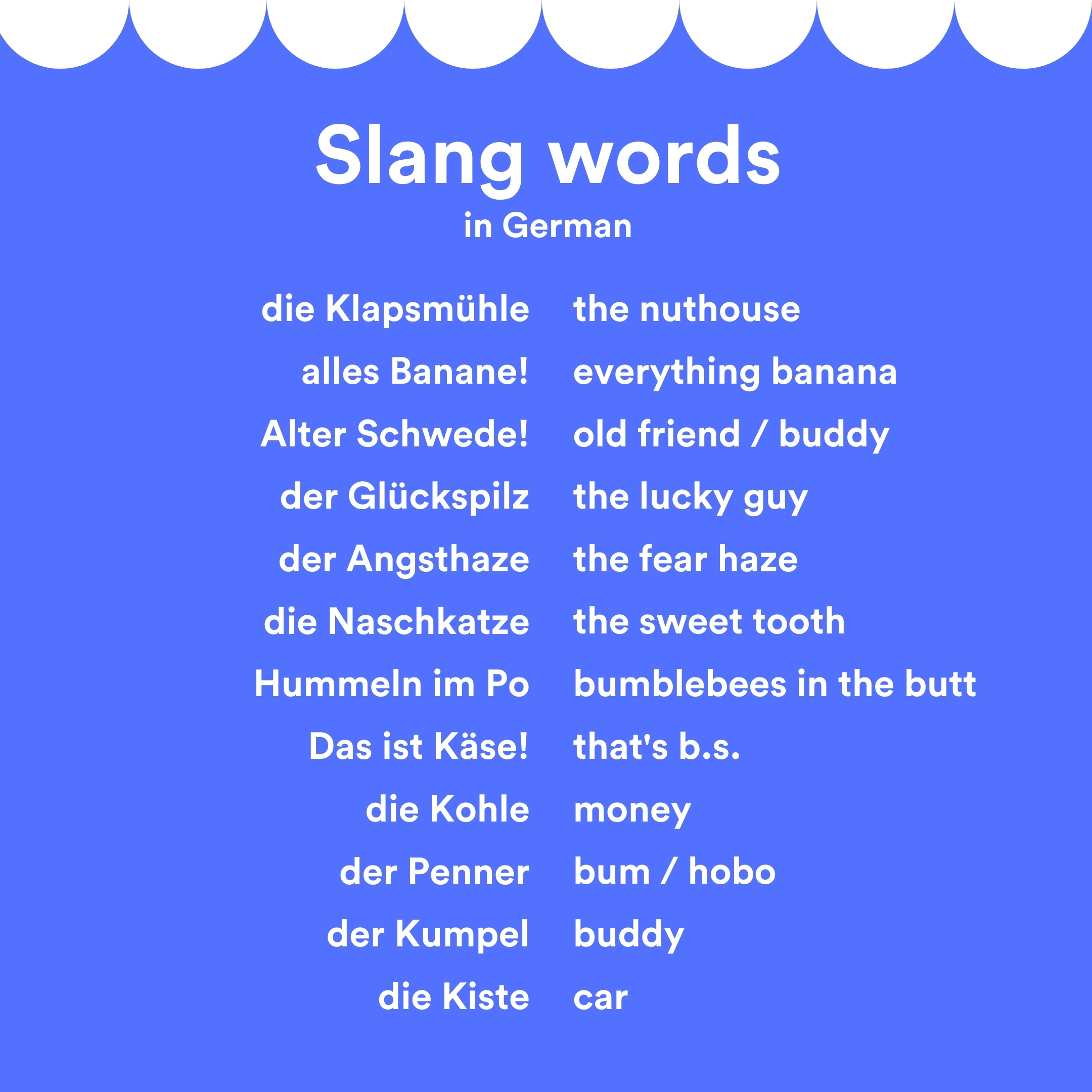
🎁 Bonus words in the picture 👇🏻
💥 Let's work on pronunciation? German tongue twisters🤯
1. Blase blubbernd in Seifenbruhe — bilde bunte Seifenblasen!
2. Brauchbare Bierbrauerburschen brauen brausendes Braunbier.
3. Wenn der Benz bremst, brennt das Benz-Bremmslicht.
4. Plättbrett bleibt Plättbrett.
5. Die Bürsten mit schwarzen Borsten bürsten besser, als die Bürsten mit schwarzen Borsten.
6. Bürsten mit harten Borsten bürsten besonders sauber.
7. Weiße Borsten bürsten besser als schwarze Borsten bursten.
8. Blaukraut bleibt Blaukraut und Brautkleid bleibt Brautkleid. Brautkleid bleibt Brautkleid und Blaukraut bleibt Blaukraut.
9. Wenn der Benz bremst, brennt das Benz-Bremmslicht.
10. Auch freche Fechter fechten mitternachts nicht.
11. Peter pappt das Pappplakat, das Pappplakat pappt Peter.
12. Wachs wächst nicht auf Wachsbäumen.
13. Kasperle kaspert kindisch in kleinen Kastenkapseln.
14. Warmes Wasser wäscht wollende Wäsche wachs weiß, wenn wachsende Wärme Wasser waschwarm werden lässt.
15. Kleine Kinder können keine Kirschkerne knacken.
16. Zwischen zwei Zwetschgenbäumen zwitschern zwei Schwalben.
17. Brautkleid, bleibt Brautkleid. Blaukohl, bleibt Blaukohl.
18. Esel fressen Nesseln nicht- Nesseln fressen Esel nicht.
19. Frau von Hagen,
darf ich’s wagen Sie zu fragen,
wieviel Kragen Sie getragen,
als sie lagen krank am Magen,
im Spital zu Kopenhagen?
20. Was Esel gern afu Wege legen,
fegen Kehrer weg mit Besen.
Feger kehren weg mit Besen,
was Esel gern auf Wege legen.
😉 So how did it go?
🌠🌙 Useful phrases and expressions with the word "Nacht"
die Nacht (die Nächte) - night(s)
bei Nacht = in der Nacht - at night
über Nacht bleiben - to stay overnight
mitten in der Nacht - in the middle of the night
gute Nacht! - Good night!
eines Nachts - one night
eine durchwachte Nacht - a sleepless night
im Dunkel der Nacht - in the gloom of the night
es wird Nacht - the night is falling
es ist Nacht geworden - the night has come
heute Nacht habe ich von dir geträumt - I dreamt of you tonight
bei Nacht und Nebel - in the darkness of the night, in the late hour; under cover of darkness; secretly
durch Nacht und Graus, through the darkness, through the terrors
die Nacht über - at night, during the night, all night
er kommt vor der Nacht nicht heim - he won't come home before night
eine finstere dunkle Nacht - a dark dark night
den Tag zur Nacht und die Nacht zum Tag machen - to turn day into night and night into day, to sleep by day and work by night
nachts - at night
nachts sind alle Katzen grau - all cats are gray at night
je dunkler die Nacht, je schöner der Tag ≈ the darker the night, the brighter the stars
✅ What other interesting expressions do you know?
😨📱What does it mean: "ivd! bb" or learning to read a German text message
You can be great at German, but not understand a basic five-word or even five-letter text message.
🚀Let's go, basic German abbreviations in SMS:
MfG - Mit freundlichen Grüßen (at the end of the official message)
LG - Liebe Grüße (at the end of a private message)
G+K - Grüß und Kuss - Hugs and kisses
www - Wir werden warten - We are waiting for you.
bb - bis bald! - See you soon!
bbb - bis bald, baby! - See you soon, baby!
NEWS - Nur ein wenig sauer. - I am not happy (a little bit angry).
ivd! - ich vermisse dich! - I miss you!
WaMaDuHeu? - was machst du heute? - What are you doing today?
KV - kannste vergessen - Forget it.
sTn - schönen Tag noch - Have a nice day
hdl - hab dich lieb - love ya
gn8 - Gute Nacht - Good night
akla - Alles klar? - Is everything clear?
bd - brauche dich - I need you
braduhi? - Brauchst du Hilfe? - Do you need help?
BSE - Bin so einsam - I am so lonely
DaD - Denk an dich - Thinking of you
DaM - Denk an mich - Remember me
DN! - Du nervst! - You make me nervous!
dubido - Du bist doof - (You) idiot!
DuBiMeiLe - Du bist mein Leben - You are my life.
HAHU - Habe Hunger
HASE - Habe Sehnsucht
Q6 - Komme um sechs Uhr - I'll be there at 6 o'clock
ko20mispa - komme 20 Minuten später - I will come 20 min later
ZDOM? - Zu dir oder zu mir? - Your place or mine?
MaMiMa - Mail mir mal - Write me a letter
RUMIAN - Ruf mich an - Call me
JoN - Jetzt oder nie - Now or never
🇩🇪 Do you shorten your text messages?
👍1
🇩🇪💡German proverbs and their translations
Was du heute kannst besorgen, das verschiebe nicht auf morgen. - Don't put off until tomorrow what you can do today.
Alles zu seiner Zeit. - All things have their time.
Die Zeit heilt alle Wunden. - Time is the best healer.
Ohne Fleiß kein Preis. - You won't catch fish out of the pond without hard work. (Without effort there is no reward.)
Jeder hat sein Päckchen zu tragen. - Each one has his own concerns.
Reden ist Silber, Schweigen ist Gold. - A word is silver, silence is gold.
Die Katze lässt das Mausen nicht. - All you feed a wolf, he still looks into the woods.
Das Ei will klüger sein als die Henne. - The eggs do not teach the hen. (The egg wants to be smarter than the hen.)
Viele Köpfe, viele Sinne. - There are as many heads as there are minds.
Durch Schaden wird man klug. - Mistakes are learned from.
Man lernt nie aus! - You learn for a long time!
Eine Schwalbe macht noch keinen Sommer. - One swallow does not make a summer.
Es ist noch kein Meister vom Himmel gefallen. - No master has yet fallen from the sky.
Lieber ein Ende mit Schrecken als ein Schrecken ohne Ende. - Better a terrible end than a horror without an end.
Wer andern eine Grube gräbt, fällt selbst hinein. - Do not dig a hole for others, you will fall into it yourself.
Man muss die Menschen nehmen, wie sie sind. - You have to take people as they are.
Man soll nie die Bärenhaut verkaufen, bevor man den Bären erlegt hat. - You should never sell the bear skin before you have killed the bear.
Liebe macht blind. - Love is blind.
Ende gut, alles gut. - Ende gut, alles gut. - All's well that ends well.
Morgenstunde hat Gold im Munde. - The early hour has gold in its mouth.
Hochmut kommt vor dem Fall. - Arrogance comes before the fall.
In einer rauher Schale steckt oft ein guter (süßer) Kern. - Beneath the rough rind is often a sweet fruit. / The tree is crooked, but the apples are sweet.
👍1
🤨 Happiness is happiness?
🇩🇪The word das Glück means happiness, luck and fortune in German & it has no plural.
🔥 Here're 20 useful expressions with the word das Glück. Let's go!
Viel Glück! - wish you luck!
sein Glück herausfordern- to try your luck
zum Glück - luckily
auf gut Glück - on good luck
sein Glück machen - make his fortune
sein Glück versäumen - to squander one's good fortune
Reichtum macht das Glück nicht aus - money is not happiness
sein Glück versuchen - to try one's luck
(j-m) Glück wünschen - to wish (someone) happiness, congratulate (someone)
in Glück und Unglück zusammenhalten - to share joy and sorrow.
damit hast du bei mir kein Glück - you won't get anything out of me
vom Glück begünstigt sein - to be a darling of fortune
ein Kind des Glücks sein - to be a spoilt for fortune
das Glück hat ihn verlassen - luck has left him
er hat Glück - he is lucky
er hat kein Glück - he has no luck
du hast Glück gehabt, dass... - you are lucky that...
er hat mehr Glück als Verstand - fools are lucky
jeder ist seines Glückes Schmied - everyone is an artisan of his own luck
Glück bringen - to bring happiness / luck
🥰🇩🇪 Describing appearance in German
das Äußere - appearance
dünn - thin, sparse (about hair)
gepflegt - well-groomed
jung - young
mager - slim, thin, lean, skinny
mittelgroß - of medium height
schlank - slender
schlanke Figur - slender figure
sportlich - athletic
das Gesicht, die Gesichter - face, faces
böses Gesicht - evil face
das Grübchen im Kinn - the dimple on the chin.
der Bart - beard
der Schnurrbart - the moustache.
die Falten auf der Stirn - forehead wrinkle.
die Grübchen in den Wangen - dimples on the cheeks.
die Sommersprossen - freckles
regelmäßige Züge - regular characteristics
schmales Gesicht - narrow, thin face
trauriges Gesicht - sad face
unregelmäßige Züge - irregular characteristics
das Auge, die Augen - eye(s)
ausdrucksvolle Augen - expressive eyes
ehrliche Augen - honest eyes
ernste Augen - serious eyes
glänzende Augen - sparkling eyes
kluge Augen - clever eyes
lachende Augen - laughing eyes
strahlende Augen - clear eyes
traurige Augen - sad eyes
die Haare - hair
die Glatze - bald spot
die Stupsnase - snub nose
gerade Nase - straight nose
kleine Nase - little nose
lange Nase - long nose
spitze Nase - sharp nose
der Mund - mouth
großer Mund - big mouth
kleiner Mund - little mouth
mit schmalen Lippen - with narrow lips
mit vollen Lippen - with full lips
der Zahn, die Zähne - tooth, teeth
feste Zähne - strong teeth
gesunde Zähne - healthy teeth.
weiße Zähne - white teeth.
die Haut - skin
frische Haut - fresh skin
gepflegte Haut - tidy skin
glatte Haut - smooth skin.
✨ Now try describing yourself!
👩🍳🇩🇪 Cooking in German
brechen - to break
schlagen - to beat
einfetten - to lubricate
gießen - to pour
rühren - to move
kochen - to cook
zerschneiden - to cut
schälen - to peel
schneiden - to chop
zerkleinern - to stuff
kochen - to cook
hinzufügen - to add
köcheln - to boil
brutzeln - to fry
braten - to fry
grillen - to grill
pfannenrühren - to roast
hacken - to cut
dünsten - to steam
reiben - to grate
mischen - to mix
backen - to bake
🍝🎂 Do you like cooking?
👍1
😁😠 "What's up" in German
20 simple answers (by degree of positivity)
❓ How to ask "how are you?":
Wie geht's? - How are you doing?
Wie geht es dir / Ihnen? - How are you/you(formal)
Wie steht's? - What's up?
Wie geht's, wie steht's? - How are you? (jokingly)
✅Answers:
sehr gut - very good
ausgezeichnet - excellent
fantastisch - fantastic
toll - great
prima - super
ganz gut - quite good
gut - good
normal - normal
so-so - so-so, 50/50
nicht schlecht - not bad
nicht besonders gut - not so good
leidlich - more or less
nicht gut - not good
schlecht - bad
sehr schlecht - very bad
miserabel - miserable
mies - lousy
erbärmlich - pathetic
scheußlich - awful
❓ Und wie geht es dir?
👍1
🤓☝🏻 Useful words and expressions with the word: helfen - to help
es hilft nichts - nothing can help.
der Sache ist nicht mehr zu helfen - (this) case can no longer be helped.
ihm ist nicht mehr zu helfen - he can't be helped anymore
sich zu helfen wissen - be able to find a way out of a difficulty, be clever
ich weiß mir nicht zu raten noch zu helfen - I am completely helpless in this (case)
ich werde dir helfen! - I'll hell you
auf die Beine helfen - to help to get back on feet.
auf die Spur auf die Fährte helfen - help find the trail
aus der Verlegenheit helfen - to help get out of a tight spot
bei der Arbeit helfen - to help at work, to help with work
sich bei der Arbeit helfen lassen - to an to help at work
mit Geld helfen - to help with money.
damit ist mir nicht geholfen - it does not do me any good.
zu seinem Recht helfen - help to get one's right
🙏🏻 Important requests and questions in German
May I ask? = Darf ich fragen?
I need help! = Ich brauche Hilfe!
Can you help me? = Können Sie mir helfen?
May I go through? = Darf ich durch?
I need a car (cab, plane tickets). = Ich brauche ein Auto (ein Taxi, Flugtickets).
May I come in? = Darf ich rein?
Can I get out? = Darf ich raus?
May I smoke? = Darf ich rauchen?
Can I take it with me? = Darf ich das mitnehmen?
Can I take it? = Darf ich das haben?
Please meet me! = Holen Sie mich bitte ab!
Please call the police! = Bitte rufen Sie die Polizei!
Please call the doctor! = Bitte rufen Sie den Arzt!
Please call a cab! = Bitte rufen Sie ein Taxi!
What happened? = Was ist los?
Give (show) me, please... = Geben (zeigen) Sie mir bitte...
I need (require)... = Ich brauche...
I need help! = Ich brauche Hilfe!
Can you help me? = Könnten Sie mir bitte helfen?
I would like mineral water (tea, juice, coffee, food, sleep, dance). = Ich möchte Mineralwasser (Tee, Saft, Kaffee,essen, schlafen, tanzen).
✔️ Vocabulary development: All about university life 🎓
Das Studium - the studies
immatrikuliert sein - to be enrolled
exmatrikuliert sein - to be expelled
der Studienbewerber - applicant
der Student - student at a university
der Lektor - lecturer (at a university)
die Universität - university
die Vorlesung - lecture
der Unterricht - class
Vorprüfung - preliminary examination
die Prüfung - examination
das Studienjahr - course
die Fakultät - faculty
die Fachrichtung, das Fach - speciality
die Jahresarbeit - coursework
das Diplom - diploma
der Hörsaal, der Unterrichtsraum - classroom
der Studеntenausweis - student card.
das Studentenwohnheim - student residences
absolvieren - to graduate
die Vorlesung, den Unterricht besuchen - to attend a lecture or class.
zur Vorlesung, zum Unterricht gehen - to go to a lecture or class.
die Prüfung bestehen, ablegen - to take an exam.
die Vorlesung halten - to give a lecture
unterrichten, lehren - to teach
😉 Do you like studying?
❤1👍1
✅15 tips on how to new learn words effectively!
1. Underline and highlight words
2. Learn the words for 30 minutes at a time, with a 10-minute break.
3. The brighter, more unusual or vulgar the word you memorize, the better.
4. Create sentences from the words
5. Words with pictures are better to remember
6. Imagine the word, say the word, picture the word
7. Sleep. Regular and healthy sleep is the main component of the learning process
8. Repeat:
first time in a few minutes;
second time - after 1 hour;
the third time - after sleeping;
fourth time - after 1 month.
9. Memorize no more than 7 new words at a time
10. Make chains of words. Example: table-chair-girl.
11. Mental attitude: imagine yourself successful, set yourself up for success.
12. Human possibilities are limitless with regular rest and a sense of security;
- to memorize information, imagine it;
- rest with music & a quiet sound of foreign words being pronounced;
- use of words in games, daily activities, etc.
13. Imagine the words you are hearing in music
14. The better the description of the word, the better🗿
15. 50-100 new words in 1 day - possible!
❓ Do you remember new vocabulary easily?
💥 Let's work on the pronunciation? Tongue twisters-breakers:
1. Blase blubbernd in Seifenbruhe — bilde bunte Seifenblasen!
2. Brauchbare Bierbrauerburschen brauen brausendes Braunbier.
3. Wenn der Benz bremst, brennt das Benz-Bremmslicht.
4. Plättbrett bleibt Plättbrett.
5. Die Bürsten mit schwarzen Borsten bürsten besser, als die Bürsten mit schwarzen Borsten.
6. Bürsten mit harten Borsten bürsten besonders sauber.
7. Weiße Borsten bürsten besser als schwarze Borsten bursten.
8. Blaukraut bleibt Blaukraut und Brautkleid bleibt Brautkleid. Brautkleid bleibt Brautkleid und Blaukraut bleibt Blaukraut.
9. Wenn der Benz bremst, brennt das Benz-Bremmslicht.
10. Auch freche Fechter fechten mitternachts nicht.
11. Peter pappt das Pappplakat, das Pappplakat pappt Peter.
12. Wachs wächst nicht auf Wachsbäumen.
13. Kasperle kaspert kindisch in kleinen Kastenkapseln.
14. Warmes Wasser wäscht wollende Wäsche wachs weiß, wenn wachsende Wärme Wasser waschwarm werden lässt.
15. Kleine Kinder können keine Kirschkerne knacken.
16. Zwischen zwei Zwetschgenbäumen zwitschern zwei Schwalben.
17. Brautkleid, bleibt Brautkleid. Blaukohl, bleibt Blaukohl.
18. Esel fressen Nesseln nicht- Nesseln fressen Esel nicht.
19. Frau von Hagen,
darf ich’s wagen Sie zu fragen,
wieviel Kragen Sie getragen,
als sie lagen krank am Magen,
im Spital zu Kopenhagen?
20. Was Esel gern afu Wege legen,
fegen Kehrer weg mit Besen.
Feger kehren weg mit Besen,
was Esel gern auf Wege legen.
😉Well, how did you manage?
🇩🇪👍🏻 Important phrases to express consent!
📌 In a conversation, we often have to express our attitude to what the interlocutor said. We don’t want to just nod and say "Ja-ja!" - it's time to learn something more interesting:
Ich bin einverstanden - I agree
Du hast Recht - you're right
Genau! - exactly!
Ich habe nichts dagegen - I have nothing against
Das stimmt - right
Ich glaube dir - I believe you
Ich bin deiner (Ihrer) Meinung - I am of the same opinion as you
Super! - super!
Ich stimme dir zu - I agree with you
Natürlich! - of course!
Selbstverständlich! - obviously!
Abgemacht - agreed
Da hast du (haben Sie) völlig Recht - here you are absolutely right
Ja, das sehe ich auch so - yes, I have the same opinion
Das klingt überzeugend - it sounds convincing
Ich teile deine (Ihre) Ansicht - I share your (your) point of view
⛔️ How to turn down an invitation.
🔔 Another round of useful expressions for every day.
❗️ Saying no can be difficult. Especially when you have to refuse in a foreign language and you don't want to offend your conversation partner.
👇🏻How to refuse an invitation in German
🙏🏻 First, it would be a good idea to thank you for the invitation:
Danke für die Einladung, aber ... - Thanks for the invitation, but ...
Das ist sehr nett, aber ... - That is very nice, but ...
❗️Now we move on to the but part:
Ich kann leider nicht - Unfortunately, I cannot.
Vielleicht das nächste Mal - Maybe another time.
Ich habe keine Zeit. - I have no time.
Ich bin beschäftigt. - I am busy.
Dazu habe ich keine Lust. - I have no desire.
Ich habe viel zu tun. - I have a lot to do.
Ich habe schon einen Termin. - I already have an appointment.
🚫 Very annoying offers can be rejected in harsher terms:
Lassen Sie mich bitte in Ruhe! - Leave me alone, please.
Hören Sie sofort damit auf! - Stop it immediately!
Es reicht jetzt! - Enough!
🔥 🇩🇪 Ich... was?
FIRST-PERSON EXPRESSIONS
Ich habe keinen Bock darauf! - I don't feel like it!
Ich habe mir unsere Zukunft ganz anders vorgestellt. - I imagined our future quite differently.
Ich halte es nicht mehr aus. - I can't take it anymore.
Ich hoffe, dass es klappt. - I hope it will work out.
Ich bin enttäuscht. - I am disappointed.
Ich bin mir (nicht) sicher. - I am (not) sure
Ich bin mit dir (nicht) einverstanden - I (don't) agree with you.
Ich teile diese Meinung (nicht). - I (do not) share this opinion.
Ich werde das nie mehr tun. - I will never do this again.
Ich weiß es nicht. - I do not know.
Ich bin nicht in der Stimmung - I am not in the mood.
Ich bin sehr dankbar für Ihre Hilfe. - I am very grateful for your help.
Ich drück dir die Daumen! - I keep my fingers crossed for you!
Ich freue mich wirklich darauf zu ... - I am really glad ...
Ich interessiere mich für ... - I am interested...
Ich kann nicht mehr. - I am not able any more.
Ich schreibe, um zu sagen ... - I write to say ...
Ich hab' Schnauze voll! - I'm fed up!
🔥 🇩🇪 ADJECTIVES OF FEELING AND EMOTION
fröhlich - joyful
lustig - cheerful
klug - clever
fleißig - conscientious
reich - rich
stark - strong
schüchtern - shy
glücklich - happy
freundlich - friendly
ehrlich - honest
böse - evil
verrückt - mad
aggressiv - aggressive
krank - sickly
müde - tired
traurig - sad
nervös - nervous
langweilig - boring
faul - lazy
arm - poor
📝 Write them out for yourself to remember them better.
❤1
🔥 ABOUT STRESS IN GERMAN
🌧️ in rainy weather
Ich habe zu viel Stress. - I have too much stress.
Ich habe keinen Stress. - I have no stress.
Ich bin gestresst. - I am stressed.
.... ist für mich Stress. - ... is stress for me.
...ist / sind ein bisschen nervig. - .... is a bit nervous.
... macht / machen mich wahnsinnig! - ... makes me mad!
Ich ärgere mich sehr oft über... - I get very angry about... / I am very annoyed....
Es stört mich, dass / wenn... - It bothers me that... / when...
Es macht mich nervös, wenn / dass... - It makes me nervous if... / that...
total fertig sein - totally tired / exhausted / nervous
💆🏻 Giving advice
Du solltest mal wieder... - You should again ...
Du könntest ... - You could ...
Meine Mutter findet, ich sollte... - My mother thinks that I should...
👍1