
🚨 CVE-2026-8216
A vulnerability was identified in Industrial Application Software IAS Canias ERP 8.03. This issue affects the function iasServerRemoteInterface.doAction of the component Java RMI Session Management. Such manipulation leads to improper authentication. The attack can be launched remotely. The vendor was contacted early about this disclosure but did not respond in any way.
🎖@cveNotify
A vulnerability was identified in Industrial Application Software IAS Canias ERP 8.03. This issue affects the function iasServerRemoteInterface.doAction of the component Java RMI Session Management. Such manipulation leads to improper authentication. The attack can be launched remotely. The vendor was contacted early about this disclosure but did not respond in any way.
🎖@cveNotify
Hawktrace
Compromising caniasERP 8.03: Eight CVEs, One Unauthenticated RCE Chain
Eight zero-interaction vulnerabilities in Industrial Application Software caniasERP 8.03 — from unauthenticated session enumeration to full OS command execution via a Java RMI session hijack chain.
🚨 CVE-2026-8218
A weakness has been identified in Devs Palace ERP Online up to 4.0.0. The affected element is an unknown function of the file /inventory/purchase_return_save. Executing a manipulation can lead to cross site scripting. The attack may be launched remotely. The exploit has been made available to the public and could be used for attacks. The vendor was contacted early about this disclosure but did not respond in any way.
🎖@cveNotify
A weakness has been identified in Devs Palace ERP Online up to 4.0.0. The affected element is an unknown function of the file /inventory/purchase_return_save. Executing a manipulation can lead to cross site scripting. The attack may be launched remotely. The exploit has been made available to the public and could be used for attacks. The vendor was contacted early about this disclosure but did not respond in any way.
🎖@cveNotify
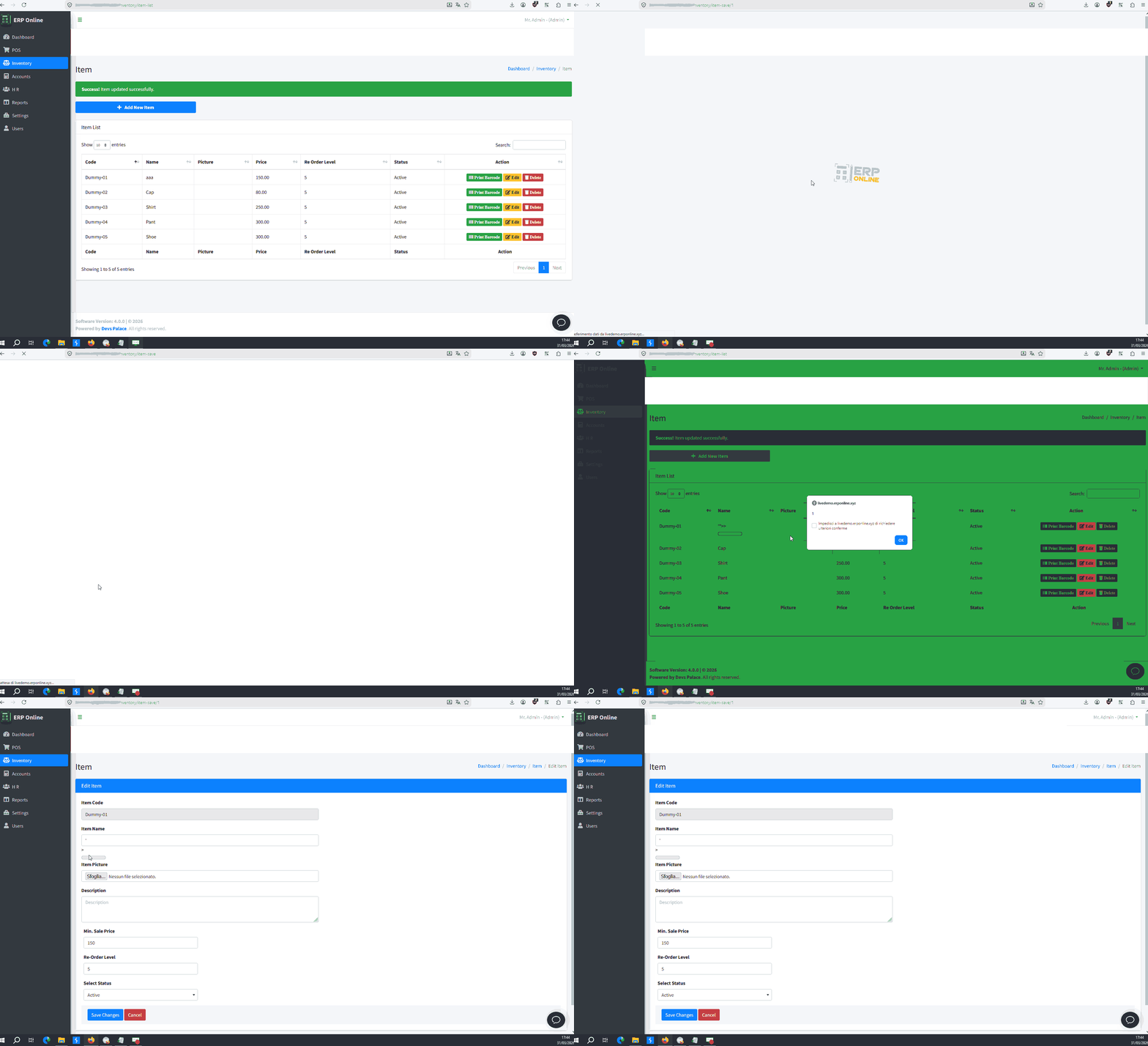
🚨 CVE-2026-8219
A security vulnerability has been detected in Devs Palace ERP Online up to 4.0.0. The impacted element is an unknown function of the file /inventory/supplier-save. The manipulation leads to cross site scripting. Remote exploitation of the attack is possible. The exploit has been disclosed publicly and may be used. The vendor was contacted early about this disclosure but did not respond in any way.
🎖@cveNotify
A security vulnerability has been detected in Devs Palace ERP Online up to 4.0.0. The impacted element is an unknown function of the file /inventory/supplier-save. The manipulation leads to cross site scripting. Remote exploitation of the attack is possible. The exploit has been disclosed publicly and may be used. The vendor was contacted early about this disclosure but did not respond in any way.
🎖@cveNotify
🚨 CVE-2026-6722
In PHP versions 8.2.* before 8.2.31, 8.3.* before 8.3.31, 8.4.* before 8.4.21, and 8.5.* before 8.5.6, the SOAP extension's object deduplication mechanism stores pointers to PHP objects in a global map without incrementing their reference counts. When an apache:Map node contains duplicate keys, processing the second entry overwrites the first in the temporary result map, freeing the original PHP object while its stale pointer remains in the map. A subsequent href reference to the freed node can copy the dangling pointer into the result. As PHP string allocations can reclaim the freed memory region, an attacker with control over the SOAP request body can exploit this use-after-free to achieve remote code execution.
🎖@cveNotify
In PHP versions 8.2.* before 8.2.31, 8.3.* before 8.3.31, 8.4.* before 8.4.21, and 8.5.* before 8.5.6, the SOAP extension's object deduplication mechanism stores pointers to PHP objects in a global map without incrementing their reference counts. When an apache:Map node contains duplicate keys, processing the second entry overwrites the first in the temporary result map, freeing the original PHP object while its stale pointer remains in the map. A subsequent href reference to the freed node can copy the dangling pointer into the result. As PHP string allocations can reclaim the freed memory region, an attacker with control over the SOAP request body can exploit this use-after-free to achieve remote code execution.
🎖@cveNotify
GitHub
Use-After-Free in SOAP using Apache map with Remote Code Execution
ext-soap supports deduplicating objects in the XML graph through `id` and `href`. When traversing the XML graph, ext-soap will remember all plain PHP objects using the hash map `SOAP_GLOBAL(ref_map...
🚨 CVE-2026-6735
In PHP versions 8.2.* before 8.2.31, 8.3.* before 8.3.31, 8.4.* before 8.4.21, 8.5.* before 8.5.6, due to improper sanitation of user data, it allows an attacker to compose an URL, which will cause the target to execute arbitrary JavaScript code (XSS) on the target's machine when the target is viewing the PHP-FPM status page.
🎖@cveNotify
In PHP versions 8.2.* before 8.2.31, 8.3.* before 8.3.31, 8.4.* before 8.4.21, 8.5.* before 8.5.6, due to improper sanitation of user data, it allows an attacker to compose an URL, which will cause the target to execute arbitrary JavaScript code (XSS) on the target's machine when the target is viewing the PHP-FPM status page.
🎖@cveNotify
GitHub
XSS within PHP-FPM status endpoint
Improper sanitization of the request URI within the PHP-FPM status page allows an attacker to execute arbitrary JavaScript code (XSS) on the victims machine, possibly stealing cookies on insufficie...
🚨 CVE-2026-7258
In PHP versions 8.2.* before 8.2.31, 8.3.* before 8.3.31, 8.4.* before 8.4.21, and 8.5.* before 8.5.6, some functions, including urldecode(), pass signed char to ctype functions (like isxdigit()). On the systems with default signed char and optimized table-lookup ctype functions - such as NetBSD - this can lead to accessing array with negative offset, which can trigger a denial of service.
🎖@cveNotify
In PHP versions 8.2.* before 8.2.31, 8.3.* before 8.3.31, 8.4.* before 8.4.21, and 8.5.* before 8.5.6, some functions, including urldecode(), pass signed char to ctype functions (like isxdigit()). On the systems with default signed char and optimized table-lookup ctype functions - such as NetBSD - this can lead to accessing array with negative offset, which can trigger a denial of service.
🎖@cveNotify
GitHub
Out-of-bounds read in urldecode()
Consider the following snippet within `php_url_decode_ex()` at `ext/standard/url.c`, called from PHPs `urldecode()` function:
https://github.com/php/php-src/blob/dcf653339c245e25ea319248d0fc071a...
https://github.com/php/php-src/blob/dcf653339c245e25ea319248d0fc071a...
🚨 CVE-2026-7259
In PHP versions 8.2.* before 8.2.31, 8.3.* before 8.3.31, 8.4.* before 8.4.21, and 8.5.* before 8.5.6, a mismatch between encoding lists in Oniguruma and mbfl leads to a NULL pointer dereference, resulting in a segmentation fault and denial of service. The vulnerability is exploitable when user-controlled input can influence the encoding passed to mb_regex_encoding().
🎖@cveNotify
In PHP versions 8.2.* before 8.2.31, 8.3.* before 8.3.31, 8.4.* before 8.4.21, and 8.5.* before 8.5.6, a mismatch between encoding lists in Oniguruma and mbfl leads to a NULL pointer dereference, resulting in a segmentation fault and denial of service. The vulnerability is exploitable when user-controlled input can influence the encoding passed to mb_regex_encoding().
🎖@cveNotify
GitHub
Null pointer dereference in php_mb_check_encoding() via mb_ereg_search_init()
The following PHP code triggers a segmentation fault due to a NULL pointer dereference:
```php
<?php
mb_regex_encoding('iso-8859-11');
$test_str = 'x';
if (mb_ereg_searc...
```php
<?php
mb_regex_encoding('iso-8859-11');
$test_str = 'x';
if (mb_ereg_searc...
🚨 CVE-2026-7261
In PHP versions 8.2.* before 8.2.31, 8.3.* before 8.3.31, 8.4.* before 8.4.21, and 8.5.* before 8.5.6, when SoapServer is configured with SOAP_PERSISTENCE_SESSION, the handler object is persisted across requests via session storage. However, in the case SOAP requests results in an error, the persistance is handled incorrectly, resulting in freeing the object while keeping a pointer to it, which may lead to use-after-free. This may lead to memory corruption, information disclosure, or process crashes, with confidentiality, integrity, and availability impact on the vulnerable system.
🎖@cveNotify
In PHP versions 8.2.* before 8.2.31, 8.3.* before 8.3.31, 8.4.* before 8.4.21, and 8.5.* before 8.5.6, when SoapServer is configured with SOAP_PERSISTENCE_SESSION, the handler object is persisted across requests via session storage. However, in the case SOAP requests results in an error, the persistance is handled incorrectly, resulting in freeing the object while keeping a pointer to it, which may lead to use-after-free. This may lead to memory corruption, information disclosure, or process crashes, with confidentiality, integrity, and availability impact on the vulnerable system.
🎖@cveNotify
GitHub
SoapServer session-persisted object use-after-free via SOAP header fault
`SOAP_PERSISTENCE_SESSION` allows to persist the SOAP handler object between requests using the session storage. Normally the object is immediately released after `SoapServer::handle()`, unless thi...
🚨 CVE-2026-7262
In PHP versions 8.2.* before 8.2.31, 8.3.* before 8.3.31, 8.4.* before 8.4.21, and 8.5.* before 8.5.6, when a SOAP server has a typemap configured, the decoding process contains a mistake which checks the wrong variable in case of missing value element. This leads to dereferences a NULL pointer, causing a segmentation fault. This allows a remote unauthenticated attacker to crash the PHP SOAP server process, resulting in denial of service.
🎖@cveNotify
In PHP versions 8.2.* before 8.2.31, 8.3.* before 8.3.31, 8.4.* before 8.4.21, and 8.5.* before 8.5.6, when a SOAP server has a typemap configured, the decoding process contains a mistake which checks the wrong variable in case of missing value element. This leads to dereferences a NULL pointer, causing a segmentation fault. This allows a remote unauthenticated attacker to crash the PHP SOAP server process, resulting in denial of service.
🎖@cveNotify
GitHub
NULL pointer dereference in SOAP apache:Map decoder with missing <value>
`to_zval_map()` in `ext/soap/php_encoding.c` decodes `apache:Map` nodes. The `<key>` branch correctly guards against missing keys, but the `<value>` branch rechecks `xmlKey` instead of ...
🚨 CVE-2026-7568
In PHP versions 8.2.* before 8.2.31, 8.3.* before 8.3.31, 8.4.* before 8.4.21, and 8.5.* before 8.5.6, the metaphone() function in ext/standard/metaphone.c uses a signed int variable to track the current position within the input string. If a string longer than 2,147,483,647 bytes is passed, a signed integer overflow occurs, resulting in undefined behavior. This can lead to an out-of-bounds read, causing a segmentation fault or access to unrelated memory, and may affect the availability of the PHP process.
🎖@cveNotify
In PHP versions 8.2.* before 8.2.31, 8.3.* before 8.3.31, 8.4.* before 8.4.21, and 8.5.* before 8.5.6, the metaphone() function in ext/standard/metaphone.c uses a signed int variable to track the current position within the input string. If a string longer than 2,147,483,647 bytes is passed, a signed integer overflow occurs, resulting in undefined behavior. This can lead to an out-of-bounds read, causing a segmentation fault or access to unrelated memory, and may affect the availability of the PHP process.
🎖@cveNotify
GitHub
Signed integer overflow in metaphone()
**Researcher: Aleksey Solovev (Positive Technologies)**
The PHP standard library provides the function `metaphone()` (php-src/ext/standard/metaphone.c). This function is used for searching and m...
The PHP standard library provides the function `metaphone()` (php-src/ext/standard/metaphone.c). This function is used for searching and m...
🚨 CVE-2026-6104
In PHP versions 8.4.* before 8.4.21 and 8.5.* before 8.5.6, when an encoding name containing an embedded NUL byte is passed to mb_convert_encoding() or related mbstring functions, the code incorrectly assumes that when strncasecmp() returns 0 it means the strings have the same length. This can lead to out-of-bounds read of global memory, potentially causing a crash or information disclosure or crash. Affected functions include mb_convert_encoding(), mb_detect_encoding(), mb_convert_variables(), and mb_detect_order(), as well as the mbstring.detect_order and mbstring.http_output INI settings.
🎖@cveNotify
In PHP versions 8.4.* before 8.4.21 and 8.5.* before 8.5.6, when an encoding name containing an embedded NUL byte is passed to mb_convert_encoding() or related mbstring functions, the code incorrectly assumes that when strncasecmp() returns 0 it means the strings have the same length. This can lead to out-of-bounds read of global memory, potentially causing a crash or information disclosure or crash. Affected functions include mb_convert_encoding(), mb_detect_encoding(), mb_convert_variables(), and mb_detect_order(), as well as the mbstring.detect_order and mbstring.http_output INI settings.
🎖@cveNotify
GitHub
Global buffer over-read in mb_convert_encoding() with attacker-supplied encoding
## Summary
A global buffer over-read exists in `mbfl_name2encoding_ex()` (`ext/mbstring/libmbfl/mbfl/mbfl_encoding.c`, line 352), called from `mb_convert_encoding(...)` and other mbstring functi...
A global buffer over-read exists in `mbfl_name2encoding_ex()` (`ext/mbstring/libmbfl/mbfl/mbfl_encoding.c`, line 352), called from `mb_convert_encoding(...)` and other mbstring functi...
🚨 CVE-2026-7263
In PHP versions 8.4.* before 8.4.21 and 8.5.* before 8.5.6, DOMNode::C14N() method may process the XML data incorrectly, causing a circular linked list in the data structure representing the XML document. This may cause subsequent processing of the XML document to enter infinite loop, causing denial of service in the processing application.
🎖@cveNotify
In PHP versions 8.4.* before 8.4.21 and 8.5.* before 8.5.6, DOMNode::C14N() method may process the XML data incorrectly, causing a circular linked list in the data structure representing the XML document. This may cause subsequent processing of the XML document to enter infinite loop, causing denial of service in the processing application.
🎖@cveNotify
GitHub
DoS attack via DOMNode::C14N()
**Researcher: Nikita Sveshnikov (Positive Technologies)**
In `DOMNode::C14N()`, improper removal of a `xmlns` libxml2 attribute from a doubly linked list can lead to a corrupt, circular linked l...
In `DOMNode::C14N()`, improper removal of a `xmlns` libxml2 attribute from a doubly linked list can lead to a corrupt, circular linked l...
🚨 CVE-2026-8177
XML::LibXML versions through 2.0210 for Perl read out-of-bounds heap memory when parsing XML node names containing truncated UTF-8 byte sequences.
A node name ending in the middle of a multi byte UTF-8 sequence causes the parser to read past the end of the input string into adjacent heap memory.
Any Perl process that passes attacker controlled strings to XML::LibXML's DOM node-name methods can reach this path on the default API. The likely consequence is a crash, causing denial of service.
🎖@cveNotify
XML::LibXML versions through 2.0210 for Perl read out-of-bounds heap memory when parsing XML node names containing truncated UTF-8 byte sequences.
A node name ending in the middle of a multi byte UTF-8 sequence causes the parser to read past the end of the input string into adjacent heap memory.
Any Perl process that passes attacker controlled strings to XML::LibXML's DOM node-name methods can reach this path on the default API. The likely consequence is a crash, causing denial of service.
🎖@cveNotify
🚨 CVE-2026-6009
Java Deserialisation Vulnerability in Jaspersoft Reports Library leads to Remote Code Execution (RCE), potentially allowing code execution on the affected system
🎖@cveNotify
Java Deserialisation Vulnerability in Jaspersoft Reports Library leads to Remote Code Execution (RCE), potentially allowing code execution on the affected system
🎖@cveNotify
Jaspersoft Community
Jaspersoft Security Advisory: May 19, 2026 - Jaspersoft Library - CVE-2026-6009
Jaspersoft Library Deserialisation VulnerabilityOriginal release date: May 19, 2026Last revised: ---CVE-2026-6009Source: JaspersoftDescription of Problem A Java deserialisation vulnerability has been discovered in Jaspersoft Library. Refer below for further…
🚨 CVE-2026-8073
The Kirki – Freeform Page Builder, Website Builder & Customizer plugin for WordPress is vulnerable to arbitrary file deletion due to insufficient file path validation and missing capability check in the 'downloadZIP' function in all versions up to, and including, 6.0.6. This makes it possible for unauthenticated attackers to read and delete arbitrary files limited in the WordPress uploads base directory.
🎖@cveNotify
The Kirki – Freeform Page Builder, Website Builder & Customizer plugin for WordPress is vulnerable to arbitrary file deletion due to insufficient file path validation and missing capability check in the 'downloadZIP' function in all versions up to, and including, 6.0.6. This makes it possible for unauthenticated attackers to read and delete arbitrary files limited in the WordPress uploads base directory.
🎖@cveNotify
🚨 CVE-2026-8096
The Kirki – Freeform Page Builder, Website Builder & Customizer plugin for WordPress is vulnerable to authorization bypass in all versions up to, and including, 6.0.6. This is due to the plugin not properly verifying that a user is authorized to perform an action. This makes it possible for authenticated attackers, with subscriber-level access and above, to view all Kirki frontend forms and read stored visitor form submission data, including contact details, messages, and any other visitor-provided information submitted through site forms.
🎖@cveNotify
The Kirki – Freeform Page Builder, Website Builder & Customizer plugin for WordPress is vulnerable to authorization bypass in all versions up to, and including, 6.0.6. This is due to the plugin not properly verifying that a user is authorized to perform an action. This makes it possible for authenticated attackers, with subscriber-level access and above, to view all Kirki frontend forms and read stored visitor form submission data, including contact details, messages, and any other visitor-provided information submitted through site forms.
🎖@cveNotify
🚨 CVE-2026-6095
Improper Neutralization of Input During Web Page Generation ("Cross-site Scripting") vulnerability in Drupal Orejime allows Cross-Site Scripting (XSS).
This issue affects Orejime: from 0.0.0 before 2.0.16.
🎖@cveNotify
Improper Neutralization of Input During Web Page Generation ("Cross-site Scripting") vulnerability in Drupal Orejime allows Cross-Site Scripting (XSS).
This issue affects Orejime: from 0.0.0 before 2.0.16.
🎖@cveNotify
Drupal.org
Orejime - Moderately critical - Cross-site scripting - SA-CONTRIB-2026-032
The IframeConsent element writes HTML attributes without escaping their value. This module has a XSS vulnerability. If an attacker is able to write an tag, they may be able to insert arbitrary JavaScript. This vulnerability is mitigated by the fact that a…
🚨 CVE-2026-6365
Improper Neutralization of Input During Web Page Generation ("Cross-site Scripting") vulnerability in Drupal Drupal core allows Cross-Site Scripting (XSS).
This issue affects Drupal core: from 8.0.0 before 10.5.9, from 10.6.0 before 10.6.7, from 11.0.0 before 11.2.11, from 11.3.0 before 11.3.7.
🎖@cveNotify
Improper Neutralization of Input During Web Page Generation ("Cross-site Scripting") vulnerability in Drupal Drupal core allows Cross-Site Scripting (XSS).
This issue affects Drupal core: from 8.0.0 before 10.5.9, from 10.6.0 before 10.6.7, from 11.0.0 before 11.2.11, from 11.3.0 before 11.3.7.
🎖@cveNotify
Drupal.org
Drupal core - Critical - Cross-site scripting - SA-CORE-2026-001
Drupal core's jQuery integration for AJAX modal dialog boxes does not sufficiently sanitize certain options, which can lead to a cross-site scripting (XSS) vulnerability.
🚨 CVE-2026-6366
Improperly Controlled Modification of Dynamically-Determined Object Attributes vulnerability in Drupal Drupal core allows Object Injection.
This issue affects Drupal core: from 8.0.0 before 10.5.9, from 10.6.0 before 10.6.7, from 11.0.0 before 11.2.11, from 11.3.0 before 11.3.7.
🎖@cveNotify
Improperly Controlled Modification of Dynamically-Determined Object Attributes vulnerability in Drupal Drupal core allows Object Injection.
This issue affects Drupal core: from 8.0.0 before 10.5.9, from 10.6.0 before 10.6.7, from 11.0.0 before 11.2.11, from 11.3.0 before 11.3.7.
🎖@cveNotify
Drupal.org
Drupal core - Moderately critical - Gadget Chain - SA-CORE-2026-002
Drupal core contains a chain of methods that could be exploitable when an insecure deserialization vulnerability exists on the site. This so-called "gadget chain" presents no direct threat, but is a vector that can be used to achieve remote code execution…
🚨 CVE-2026-6367
Improper Neutralization of Input During Web Page Generation ("Cross-site Scripting") vulnerability in Drupal Drupal core allows Cross-Site Scripting (XSS).
This issue affects Drupal core: from 11.3.0 before 11.3.7.
🎖@cveNotify
Improper Neutralization of Input During Web Page Generation ("Cross-site Scripting") vulnerability in Drupal Drupal core allows Cross-Site Scripting (XSS).
This issue affects Drupal core: from 11.3.0 before 11.3.7.
🎖@cveNotify
Drupal.org
Drupal core - Moderately critical - Cross-site scripting - SA-CORE-2026-003
Drupal 11.3 comes with support for completing entity suggestions whilst adding a link to CKEditor 5. The suggestions aren't sufficiently sanitized and a malicious user could trigger a stored cross site scripting attack against another user.
🚨 CVE-2026-6072
The Oliver POS – A WooCommerce Point of Sale (POS) plugin for WordPress is vulnerable to Authorization Bypass Through User-Controlled Key in all versions up to and including 2.4.2.6. The plugin protects its entire /wp-json/pos-bridge/* REST API namespace through the oliver_pos_rest_authentication() permission callback, which uses a loose PHP comparison (==) to compare the attacker-supplied 'OliverAuth' header value against the 'oliver_pos_authorization_token' option. On fresh installations where the admin has not yet completed the connection flow, this option is unset (get_option returns false). Due to PHP's type juggling, the loose comparison '0' == false evaluates to true, allowing an unauthenticated attacker to bypass authentication by sending 'OliverAuth: 0'. This grants full access to all POS API endpoints, enabling attackers to read user data (including administrator details), update user profiles (including email addresses), and delete non-admin users. An admin account email reset can lead to site takeover.
🎖@cveNotify
The Oliver POS – A WooCommerce Point of Sale (POS) plugin for WordPress is vulnerable to Authorization Bypass Through User-Controlled Key in all versions up to and including 2.4.2.6. The plugin protects its entire /wp-json/pos-bridge/* REST API namespace through the oliver_pos_rest_authentication() permission callback, which uses a loose PHP comparison (==) to compare the attacker-supplied 'OliverAuth' header value against the 'oliver_pos_authorization_token' option. On fresh installations where the admin has not yet completed the connection flow, this option is unset (get_option returns false). Due to PHP's type juggling, the loose comparison '0' == false evaluates to true, allowing an unauthenticated attacker to bypass authentication by sending 'OliverAuth: 0'. This grants full access to all POS API endpoints, enabling attackers to read user data (including administrator details), update user profiles (including email addresses), and delete non-admin users. An admin account email reset can lead to site takeover.
🎖@cveNotify