
🚨 CVE-2026-8253
A vulnerability was identified in Devs Palace ERP Online up to 4.0.0. Affected by this vulnerability is an unknown functionality of the file /inventory/purchase_save. The manipulation leads to cross site scripting. It is possible to initiate the attack remotely. The exploit is publicly available and might be used. The vendor was contacted early about this disclosure but did not respond in any way.
🎖@cveNotify
A vulnerability was identified in Devs Palace ERP Online up to 4.0.0. Affected by this vulnerability is an unknown functionality of the file /inventory/purchase_save. The manipulation leads to cross site scripting. It is possible to initiate the attack remotely. The exploit is publicly available and might be used. The vendor was contacted early about this disclosure but did not respond in any way.
🎖@cveNotify
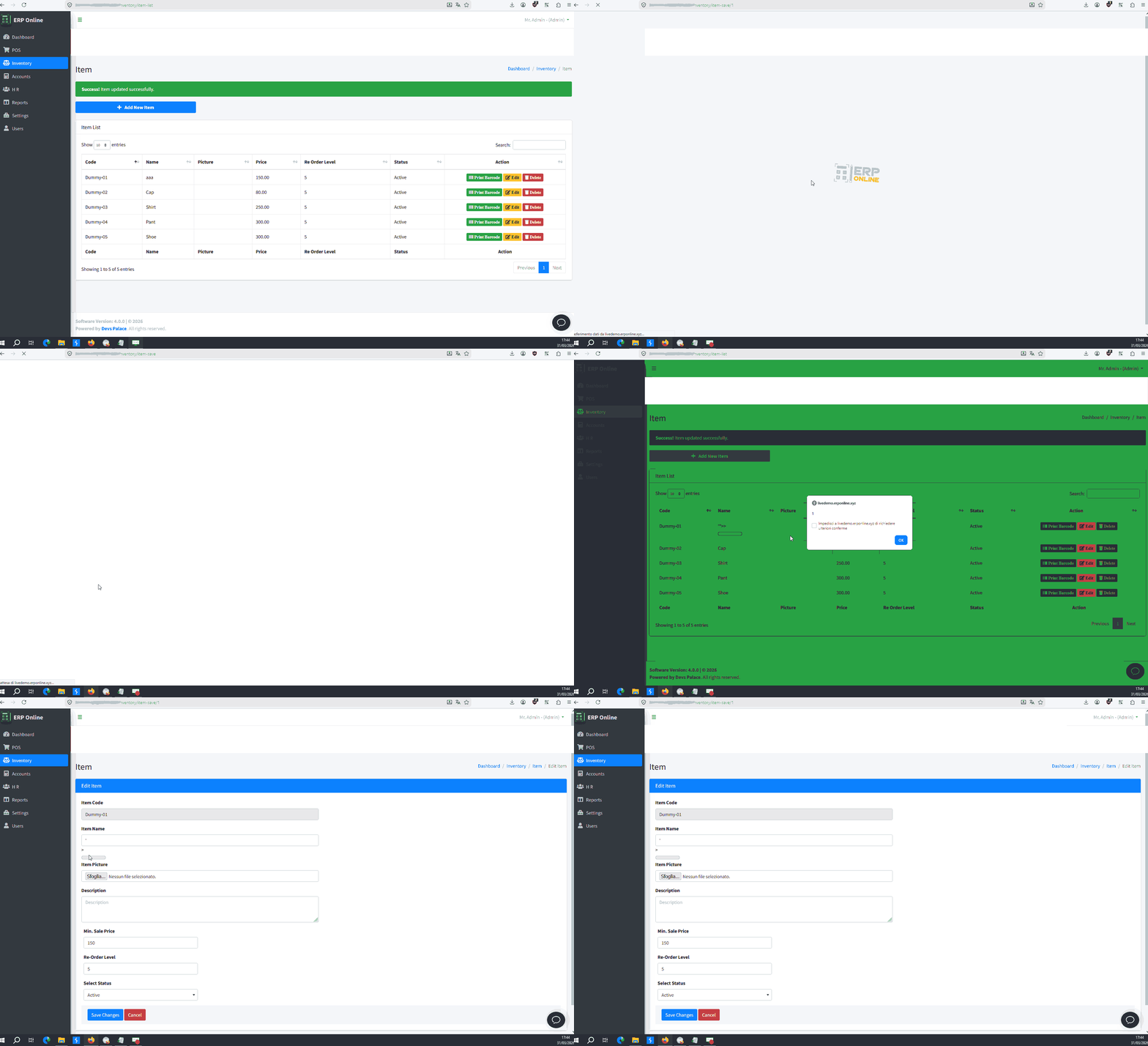
🚨 CVE-2026-8254
A security flaw has been discovered in Devs Palace ERP Online up to 4.0.0. Affected by this issue is some unknown functionality of the file /inventory/sales_save. The manipulation results in cross site scripting. It is possible to launch the attack remotely. The exploit has been released to the public and may be used for attacks. The vendor was contacted early about this disclosure but did not respond in any way.
🎖@cveNotify
A security flaw has been discovered in Devs Palace ERP Online up to 4.0.0. Affected by this issue is some unknown functionality of the file /inventory/sales_save. The manipulation results in cross site scripting. It is possible to launch the attack remotely. The exploit has been released to the public and may be used for attacks. The vendor was contacted early about this disclosure but did not respond in any way.
🎖@cveNotify
🚨 CVE-2026-8255
A weakness has been identified in Devs Palace ERP Online up to 4.0.0. This affects an unknown part of the file /inventory/add_new_customer. This manipulation causes cross site scripting. The attack can be initiated remotely. The exploit has been made available to the public and could be used for attacks. The vendor was contacted early about this disclosure but did not respond in any way.
🎖@cveNotify
A weakness has been identified in Devs Palace ERP Online up to 4.0.0. This affects an unknown part of the file /inventory/add_new_customer. This manipulation causes cross site scripting. The attack can be initiated remotely. The exploit has been made available to the public and could be used for attacks. The vendor was contacted early about this disclosure but did not respond in any way.
🎖@cveNotify
🚨 CVE-2026-8256
A security vulnerability has been detected in Devs Palace ERP Online up to 4.0.0. This vulnerability affects unknown code of the file /accounts/mr-save. Such manipulation leads to cross site scripting. The attack can be launched remotely. The exploit has been disclosed publicly and may be used. The vendor was contacted early about this disclosure but did not respond in any way.
🎖@cveNotify
A security vulnerability has been detected in Devs Palace ERP Online up to 4.0.0. This vulnerability affects unknown code of the file /accounts/mr-save. Such manipulation leads to cross site scripting. The attack can be launched remotely. The exploit has been disclosed publicly and may be used. The vendor was contacted early about this disclosure but did not respond in any way.
🎖@cveNotify
🚨 CVE-2026-64600
In the Linux kernel, the following vulnerability has been resolved:
xfs: resample the data fork mapping after cycling ILOCK
xfs_reflink_fill_{cow_hole,delalloc} are both presented with an inode,
a data fork mapping, and a cow fork mapping. Unfortunately, these two
helpers cycle the ILOCK to grab a transaction, which means that the
mappings are stale as soon as we reacquire the ILOCK. Currently we
refresh the cow fork mapping by re-calling xfs_find_trim_cow_extent, but
we don't refresh the data fork mapping beforehand, which means that the
xfs_bmap_trim_cow in that function queries the refcount btree about the
wrong physical blocks and returns an inaccurate value in *shared.
If *shared is now false, the directio write proceeds with a stale data
fork mapping. Fix this by querying the data fork mapping if the
sequence counter changes across the ILOCK cycle.
🎖@cveNotify
In the Linux kernel, the following vulnerability has been resolved:
xfs: resample the data fork mapping after cycling ILOCK
xfs_reflink_fill_{cow_hole,delalloc} are both presented with an inode,
a data fork mapping, and a cow fork mapping. Unfortunately, these two
helpers cycle the ILOCK to grab a transaction, which means that the
mappings are stale as soon as we reacquire the ILOCK. Currently we
refresh the cow fork mapping by re-calling xfs_find_trim_cow_extent, but
we don't refresh the data fork mapping beforehand, which means that the
xfs_bmap_trim_cow in that function queries the refcount btree about the
wrong physical blocks and returns an inaccurate value in *shared.
If *shared is now false, the directio write proceeds with a stale data
fork mapping. Fix this by querying the data fork mapping if the
sequence counter changes across the ILOCK cycle.
🎖@cveNotify
🚨 CVE-2026-12497
The Paid Membership Plugin, Ecommerce, User Registration Form, Login Form, User Profile & Restrict Content WordPress plugin before 4.16.18 does not consistently enforce the role restriction configured on its front-end registration role-selection field. The set of roles offered to the visitor and the set of roles the registration handler accepts are derived by two different parsers, and for some valid ways of configuring the offered roles the handler ignores the restriction and falls back to accepting any non-administrator role. Combined with the absence of a nonce on the public registration handler, this allows an unauthenticated visitor to register an account with a higher role, such as Editor or Author, than the form was configured to offer.
🎖@cveNotify
The Paid Membership Plugin, Ecommerce, User Registration Form, Login Form, User Profile & Restrict Content WordPress plugin before 4.16.18 does not consistently enforce the role restriction configured on its front-end registration role-selection field. The set of roles offered to the visitor and the set of roles the registration handler accepts are derived by two different parsers, and for some valid ways of configuring the offered roles the handler ignores the restriction and falls back to accepting any non-administrator role. Combined with the absence of a nonce on the public registration handler, this allows an unauthenticated visitor to register an account with a higher role, such as Editor or Author, than the form was configured to offer.
🎖@cveNotify
WPScan
ProfilePress < 4.16.18 - Unauthenticated Privilege Escalation via Registration Role Selection
See details on ProfilePress < 4.16.18 - Unauthenticated Privilege Escalation via Registration Role Selection CVE 2026-12497. View the latest Plugin Vulnerabilities on WPScan.
🚨 CVE-2026-12688
The ProfileGrid WordPress plugin before 5.9.9.7 does not verify PayPal IPN notifications before granting paid group membership, allowing unauthenticated attackers to forge a payment notification and mark any user as a paid member of any group without any payment being made.
🎖@cveNotify
The ProfileGrid WordPress plugin before 5.9.9.7 does not verify PayPal IPN notifications before granting paid group membership, allowing unauthenticated attackers to forge a payment notification and mark any user as a paid member of any group without any payment being made.
🎖@cveNotify
WPScan
ProfileGrid < 5.9.9.7 - Unauthenticated Payment Bypass and Forced Group Membership via PayPal IPN Forgery
See details on ProfileGrid < 5.9.9.7 - Unauthenticated Payment Bypass and Forced Group Membership via PayPal IPN Forgery CVE 2026-12688. View the latest Plugin Vulnerabilities on WPScan.
🚨 CVE-2026-12689
The ProfileGrid WordPress plugin before 5.9.9.7 does not perform any authorization or ownership check on some of its private-message thread actions, allowing authenticated users with Subscriber-level access and above to soft-delete, tamper with the metadata of, and mark as read other users' private message threads.
🎖@cveNotify
The ProfileGrid WordPress plugin before 5.9.9.7 does not perform any authorization or ownership check on some of its private-message thread actions, allowing authenticated users with Subscriber-level access and above to soft-delete, tamper with the metadata of, and mark as read other users' private message threads.
🎖@cveNotify
WPScan
ProfileGrid < 5.9.9.7 - Subscriber+ Cross-User Private Message Thread Deletion and Tampering via Missing Authorization
See details on ProfileGrid < 5.9.9.7 - Subscriber+ Cross-User Private Message Thread Deletion and Tampering via Missing Authorization CVE 2026-12689. View the latest Plugin Vulnerabilities on WPScan.
🚨 CVE-2026-12690
The ProfileGrid WordPress plugin before 5.9.9.7 does not perform a capability check on its license management actions, relying only on a nonce that is exposed to any logged-in user, allowing authenticated users with Subscriber-level access and above to overwrite the site's premium license settings.
🎖@cveNotify
The ProfileGrid WordPress plugin before 5.9.9.7 does not perform a capability check on its license management actions, relying only on a nonce that is exposed to any logged-in user, allowing authenticated users with Subscriber-level access and above to overwrite the site's premium license settings.
🎖@cveNotify
WPScan
ProfileGrid < 5.9.9.7 - Subscriber+ Premium License Tampering via Missing Authorization
See details on ProfileGrid < 5.9.9.7 - Subscriber+ Premium License Tampering via Missing Authorization CVE 2026-12690. View the latest Plugin Vulnerabilities on WPScan.
🚨 CVE-2026-12877
The Project Management, Bug and Issue Tracking Plugin WordPress plugin before 5.1.0 does not sanitise and escape user supplied input before using it in a SQL query, allowing unauthenticated attackers to perform SQL injection attacks. This is exploitable in the Project Management, Bug and Issue Tracking Plugin WordPress plugin before 5.1.0's standard front-end issue-tracker configuration.
🎖@cveNotify
The Project Management, Bug and Issue Tracking Plugin WordPress plugin before 5.1.0 does not sanitise and escape user supplied input before using it in a SQL query, allowing unauthenticated attackers to perform SQL injection attacks. This is exploitable in the Project Management, Bug and Issue Tracking Plugin WordPress plugin before 5.1.0's standard front-end issue-tracker configuration.
🎖@cveNotify
WPScan
Software Issue Manager < 5.1.0 - Unauthenticated SQL Injection via Search Parameter
See details on Software Issue Manager < 5.1.0 - Unauthenticated SQL Injection via Search Parameter CVE 2026-12877. View the latest Plugin Vulnerabilities on WPScan.
🚨 CVE-2026-12981
The CAFEHAUS API WordPress plugin through 1.0.0 does not have any authentication or authorisation when updating user passwords, allowing unauthenticated attackers to set the password of any user, including administrators, and fully take over their accounts.
🎖@cveNotify
The CAFEHAUS API WordPress plugin through 1.0.0 does not have any authentication or authorisation when updating user passwords, allowing unauthenticated attackers to set the password of any user, including administrators, and fully take over their accounts.
🎖@cveNotify
WPScan
CAFEHAUS API <= 1.0.0 - Unauthenticated Arbitrary User Password Reset
See details on CAFEHAUS API <= 1.0.0 - Unauthenticated Arbitrary User Password Reset CVE 2026-12981. View the latest Plugin Vulnerabilities on WPScan.
🚨 CVE-2026-14172
Rapid7 InsightVM, Nexpose, and the Insight Agent execute discovered executables during authenticated assessment without validating file ownership, allowing a local low-privileged user to run code as the scan credential (Scan Engine) or as root/SYSTEM (Insight Agent). Fixed in Scan Engine content 1.1.3935 and Insight Agent content component 0.0.245.0.
🎖@cveNotify
Rapid7 InsightVM, Nexpose, and the Insight Agent execute discovered executables during authenticated assessment without validating file ownership, allowing a local low-privileged user to run code as the scan credential (Scan Engine) or as root/SYSTEM (Insight Agent). Fixed in Scan Engine content 1.1.3935 and Insight Agent content component 0.0.245.0.
🎖@cveNotify
🚨 CVE-2026-14603
The WowOptin: Next-Gen Popup Maker WordPress plugin before 1.4.38 does not have proper authorization on a REST endpoint, allowing unauthenticated users to disable all of the site's opt-in forms and insert new template-based opt-in rows into the database.
🎖@cveNotify
The WowOptin: Next-Gen Popup Maker WordPress plugin before 1.4.38 does not have proper authorization on a REST endpoint, allowing unauthenticated users to disable all of the site's opt-in forms and insert new template-based opt-in rows into the database.
🎖@cveNotify
WPScan
WowOptin < 1.4.38 - Unauthenticated Opt-in Deactivation and Template Row Injection
See details on WowOptin < 1.4.38 - Unauthenticated Opt-in Deactivation and Template Row Injection CVE 2026-14603. View the latest Plugin Vulnerabilities on WPScan.
🚨 CVE-2026-5858
Heap buffer overflow in WebML in Google Chrome prior to 147.0.7727.55 allowed a remote attacker to execute arbitrary code via a crafted HTML page. (Chromium security severity: Critical)
🎖@cveNotify
Heap buffer overflow in WebML in Google Chrome prior to 147.0.7727.55 allowed a remote attacker to execute arbitrary code via a crafted HTML page. (Chromium security severity: Critical)
🎖@cveNotify
Chrome Releases
Stable Channel Update for Desktop
The Chrome team is delighted to announce the promotion of Chrome 147 to the stable channel for Windows, Mac and Linux. This will roll out ...
🚨 CVE-2026-5859
Integer overflow in WebML in Google Chrome prior to 147.0.7727.55 allowed a remote attacker to potentially exploit heap corruption via a crafted HTML page. (Chromium security severity: Critical)
🎖@cveNotify
Integer overflow in WebML in Google Chrome prior to 147.0.7727.55 allowed a remote attacker to potentially exploit heap corruption via a crafted HTML page. (Chromium security severity: Critical)
🎖@cveNotify
Chrome Releases
Stable Channel Update for Desktop
The Chrome team is delighted to announce the promotion of Chrome 147 to the stable channel for Windows, Mac and Linux. This will roll out ...
🚨 CVE-2026-5860
Use after free in WebRTC in Google Chrome prior to 147.0.7727.55 allowed a remote attacker to execute arbitrary code inside a sandbox via a crafted HTML page. (Chromium security severity: High)
🎖@cveNotify
Use after free in WebRTC in Google Chrome prior to 147.0.7727.55 allowed a remote attacker to execute arbitrary code inside a sandbox via a crafted HTML page. (Chromium security severity: High)
🎖@cveNotify
Chrome Releases
Stable Channel Update for Desktop
The Chrome team is delighted to announce the promotion of Chrome 147 to the stable channel for Windows, Mac and Linux. This will roll out ...
🚨 CVE-2026-5861
Use after free in V8 in Google Chrome prior to 147.0.7727.55 allowed a remote attacker to execute arbitrary code inside a sandbox via a crafted HTML page. (Chromium security severity: High)
🎖@cveNotify
Use after free in V8 in Google Chrome prior to 147.0.7727.55 allowed a remote attacker to execute arbitrary code inside a sandbox via a crafted HTML page. (Chromium security severity: High)
🎖@cveNotify
Chrome Releases
Stable Channel Update for Desktop
The Chrome team is delighted to announce the promotion of Chrome 147 to the stable channel for Windows, Mac and Linux. This will roll out ...
🚨 CVE-2026-5862
Inappropriate implementation in V8 in Google Chrome prior to 147.0.7727.55 allowed a remote attacker to execute arbitrary code inside a sandbox via a crafted HTML page. (Chromium security severity: High)
🎖@cveNotify
Inappropriate implementation in V8 in Google Chrome prior to 147.0.7727.55 allowed a remote attacker to execute arbitrary code inside a sandbox via a crafted HTML page. (Chromium security severity: High)
🎖@cveNotify
Chrome Releases
Stable Channel Update for Desktop
The Chrome team is delighted to announce the promotion of Chrome 147 to the stable channel for Windows, Mac and Linux. This will roll out ...
🚨 CVE-2026-5863
Inappropriate implementation in V8 in Google Chrome prior to 147.0.7727.55 allowed a remote attacker to execute arbitrary code inside a sandbox via a crafted HTML page. (Chromium security severity: High)
🎖@cveNotify
Inappropriate implementation in V8 in Google Chrome prior to 147.0.7727.55 allowed a remote attacker to execute arbitrary code inside a sandbox via a crafted HTML page. (Chromium security severity: High)
🎖@cveNotify
Chrome Releases
Stable Channel Update for Desktop
The Chrome team is delighted to announce the promotion of Chrome 147 to the stable channel for Windows, Mac and Linux. This will roll out ...
🚨 CVE-2026-5864
Heap buffer overflow in WebAudio in Google Chrome prior to 147.0.7727.55 allowed a remote attacker to obtain potentially sensitive information from process memory via a crafted HTML page. (Chromium security severity: High)
🎖@cveNotify
Heap buffer overflow in WebAudio in Google Chrome prior to 147.0.7727.55 allowed a remote attacker to obtain potentially sensitive information from process memory via a crafted HTML page. (Chromium security severity: High)
🎖@cveNotify
Chrome Releases
Stable Channel Update for Desktop
The Chrome team is delighted to announce the promotion of Chrome 147 to the stable channel for Windows, Mac and Linux. This will roll out ...
🚨 CVE-2026-5865
Type Confusion in V8 in Google Chrome prior to 147.0.7727.55 allowed a remote attacker to execute arbitrary code inside a sandbox via a crafted HTML page. (Chromium security severity: High)
🎖@cveNotify
Type Confusion in V8 in Google Chrome prior to 147.0.7727.55 allowed a remote attacker to execute arbitrary code inside a sandbox via a crafted HTML page. (Chromium security severity: High)
🎖@cveNotify
Chrome Releases
Stable Channel Update for Desktop
The Chrome team is delighted to announce the promotion of Chrome 147 to the stable channel for Windows, Mac and Linux. This will roll out ...