🚨 CVE-2026-16584
Improper handling of an initialization failure in AWS API MCP Server from 0.2.13 through 1.3.46 might allow an actor to bypass the user-configured security policy and execute AWS API operations that the policy was set to deny or gate. When initialization of the security policy enforcement data fails at server startup, the policy check is skipped for the lifetime of the process. IAM permissions on the configured credentials remain in effect and are unaffected.
To remediate this issue, users should upgrade to version 1.3.47.
🎖@cveNotify
Improper handling of an initialization failure in AWS API MCP Server from 0.2.13 through 1.3.46 might allow an actor to bypass the user-configured security policy and execute AWS API operations that the policy was set to deny or gate. When initialization of the security policy enforcement data fails at server startup, the policy check is skipped for the lifetime of the process. IAM permissions on the configured credentials remain in effect and are unaffected.
To remediate this issue, users should upgrade to version 1.3.47.
🎖@cveNotify
🚨 CVE-2026-16768
A flaw was found in gdk-pixbuf. When parsing a specially crafted ICO file with pixel values that exceed the defined palette range, an out-of-bounds read can occur due to improper bounds checking against the actual palette size. This vulnerability causes heap bytes to be interpreted as valid palette indices and rendered as RGB pixel values in the output image, allowing an attacker to extract heap content via the generated output, such as a thumbnail.
🎖@cveNotify
A flaw was found in gdk-pixbuf. When parsing a specially crafted ICO file with pixel values that exceed the defined palette range, an out-of-bounds read can occur due to improper bounds checking against the actual palette size. This vulnerability causes heap bytes to be interpreted as valid palette indices and rendered as RGB pixel values in the output image, allowing an attacker to extract heap content via the generated output, such as a thumbnail.
🎖@cveNotify
🚨 CVE-2026-65695
Office-Word-MCP-Server through 1.1.11 contains a path traversal vulnerability in its document tools that allows attackers who can influence the filename argument to read arbitrary .docx files or create and overwrite .docx files outside the intended working directory. Attackers can supply absolute paths or ../ traversal sequences directly to document open and save operations, bypassing the check_file_writeable and ensure_docx_extension helpers which perform no base-directory confinement or realpath validation.
🎖@cveNotify
Office-Word-MCP-Server through 1.1.11 contains a path traversal vulnerability in its document tools that allows attackers who can influence the filename argument to read arbitrary .docx files or create and overwrite .docx files outside the intended working directory. Attackers can supply absolute paths or ../ traversal sequences directly to document open and save operations, bypassing the check_file_writeable and ensure_docx_extension helpers which perform no base-directory confinement or realpath validation.
🎖@cveNotify
GitHub
oss/Office-Word-MCP-Server.md at main · geo-chen/oss
securing oss responsibly. Contribute to geo-chen/oss development by creating an account on GitHub.
🚨 CVE-2026-65697
Fathom Lite through 1.3.1 contains a stored cross-site scripting vulnerability in the analytics collection endpoint that allows unauthenticated attackers to inject a javascript: URI into the Top Pages dashboard by supplying a crafted hostname and pathname to the unauthenticated /collect endpoint. The parseHostname and parsePathname functions perform no URI scheme validation, allowing a javascript: hostname combined with a newline-prefixed pathname to be stored and later rendered as an anchor href in the authenticated dashboard without sanitization, enabling session hijacking and full account takeover when an operator clicks the poisoned entry.
🎖@cveNotify
Fathom Lite through 1.3.1 contains a stored cross-site scripting vulnerability in the analytics collection endpoint that allows unauthenticated attackers to inject a javascript: URI into the Top Pages dashboard by supplying a crafted hostname and pathname to the unauthenticated /collect endpoint. The parseHostname and parsePathname functions perform no URI scheme validation, allowing a javascript: hostname combined with a newline-prefixed pathname to be stored and later rendered as an anchor href in the authenticated dashboard without sanitization, enabling session hijacking and full account takeover when an operator clicks the poisoned entry.
🎖@cveNotify
GitHub
oss/fathom.md at main · geo-chen/oss
securing oss responsibly. Contribute to geo-chen/oss development by creating an account on GitHub.
🚨 CVE-2026-47668
DbGate is cross-platform database manager. In versions 7.1.8 and prior, DbGate's JSON script runner (`POST /runners/start`) allows remote code execution via code injection in the `functionName` parameter of JSON script `assign` commands. The `functionName` value is interpolated directly into dynamically generated JavaScript source code via string concatenation. The generated code is then executed in a forked Node.js child process. Version 7.1.9 contains a patch.
🎖@cveNotify
DbGate is cross-platform database manager. In versions 7.1.8 and prior, DbGate's JSON script runner (`POST /runners/start`) allows remote code execution via code injection in the `functionName` parameter of JSON script `assign` commands. The `functionName` value is interpolated directly into dynamically generated JavaScript source code via string concatenation. The generated code is then executed in a forked Node.js child process. Version 7.1.9 contains a patch.
🎖@cveNotify
GitHub
Release v7.1.9 · dbgate/dbgate
7.1.9
FIXED: writeQueryHistory function error #1432
FIXED: UUID parsing issues #1434, #1431
ADDED: Validation for function and file names, fixed security issues
CHANGED: Public DbGate cloud migrat...
FIXED: writeQueryHistory function error #1432
FIXED: UUID parsing issues #1434, #1431
ADDED: Validation for function and file names, fixed security issues
CHANGED: Public DbGate cloud migrat...
🚨 CVE-2026-47743
Shopper is a Headless e-commerce Admin Panel. Prior to 2.8.0, three related defects on admin Livewire components allowed data tampering, sensitive data disclosure, and stored XSS. First, several Livewire components in the admin panel exposed Eloquent model identifiers as public properties without the `#[Locked]` attribute. An authenticated user could rewrite the wire payload from the browser to target any record id, bypassing the implicit scoping enforced by the page routing. Second, `Customers/Create::store()` re-passed a `Hidden` `_password` form field straight into the create payload. The plaintext password was rendered into the HTML and transported through the Livewire snapshot in clear text, exposing credentials in the page DOM and in any logging that captures Livewire payloads. Finally, the product barcode field was rendered through `DNS1DFacade::getBarcodeHTML()` with `{!! !!}`. An attacker with `edit_products` permission could persist malicious payload in the barcode field that would execute in the browser of any admin user viewing that product, enabling session theft and privileged-action chaining. Starting in v2.8.0, all vulnerable Livewire model identifiers are now marked `#[Locked]`; `Customers/Create` no longer round-trips the password through a Hidden form field; the plaintext password is hashed at action boundary and never returned to the client; and the product barcode rendering now escapes the value before passing it to the barcode generator and the output is wrapped in an `<svg>` context that does not interpret event handlers. No known workarounds are available.
🎖@cveNotify
Shopper is a Headless e-commerce Admin Panel. Prior to 2.8.0, three related defects on admin Livewire components allowed data tampering, sensitive data disclosure, and stored XSS. First, several Livewire components in the admin panel exposed Eloquent model identifiers as public properties without the `#[Locked]` attribute. An authenticated user could rewrite the wire payload from the browser to target any record id, bypassing the implicit scoping enforced by the page routing. Second, `Customers/Create::store()` re-passed a `Hidden` `_password` form field straight into the create payload. The plaintext password was rendered into the HTML and transported through the Livewire snapshot in clear text, exposing credentials in the page DOM and in any logging that captures Livewire payloads. Finally, the product barcode field was rendered through `DNS1DFacade::getBarcodeHTML()` with `{!! !!}`. An attacker with `edit_products` permission could persist malicious payload in the barcode field that would execute in the browser of any admin user viewing that product, enabling session theft and privileged-action chaining. Starting in v2.8.0, all vulnerable Livewire model identifiers are now marked `#[Locked]`; `Customers/Create` no longer round-trips the password through a Hidden form field; the plaintext password is hashed at action boundary and never returned to the client; and the product barcode rendering now escapes the value before passing it to the barcode generator and the output is wrapped in an `<svg>` context that does not interpret event handlers. No known workarounds are available.
🎖@cveNotify
GitHub
fix(security): authorization bypass and discount race in cart/checkout by mckenziearts · Pull Request #511 · shopperlabs/shopper
Summary
Hardens the admin and checkout against unauthorized mutations and fixes the long-standing discount race condition reported in #510.
Authorization bypasses
Order Detail / Shipments: 8 Filam...
Hardens the admin and checkout against unauthorized mutations and fixes the long-standing discount race condition reported in #510.
Authorization bypasses
Order Detail / Shipments: 8 Filam...
🚨 CVE-2026-47769
APIFold reads an OpenAPI 3.x or Swagger 2.x specification and generates a live, production-ready MCP server endpoint. Prior to commit 7f19b52280f414f57af2b79a95333d1c8fbeece5, the `/webhooks/:serverSlug/:eventName` endpoint accepts arbitrary unauthenticated JSON and stores it in Redis and the `webhook_events` PostgreSQL table without any signature check or authentication requirement. The root cause is that `createWebhookRouter` is called at `server.ts:188` without a `validators` map, so `receivers.ts:80`'s optional-chaining guard evaluates to `undefined` and the signature-validation block (`receiver.ts:81–95`) is unconditionally skipped. Any unauthenticated network client that knows a valid server slug can inject arbitrary payloads, which are subsequently served as trusted resource state to legitimate MCP clients. Commit 7f19b52280f414f57af2b79a95333d1c8fbeece5 patches the issue.
🎖@cveNotify
APIFold reads an OpenAPI 3.x or Swagger 2.x specification and generates a live, production-ready MCP server endpoint. Prior to commit 7f19b52280f414f57af2b79a95333d1c8fbeece5, the `/webhooks/:serverSlug/:eventName` endpoint accepts arbitrary unauthenticated JSON and stores it in Redis and the `webhook_events` PostgreSQL table without any signature check or authentication requirement. The root cause is that `createWebhookRouter` is called at `server.ts:188` without a `validators` map, so `receivers.ts:80`'s optional-chaining guard evaluates to `undefined` and the signature-validation block (`receiver.ts:81–95`) is unconditionally skipped. Any unauthenticated network client that knows a valid server slug can inject arbitrary payloads, which are subsequently served as trusted resource state to legitimate MCP clients. Commit 7f19b52280f414f57af2b79a95333d1c8fbeece5 patches the issue.
🎖@cveNotify
GitHub
fix: enforce webhook signature validation (GHSA-x82h-9r8v-m672) (#235) · Work90210/APIFold@7f19b52
* fix: enforce webhook signature validation (GHSA-x82h-9r8v-m672)
The webhook receiver endpoint accepted unauthenticated payloads because
createWebhookRouter was called without a validators map an...
The webhook receiver endpoint accepted unauthenticated payloads because
createWebhookRouter was called without a validators map an...
🚨 CVE-2026-65699
AgentGPT through 1.0.0 contains an authorization bypass through user-controlled key vulnerability that allows authenticated users to attach tasks to another user's agent run by supplying a target run_id in the request body without ownership verification. The AgentCRUD.create_task and validate_task_count functions look up the target AgentRun using the client-supplied run_id without confirming the run belongs to the requesting user, enabling an attacker who obtains a valid run_id to corrupt task history, exhaust the per-run loop budget, and drive LLM costs against the victim's run.
🎖@cveNotify
AgentGPT through 1.0.0 contains an authorization bypass through user-controlled key vulnerability that allows authenticated users to attach tasks to another user's agent run by supplying a target run_id in the request body without ownership verification. The AgentCRUD.create_task and validate_task_count functions look up the target AgentRun using the client-supplied run_id without confirming the run belongs to the requesting user, enabling an attacker who obtains a valid run_id to corrupt task history, exhaust the per-run loop budget, and drive LLM costs against the victim's run.
🎖@cveNotify
GitHub
oss/AgentGPT.md at main · geo-chen/oss
securing oss responsibly. Contribute to geo-chen/oss development by creating an account on GitHub.
🚨 CVE-2026-65701
SoftVC VITS Singing Voice Conversion through commit 730930d contains a path traversal vulnerability in the full-song inference server that allows unauthenticated remote attackers to read and exfiltrate arbitrary files by supplying attacker-controlled filesystem paths through the audio_path field of an unauthenticated POST request to the /wav2wav route. Attackers can pass arbitrary server-side paths verbatim to librosa.load, torchaudio.load, and soundfile.write sinks, causing the server to decode and return file contents via the HTTP response body while also writing attacker-specified .wav files to arbitrary locations on the filesystem.
🎖@cveNotify
SoftVC VITS Singing Voice Conversion through commit 730930d contains a path traversal vulnerability in the full-song inference server that allows unauthenticated remote attackers to read and exfiltrate arbitrary files by supplying attacker-controlled filesystem paths through the audio_path field of an unauthenticated POST request to the /wav2wav route. Attackers can pass arbitrary server-side paths verbatim to librosa.load, torchaudio.load, and soundfile.write sinks, causing the server to decode and return file contents via the HTTP response body while also writing attacker-specified .wav files to arbitrary locations on the filesystem.
🎖@cveNotify
GitHub
oss/so-vits-svc.md at main · geo-chen/oss
securing oss responsibly. Contribute to geo-chen/oss development by creating an account on GitHub.
🚨 CVE-2026-65918
PyTorch torchvision through 0.28.0, fixed in commit 4e05dc2, contains an out-of-bounds heap read vulnerability in the GIF decoder's read_from_tensor callback that passes unclamped length to memcpy. Attackers can supply malicious or truncated GIF files to cause denial of service via segmentation fault or disclose adjacent heap memory contents.
🎖@cveNotify
PyTorch torchvision through 0.28.0, fixed in commit 4e05dc2, contains an out-of-bounds heap read vulnerability in the GIF decoder's read_from_tensor callback that passes unclamped length to memcpy. Attackers can supply malicious or truncated GIF files to cause denial of service via segmentation fault or disclose adjacent heap memory contents.
🎖@cveNotify
GitHub
Fix gif decoder bug (#9520) · pytorch/vision@4e05dc2
Datasets, Transforms and Models specific to Computer Vision - Fix gif decoder bug (#9520) · pytorch/vision@4e05dc2
🚨 CVE-2026-65920
Diffusers through 0.39.0, fixed in commit cee298c, contains a path traversal vulnerability in the _get_checkpoint_shard_files function that allows attackers to read arbitrary files by supplying malicious weight_map values in model index JSON. Attackers can use ../ sequences or absolute paths in weight_map entries to escape the model directory and read safetensors files outside the intended location during model loading.
🎖@cveNotify
Diffusers through 0.39.0, fixed in commit cee298c, contains a path traversal vulnerability in the _get_checkpoint_shard_files function that allows attackers to read arbitrary files by supplying malicious weight_map values in model index JSON. Attackers can use ../ sequences or absolute paths in weight_map entries to escape the model directory and read safetensors files outside the intended location during model loading.
🎖@cveNotify
GitHub
Fixing path traversal/arbitrary out-of-directory file read via sharde… · huggingface/diffusers@cee298c
…… (#14182)
Fixing path traversal/arbitrary out-of-directory file read via sharded-checkpoint
Co-authored-by: Buffett Liu <jengliu@linkedin.com>
Co-authored-by: Sayak Paul <s...
Fixing path traversal/arbitrary out-of-directory file read via sharded-checkpoint
Co-authored-by: Buffett Liu <jengliu@linkedin.com>
Co-authored-by: Sayak Paul <s...
🚨 CVE-2026-15687
A security issue was discovered in the Kubernetes Java client library where a compromised pod may be able to create new files in arbitrary locations on the client machine executing copy operations via non-tar copyDirectoryFromPod when enableTarCompressing is false.
🎖@cveNotify
A security issue was discovered in the Kubernetes Java client library where a compromised pod may be able to create new files in arbitrary locations on the client machine executing copy operations via non-tar copyDirectoryFromPod when enableTarCompressing is false.
🎖@cveNotify
GitHub
CVE-2026-15687: Path traversal via non-tar copyDirectoryFromPod · Issue #4861 · kubernetes-client/java
A security issue was discovered in the Kubernetes Java client library where a compromised pod may be able to create new files in arbitrary locations on the client machine executing copy operations....
🚨 CVE-2026-16756
Missing connection and header-read timeouts and the absence of a concurrent-connection cap in the default serve() path of Amazon aws-smithy-http-server might allow remote attackers to cause a denial of service by opening many connections and sending partial requests that are never completed, exhausting server sockets and tasks.
To mitigate this issue, users should upgrade to aws-smithy-http-server 0.66.5 or later.
🎖@cveNotify
Missing connection and header-read timeouts and the absence of a concurrent-connection cap in the default serve() path of Amazon aws-smithy-http-server might allow remote attackers to cause a denial of service by opening many connections and sending partial requests that are never completed, exhausting server sockets and tasks.
To mitigate this issue, users should upgrade to aws-smithy-http-server 0.66.5 or later.
🎖@cveNotify
🚨 CVE-2026-63765
Chatwoot before 4.16.0 contains an authentication bypass vulnerability in the direct uploads controller that allows unauthenticated attackers to create arbitrary ActiveStorage blobs in any tenant account. Attackers can exploit missing authentication checks to resolve any account and conversation, then obtain signed PUT URLs to write arbitrary data to the application's storage backend.
🎖@cveNotify
Chatwoot before 4.16.0 contains an authentication bypass vulnerability in the direct uploads controller that allows unauthenticated attackers to create arbitrary ActiveStorage blobs in any tenant account. Attackers can exploit missing authentication checks to resolve any account and conversation, then obtain signed PUT URLs to write arbitrary data to the application's storage backend.
🎖@cveNotify
GitHub
refactor: align conversation direct uploads with standard account aut… · chatwoot/chatwoot@8dd0d08
…h (#15039)
Conversation attachment uploads now go through the same authentication
that every other account-scoped API endpoint uses. Agents continue to
attach files exactly as before, and the upl...
Conversation attachment uploads now go through the same authentication
that every other account-scoped API endpoint uses. Agents continue to
attach files exactly as before, and the upl...
🚨 CVE-2026-65010
Datasets through 5.00, fixed in commit ad2d853, contains a symlink-following vulnerability in Extractor.extract() that allows local attackers to write arbitrary files by pre-planting symlinks at predictable output paths. Attackers can redirect archive extraction to arbitrary filesystem locations in shared-cache environments, enabling overwrite of sensitive files and potential privilege escalation or code execution.
🎖@cveNotify
Datasets through 5.00, fixed in commit ad2d853, contains a symlink-following vulnerability in Extractor.extract() that allows local attackers to write arbitrary files by pre-planting symlinks at predictable output paths. Attackers can redirect archive extraction to arbitrary filesystem locations in shared-cache environments, enabling overwrite of sensitive files and potential privilege escalation or code execution.
🎖@cveNotify
GitHub
Fix symlink-following arbitrary file write in archive extraction (#8303) · huggingface/datasets@ad2d853
Extractor.extract() called shutil.rmtree(output_path, ignore_errors=True)
before extracting. Since Python 3.8, shutil.rmtree() raises OSError on a
symlink pointing to a directory, which ignore_erro...
before extracting. Since Python 3.8, shutil.rmtree() raises OSError on a
symlink pointing to a directory, which ignore_erro...
🚨 CVE-2026-8257
A vulnerability was detected in WebAssembly Binaryen up to 117. This issue affects the function IRBuilder::makeBrOn of the file src/wasm/wasm-ir-builder.cpp of the component BrOn Parser. Performing a manipulation results in reachable assertion. The attack needs to be approached locally. The exploit is now public and may be used. The patch is named 1251efbc1ea471c1311d2726b2bbe061ff2a291c. It is suggested to install a patch to address this issue.
🎖@cveNotify
A vulnerability was detected in WebAssembly Binaryen up to 117. This issue affects the function IRBuilder::makeBrOn of the file src/wasm/wasm-ir-builder.cpp of the component BrOn Parser. Performing a manipulation results in reachable assertion. The attack needs to be approached locally. The exploit is now public and may be used. The patch is named 1251efbc1ea471c1311d2726b2bbe061ff2a291c. It is suggested to install a patch to address this issue.
🎖@cveNotify
GitHub
CVE-Repos/wasm-binaryen/Assertion_Failure_isRef_wasm_Type_getHeapType_commit_3ef8d19 at main · HackC0der/CVE-Repos
Contribute to HackC0der/CVE-Repos development by creating an account on GitHub.
🚨 CVE-2026-8258
A flaw has been found in Squirrel up to 3.2. Impacted is the function validate_format in the library sqstdlib/sqstdstring.cpp. Executing a manipulation can lead to stack-based buffer overflow. The attack can only be executed locally. The exploit has been published and may be used. The project was informed of the problem early through an issue report but has not responded yet.
🎖@cveNotify
A flaw has been found in Squirrel up to 3.2. Impacted is the function validate_format in the library sqstdlib/sqstdstring.cpp. Executing a manipulation can lead to stack-based buffer overflow. The attack can only be executed locally. The exploit has been published and may be used. The project was informed of the problem early through an issue report but has not responded yet.
🎖@cveNotify
GitHub
Stack buffer overflow in validate_format due to off-by-one length check · Issue #325 · albertodemichelis/squirrel
Stack buffer overflow in validate_format due to off-by-one length check validate_format() (sqstdlib/sqstdstring.cpp) copies a format specifier into a 20-byte stack buffer using memcpy, but the prec...
🚨 CVE-2026-8259
A vulnerability has been found in Tenda AC6 2.0/15.03.06.23. The affected element is an unknown function of the file /goform/telnet of the component httpd. The manipulation of the argument lan.ip leads to os command injection. Remote exploitation of the attack is possible. The exploit has been disclosed to the public and may be used.
🎖@cveNotify
A vulnerability has been found in Tenda AC6 2.0/15.03.06.23. The affected element is an unknown function of the file /goform/telnet of the component httpd. The manipulation of the argument lan.ip leads to os command injection. Remote exploitation of the attack is possible. The exploit has been disclosed to the public and may be used.
🎖@cveNotify
GitHub
WAVLINK-WN530H4-Command-Injection-in-set_add_routing/Tenda AC6V2 TendaTelnet Command Injection.md at main · dxz0069/WAVLINK-WN530H4…
submit . Contribute to dxz0069/WAVLINK-WN530H4-Command-Injection-in-set_add_routing development by creating an account on GitHub.
🚨 CVE-2026-8260
A vulnerability was found in D-Link DCS-935L up to 1.10.01. The impacted element is the function SetDeviceSettings of the file /web/cgi-bin/hnap/hnap_service of the component HNAP Service. The manipulation of the argument AdminPassword results in buffer overflow. The attack can be executed remotely. The exploit has been made public and could be used.
🎖@cveNotify
A vulnerability was found in D-Link DCS-935L up to 1.10.01. The impacted element is the function SetDeviceSettings of the file /web/cgi-bin/hnap/hnap_service of the component HNAP Service. The manipulation of the argument AdminPassword results in buffer overflow. The attack can be executed remotely. The exploit has been made public and could be used.
🎖@cveNotify
GitHub
GitHub - 0xcc12138/DCS-935L-HNAP-Service-CVE: This vulnerability exists in the HNAP service handler of the D-Link DCS-935L firmware.…
This vulnerability exists in the HNAP service handler of the D-Link DCS-935L firmware. An attacker can exploit a flaw in `AESDecrypt` and its underlying decoding function by sending a specially cra...
🚨 CVE-2026-8261
A vulnerability was determined in Squirrel up to 3.2. This affects the function SQFunctionProto::Load of the file squirrel/sqobject.cpp. This manipulation causes heap-based buffer overflow. The attack is restricted to local execution. The exploit has been publicly disclosed and may be utilized. The project was informed of the problem early through an issue report but has not responded yet.
🎖@cveNotify
A vulnerability was determined in Squirrel up to 3.2. This affects the function SQFunctionProto::Load of the file squirrel/sqobject.cpp. This manipulation causes heap-based buffer overflow. The attack is restricted to local execution. The exploit has been publicly disclosed and may be utilized. The project was informed of the problem early through an issue report but has not responded yet.
🎖@cveNotify
GitHub
Heap buffer overflow in SQFunctionProto::Load via integer overflow in _FUNC_SIZE (nlineinfos) · Issue #326 · albertodemichelis/squirrel
SQFunctionProto::Load() (squirrel/sqobject.cpp) reads count fields from the bytecode stream without validation. The counts are passed to SQFunctionProto::Create() which computes the total allocatio...
🚨 CVE-2026-8262
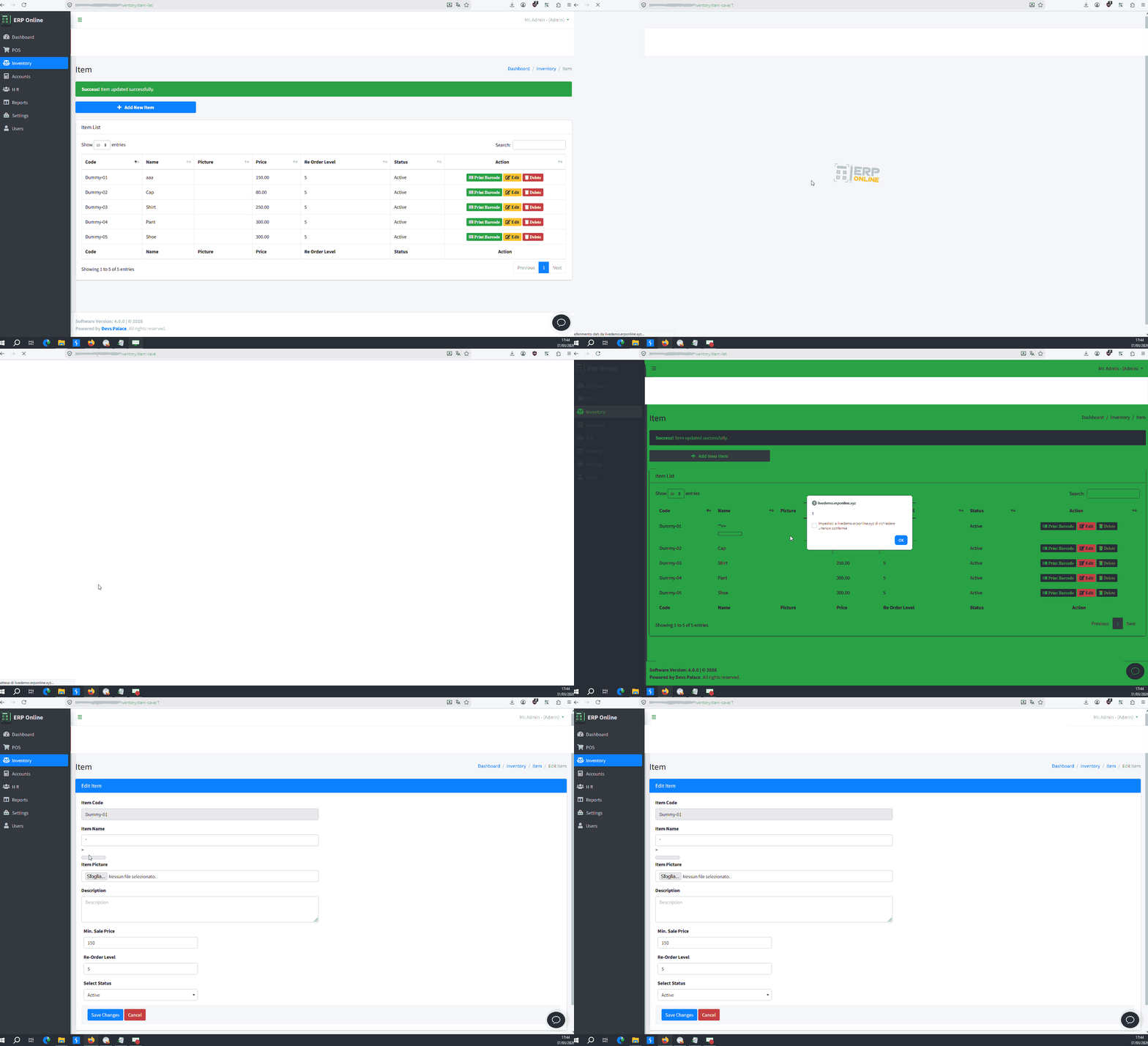
A vulnerability was identified in Devs Palace ERP Online up to 4.0.0. This impacts an unknown function of the file /accounts/chart-save. Such manipulation leads to cross site scripting. The attack may be performed from remote. The exploit is publicly available and might be used. The vendor was contacted early about this disclosure but did not respond in any way.
🎖@cveNotify
A vulnerability was identified in Devs Palace ERP Online up to 4.0.0. This impacts an unknown function of the file /accounts/chart-save. Such manipulation leads to cross site scripting. The attack may be performed from remote. The exploit is publicly available and might be used. The vendor was contacted early about this disclosure but did not respond in any way.
🎖@cveNotify