
🚨 CVE-2026-34314
Vulnerability in the Oracle Financial Services Analytical Applications Infrastructure product of Oracle Financial Services Applications (component: Platform). Supported versions that are affected are 8.0.7.9, 8.0.8.7 and 8.1.2.5. Difficult to exploit vulnerability allows low privileged attacker with network access via HTTP to compromise Oracle Financial Services Analytical Applications Infrastructure. Successful attacks of this vulnerability can result in unauthorized creation, deletion or modification access to critical data or all Oracle Financial Services Analytical Applications Infrastructure accessible data as well as unauthorized access to critical data or complete access to all Oracle Financial Services Analytical Applications Infrastructure accessible data. CVSS 3.1 Base Score 6.8 (Confidentiality and Integrity impacts). CVSS Vector: (CVSS:3.1/AV:N/AC:H/PR:L/UI:N/S:U/C:H/I:H/A:N).
🎖@cveNotify
Vulnerability in the Oracle Financial Services Analytical Applications Infrastructure product of Oracle Financial Services Applications (component: Platform). Supported versions that are affected are 8.0.7.9, 8.0.8.7 and 8.1.2.5. Difficult to exploit vulnerability allows low privileged attacker with network access via HTTP to compromise Oracle Financial Services Analytical Applications Infrastructure. Successful attacks of this vulnerability can result in unauthorized creation, deletion or modification access to critical data or all Oracle Financial Services Analytical Applications Infrastructure accessible data as well as unauthorized access to critical data or complete access to all Oracle Financial Services Analytical Applications Infrastructure accessible data. CVSS 3.1 Base Score 6.8 (Confidentiality and Integrity impacts). CVSS Vector: (CVSS:3.1/AV:N/AC:H/PR:L/UI:N/S:U/C:H/I:H/A:N).
🎖@cveNotify
🚨 CVE-2026-3007
Successful exploitation of the stored cross-site scripting (XSS) vulnerability could allow an attacker to execute arbitrary JavaScript on any user account that has access to Koollab LMS’ courselet feature.
🎖@cveNotify
Successful exploitation of the stored cross-site scripting (XSS) vulnerability could allow an attacker to execute arbitrary JavaScript on any user account that has access to Koollab LMS’ courselet feature.
🎖@cveNotify
Cyber Security Agency of Singapore
Vulnerability in Koollab Learning Management System (LMS)
CSA has issued a CVE ID to a vulnerability reported in Koollab Learning Management System (LMS) as part of CSA’s Responsibility Vulnerability Disclosure Policy. Users and administrators of the affected product version are advised to update to the latest version…
🚨 CVE-2026-38949
Cross-Site Scripting (XSS) vulnerability exists in HTMLy version 3.1.1 in the content creation functionality at the /add/content?type=image endpoint. The application fails to properly sanitize user input, allowing injection of arbitrary code
🎖@cveNotify
Cross-Site Scripting (XSS) vulnerability exists in HTMLy version 3.1.1 in the content creation functionality at the /add/content?type=image endpoint. The application fails to properly sanitize user input, allowing injection of arbitrary code
🎖@cveNotify
GitHub
cve-research/CVE-2026-38949/README.md at main · Chittu13/cve-research
Contribute to Chittu13/cve-research development by creating an account on GitHub.
🚨 CVE-2026-35253
Vulnerability in the Oracle Macoron Tool product of Oracle Open Source Projects. The supported versions that is affected is v0.22.0. Easily exploitable vulnerability allows unauthenticated attacker with network access via HTTP to compromise Oracle Macaron Tool. Successful attacks of this vulnerability can result in Oracle Macaron Tool failing host address validation.
🎖@cveNotify
Vulnerability in the Oracle Macoron Tool product of Oracle Open Source Projects. The supported versions that is affected is v0.22.0. Easily exploitable vulnerability allows unauthenticated attacker with network access via HTTP to compromise Oracle Macaron Tool. Successful attacks of this vulnerability can result in Oracle Macaron Tool failing host address validation.
🎖@cveNotify
🚨 CVE-2026-45179
Plack::Middleware::Statsd versions before 0.9.0 for Perl may leak user IP addresses.
If the communication channel to the statsd daemon is not secured (for example, by sending UDP packets to a host on another network), then users' IP addresses may be leaked.
Since version 0.9.0, the IP address is no longer logged to statsd unless configured. When configured, an HMAC signature of the IP address is logged instead.
🎖@cveNotify
Plack::Middleware::Statsd versions before 0.9.0 for Perl may leak user IP addresses.
If the communication channel to the statsd daemon is not secured (for example, by sending UDP packets to a host on another network), then users' IP addresses may be leaked.
Since version 0.9.0, the IP address is no longer logged to statsd unless configured. When configured, an HMAC signature of the IP address is logged instead.
🎖@cveNotify
GitHub
May leak sensitive information over unsecured connections before v0.9.0
If the communication channel to the statsd daemon is not secured (for example, by sending UDP packets to a host on another network), then users' IP addresses may be leaked.
Since version...
Since version...
🚨 CVE-2026-5735
Memory safety bugs present in Firefox 149.0.1 and Thunderbird 149.0.1. Some of these bugs showed evidence of memory corruption and we presume that with enough effort some of these could have been exploited to run arbitrary code. This vulnerability was fixed in Firefox 149.0.2 and Thunderbird 149.0.2.
🎖@cveNotify
Memory safety bugs present in Firefox 149.0.1 and Thunderbird 149.0.1. Some of these bugs showed evidence of memory corruption and we presume that with enough effort some of these could have been exploited to run arbitrary code. This vulnerability was fixed in Firefox 149.0.2 and Thunderbird 149.0.2.
🎖@cveNotify
🚨 CVE-2026-28387
Issue summary: An uncommon configuration of clients performing DANE TLSA-based
server authentication, when paired with uncommon server DANE TLSA records, may
result in a use-after-free and/or double-free on the client side.
Impact summary: A use after free can have a range of potential consequences
such as the corruption of valid data, crashes or execution of arbitrary code.
However, the issue only affects clients that make use of TLSA records with both
the PKIX-TA(0/PKIX-EE(1) certificate usages and the DANE-TA(2) certificate
usage.
By far the most common deployment of DANE is in SMTP MTAs for which RFC7672
recommends that clients treat as 'unusable' any TLSA records that have the PKIX
certificate usages. These SMTP (or other similar) clients are not vulnerable
to this issue. Conversely, any clients that support only the PKIX usages, and
ignore the DANE-TA(2) usage are also not vulnerable.
The client would also need to be communicating with a server that publishes a
TLSA RRset with both types of TLSA records.
No FIPS modules are affected by this issue, the problem code is outside the
FIPS module boundary.
🎖@cveNotify
Issue summary: An uncommon configuration of clients performing DANE TLSA-based
server authentication, when paired with uncommon server DANE TLSA records, may
result in a use-after-free and/or double-free on the client side.
Impact summary: A use after free can have a range of potential consequences
such as the corruption of valid data, crashes or execution of arbitrary code.
However, the issue only affects clients that make use of TLSA records with both
the PKIX-TA(0/PKIX-EE(1) certificate usages and the DANE-TA(2) certificate
usage.
By far the most common deployment of DANE is in SMTP MTAs for which RFC7672
recommends that clients treat as 'unusable' any TLSA records that have the PKIX
certificate usages. These SMTP (or other similar) clients are not vulnerable
to this issue. Conversely, any clients that support only the PKIX usages, and
ignore the DANE-TA(2) usage are also not vulnerable.
The client would also need to be communicating with a server that publishes a
TLSA RRset with both types of TLSA records.
No FIPS modules are affected by this issue, the problem code is outside the
FIPS module boundary.
🎖@cveNotify
GitHub
dane_match_cert() should X509_free() on ->mcert instead · openssl/openssl@07e727d
of OPENSSL_free()
Fixes: 170b735820ac "DANE support for X509_verify_cert()"
Reviewed-by: Eugene Syromiatnikov <esyr@openssl.org>
Reviewed-by: Tomas Mraz <to...
Fixes: 170b735820ac "DANE support for X509_verify_cert()"
Reviewed-by: Eugene Syromiatnikov <esyr@openssl.org>
Reviewed-by: Tomas Mraz <to...
🚨 CVE-2026-31789
Issue summary: Converting an excessively large OCTET STRING value to
a hexadecimal string leads to a heap buffer overflow on 32 bit platforms.
Impact summary: A heap buffer overflow may lead to a crash or possibly
an attacker controlled code execution or other undefined behavior.
If an attacker can supply a crafted X.509 certificate with an excessively
large OCTET STRING value in extensions such as the Subject Key Identifier
(SKID) or Authority Key Identifier (AKID) which are being converted to hex,
the size of the buffer needed for the result is calculated as multiplication
of the input length by 3. On 32 bit platforms, this multiplication may overflow
resulting in the allocation of a smaller buffer and a heap buffer overflow.
Applications and services that print or log contents of untrusted X.509
certificates are vulnerable to this issue. As the certificates would have
to have sizes of over 1 Gigabyte, printing or logging such certificates
is a fairly unlikely operation and only 32 bit platforms are affected,
this issue was assigned Low severity.
The FIPS modules in 3.6, 3.5, 3.4, 3.3 and 3.0 are not affected by this
issue, as the affected code is outside the OpenSSL FIPS module boundary.
🎖@cveNotify
Issue summary: Converting an excessively large OCTET STRING value to
a hexadecimal string leads to a heap buffer overflow on 32 bit platforms.
Impact summary: A heap buffer overflow may lead to a crash or possibly
an attacker controlled code execution or other undefined behavior.
If an attacker can supply a crafted X.509 certificate with an excessively
large OCTET STRING value in extensions such as the Subject Key Identifier
(SKID) or Authority Key Identifier (AKID) which are being converted to hex,
the size of the buffer needed for the result is calculated as multiplication
of the input length by 3. On 32 bit platforms, this multiplication may overflow
resulting in the allocation of a smaller buffer and a heap buffer overflow.
Applications and services that print or log contents of untrusted X.509
certificates are vulnerable to this issue. As the certificates would have
to have sizes of over 1 Gigabyte, printing or logging such certificates
is a fairly unlikely operation and only 32 bit platforms are affected,
this issue was assigned Low severity.
The FIPS modules in 3.6, 3.5, 3.4, 3.3 and 3.0 are not affected by this
issue, as the affected code is outside the OpenSSL FIPS module boundary.
🎖@cveNotify
GitHub
Avoid possible buffer overflow in buf2hex conversion · openssl/openssl@364f095
Fixes CVE-2026-31789
Reviewed-by: Saša Nedvědický <sashan@openssl.org>
Reviewed-by: Tomas Mraz <tomas@openssl.foundation>
MergeDate: Mon Apr 6 19:39:23 2026
(cherry pi...
Reviewed-by: Saša Nedvědický <sashan@openssl.org>
Reviewed-by: Tomas Mraz <tomas@openssl.foundation>
MergeDate: Mon Apr 6 19:39:23 2026
(cherry pi...
🚨 CVE-2026-5863
Inappropriate implementation in V8 in Google Chrome prior to 147.0.7727.55 allowed a remote attacker to execute arbitrary code inside a sandbox via a crafted HTML page. (Chromium security severity: High)
🎖@cveNotify
Inappropriate implementation in V8 in Google Chrome prior to 147.0.7727.55 allowed a remote attacker to execute arbitrary code inside a sandbox via a crafted HTML page. (Chromium security severity: High)
🎖@cveNotify
Chrome Releases
Stable Channel Update for Desktop
The Chrome team is delighted to announce the promotion of Chrome 147 to the stable channel for Windows, Mac and Linux. This will roll out ...
🚨 CVE-2026-5911
Policy bypass in ServiceWorkers in Google Chrome prior to 147.0.7727.55 allowed a remote attacker to bypass content security policy via a crafted HTML page. (Chromium security severity: Low)
🎖@cveNotify
Policy bypass in ServiceWorkers in Google Chrome prior to 147.0.7727.55 allowed a remote attacker to bypass content security policy via a crafted HTML page. (Chromium security severity: Low)
🎖@cveNotify
Chrome Releases
Stable Channel Update for Desktop
The Chrome team is delighted to announce the promotion of Chrome 147 to the stable channel for Windows, Mac and Linux. This will roll out ...
🚨 CVE-2026-1502
CR/LF bytes were not rejected by HTTP client proxy tunnel headers or host.
🎖@cveNotify
CR/LF bytes were not rejected by HTTP client proxy tunnel headers or host.
🎖@cveNotify
GitHub
gh-146211: Reject CR/LF in HTTP tunnel request headers (#146212) · python/cpython@05ed7ce
Co-authored-by: Illia Volochii <illia.volochii@gmail.com>
🚨 CVE-2025-54236
Adobe Commerce versions 2.4.9-alpha2, 2.4.8-p2, 2.4.7-p7, 2.4.6-p12, 2.4.5-p14, 2.4.4-p15 and earlier are affected by an Improper Input Validation vulnerability. A successful attacker can abuse this to achieve session takeover, increasing the confidentiality, and integrity impact to high. Exploitation of this issue does not require user interaction.
🎖@cveNotify
Adobe Commerce versions 2.4.9-alpha2, 2.4.8-p2, 2.4.7-p7, 2.4.6-p12, 2.4.5-p14, 2.4.4-p15 and earlier are affected by an Improper Input Validation vulnerability. A successful attacker can abuse this to achieve session takeover, increasing the confidentiality, and integrity impact to high. Exploitation of this issue does not require user interaction.
🎖@cveNotify
Adobe
Adobe Security Bulletin
Security Updates Available for Adobe Commerce | APSB25-88
🚨 CVE-2026-45179
Plack::Middleware::Statsd versions before 0.9.0 for Perl may leak user IP addresses.
If the communication channel to the statsd daemon is not secured (for example, by sending UDP packets to a host on another network), then users' IP addresses may be leaked.
Since version 0.9.0, the IP address is no longer logged to statsd unless configured. When configured, an HMAC signature of the IP address is logged instead.
🎖@cveNotify
Plack::Middleware::Statsd versions before 0.9.0 for Perl may leak user IP addresses.
If the communication channel to the statsd daemon is not secured (for example, by sending UDP packets to a host on another network), then users' IP addresses may be leaked.
Since version 0.9.0, the IP address is no longer logged to statsd unless configured. When configured, an HMAC signature of the IP address is logged instead.
🎖@cveNotify
GitHub
May leak sensitive information over unsecured connections before v0.9.0
If the communication channel to the statsd daemon is not secured (for example, by sending UDP packets to a host on another network), then users' IP addresses may be leaked.
Since version...
Since version...
🚨 CVE-2026-8248
A vulnerability was detected in Open5GS up to 2.7.7. The affected element is the function update_authorized_pcc_rule_and_qos of the file /src/smf/npcf-handler.c of the component SMF. The manipulation results in denial of service. The attack may be launched remotely. The exploit is now public and may be used. The project was informed of the problem early through an issue report but has not responded yet.
🎖@cveNotify
A vulnerability was detected in Open5GS up to 2.7.7. The affected element is the function update_authorized_pcc_rule_and_qos of the file /src/smf/npcf-handler.c of the component SMF. The manipulation results in denial of service. The attack may be launched remotely. The exploit is now public and may be used. The project was informed of the problem early through an issue report but has not responded yet.
🎖@cveNotify
GitHub
GitHub - open5gs/open5gs: Open5GS is a C-language Open Source implementation for 5G Core and EPC, i.e. the core network of LTE/NR…
Open5GS is a C-language Open Source implementation for 5G Core and EPC, i.e. the core network of LTE/NR network (Release-17) - open5gs/open5gs
🚨 CVE-2026-8249
A flaw has been found in Open5GS up to 2.7.7. The impacted element is the function update_authorized_pcc_rule_and_qos of the file /src/smf/npcf-handler.c of the component SMF. This manipulation causes denial of service. Remote exploitation of the attack is possible. The exploit has been published and may be used. The project was informed of the problem early through an issue report but has not responded yet.
🎖@cveNotify
A flaw has been found in Open5GS up to 2.7.7. The impacted element is the function update_authorized_pcc_rule_and_qos of the file /src/smf/npcf-handler.c of the component SMF. This manipulation causes denial of service. Remote exploitation of the attack is possible. The exploit has been published and may be used. The project was informed of the problem early through an issue report but has not responded yet.
🎖@cveNotify
GitHub
GitHub - open5gs/open5gs: Open5GS is a C-language Open Source implementation for 5G Core and EPC, i.e. the core network of LTE/NR…
Open5GS is a C-language Open Source implementation for 5G Core and EPC, i.e. the core network of LTE/NR network (Release-17) - open5gs/open5gs
🚨 CVE-2026-8250
A vulnerability has been found in Open5GS up to 2.7.7. This affects the function smf_n4_build_qos_flow_to_modify_list of the file /src/smf/n4-build.c of the component SMF. Such manipulation leads to denial of service. The attack can be executed remotely. The exploit has been disclosed to the public and may be used. The project was informed of the problem early through an issue report but has not responded yet.
🎖@cveNotify
A vulnerability has been found in Open5GS up to 2.7.7. This affects the function smf_n4_build_qos_flow_to_modify_list of the file /src/smf/n4-build.c of the component SMF. Such manipulation leads to denial of service. The attack can be executed remotely. The exploit has been disclosed to the public and may be used. The project was informed of the problem early through an issue report but has not responded yet.
🎖@cveNotify
GitHub
GitHub - open5gs/open5gs: Open5GS is a C-language Open Source implementation for 5G Core and EPC, i.e. the core network of LTE/NR…
Open5GS is a C-language Open Source implementation for 5G Core and EPC, i.e. the core network of LTE/NR network (Release-17) - open5gs/open5gs
🚨 CVE-2026-8251
A vulnerability was found in Open5GS up to 2.7.7. This impacts the function update_authorized_pcc_rule_and_qos of the file /src/smf/npcf-handler.c of the component SMF. Performing a manipulation results in denial of service. The attack is possible to be carried out remotely. The exploit has been made public and could be used. The project was informed of the problem early through an issue report but has not responded yet.
🎖@cveNotify
A vulnerability was found in Open5GS up to 2.7.7. This impacts the function update_authorized_pcc_rule_and_qos of the file /src/smf/npcf-handler.c of the component SMF. Performing a manipulation results in denial of service. The attack is possible to be carried out remotely. The exploit has been made public and could be used. The project was informed of the problem early through an issue report but has not responded yet.
🎖@cveNotify
GitHub
GitHub - open5gs/open5gs: Open5GS is a C-language Open Source implementation for 5G Core and EPC, i.e. the core network of LTE/NR…
Open5GS is a C-language Open Source implementation for 5G Core and EPC, i.e. the core network of LTE/NR network (Release-17) - open5gs/open5gs
🚨 CVE-2026-8177
XML::LibXML versions through 2.0210 for Perl read out-of-bounds heap memory when parsing XML node names containing truncated UTF-8 byte sequences.
A node name ending in the middle of a multi byte UTF-8 sequence causes the parser to read past the end of the input string into adjacent heap memory.
Any Perl process that passes attacker controlled strings to XML::LibXML's DOM node-name methods can reach this path on the default API. The likely consequence is a crash, causing denial of service.
🎖@cveNotify
XML::LibXML versions through 2.0210 for Perl read out-of-bounds heap memory when parsing XML node names containing truncated UTF-8 byte sequences.
A node name ending in the middle of a multi byte UTF-8 sequence causes the parser to read past the end of the input string into adjacent heap memory.
Any Perl process that passes attacker controlled strings to XML::LibXML's DOM node-name methods can reach this path on the default API. The likely consequence is a crash, causing denial of service.
🎖@cveNotify
🚨 CVE-2026-8252
A vulnerability was determined in Open5GS up to 2.7.7. Affected is the function smf_nsmf_handle_create_data_in_hsmf of the component SMF. Executing a manipulation can lead to null pointer dereference. The attack may be performed from remote. The exploit has been publicly disclosed and may be utilized. The project was informed of the problem early through an issue report but has not responded yet.
🎖@cveNotify
A vulnerability was determined in Open5GS up to 2.7.7. Affected is the function smf_nsmf_handle_create_data_in_hsmf of the component SMF. Executing a manipulation can lead to null pointer dereference. The attack may be performed from remote. The exploit has been publicly disclosed and may be utilized. The project was informed of the problem early through an issue report but has not responded yet.
🎖@cveNotify
GitHub
GitHub - open5gs/open5gs: Open5GS is a C-language Open Source implementation for 5G Core and EPC, i.e. the core network of LTE/NR…
Open5GS is a C-language Open Source implementation for 5G Core and EPC, i.e. the core network of LTE/NR network (Release-17) - open5gs/open5gs
🚨 CVE-2026-8253
A vulnerability was identified in Devs Palace ERP Online up to 4.0.0. Affected by this vulnerability is an unknown functionality of the file /inventory/purchase_save. The manipulation leads to cross site scripting. It is possible to initiate the attack remotely. The exploit is publicly available and might be used. The vendor was contacted early about this disclosure but did not respond in any way.
🎖@cveNotify
A vulnerability was identified in Devs Palace ERP Online up to 4.0.0. Affected by this vulnerability is an unknown functionality of the file /inventory/purchase_save. The manipulation leads to cross site scripting. It is possible to initiate the attack remotely. The exploit is publicly available and might be used. The vendor was contacted early about this disclosure but did not respond in any way.
🎖@cveNotify
🚨 CVE-2026-8254
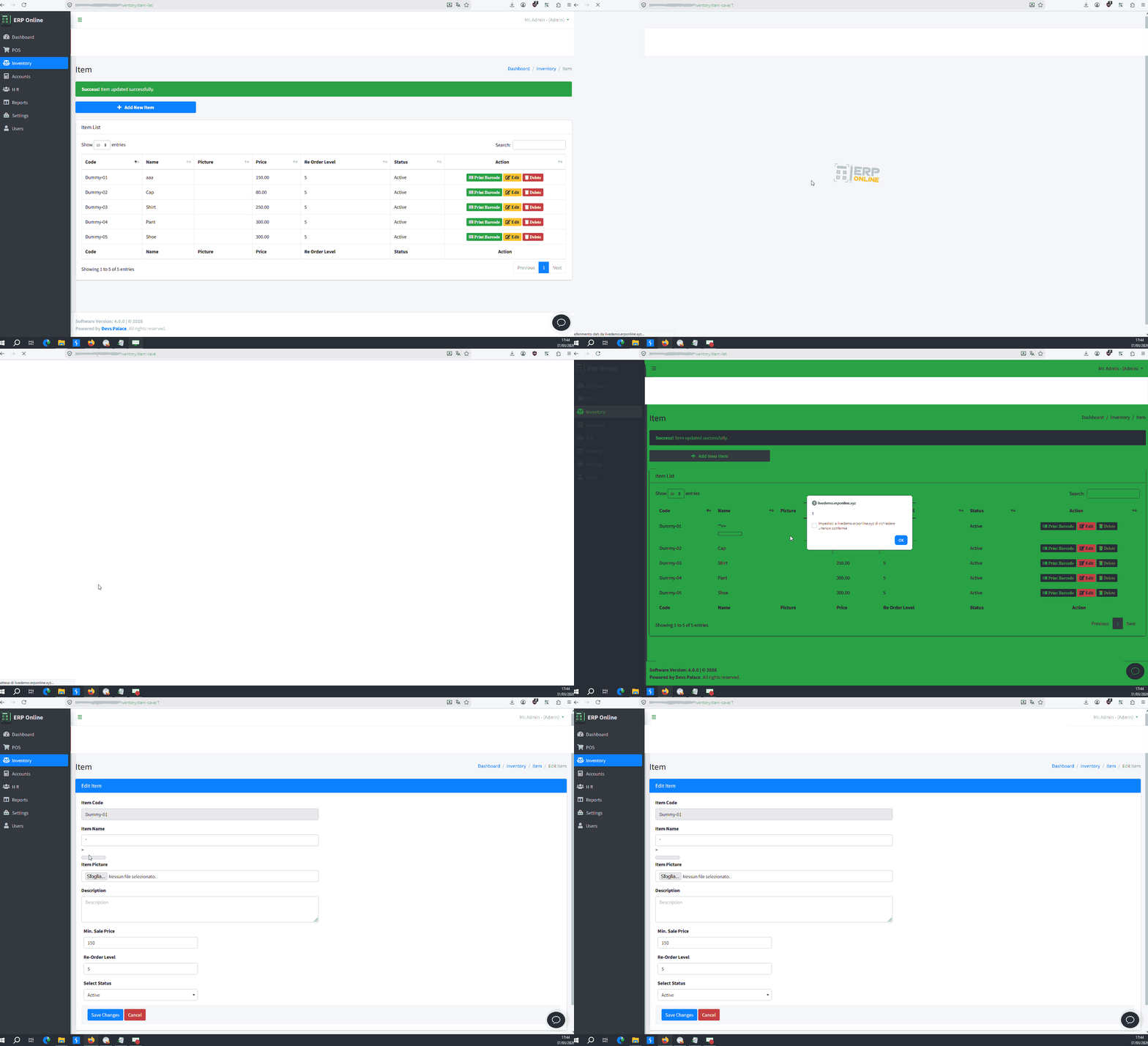
A security flaw has been discovered in Devs Palace ERP Online up to 4.0.0. Affected by this issue is some unknown functionality of the file /inventory/sales_save. The manipulation results in cross site scripting. It is possible to launch the attack remotely. The exploit has been released to the public and may be used for attacks. The vendor was contacted early about this disclosure but did not respond in any way.
🎖@cveNotify
A security flaw has been discovered in Devs Palace ERP Online up to 4.0.0. Affected by this issue is some unknown functionality of the file /inventory/sales_save. The manipulation results in cross site scripting. It is possible to launch the attack remotely. The exploit has been released to the public and may be used for attacks. The vendor was contacted early about this disclosure but did not respond in any way.
🎖@cveNotify