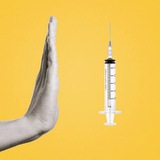
New Zealand whistleblower Barry Young says authorities raided his home and arrested him after he exposed what he claims were deadly COVID vaccine batches.
According to figures he has publicly cited:
- One batch: 152 deaths out of 711 vaccinated (≈21.4%)
- Another: 38 deaths out of 221 (≈17.2%)
- A third: 48 deaths out of 310 (≈15.5%)
He has stated the normal background death rate in that period was around 0.75%, and argued the odds of such clusters occurring by chance were vanishingly small. His conclusion: “Statistically, there is no way this vaccine isn’t killing people.”
https://phillipaltman.substack.com/p/covid-whistleblower-barry-young-on
Substack
COVID WHISTLEBLOWER BARRY YOUNG ON TRIAL IN NEW ZEALAND
The cover up continues worldwide
❤4👍1
Forwarded from Medical & Health Memes 🌲🐸🌲
Malocclusion means your upper and lower teeth don't align when you close your mouth.
🤡1
Forwarded from Medical & Health Memes 🌲🐸🌲
🎆 An 88-year-old woman ate raw bok choy for her health for several months and arrived at hospital in a coma, and the plant did exactly what a brassica is built to do.
She was eating 2.2 lbs to 3.3 lbs of it a day, raw, having read it would help her diabetes. It went into a medical journal in 2010 because she stopped being able to walk, then stopped being able to stay awake, and the diagnosis was myxoedema coma: a thyroid that had shut down.
Kale, cabbage, broccoli, sprouts, bok choy, cauliflower, turnip, swede. Every one of them carries glucosinolates, and glucosinolates are the plant's insecticide. Chew the leaf and an enzyme in it converts them into the active compounds, one of which is goitrin and another of which becomes thiocyanate.
Goitrin blocks the enzyme your thyroid uses to build its hormone. Thiocyanate blocks the pump that carries iodine into the gland in the first place. Two locks on the one door.
Cooking kills most of the enzyme, which is why the sprouts at Christmas have never put anyone in a coma. Raw is a different dose. The green smoothie, the massaged kale salad, the raw cruciferous cleanse: that is the enzyme working at full speed.
Thiocyanate is also the compound in cigarette smoke that does the same job to a smoker's thyroid. The kale smoothie and the twenty-a-day habit are pressing the same button.
The plant put that chemistry in its leaves to stop a caterpillar. It has no opinion on who else chews them.
https://www.nbcnews.com/healthmain/back-away-bok-choy-maam-1c9926279
NBC News
Back away from the bok choy, ma'am
🔥2
Forwarded from Medical & Health Memes 🌲🐸🌲
The first time ordinary English people could afford to eat meat, Parliament passed a law to stop them.
In 1256 the harvest workers on one Norfolk manor were fed a diet that was 4% meat by value. Most of the rest was bread. The deer belonged to the king, the rabbits to the lord, and the peasant to the pottage.
Then the Black Death killed half the country. Suddenly there were more fields than hands. The survivors could name their price, and they named it in beef.
1351: wages are frozen by law at their level before the plague. Asking for more is a crime, and every village is ordered to build a set of stocks for those who do.
1361: a labourer who leaves his lord for better pay is to be branded on the forehead with an F, for falsehood.
1363: a statute lays down what a servant may eat. Meat or fish once a day and no more.
It held for 30 years. In June 1381 the ploughmen marched on London, took the Tower, and beheaded the Archbishop of Canterbury.
Wat Tyler put their demands to the king in person. An end to serfdom. And every park, warren, river and wood in England thrown open, so that a poor man might take game the same as a rich one.
At St Albans the rebels walked into the abbot's private warren, caught a rabbit, and tied it to the town pillory, as notice that the game was now theirs.
Tyler was stabbed at the meeting. The king, who was 14, took back every promise. Villeins you are, he told them, and villeins you shall remain.
9 years later came the reply to the rabbit.
1390: nobody worth under 40 shillings a year may keep a hunting dog, a ferret or a net, on pain of a year in prison. Parliament wrote its reasoning into the preamble. Labourers had been seen out hunting on holy days like gentlemen, and were using the hunts as cover to meet and plot another rising.
There were plenty of deer. What could not be tolerated was a ploughman with a haunch of venison, because a man who can feed himself can afford to say no.
The laws failed. Hands were too scarce, and by 1424 that same Norfolk manor was feeding its harvesters 28% meat.
The instinct behind the laws has never failed once. Whenever the poor get their hands on meat, somebody important discovers a reason they should not have it. The king's pleasure. The social order. Their cholesterol. The climate.
The reason is replaced every century. The people giving it have never once missed a steak.
❤3✍1
During the 1920s and 1930s, a visionary British scientist named Lady May Mellanby, working alongside Sir Edward Mellanby, published groundbreaking studies demonstrating that dental decay is deeply connected to what we eat, rather than merely surface cleanliness. Through rigorous trials for the Medical Research Council, she proved that teeth are active, living tissues capable of self-repair.
Her findings revealed that meals packed with fat-soluble nutrients combined with sufficient calcium, signal the inner dental pulp to form secondary dentin. This mineralized barrier shields the nerve from within, stopping an active cavity in its tracks. Conversely, heavy intake of grains containing phytic acid, such as oatmeal, interferes with calcium absorption and accelerates decay.
A compelling real-world example came in 1932 from the remote island of Tristan da Cunha. Local inhabitants maintained nearly pristine teeth without ever picking up a toothbrush. Their daily sustenance revolved almost entirely around fresh fish, raw milk, and potatoes, precisely the nutrient-dense whole foods Mellanby advocated.
Unsurprisingly, her work met fierce pushback from dental establishment figures who clung to the dogma that brushing alone prevents cavities. Drilling, filling, and eventually topical fluoride offered far more lucrative revenue models than teaching patients how to heal their bodies naturally through nutrition. To keep expectations realistic: while early mineral loss can be arrested and remineralized, a physical cavity that has eaten completely through enamel requires professional restorative care to fill the open space.
As for Tristan da Cunha, its status as a dental utopia proved short lived. With the advent of a commercial canning factory for crayfish following the Second World War, Tristan da Cunha’s links with the outside world multiplied. As Tristan da Cunha became better integrated into the international system and income levels rose, the islanders’ consumption of processed foods soared. By 1966, over half of the islanders’ calories derived from imported foods. As the consumption of sugary, processed foods increased, so too did the incidence of cavities. By the end of the 1960s, Tristan da Cunha had earned the distinction of being “probably the best example of dental deterioration associated with the consumption of sophisticated foodstuffs enjoyed by populations with an improved standard of living.”
🔥2
According to this article the global detox products market is expected to reach nearly $95 billion by 2030…
https://medicinegirl.substack.com/p/detoxed-to-death-second-edition
https://medicinegirl.substack.com/p/detoxed-to-death-second-edition
Substack
Detoxed to Death-Second Edition
Ever Wondered if it was the Protocols Making you Constantly Ill and Needing to Detox?
Forwarded from Medical & Health Memes 🌲🐸🌲
Pharmaceuticals rarely add any chemical value to cell processes..
💯2