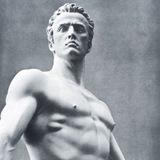
"Few people want to be saints nowadays, but everybody is trying to lose weight"
— René Girard, On Mimetic Desire.
— René Girard, On Mimetic Desire.
Conatus
Stephen George radiated dignity, pride, and a kind of priesthood. He possessed a certain prophetic magenticism, and his poetry was nothing less than the embodiment of the ancient ideal of the sage-poet. In the literary circles of Munich, a group of artists…
the question of poetic genius — There is one beautiful verse or line that can make one a great poet, whereas there are whole poems that cannot.
Conatus
Photo
In the centre of the van rides Julius Caesar, whom Shakespeare has pronounced “the foremost man of all this world.” On his right are the Egyptian called by the Greeks Sesostris, now known to be Rameses II, Attila, “the Scourge of God,” Hannibal the Carthaginian, and Tamerlane the Tartar. On his left march Napoleon, the last world-conqueror, Alexander of Macedon, Nebuchadnezzar of Babylon, that “head of gold” in the great image seen in his vision as interpreted by the prophet Daniel, and Charlemagne, who restored the fallen Roman Empire
Les conquérants by Pierre Fritel.
Les conquérants by Pierre Fritel.
“No one can extract more from things —persons, books and writings included— than he already knows. For what one lacks access to from experience one will have no ear for”
— Nietzsche
“A book is a mirror: if an ape looks into it, an apostle is hardly likely to look out."
— Lichtenberg (The Aphorism Book)
— Nietzsche
“A book is a mirror: if an ape looks into it, an apostle is hardly likely to look out."
— Lichtenberg (The Aphorism Book)
the earth is an incognito garden of riches and wonders, the gods have already encrypted their highest wisdom for the man who understood the symbolism of paradise as meaning that of the earth but hidden in its entrails from the inquisitive eye: in its black ichor and molten blood, in its divine magnetic currents, in its inexhaustible powers of renewal and rebirth. Ever it builds itself upon its own fallen half, raising life from death, form from dissolution, abundance from decay.
Conatus
On Man Ray’s Surrealist Photography The female face, with its vast range of expression, is an ideal subject for photography. Ordinary as it may appear to the casual observer, such ordinariness matters little to the artist. His task is to fashion images that…
"He looks upon things and persons, bowed and discerning, like a mad entomologist and from behind the screen of professional earnestness he almost takes pleasure in what is revealed by his gushing light of desire, in what a surprised and defenseless face unconsciously offers of its grace or misery, in an anatomized nudity, in front of an inner strength or just a presumption. All this could seem meaninglessly cruel if his desire were not always fused with mercy, a mercy born out of a profound and clear understanding of the mortal weakness common to matter and to our senses. Seen through his desire, humans and things suffer and reveal the same fate."
— Carlo Mollino on Man Ray
— Carlo Mollino on Man Ray
https://www.aldiwan.net/poem35922.html
لعلّها من أبدع ما طالعتُ في باب المديح؛ وإن كنتُ لا أميل إلى المديح لما يشوبه من إفراطٍ ومبالغة، فإنّي لا أملك إلّا أن أقرّ بجمال هذه القصيدة.
لعلّها من أبدع ما طالعتُ في باب المديح؛ وإن كنتُ لا أميل إلى المديح لما يشوبه من إفراطٍ ومبالغة، فإنّي لا أملك إلّا أن أقرّ بجمال هذه القصيدة.
الديوان
قسما بالليل وما وسقا - لسان الدين بن الخطيب - الديوان
قَسماً باللّيلِ وما وسَقا وإيَاةِ البدْرِ إذا اتّسَقا والنّجْمِ الثّاقِبِ حينَ هَوى رجْماً والصُبْحِ إذا انْفَلَقا وبنورِ الطُّوْرِ وقدْ أضْحى مُوسَى لجلالَتِهِ صَعِقا لَمَخائِلُ مُلْكِكَ
Conatus
Photo
Wilhelm Rode as Wotan and Henny Trundt as Brünnhilde
in Richard Wagner's "Die Walküre", Act 2
Munich, 1933
"You speak to Wotan's will,
you tell me what you want;
who am I, if I were not your will?"
in Richard Wagner's "Die Walküre", Act 2
Munich, 1933
"You speak to Wotan's will,
you tell me what you want;
who am I, if I were not your will?"