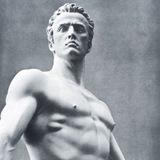
In Plato’s Theages the following passage will be found: “Every one of us would like if possible to be master of mankind; if possible, a God.” This attitude of mind must be reinstated in our midst.
The misunderstanding of love in general. — There is a slavish love which subordinates itself and gives itself away, which idealises and deceives itself; in contrast, there is a divine, roman species of love which despises and loves at the same time, and which remodels and elevates the thing it loves.
Conatus
https://youtu.be/q3LvSza9LWQ?si=qcmGKKBywob6gyCG
"Yesterday I heard-would you believe it?- Bizet's masterpiece, for the twentieth time. Again I stayed there with tender devotion, again I did not run away. This triumph over my impatience surprises me. How such a work makes one perfect! One becomes a "masterpiece" oneself, one grows wings for oneself."
I do not crush this world's corona of wonders,
nor do I kill
by reason, the mysteries I meet
on my way
in flowers, in eyes, on lips or graves.
The light of others
strangles the spell of the impenetrable, hidden
in the depth of darkness,
but I,
I grow the world's wonder with my light -
just like the moon with its white rays
does not diminish, but trembling
increases even more the mystery of the night,
same way I enrich the shadowy horizons
with grand shivers of holy mystery
and all that is unknown
changes to even greater unknowns
under my eyes -
for I do love
flowers and eyes and lips and graves.
— Lucian Blaga, Romanian Poet and Philosopher.
nor do I kill
by reason, the mysteries I meet
on my way
in flowers, in eyes, on lips or graves.
The light of others
strangles the spell of the impenetrable, hidden
in the depth of darkness,
but I,
I grow the world's wonder with my light -
just like the moon with its white rays
does not diminish, but trembling
increases even more the mystery of the night,
same way I enrich the shadowy horizons
with grand shivers of holy mystery
and all that is unknown
changes to even greater unknowns
under my eyes -
for I do love
flowers and eyes and lips and graves.
— Lucian Blaga, Romanian Poet and Philosopher.
على خلافِ الحيوان، نمّى الإنسانُ في ذاته حشدًا صاخبًا من الغرائز المتضادّة والدوافع المتنازعة، حتى غدا بسيادته على هذا الائتلاف المتوتر سيّدَ الأرض. فالأخلاق ليست إلا تجلّياتٍ لنُظُمٍ موضعيةٍ محدودةٍ من مراتب السيادة في هذا الكون المزدحم بالغرائز؛ نُظُمٌ تقي الإنسانَ من أن يتصدّع تحت وطأة صراعاته الداخلية. وعلى هذا النحو، تعمل غريزةٌ مهيمنة على إضعاف الغريزة المناوئة وتلطيفها، بتحويلها إلى قوّةٍ دافعة تُغذّي نشاط الغريزة الرئيسة وتخدم مقصدها. وأمّا الإنسان الأرقى فهو الذي يبلغ أقصى التعدّد في غرائزه، ويملكها في أقصى درجة من الشدّة التي يستطيع احتمالها دون أن يتمزّق بها. فالواقع أنّه حيثما وُجد الإنسان قويًّا، وُجدت في داخله غرائز جبّارة متقابلة، تتجاذب وتتنازع (كما في شكسبير وغوته)، غير أنّها تكون مضبوطةً ضمن وحدةٍ أعلى تكفل لها الاتّساق دون أن تُبطل توتّرها الخلّاق.
Conatus
Photo
Stephen George radiated dignity, pride, and a kind of priesthood. He possessed a certain prophetic magenticism, and his poetry was nothing less than the embodiment of the ancient ideal of the sage-poet. In the literary circles of Munich, a group of artists and intellectuals grew up around him, under his prophetic patronage, he also embodied a new formal genius of poetic style.
"Few people want to be saints nowadays, but everybody is trying to lose weight"
— René Girard, On Mimetic Desire.
— René Girard, On Mimetic Desire.
Conatus
Stephen George radiated dignity, pride, and a kind of priesthood. He possessed a certain prophetic magenticism, and his poetry was nothing less than the embodiment of the ancient ideal of the sage-poet. In the literary circles of Munich, a group of artists…
the question of poetic genius — There is one beautiful verse or line that can make one a great poet, whereas there are whole poems that cannot.
Conatus
Photo
In the centre of the van rides Julius Caesar, whom Shakespeare has pronounced “the foremost man of all this world.” On his right are the Egyptian called by the Greeks Sesostris, now known to be Rameses II, Attila, “the Scourge of God,” Hannibal the Carthaginian, and Tamerlane the Tartar. On his left march Napoleon, the last world-conqueror, Alexander of Macedon, Nebuchadnezzar of Babylon, that “head of gold” in the great image seen in his vision as interpreted by the prophet Daniel, and Charlemagne, who restored the fallen Roman Empire
Les conquérants by Pierre Fritel.
Les conquérants by Pierre Fritel.
“No one can extract more from things —persons, books and writings included— than he already knows. For what one lacks access to from experience one will have no ear for”
— Nietzsche
“A book is a mirror: if an ape looks into it, an apostle is hardly likely to look out."
— Lichtenberg (The Aphorism Book)
— Nietzsche
“A book is a mirror: if an ape looks into it, an apostle is hardly likely to look out."
— Lichtenberg (The Aphorism Book)
the earth is an incognito garden of riches and wonders, the gods have already encrypted their highest wisdom for the man who understood the symbolism of paradise as meaning that of the earth but hidden in its entrails from the inquisitive eye: in its black ichor and molten blood, in its divine magnetic currents, in its inexhaustible powers of renewal and rebirth. Ever it builds itself upon its own fallen half, raising life from death, form from dissolution, abundance from decay.