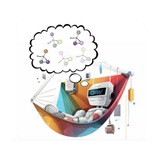
Acquisition of absorption and fluorescence spectral data using chatbots
https://doi.org/10.1039/D4DD00255E
Гайд как быстро писать новые статьи в научных журналах:
1) Берем ChatGPT или любую другую LLM
2) Спрашиваем у него о свойствах молекулы X
3) Записываем в таблицу
✅Profit: получаем статью в журнале с IF=6.2
https://doi.org/10.1039/D4DD00255E
Гайд как быстро писать новые статьи в научных журналах:
1) Берем ChatGPT или любую другую LLM
2) Спрашиваем у него о свойствах молекулы X
3) Записываем в таблицу
✅Profit: получаем статью в журнале с IF=6.2
😁12🔥3👍2
ChEMBL 35 is out!
https://chembl.blogspot.com/2024/12/heres-nice-christmas-gift-chembl-35-is.html
Вышла новая версия базы CheMBL:
#dataset
https://chembl.blogspot.com/2024/12/heres-nice-christmas-gift-chembl-35-is.html
Вышла новая версия базы CheMBL:
This fresh release comes with a wealth of new data sets and some new data sources as well. Examples include a total of 14 datasets deposited by by the ASAP (AI-driven Structure-enabled Antiviral Platform) project, a new NTD data set by Aberystwyth University on anti-schistosome activity, nine new chemical probe data sets, and seven new data sets for the Chemogenomic library of the EUbOPEN project.
This version of the database, prepared on 01/12/2024 contains:
2,496,335 compounds (of which 2,474,590 have mol files)
3,185,505 compound records (non-unique compounds)
21,123,501 activities
1,740,546 assays
16,003 targets
92,121 documents
#dataset
Blogspot
Here's a nice Christmas gift - ChEMBL 35 is out!
Use your well-deserved Christmas holidays to spend time with your loved ones and explore the new release of ChEMBL 35! This fresh...
👍7🔥4❤2
SMILES All Around: Structure to SMILES conversion for Transition Metal Complexes
https://doi.org/10.26434/chemrxiv-2024-c660p
Должно быть очень полезно для тех, кто занимает металлоорганикой:
🖥 Github link: https://github.com/jensengroup/xyz2mol_tm
#method
https://doi.org/10.26434/chemrxiv-2024-c660p
Должно быть очень полезно для тех, кто занимает металлоорганикой:
We present a method for creating RDKit parsable SMILES for transition metal complexes (TMCs) based on xyz-coordinates and overall charge of the complex. This can be viewed as an extension to the program xyz2mol that does the same for organic molecules. The only dependency is RDKit, which makes it widely applicable. One thing that has been lacking when it comes to generating SMILES from structure for TMCs is an existing SMILES dataset to compare with.
#method
Please open Telegram to view this post
VIEW IN TELEGRAM
ChemRxiv
SMILES All Around: Structure to SMILES conversion for Transition Metal Complexes
We present a method for creating RDKit parsable SMILES for transition metal complexes (TMCs) based on xyz-coordinates and overall charge of the complex. This can be viewed as an extension to the program xyz2mol that does the same for organic molecules. The…
👍3❤2🔥2
Simulation-Assisted Deep Learning Techniques for Commercially Applicable OLED Phosphorescent Materials
https://doi.org/10.1021/acs.chemmater.4c02754
📕 Chemistry of Materials (IF=7.2)
#method
https://doi.org/10.1021/acs.chemmater.4c02754
In this work, phosphorescent materials are represented as strings, molecular graphs, and point clouds, which are employed by language models, two-dimensional graph, and three-dimensional graph neural networks. In addition, more than 200 000 molecules with simulated properties highly relevant to experimental properties are used for pretraining the DL models.
Our work shows high performance in the prediction of five experimental properties that are importantly considered when commercializing OLED devices. This means that faster material discovery for OLEDs can be achieved through DL models that are trained with simulation information that is highly correlated with experimental properties.
#method
Please open Telegram to view this post
VIEW IN TELEGRAM
ACS Publications
Simulation-Assisted Deep Learning Techniques for Commercially Applicable OLED Phosphorescent Materials
Phosphorescent light-emitting materials play a central role in organic light-emitting diode (OLED) devices. Due to their synthesis difficulties, unsystematic trial-and-error synthesis is prohibitively challenging. For this reason, deep learning (DL), which…
👍6❤2🔥2
Benchmark of Density Functional Theory in the Prediction of 13C Chemical Shielding Anisotropies for Anisotropic Nuclear Magnetic Resonance-Based Structural Elucidation
https://pubs.acs.org/doi/10.1021/acs.jctc.4c01407
📕 Journal of Chemical Theory and Computation (IF=5.7)
#benchmark
https://pubs.acs.org/doi/10.1021/acs.jctc.4c01407
In this study, we present a comprehensive benchmark of carbon shielding anisotropies based on coupled cluster reference tensors taken from the NS372 benchmark data set.
Additionally, we investigate the representation of the DFT-predicted shielding tensors, such as the eigenvalues and eigenvectors. Moreover, we evaluated how various DFT methods influence the discrimination of possible relative configurations using recently published ΔΔRCSA data for a set of structurally diverse natural products.
Our findings demonstrate that accurate interpretation of RCSAs for configurational and conformational analysis is possible with semilocal DFT methods, which also reduce computational demands compared to hybrid functionals such as the commonly used B3LYP.
#benchmark
Please open Telegram to view this post
VIEW IN TELEGRAM
ACS Publications
Benchmark of Density Functional Theory in the Prediction of 13C Chemical Shielding Anisotropies for Anisotropic Nuclear Magnetic…
Density functional theory (DFT) calculations have emerged as a powerful theoretical toolbox for interpreting and analyzing the experimental nuclear magnetic resonance (NMR) spectra of chemical compounds. While DFT has been extensively used and benchmarked…
❤3👍3🔥2
A generative model for inorganic materials design
https://www.nature.com/articles/s41586-025-08628-5
Сегодня в журнале Nature вышла очень интересная работа.
Microsoft представил MatterGen — новую парадигму в дизайне материалов с использованием генеративного искусственного интеллекта. MatterGen позволяет ускорить процесс разработки материалов, автоматически генерируя и оценивая потенциальные структуры с заданными свойствами.
Модель может быть настроена на создание материалов с конкретными химическими составами, симметрией или физическими характеристиками, такими как магнитная плотность, ширина запрещённой зоны и механическая прочность, используя обучающий набор из более чем 608 000 стабильных соединений из известных баз данных материалов.
Экспериментальная проверка подтвердила успешный синтез материала TaCr2O6, в точности совпадающий с предсказаниями модели.
🖥 Код доступен бесплатно на гитхабе: https://github.com/microsoft/mattergen
https://www.nature.com/articles/s41586-025-08628-5
Сегодня в журнале Nature вышла очень интересная работа.
Microsoft представил MatterGen — новую парадигму в дизайне материалов с использованием генеративного искусственного интеллекта. MatterGen позволяет ускорить процесс разработки материалов, автоматически генерируя и оценивая потенциальные структуры с заданными свойствами.
Модель может быть настроена на создание материалов с конкретными химическими составами, симметрией или физическими характеристиками, такими как магнитная плотность, ширина запрещённой зоны и механическая прочность, используя обучающий набор из более чем 608 000 стабильных соединений из известных баз данных материалов.
Экспериментальная проверка подтвердила успешный синтез материала TaCr2O6, в точности совпадающий с предсказаниями модели.
Please open Telegram to view this post
VIEW IN TELEGRAM
🔥11👍7❤5
Real-World Applications and Experiences of AI/ML Deployment for Drug Discovery
🔥 https://doi.org/10.1021/acs.jmedchem.4c03044
У📕 Journal of Medicinal Chemistry вышел Editorial, посвященный методам ML/AI, которые используются для поиска лекарств.
Briefly summarized are our and others’ experiences with the AI/ML applications that currently have the greatest impact on our work.
У
Please open Telegram to view this post
VIEW IN TELEGRAM
🔥5❤4👍2
Hybrid nanophotonic-microfluidic sensor integrated with machine learning for operando state-of-charge monitoring in vanadium flow batteries
https://doi.org/10.1016/j.est.2025.115349
При нашем скромном участии вчера вышла работа, в которой представлен усовершенствованный метод измерения степени заряда (SoC) ванадиевых проточных батарей (VRFB) с использованием показателя преломления и машинного обучения.
Основной акцент сделан на использовании изменения показателя преломления (RI) электролитов для оценки концентрации ионов ванадия.
Разработанный сенсор основан на фотонных интегральных схемах (PIC) и микрофлюидных каналах, что обеспечивает высокую чувствительность. Система прошла тестирование на рабочих условиях батареи, показав устойчивую корреляцию между спектральными характеристиками и данными о заряде.
Используя экспериментальные данные, ML модель была обучена точно предсказывать степень заряда проточной ванадиевой батареи путем анализа спектральных характеристик.
🔗По этой ссылке статья будет доступна бесплатно в течение первых 50 дней: https://authors.elsevier.com/c/1kSYB,rUrFxfAl
📕 Journal of Energy Storage (IF=8.9)
#application
https://doi.org/10.1016/j.est.2025.115349
При нашем скромном участии вчера вышла работа, в которой представлен усовершенствованный метод измерения степени заряда (SoC) ванадиевых проточных батарей (VRFB) с использованием показателя преломления и машинного обучения.
Основной акцент сделан на использовании изменения показателя преломления (RI) электролитов для оценки концентрации ионов ванадия.
Разработанный сенсор основан на фотонных интегральных схемах (PIC) и микрофлюидных каналах, что обеспечивает высокую чувствительность. Система прошла тестирование на рабочих условиях батареи, показав устойчивую корреляцию между спектральными характеристиками и данными о заряде.
Используя экспериментальные данные, ML модель была обучена точно предсказывать степень заряда проточной ванадиевой батареи путем анализа спектральных характеристик.
🔗По этой ссылке статья будет доступна бесплатно в течение первых 50 дней: https://authors.elsevier.com/c/1kSYB,rUrFxfAl
#application
Please open Telegram to view this post
VIEW IN TELEGRAM
👍7🔥6❤4
Harnessing Large Language Models to Collect and Analyze Metal–Organic Framework Property Data Set
https://pubs.acs.org/doi/10.1021/jacs.4c11085
📕 Journal of the American Chemical Society (IF=14.4)
#dataset #method
https://pubs.acs.org/doi/10.1021/jacs.4c11085
Utilizing a chain of advanced large language models (LLMs), we developed a systematic approach to extract and organize MOF data into a structured format.
Our methodology successfully compiled information from more than 40,000 research articles, creating a comprehensive and ready-to-use data set. Specifically, data regarding MOF synthesis conditions and properties were extracted from both tables and text and then analyzed. Subsequently, we utilized the curated database to analyze the relationships between synthesis conditions, properties, and structure.
#dataset #method
Please open Telegram to view this post
VIEW IN TELEGRAM
ACS Publications
Harnessing Large Language Models to Collect and Analyze Metal–Organic Framework Property Data Set
This research focused on the efficient collection of experimental metal–organic framework (MOF) data from scientific literature to address the challenges of accessing hard-to-find data and improving the quality of information available for machine learning…
❤4🔥3👍2
Using Classifiers To Predict Catalyst Design for Polyketone Microstructure
https://pubs.acs.org/doi/10.1021/jacs.4c11666
📕 Journal of the American Chemical Society (IF=14.4)
#method
https://pubs.acs.org/doi/10.1021/jacs.4c11666
We applied a classifier method to predict palladium catalysts for the formation of nonalternating polyketones via the copolymerization of CO and ethylene; current examples are limited to using phosphine sulfonate and diphosphazane monoxide supporting ligands.
With the reported workflow, we discovered two new classes of palladium complexes capable of achieving the synthesis of nonalternating polyketones with a lower CO content than those made by known palladium catalysts.
Our results show that we doubled the number of classes of palladium compounds that can catalyze the formation of this type of polymer. We envision that this methodology can be applied to accelerate catalyst discovery when selectivity is an important outcome.
#method
Please open Telegram to view this post
VIEW IN TELEGRAM
ACS Publications
Using Classifiers To Predict Catalyst Design for Polyketone Microstructure
We applied a classifier method to predict palladium catalysts for the formation of nonalternating polyketones via the copolymerization of CO and ethylene; current examples are limited to using phosphine sulfonate and diphosphazane monoxide supporting ligands.…
👍4🔥3❤2
Когда-то давно в 2022 году мы опубликовали на Zenodo BigSolDB — крупнейший датасет (известный нам) по растворимости, содержащий 54273 значений растворимости при температурах от 243.15 до 403.15K, в котором присутствуют 138 растворителей и 830 соединений.
Чем были полезны наши данные со стороны авторов:
🔹 Дополнением внутренней базы GSK, которая ограничена их исследовательскими соединениями.
🔹 Доступом к разным температурным режимам, что улучшило предсказания при высоких температурах.
🔹 Добавлением редких растворителей, которые раньше модель предсказывала с высокой погрешностью.
Такие моменты сильно повышают мотивацию и далее делать открытые датасеты для более полной систематизации экспериментальных данных по разным химическим областям.
Please open Telegram to view this post
VIEW IN TELEGRAM
👍14🔥8❤6🦄1
https://doi.org/10.1039/D4SC03921A
This review highlights LLM capabilities in these domains and their potential to accelerate scientific discovery through automation. We also review LLM-based autonomous agents: LLMs with a broader set of tools to interact with their surrounding environment. These agents perform diverse tasks such as paper scraping, interfacing with automated laboratories, and synthesis planning.
As agents are an emerging topic, we extend the scope of our review of agents beyond chemistry and discuss across any scientific domains.
This review covers the recent history, current capabilities, and design of LLMs and autonomous agents, addressing specific challenges, opportunities, and future directions in chemistry.
#review
Please open Telegram to view this post
VIEW IN TELEGRAM
pubs.rsc.org
A review of large language models and autonomous agents in chemistry
Large language models (LLMs) have emerged as powerful tools in chemistry, significantly impacting molecule design, property prediction, and synthesis optimization. This review highlights LLM capabilities in these domains and their potential to accelerate…
👍6❤3🔥3
Artificial Intelligence in Retrosynthesis Prediction and its Applications in Medicinal Chemistry
https://doi.org/10.1021/acs.jmedchem.4c02749
📕 Journal of Medicinal Chemistry (IF = 6.8)
#review
https://doi.org/10.1021/acs.jmedchem.4c02749
Herein, we review the recent advancements in AI applications for retrosynthesis prediction by summarizing related techniques and the landscape of current representative retrosynthesis models and propose feasible solutions to tackle existing problems and outline future directions in this field.
#review
Please open Telegram to view this post
VIEW IN TELEGRAM
ACS Publications
Artificial Intelligence in Retrosynthesis Prediction and its Applications in Medicinal Chemistry
Retrosynthesis is a strategy to analyze the synthetic routes for target molecules in medicinal chemistry. However, traditional retrosynthesis predictions performed by chemists and rule-based expert systems struggle to adapt to the vast chemical space of real…
🔥3❤2👍2
https://pubs.acs.org/doi/10.1021/jacs.4c15902
The development of machine learning models to predict the regioselectivity of C(sp3)–H functionalization reactions is reported. A data set for dioxirane oxidations was curated from the literature and used to generate a model to predict the regioselectivity of C–H oxidation.
To assess whether smaller, intentionally designed data sets could provide accuracy on complex targets, a series of acquisition functions were developed to select the most informative molecules for the specific target.
Finally, the workflow was experimentally validated on five complex substrates and shown to be applicable to predicting the regioselectivity of arene C–H radical borylation.
#dataset
Please open Telegram to view this post
VIEW IN TELEGRAM
ACS Publications
Designing Target-specific Data Sets for Regioselectivity Predictions on Complex Substrates
The development of machine learning models to predict the regioselectivity of C(sp3)–H functionalization reactions is reported. A data set for dioxirane oxidations was curated from the literature and used to generate a model to predict the regioselectivity…
❤3👍2🔥2
https://doi.org/10.1039/D4DD00292J
AI-predicted routes are typically compared to experimental syntheses to check for an exact match among the top-ranked predictions (top-N accuracy).
This method is ideal for the evaluation of retrosynthetic algorithms on large datasets (>10^6 routes), but it cannot assess a degree of similarity between routes, which would be desirable for small datasets (<10^2 routes).
Here, we present a simple method to calculate a similarity score between any two synthetic routes to a given molecule.
The score is based on two concepts: which bonds are formed during the synthesis; and how the atoms of the final compound are grouped together throughout the synthesis. As a result, the similarity score overlaps well with chemists' intuition and provides a finer assessment of prediction accuracy.
#method
Please open Telegram to view this post
VIEW IN TELEGRAM
pubs.rsc.org
A simple similarity metric for comparing synthetic routes
Experimentally validated routes to synthetic compounds can be compared to each other by quantitative metrics (step count, yield, atom economy), or by qualitative assessments (strategy, novelty). AI-predicted routes are typically compared to experimental syntheses…
👍3🔥3❤2
Balancing molecular information and empirical data in the prediction of physico-chemical properties
https://doi.org/10.1039/D4DD00154K
📕 Digital Discovery (IF=6.2)
#method
https://doi.org/10.1039/D4DD00154K
In this work, we propose a general method for combining molecular descriptors with representation learning using the so-called expectation maximization algorithm from the probabilistic machine-learning literature, which uses uncertainty estimates to trade off between the two approaches.
The proposed hybrid model exploits chemical structure information using graph neural networks, but it automatically detects cases where structure-based predictions are unreliable, in which case it corrects them by representation-learning based predictions that can better specialize to unusual cases. The effectiveness of the proposed method is demonstrated using the prediction of activity coefficients in binary mixtures as an example.
The results are compelling, as the method significantly improves predictive accuracy over the current state of the art, showcasing its potential to advance the prediction of physico-chemical properties in general.
#method
Please open Telegram to view this post
VIEW IN TELEGRAM
pubs.rsc.org
Balancing molecular information and empirical data in the prediction of physico-chemical properties
Predicting the physico-chemical properties of pure substances and mixtures is a central task in thermodynamics. Established prediction methods range from fully physics-based ab initio calculations, which are only feasible for very simple systems, over descriptor…
👍4❤2🔥1
🎊Сегодня у нас наконец-то вышла статья:
Towards Accelerating the Discovery of Efficient Iridium(III) Emitters Using Novel Database and Machine Learning Based Only on Structural Formula
https://doi.org/10.1039/D5TC00305A
1. В этой статье мы собрали базу данных IrLumDB, в которой содержатся экспериментальные данные о 1287 бис-циклометалированных комлексах иридия (III) и их фотофизических свойствах (длина волны эмиссии (λmax), квантовый выход (PLQY) и время жизни).
2. На основе IrLumDB обучили XGBoost, LightGBM и Catboost предсказывать λmax и PLQY с MAE 18.26 нм и 0.13 на десятикратной кросс-валидации.
3. Протестировали работу обученных моделей на 33 синтезированных в нашей лаборатории комплексах, 12 из которых были получены для этой статьи. Комплексы были охарактеризованы с помощью ЯМР, РСА, масс-спектрометрии высокого разрешения, и частично РФА. 9 новых структур были депонированы в CCDC.
4. Сравнили на изученных нами соединениях точность предсказания длины волны эмиссии с помощью алгоритмов машинного обучения и с помощью DFT-расчетов; показали, что алгоритмы машинного обучения справляются с задачей лучше.
5. Так как нам важно искать новые комплексы с потенциально высокими квантовыми выходами, то мы разделили все комплексы на 3 класса: с низким (0-0.1), средним (0.1-0.5) и высоким PLQY (0.5-1), далее обучили классификационные модели и получили точность 72.4% на десятикратной кросс-валидации.
6. Подготовили мини-приложение IrLumDB App для того, чтобы любой исследователь смог предсказать свойства для своих комплексов. Для предсказания достаточно SMILES лигандов.
Датасет на Zenodo | IrLumDB App
📕 Journal of Materials Chemistry C (IF=5.7)
#dataset #application
Towards Accelerating the Discovery of Efficient Iridium(III) Emitters Using Novel Database and Machine Learning Based Only on Structural Formula
https://doi.org/10.1039/D5TC00305A
1. В этой статье мы собрали базу данных IrLumDB, в которой содержатся экспериментальные данные о 1287 бис-циклометалированных комлексах иридия (III) и их фотофизических свойствах (длина волны эмиссии (λmax), квантовый выход (PLQY) и время жизни).
2. На основе IrLumDB обучили XGBoost, LightGBM и Catboost предсказывать λmax и PLQY с MAE 18.26 нм и 0.13 на десятикратной кросс-валидации.
3. Протестировали работу обученных моделей на 33 синтезированных в нашей лаборатории комплексах, 12 из которых были получены для этой статьи. Комплексы были охарактеризованы с помощью ЯМР, РСА, масс-спектрометрии высокого разрешения, и частично РФА. 9 новых структур были депонированы в CCDC.
4. Сравнили на изученных нами соединениях точность предсказания длины волны эмиссии с помощью алгоритмов машинного обучения и с помощью DFT-расчетов; показали, что алгоритмы машинного обучения справляются с задачей лучше.
5. Так как нам важно искать новые комплексы с потенциально высокими квантовыми выходами, то мы разделили все комплексы на 3 класса: с низким (0-0.1), средним (0.1-0.5) и высоким PLQY (0.5-1), далее обучили классификационные модели и получили точность 72.4% на десятикратной кросс-валидации.
6. Подготовили мини-приложение IrLumDB App для того, чтобы любой исследователь смог предсказать свойства для своих комплексов. Для предсказания достаточно SMILES лигандов.
Датасет на Zenodo | IrLumDB App
#dataset #application
Please open Telegram to view this post
VIEW IN TELEGRAM
Please open Telegram to view this post
VIEW IN TELEGRAM
🔥17❤5👍5🎉2
Will we ever be able to accurately predict solubility?
https://doi.org/10.1038/s41597-024-03105-6
📕 Scientific Data (IF=5.9)
#dataset
https://doi.org/10.1038/s41597-024-03105-6
Accurate prediction of thermodynamic solubility by machine learning remains a challenge.
We investigated over 20 years of published solubility datasets and models, highlighting overlooked datasets and the overlaps between popular sets.
We benchmarked recently published models on a novel curated solubility dataset and report poor performances. We also propose a workflow to cure aqueous solubility data aiming at producing useful models for bench chemist.
Our results demonstrate that some state-of-the-art models are not ready for public usage because they lack a well-defined applicability domain and overlook historical data sources.
We report the impact of factors influencing the utility of the models: interlaboratory standard deviation, ionic state of the solute and data sources. The herein obtained models, and quality-assessed datasets are publicly available.
#dataset
Please open Telegram to view this post
VIEW IN TELEGRAM
Nature
Will we ever be able to accurately predict solubility?
Scientific Data - Will we ever be able to accurately predict solubility?
👍7🔥5❤3
A robust crystal structure prediction method to support small molecule drug development with large scale validation and blind study
https://doi.org/10.1038/s41467-025-57479-1
Совсем свежая работа от 5 марта:
📕 Nature Communications (IF=14.7)
#method
https://doi.org/10.1038/s41467-025-57479-1
Совсем свежая работа от 5 марта:
In this paper, we report a crystal structure prediction (CSP) method with state of the art accuracy and efficiency, validated on a large and diverse dataset including 66 molecules with 137 experimentally known polymorphic forms. The method combines a novel systematic crystal packing search algorithm and the use of machine learning force fields in a hierarchical crystal energy ranking.
Our method not only reproduces all the experimentally known polymorphs, but also suggests new low energy polymorphs yet to be discovered by experiment that might pose potential risks to development of the currently known forms of these compounds.
In addition, we report the prediction results of a blinded study, results for Target XXXI from the seventh CSP blind test, and demonstrate how the method can be used to accelerate clinical formulation design and derisk downstream processing.
#method
Please open Telegram to view this post
VIEW IN TELEGRAM
Nature
A robust crystal structure prediction method to support small molecule drug development with large scale validation and blind study
Nature Communications - Crystal polymorphism plays an important role in pharmaceuticals, agrisciences and other industries. Here the authors present an efficient and accurate crystal structure...
🔥3❤2👍2