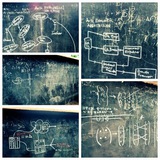
Blackboard Computing Adventures 💡
Also, please get us jobs & some [paid] work 🙏 #uganda #productive #youngadults
While looking at the future of the GTNC and its applications across mathematics, in physics, computer science and beyond...
•••••••••••••••••••••••••••••|
The Inverted Pi might become the official Cardinality Sym. Otherwise,
we might have to deal with
maths like...
𐎜(σ+ω) ≤ ⌈𐎜(σ,ω)⌉ + 1
iff σ,ω ∈ {ⲗ.ⲗ* | ⲗ ∈ ψ:β} ∧ β∈𝜨
--- JWL, inventor of the GTNC theory.
•••••••••••••••••••••••••••••|
Those interested, perhaps work backwards from the most recent paper and results: https://bit.ly/ossipaper
Something truly terrific is in the works! And we can't certainly #shutup 🙈⚡😄🙌
#gtnc #symbolsets #numbertheory #jwl #nuchwezi #modernmaths #basecalculus
•••••••••••••••••••••••••••••|
The Inverted Pi might become the official Cardinality Sym. Otherwise,
we might have to deal with
maths like...
𐎜(σ+ω) ≤ ⌈𐎜(σ,ω)⌉ + 1
iff σ,ω ∈ {ⲗ.ⲗ* | ⲗ ∈ ψ:β} ∧ β∈𝜨
--- JWL, inventor of the GTNC theory.
•••••••••••••••••••••••••••••|
Those interested, perhaps work backwards from the most recent paper and results: https://bit.ly/ossipaper
Something truly terrific is in the works! And we can't certainly #shutup 🙈⚡😄🙌
#gtnc #symbolsets #numbertheory #jwl #nuchwezi #modernmaths #basecalculus
Blackboard Computing Adventures 💡
While looking at the future of the GTNC and its applications across mathematics, in physics, computer science and beyond... •••••••••••••••••••••••••••••| The Inverted Pi might become the official Cardinality Sym. Otherwise, we might have to deal with maths…
A JWL Mini-Lecture: Introducing A New BASE CALCULUS: Theory & Applications of Arbitrary Symbol Sets
https://youtu.be/Q14rhTaFlXs?
👆🏼🔆 Delivered on 28 April, 2025, this Mini-Lecture, a continuation of Internet Community Blackboard Adventures by Fut. Prof. JWL, briefly presents an interesting application of the recently furthered theory concerning symbol sets and the GTNC. Essentially, we get to see how, even for arbitrary or rather esoteric number systems such as numbers that use neither the Latin Number System nor the more typical Arabic Number System, we still can treat of such strange numbers using the GTNC mechanics, logic and notation, to quantify their properties, analyze them and more.
It is recommended to read JWL's recent paper so as to properly make sense of what's going on here: https://bit.ly/ossipaper
#numbersystems #cryptography #informationsecurity #bases #gtnc #symbolsets #numbercardinality #newmathematics #profjwl
https://youtu.be/Q14rhTaFlXs?
👆🏼🔆 Delivered on 28 April, 2025, this Mini-Lecture, a continuation of Internet Community Blackboard Adventures by Fut. Prof. JWL, briefly presents an interesting application of the recently furthered theory concerning symbol sets and the GTNC. Essentially, we get to see how, even for arbitrary or rather esoteric number systems such as numbers that use neither the Latin Number System nor the more typical Arabic Number System, we still can treat of such strange numbers using the GTNC mechanics, logic and notation, to quantify their properties, analyze them and more.
It is recommended to read JWL's recent paper so as to properly make sense of what's going on here: https://bit.ly/ossipaper
#numbersystems #cryptography #informationsecurity #bases #gtnc #symbolsets #numbercardinality #newmathematics #profjwl
JWL // literature
The_Symbol_Set_Identity_paper_Joseph_Willrich_Lutalo_25APR2025.pdf
Accessible on Google Scholar now. Also with full BiBTeX as such:
@article{lutalo2025concerning,
  title={Concerning A Special Summation That Preserves The Base-10 Orthogonal Symbol Set Identity In Both Addends And The Sum},
  author={Lutalo, Joseph Willrich},
  year={2025},
  doi={10.6084/m9.figshare.28869755},  % Replace with the actual DOI if available url={https://doi.org/10.6084/m9.figshare.28869755},
  note={Available at: [PDF](https://www.academia.edu/129011333/Concerning_A_Special_Summation_That_Preserves_The_Base_10_Orthogonal_Symbol_Set_Identity_In_Both_Addends_And_The_Sum)}
}
figshare
Concerning A Special Summation That Preserves The Base-10 Orthogonal Symbol Set Identity In Both Addends And The Sum
PAPER TITLE: Concerning A Special Summation That Preserves The Base-10 Orthogonal Symbol Set Identity In Both Addends And The SumABSTRACT:While working on another paper (yet to be published) on the matter of random number generators and some number theoretic…
👍1
Blackboard Computing Adventures 💡
Video
FIRST QUEER CONSEQUENCES OF THE lu-BASE CALCULUS
-×--------×-×--------×-×--------×-×--------×-×-
Talking of the first consequences of the new Lu Base Calculus --- summing we refer to the proposed body of base-algebra and symbol set logic[2] from Joseph Willrich Lutalo as such.
We find that by first taking a leap of faith and closing our eyes to what magnitudes we normally assign common symbols or digits in the typically, conventional Arabic Number symbol set for base-10 (the digits 0-9), instead, using the meaningful Base Calculus idea of determining a digit's value or cardinal magnitude based on its position within the ordered symbol set of the base to which it belongs[1] (meaning, assuming we were to redefine the base-10 symbol set with its usual digits ordered differently not as they conventionally are), we essentially would have to rethink the meaning not just of individual digits, but any multi-digit number such as 894! This new mathematics might surely end up disrupting all conventional mathematics and science! And there might be a need to rewrite the foundational philosophy of most mathematics.
---[REFERENCES]:
1. Joseph Willrich Lutalo. Numbers from arbitrary text: Mapping human readable text to numbers in base-36. Academia.edu, 2024. Accessible via https://www.academia.edu/123296302/Numbers_from_Arbitrary_ Text_Mapping_Human_Readable_Text_to_Numbers_in_Base_36.
2. Lutalo, Joseph Willrich. "Concerning A Special Summation That Preserves The Base-10 Orthogonal Symbol Set Identity In Both Addends And The Sum." (2025).
-×--------×-×--------×-×--------×-×--------×-×-
Talking of the first consequences of the new Lu Base Calculus --- summing we refer to the proposed body of base-algebra and symbol set logic[2] from Joseph Willrich Lutalo as such.
We find that by first taking a leap of faith and closing our eyes to what magnitudes we normally assign common symbols or digits in the typically, conventional Arabic Number symbol set for base-10 (the digits 0-9), instead, using the meaningful Base Calculus idea of determining a digit's value or cardinal magnitude based on its position within the ordered symbol set of the base to which it belongs[1] (meaning, assuming we were to redefine the base-10 symbol set with its usual digits ordered differently not as they conventionally are), we essentially would have to rethink the meaning not just of individual digits, but any multi-digit number such as 894! This new mathematics might surely end up disrupting all conventional mathematics and science! And there might be a need to rewrite the foundational philosophy of most mathematics.
---[REFERENCES]:
1. Joseph Willrich Lutalo. Numbers from arbitrary text: Mapping human readable text to numbers in base-36. Academia.edu, 2024. Accessible via https://www.academia.edu/123296302/Numbers_from_Arbitrary_ Text_Mapping_Human_Readable_Text_to_Numbers_in_Base_36.
2. Lutalo, Joseph Willrich. "Concerning A Special Summation That Preserves The Base-10 Orthogonal Symbol Set Identity In Both Addends And The Sum." (2025).
www.academia.edu
Numbers from Arbitrary Text: Mapping Human Readable Text to Numbers in Base-36
Starting with numbers in base-2, then turning to base-16, we find that extending the hexadecimal symbol set beyond the element “F”, to “Z”—-essentially, treating of the entire Latin alphabet prefixed by the Arabic numerals (the symbol set for
Blackboard Computing Adventures 💡
FIRST QUEER CONSEQUENCES OF THE lu-BASE CALCULUS -×--------×-×--------×-×--------×-×--------×-×- Talking of the first consequences of the new Lu Base Calculus --- summing we refer to the proposed body of base-algebra and symbol set logic[2] from Joseph Willrich…
Yup yup 🤭😆 I'm telling you... Base Calculus is so crazy!! We must rethink numbers starting now 🙈
#basecalculus #modernmaths #symbolsets just madness!!!
#basecalculus #modernmaths #symbolsets just madness!!!
Blackboard Computing Adventures 💡
Yup yup 🤭😆 I'm telling you... Base Calculus is so crazy!! We must rethink numbers starting now 🙈 #basecalculus #modernmaths #symbolsets just madness!!!
And then, think, if you might, what happens if, instead of attempting to visualize such NE or number sequences as the interesting n-SSI & o-SSIs using the calculator keypad method (a 3×3 matrix), we instead use a traditional numberline (also, because, some calculators and computers do have their numerical pads as a linear sequence of digits instead of a matrix). Compare this way of visually analyzing the o-SSIs to the method of the matrix shown in the original o-SSI paper. Do you see any interesting or exciting patterns yet?*
--- JWL, author of The o-SSI Paper
The Original Paper using the matrix visual analysis method on the o-SSIs: https://bit.ly/ossipaper
*NOTE: Feedback & ideas most welcome 🤞
JWL // literature
The_Symbol_Set_Identity_paper_Joseph_Willrich_Lutalo_25APR2025.pdf
Here's the o-SSI Paper Preprints.org Citation Info:
Lutalo, J. (2025). Concerning A Special Summation That Preserves The Base-10 Orthogonal Symbol Set Identity In Both Addends and The Sum. Preprints. https://doi.org/10.20944/preprints202504.2402.v1
Lutalo, J. (2025). Concerning A Special Summation That Preserves The Base-10 Orthogonal Symbol Set Identity In Both Addends and The Sum. Preprints. https://doi.org/10.20944/preprints202504.2402.v1
@article{202504.2402,
doi = {10.20944/preprints202504.2402.v1},
url = {https://doi.org/10.20944/preprints202504.2402.v1},
year = 2025,
month = {April},
publisher = {Preprints},
author = {Joseph Lutalo},
title = {Concerning A Special Summation That Preserves The Base-10 Orthogonal Symbol Set Identity In Both Addends and The Sum},
journal = {Preprints}
}
www.preprints.org
Concerning A Special Summation That Preserves The Base-10 Orthogonal Symbol Set Identity In Both Addends and The Sum
While working on another paper (yet to be published) on the matter of random number generators and some number theoretic ideas, the author has identified a very queer, but interesting summation operation involving two special pure numbers that produce another…
Blackboard Computing Adventures 💡
Such a well spent day... Mostly studying an entertaining advanced CS paper: Bikos, Anastasios, Panagiotis E. Nastou, Georgios Petroudis, and Yannis C. Stamatiou. "Random number generators: Principles and applications." Cryptography 7, no. 4 (2023): 54. h…
Not yet finished reading that very epic paper on RNGs (Anastasios Bikos et al, 2023). Currently done with reviewing it up to just page 4 (out of 30!). Did look up some of the referenced works too.. especially the NIST paper on RBGs (2018). I trust, we are making progress, and the Holy Grail is starting to appear near the horizon!
#research #rngs #jwl #phd #wip
#research #rngs #jwl #phd #wip
Meanwhile, the economy* compelled us to momentarily dive into an economics lecture...
(( refer to attached screenshots ))
*All reported price updates take immediate effect in our local economy.
🤞😖
Thanks | MANAGEMENT | Department of Finance & Shop Keepings
(( refer to attached screenshots ))
*All reported price updates take immediate effect in our local economy.
🤞😖
Thanks | MANAGEMENT | Department of Finance & Shop Keepings
Blackboard Computing Adventures 💡
Photo
Meanwhile, talking of making progress with mathematical research.. Lately I have made a habit of waking up to test myself on important Mathematical Facts.
Of course, my current focus is on preparing for that RNG paper and the theory I'm steadily building from scratch... It concerns numbers, and not just any numbers! 🤭
So, I'm currently in bed with some (now 5) important mathematical and natural constants, and can write those numbers down even if you wake me up in thee middle of the night!!
🤞😁😖 #research #randomnumbers #numbertheory #natural #constants #jwl #phd #computerscience and beyond...
Of course, my current focus is on preparing for that RNG paper and the theory I'm steadily building from scratch... It concerns numbers, and not just any numbers! 🤭
So, I'm currently in bed with some (now 5) important mathematical and natural constants, and can write those numbers down even if you wake me up in thee middle of the night!!
🤞😁😖 #research #randomnumbers #numbertheory #natural #constants #jwl #phd #computerscience and beyond...
Forwarded from 266 TV
## MOMENTS With ARCH L | Hip Hop Lesson: RAP & Produce BEATS too!
[V] https://youtube.com/shorts/Ub-Hw_ikIOk
In a brief interaction with Ugandan Underground Hip Hop Emcee, ARCH L, we get some tips from him concerning how to really get deep into Underground Hip Hop (lesson to young ones especially); Learn Hip Hop; listen to the music, keep records in sound and in writing; learn to rap or rather how to emcee, but also learn how to produce or make your own original Hip Hop beats ⚡🔱🎙️
-----[The Arch-L Hip Hop Production Lecture Notes]:
💎🪙💸🔶💠🪙💸🔶💠🪙💸🔶💠
Talking of which, the beat used in this brief educational video was the first of its kind that I ever made on-the-fly and purely just using the mobile phone even though it might sound cool and perhaps too professional for some newcomers!
I had first attempted to upload the video with an already made Hip Hop instrumental ("Dreams" by The Game) that I had downloaded from the Internet previously --- many video creators on the modern Internet via TikTok, WhatsApp, YouTube and other playoffs platforms generally do this; they record their own video or voices, and then just mix them with someone else's beat, especially because it's simpler to do and many internet softwares and apps encourage or support it.
But, upon uploading the first video to YouTube, it was flagged as having copyrighted material and was tagged as "invisible worldwide" -- meaning people wouldn't be allowed to view it. I was advised to re-upload without the Copyrighted soundtrack or none at all. At that moment, panicking as I didn't want to waste time and didn't want to go make a beat via the desktop PC (from where I normally make such Hip Hop tracks from say Fruity Loops Studio software),
I decided to consult my Copilot Artificial Personal Assistant for simple apps useful in producing hip hop beats via the phone. Among software it recommended was an app called "BandLab". I downloaded it and immediately started trying to make a beat with it. I was low on data, and so couldn't use it properly in offline mode; for example, couldn't just download preset instruments, beat loops or pads for use in composing an original instrumental quickly/simply, and so, after noticing it had the option to allow turning "any" sound sample into an instrument, I then decided to create some original sounds of mine using ordinary stuff lying around... hitting metal objects to produce snares, throwing pieces of glass against each other to make interesting effects and rubbing my hand over some rough surfaces... (not use of real drums or musical instruments even though I had them back in the house). So, all these I recorded using normal phone microphone and the phone's sound recording tool.
There after, I tried to import those improvised sounds into the BandLab Software so I can make the beat. But, being a first time user of the tool, I noticed progress was very slow and there was still much to learn yet I had little time, and so, having noticed/quickly recalled the basic ideas behind such beat-making;
- envision a kind of soundtrack you wish to make and especially how its drums shall sound like --- the "rythm" of the beat. For Hip Hop, that typically means a 4-4 or 4/4 pattern, but others might also use the "Amen-break" pattern that's slightly faster. Essentially, you have a leading drum hit, some responding snares and/ot hi-hats or cymbals and then a background sound or perhaps a pad to support these, and then merely looping these, with some few variations of these later-on, to make the beat not so monotonous across its entirety).
- use available things (kitchen implements, pieces of rocks, your hands, mouth sounds, background noises, live music instruments, etc) to record short sound clips that shall serve as the starting materials to make important components of the beat.
[V] https://youtube.com/shorts/Ub-Hw_ikIOk
In a brief interaction with Ugandan Underground Hip Hop Emcee, ARCH L, we get some tips from him concerning how to really get deep into Underground Hip Hop (lesson to young ones especially); Learn Hip Hop; listen to the music, keep records in sound and in writing; learn to rap or rather how to emcee, but also learn how to produce or make your own original Hip Hop beats ⚡🔱🎙️
-----[The Arch-L Hip Hop Production Lecture Notes]:
💎🪙💸🔶💠🪙💸🔶💠🪙💸🔶💠
Talking of which, the beat used in this brief educational video was the first of its kind that I ever made on-the-fly and purely just using the mobile phone even though it might sound cool and perhaps too professional for some newcomers!
I had first attempted to upload the video with an already made Hip Hop instrumental ("Dreams" by The Game) that I had downloaded from the Internet previously --- many video creators on the modern Internet via TikTok, WhatsApp, YouTube and other playoffs platforms generally do this; they record their own video or voices, and then just mix them with someone else's beat, especially because it's simpler to do and many internet softwares and apps encourage or support it.
But, upon uploading the first video to YouTube, it was flagged as having copyrighted material and was tagged as "invisible worldwide" -- meaning people wouldn't be allowed to view it. I was advised to re-upload without the Copyrighted soundtrack or none at all. At that moment, panicking as I didn't want to waste time and didn't want to go make a beat via the desktop PC (from where I normally make such Hip Hop tracks from say Fruity Loops Studio software),
I decided to consult my Copilot Artificial Personal Assistant for simple apps useful in producing hip hop beats via the phone. Among software it recommended was an app called "BandLab". I downloaded it and immediately started trying to make a beat with it. I was low on data, and so couldn't use it properly in offline mode; for example, couldn't just download preset instruments, beat loops or pads for use in composing an original instrumental quickly/simply, and so, after noticing it had the option to allow turning "any" sound sample into an instrument, I then decided to create some original sounds of mine using ordinary stuff lying around... hitting metal objects to produce snares, throwing pieces of glass against each other to make interesting effects and rubbing my hand over some rough surfaces... (not use of real drums or musical instruments even though I had them back in the house). So, all these I recorded using normal phone microphone and the phone's sound recording tool.
There after, I tried to import those improvised sounds into the BandLab Software so I can make the beat. But, being a first time user of the tool, I noticed progress was very slow and there was still much to learn yet I had little time, and so, having noticed/quickly recalled the basic ideas behind such beat-making;
- envision a kind of soundtrack you wish to make and especially how its drums shall sound like --- the "rythm" of the beat. For Hip Hop, that typically means a 4-4 or 4/4 pattern, but others might also use the "Amen-break" pattern that's slightly faster. Essentially, you have a leading drum hit, some responding snares and/ot hi-hats or cymbals and then a background sound or perhaps a pad to support these, and then merely looping these, with some few variations of these later-on, to make the beat not so monotonous across its entirety).
- use available things (kitchen implements, pieces of rocks, your hands, mouth sounds, background noises, live music instruments, etc) to record short sound clips that shall serve as the starting materials to make important components of the beat.
YouTube
MOMENTS With ARCH L | Hip Hop Lesson: RAP & Produce BEATS too!
*MOMENTS With ARCH L | Hip Hop Lesson: RAP & Produce BEATS too!*In a brief interaction with Ugandan Underground Hip Hop Emcee, ARCH L, we get some tips from...