Blackboard Computing Adventures 💡
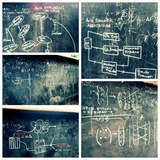
In this Mini-Lecture, Joseph takes us on a brief tour of some interesting ideas he's come up with concerning his quest to develop a new mathematical theory for the random generation of numbers. He also illustrates this background with useful symbolic depiction…
JWL Mini-Lecture: Natural Constants & RNGs
🌐⚡https://youtu.be/1O-c5Vq-93c?
In this Mini-Lecture, we get to look at some well-known, fundamentally important numbers; some 4 natural physical and mathematical constants. The lecture builds upon previous work concerning JWL's interests in building a new mathematical theory for the systematic generation of purely random numbers; an idea and results of which would have immediate practical and theoretical relevance in Artificial Intelligence, Human Computer Interaction, Scientific Modelling and Simulations, Statistical Engineering & more. A paper and perhaps a book might follow from this work in the future, so, stay tuned, and follow his work via Blackboard Adventures: https://t.me/bclectures
#jwl #nuchwezi #research #foundationalresearch #mathematics #computerscience #randomnumbers
🌐⚡https://youtu.be/1O-c5Vq-93c?
In this Mini-Lecture, we get to look at some well-known, fundamentally important numbers; some 4 natural physical and mathematical constants. The lecture builds upon previous work concerning JWL's interests in building a new mathematical theory for the systematic generation of purely random numbers; an idea and results of which would have immediate practical and theoretical relevance in Artificial Intelligence, Human Computer Interaction, Scientific Modelling and Simulations, Statistical Engineering & more. A paper and perhaps a book might follow from this work in the future, so, stay tuned, and follow his work via Blackboard Adventures: https://t.me/bclectures
#jwl #nuchwezi #research #foundationalresearch #mathematics #computerscience #randomnumbers
Blackboard Computing Adventures 💡
Photo
Such a well spent day... Mostly studying an entertaining advanced CS paper:
featuring some moving ideas on RNGs by that guy you see.. John Von Neumann 👆🏼🙄👋😄
#authorities #background #researchers #profiles #computerscientist #bafun
Bikos, Anastasios, Panagiotis E. Nastou, Georgios Petroudis, and Yannis C. Stamatiou. "Random number generators: Principles and applications." Cryptography 7, no. 4 (2023): 54. https://doi.org/10.3390/cryptography7040054
featuring some moving ideas on RNGs by that guy you see.. John Von Neumann 👆🏼🙄👋😄
#authorities #background #researchers #profiles #computerscientist #bafun
Blackboard Computing Adventures 💡
Such a well spent day... Mostly studying an entertaining advanced CS paper: Bikos, Anastasios, Panagiotis E. Nastou, Georgios Petroudis, and Yannis C. Stamatiou. "Random number generators: Principles and applications." Cryptography 7, no. 4 (2023): 54. h…
----[In Researcher Features]:
Professor John von Neumann (1903–1957) was a Hungarian-American mathematician, physicist, and computer scientist known for his groundbreaking contributions across multiple fields.
### Key Contributions
- Mathematics & Physics – Developed the mathematical framework for quantum mechanics and contributed to functional analysis.
- Game Theory – Pioneered game theory, influencing economics and strategic decision-making.
- Computing – Designed the von Neumann architecture, the foundation of modern computers.
- Nuclear Research – Played a crucial role in the Manhattan Project, contributing to nuclear weapon development.
He was a professor at Princeton University and the Institute for Advanced Study, collaborating with leading scientists of his time. His work continues to shape fields like artificial intelligence, cryptography, and computational science[1][2][3].
---[REFERENCES]:
1. https://en.wikipedia.org/wiki/John_von_Neumann?
2. https://www.britannica.com/biography/John-von-Neumann?
3. https://mathshistory.st-andrews.ac.uk/Biographies/Von_Neumann/?
Professor John von Neumann (1903–1957) was a Hungarian-American mathematician, physicist, and computer scientist known for his groundbreaking contributions across multiple fields.
### Key Contributions
- Mathematics & Physics – Developed the mathematical framework for quantum mechanics and contributed to functional analysis.
- Game Theory – Pioneered game theory, influencing economics and strategic decision-making.
- Computing – Designed the von Neumann architecture, the foundation of modern computers.
- Nuclear Research – Played a crucial role in the Manhattan Project, contributing to nuclear weapon development.
He was a professor at Princeton University and the Institute for Advanced Study, collaborating with leading scientists of his time. His work continues to shape fields like artificial intelligence, cryptography, and computational science[1][2][3].
---[REFERENCES]:
1. https://en.wikipedia.org/wiki/John_von_Neumann?
2. https://www.britannica.com/biography/John-von-Neumann?
3. https://mathshistory.st-andrews.ac.uk/Biographies/Von_Neumann/?
Blackboard Computing Adventures 💡
👆🏻😆🔥🔥🙏🏻 RNG baby.. 😉 #bacomics #bafun and just some fans... tis getting too hot in here 🙏🤣👆🏼😄
Meanwhile, some greetings came in from a friend at U Eel! 🤞😄 Okay, that's University of East London. Specifically, someone reached out from the Docklands campus 🤭
Haha.. let's see a brief about it..
----[UEL in Brief]:
The University of East London Docklands Campus is located in East London, specifically at University Way, London E16 2RD[1]. It sits in the Royal Docks area, offering waterfront views and easy access to transport links like the Docklands Light Railway (DLR)[2].
It’s one of the few universities in London with a self-contained campus, meaning students have almost everything they need on-site, from study spaces to cafes and sports facilities[2].
---[REFERENCES]:
1. https://www.uel.ac.uk/
2. https://www.uel.ac.uk/student-life/our-campuses/docklands-campus
Haha.. let's see a brief about it..
----[UEL in Brief]:
The University of East London Docklands Campus is located in East London, specifically at University Way, London E16 2RD[1]. It sits in the Royal Docks area, offering waterfront views and easy access to transport links like the Docklands Light Railway (DLR)[2].
It’s one of the few universities in London with a self-contained campus, meaning students have almost everything they need on-site, from study spaces to cafes and sports facilities[2].
---[REFERENCES]:
1. https://www.uel.ac.uk/
2. https://www.uel.ac.uk/student-life/our-campuses/docklands-campus
Blackboard Computing Adventures 💡
Photo
Anyways.. UEL, despite not being a terrific place for me to go for my PhD interests in Computer Science or Software Engineering (because they are generally heavily into [Creative] Arts, Architecture & Psychology programmes from what I've gleaned thus far), it's still one of interesting schools in London or rather the UK that's of note to me, and which has caught my interests in the past!
If anyone from UEL is passing by, or visiting us here on Blackboard Adventures, we definitely love you
👋💚 And think we'll possibly bump into each other in the future if all goes well 🤭
If anyone from UEL is passing by, or visiting us here on Blackboard Adventures, we definitely love you
👋💚 And think we'll possibly bump into each other in the future if all goes well 🤭
Forwarded from Museum of ~{MAZERA}~
Meanwhile, so sad concerning the death of Pope Francis. Yet another pope dead in my lifetime. God help us All. 🙏😔
#thepapacy #catholicchurch #deadpope #popefrancis #requiemmusic #mazera #communityupdates #happenningnow #internetcommunity
#thepapacy #catholicchurch #deadpope #popefrancis #requiemmusic #mazera #communityupdates #happenningnow #internetcommunity
Forwarded from UGANDA
Messing about in my little private library, came across this interesting little book by a UGANDAN teacher of Science (P.4-P.7) & Biology (S.1-S.4); a one Yuga Fred. In case anyone is interested, get in touch. Could help you obtain a copy. Good volume for labelled scientific illustrations for students & our kids in school ✓✓
Forwarded from UGANDA
UGANDA
Messing about in my little private library, came across this interesting little book by a UGANDAN teacher of Science (P.4-P.7) & Biology (S.1-S.4); a one Yuga Fred. In case anyone is interested, get in touch. Could help you obtain a copy. Good volume for labelled…
## Quick JWL Mini-Lecture: About The Eye as its Own Mini-Computer!
It hits me as rather not just miraculous, but very breathtaking, that the eye itself does some actual computations independently of the brain!
Like, when light arrives in the eye (as photons), it doesn't go as photons to the visual cortex (in the brain) for our brains to detect or process images we've seen via the eye!
The eye itself does some preprocessing[1] of light information about what is seen, and then only sends the processed information (as chemically encoded electrical signals[2]) to the brain; somehow, meaning the eye has a little brain/processor of itself!
The 👀👁️ Eye computes;
✓ Edge & Contrast Detection [3]
✓ Color Processing [2]
✓ Motion Detection [4]
✓ Data Compression [3]
I mean.. OMG!
Just an Eye!! 👀
Before the 🧠 Brian ever gets involved!! Isn't this such a fun fact?
Once the signals reach the visual cortex in the brain, that's when they undergo higher-level processing, including object recognition, depth perception, and spatial awareness[5].
Your Exercise: How many such mini-computers does the (human) body have in it independent of the main, central Main Computer (aka. Brain)?
🙌🤭
---[REFERENCES]:
1. https://www.eyehealthcentertroy.com/blog/how-the-brain-interprets-visual-information
2. https://discoveryeye.org/optic-nerve-visual-link-brain/
3. https://neurolaunch.com/visual-processing-in-the-brain/
4. https://nba.uth.tmc.edu/neuroscience/m/s2/chapter14.html
5. Thanks Microsoft Copilot!
#essentialreadings #basic #scienceeducation #biology #computerscience #learnsomething #internetclass #jwl hahaha #netizen #emancipation
It hits me as rather not just miraculous, but very breathtaking, that the eye itself does some actual computations independently of the brain!
Like, when light arrives in the eye (as photons), it doesn't go as photons to the visual cortex (in the brain) for our brains to detect or process images we've seen via the eye!
The eye itself does some preprocessing[1] of light information about what is seen, and then only sends the processed information (as chemically encoded electrical signals[2]) to the brain; somehow, meaning the eye has a little brain/processor of itself!
The 👀👁️ Eye computes;
✓ Edge & Contrast Detection [3]
✓ Color Processing [2]
✓ Motion Detection [4]
✓ Data Compression [3]
I mean.. OMG!
Just an Eye!! 👀
Before the 🧠 Brian ever gets involved!! Isn't this such a fun fact?
Once the signals reach the visual cortex in the brain, that's when they undergo higher-level processing, including object recognition, depth perception, and spatial awareness[5].
Your Exercise: How many such mini-computers does the (human) body have in it independent of the main, central Main Computer (aka. Brain)?
🙌🤭
---[REFERENCES]:
1. https://www.eyehealthcentertroy.com/blog/how-the-brain-interprets-visual-information
2. https://discoveryeye.org/optic-nerve-visual-link-brain/
3. https://neurolaunch.com/visual-processing-in-the-brain/
4. https://nba.uth.tmc.edu/neuroscience/m/s2/chapter14.html
5. Thanks Microsoft Copilot!
#essentialreadings #basic #scienceeducation #biology #computerscience #learnsomething #internetclass #jwl hahaha #netizen #emancipation
Eye Health Center
How the brain interprets visual information — Eye Health Center
How the brain processes and interprets signals from the retina to form an image.