Blackboard Computing Adventures 💡
Glad to see more students and researchers picking interest in our work here 👏
At our private research lab, we continue to define the next generation of computing and info-sec technologies and formalisms.. Esp. for the greater good 👓🎩💻⚡⚡👉🏻💶💷✨🌐
Blackboard Computing Adventures 💡
At our private research lab, we continue to define the next generation of computing and info-sec technologies and formalisms.. Esp. for the greater good 👓🎩💻⚡⚡👉🏻💶💷✨🌐
Memories of Joseph W. Lutalo with classmates (L-R; Ssegawa, Stephen, Maurice, and JWL himself) back in their undergraduate days at Makerere.. circa 2009. That's one example of a very successful and productive study group we formed to see us to the finals with flying colours.. 🤞😁
Blackboard Computing Adventures 💡
Memories of Joseph W. Lutalo with classmates (L-R; Ssegawa, Stephen, Maurice, and JWL himself) back in their undergraduate days at Makerere.. circa 2009. That's one example of a very successful and productive study group we formed to see us to the finals…
More school/study memories from that era
So, today, after about 3 days of hard reading work, we've finished reviewing the smaller (21 pages) version of Dr. Tom Ridge's epic, foundational 2014 ACM SLE paper [3].
Blackboard Computing Adventures 💡
Photo
---[Brief Bio]:
Not to be confused with the former & first US Secretary of Homeland Security that goes by the same name and title[1], Dr. Tom Ridge is an ex-academician[2] and computer scientist interested in programming, and who is currently working on AWS Cloud problems [2]. He previously worked in academia at the University of Leicester, as well as University of Cambridge[2].
Not to be confused with the former & first US Secretary of Homeland Security that goes by the same name and title[1], Dr. Tom Ridge is an ex-academician[2] and computer scientist interested in programming, and who is currently working on AWS Cloud problems [2]. He previously worked in academia at the University of Leicester, as well as University of Cambridge[2].
Blackboard Computing Adventures 💡
Photo
---[About Paper]:
Ridge's paper[3] covers his GLR-related work involving a more performant version of the P3 combinator parsing algorithm that enhances its performance by introducing the mechanism of an oracle. Ridge's new algorithm is "Mini-P3". In this paper, we also discover that in terms of performance, Ridge's algorithm was the best as of writing, for all/any-CFG (Context Free Grammar) parser, with the only potential serious competition likely to come from future attempts from anyone building a more performant (O(n^3) Earley parsing-like or better) GLL parsers that also offer a combinator parsing (parsers built out of combinations of other parsers) interface.
---[REFS]:
1. https://en.m.wikipedia.org/wiki/Tom_Ridge
2. https://www.linkedin.com/in/tom-ridge-5baab135?
3. Ridge, T. (2014). Simple, efficient, sound and complete combinator parsing for all context-free grammars, using an oracle. In Software Language Engineering: 7th International Conference, SLE 2014, Västerås, Sweden, September 15-16, 2014. Proceedings 7 (pp. 261-281). Springer International Publishing. URL: https://figshare.le.ac.uk/articles/conference_contribution/Simple_efficient_sound_and_complete_combinator_parsing_for_all_context-free_grammars_using_an_oracle/10143794/1/files/18281084.pdf
Ridge's paper[3] covers his GLR-related work involving a more performant version of the P3 combinator parsing algorithm that enhances its performance by introducing the mechanism of an oracle. Ridge's new algorithm is "Mini-P3". In this paper, we also discover that in terms of performance, Ridge's algorithm was the best as of writing, for all/any-CFG (Context Free Grammar) parser, with the only potential serious competition likely to come from future attempts from anyone building a more performant (O(n^3) Earley parsing-like or better) GLL parsers that also offer a combinator parsing (parsers built out of combinations of other parsers) interface.
---[REFS]:
1. https://en.m.wikipedia.org/wiki/Tom_Ridge
2. https://www.linkedin.com/in/tom-ridge-5baab135?
3. Ridge, T. (2014). Simple, efficient, sound and complete combinator parsing for all context-free grammars, using an oracle. In Software Language Engineering: 7th International Conference, SLE 2014, Västerås, Sweden, September 15-16, 2014. Proceedings 7 (pp. 261-281). Springer International Publishing. URL: https://figshare.le.ac.uk/articles/conference_contribution/Simple_efficient_sound_and_complete_combinator_parsing_for_all_context-free_grammars_using_an_oracle/10143794/1/files/18281084.pdf
Wikipedia
Tom Ridge
Thomas Joseph Ridge (born August 26, 1945) is an American politician and author who served in the George W. Bush administration as the Assistant to the President for Homeland Security from 2001 to 2003 and as the United States secretary of homeland security…
Blackboard Computing Adventures 💡
---[About Paper]: Ridge's paper[3] covers his GLR-related work involving a more performant version of the P3 combinator parsing algorithm that enhances its performance by introducing the mechanism of an oracle. Ridge's new algorithm is "Mini-P3". In this…
Look forward to the full review in a future work... 🤞🎩
Blackboard Computing Adventures 💡
Photo
Media is too big
VIEW IN TELEGRAM
We've read Dr. Tom Ridge's Mini-P3 research paper ✓
Circa 2008, the field of Software Language Engineering was considered and treated as a wholly new field of scientific inquiry [3]. With many things still needing clarification as well as the scope of the field yet to be well defined. So, in this keynote paper at the 2008 SLE international conference (the first ever), we see how Anneke Kleppe laid down the foundations for most of future SLE research in the talk she gave.
Blackboard Computing Adventures 💡
Circa 2008, the field of Software Language Engineering was considered and treated as a wholly new field of scientific inquiry [3]. With many things still needing clarification as well as the scope of the field yet to be well defined. So, in this keynote paper…
---[Brief Bio]:
Anneke Kleppe is a distinguished researcher & Dutch Computer Scientist with interest in software languages [1] and more than 2 decades experience working in the software industry since her Masters in 1988 [2]. She started her career in telecommunications and then worked as an independent consultant with her own company, Klasse Objecten. She has coached and trained employees of companies working with MDA, OCL, and UML.[2]
Anneke Kleppe is a distinguished researcher & Dutch Computer Scientist with interest in software languages [1] and more than 2 decades experience working in the software industry since her Masters in 1988 [2]. She started her career in telecommunications and then worked as an independent consultant with her own company, Klasse Objecten. She has coached and trained employees of companies working with MDA, OCL, and UML.[2]
Blackboard Computing Adventures 💡
Circa 2008, the field of Software Language Engineering was considered and treated as a wholly new field of scientific inquiry [3]. With many things still needing clarification as well as the scope of the field yet to be well defined. So, in this keynote paper…
---[About Paper]:
First of all, the paper[3] builds on the SLE intro established by the author in their 2008 book on the subject [2]. We see how Software Languages (which are artificial & the concern of computer scientists mostly) relate to but also differ from natural languages (mostly studied by linguists). The concept of a "Mogram" is introduced, and we see how SLE mainly deals with how these are constructed, interpreted and executed or applied, starting from formal specifications in the form of Abstract Syntax Models (ASM). Matters on the usage and life of a new language post-design phase are also touched on, and especially how to advance from ASM to pragmatic semantics is given special attention. Overall, it is a sure must-read for advanced and new entrants into the SLE field.
---[REFS]:
1. http://msdl.uantwerpen.be/conferences/CAMPaM/2006/repository/AnnekeKleppe/background.pdf
2. https://books.google.co.ug/books/about/Software_Language_Engineering.html
3. Kleppe, A. (2009). The Field of Software Language Engineering. In: Gašević, D., Lämmel, R., Van Wyk, E. (eds) Software Language Engineering. SLE 2008. Lecture Notes in Computer Science, vol 5452. Springer, Berlin, Heidelberg. https://doi.org/10.1007/978-3-642-00434-6_1
First of all, the paper[3] builds on the SLE intro established by the author in their 2008 book on the subject [2]. We see how Software Languages (which are artificial & the concern of computer scientists mostly) relate to but also differ from natural languages (mostly studied by linguists). The concept of a "Mogram" is introduced, and we see how SLE mainly deals with how these are constructed, interpreted and executed or applied, starting from formal specifications in the form of Abstract Syntax Models (ASM). Matters on the usage and life of a new language post-design phase are also touched on, and especially how to advance from ASM to pragmatic semantics is given special attention. Overall, it is a sure must-read for advanced and new entrants into the SLE field.
---[REFS]:
1. http://msdl.uantwerpen.be/conferences/CAMPaM/2006/repository/AnnekeKleppe/background.pdf
2. https://books.google.co.ug/books/about/Software_Language_Engineering.html
3. Kleppe, A. (2009). The Field of Software Language Engineering. In: Gašević, D., Lämmel, R., Van Wyk, E. (eds) Software Language Engineering. SLE 2008. Lecture Notes in Computer Science, vol 5452. Springer, Berlin, Heidelberg. https://doi.org/10.1007/978-3-642-00434-6_1
Blackboard Computing Adventures 💡
---[About Paper]: First of all, the paper[3] builds on the SLE intro established by the author in their 2008 book on the subject [2]. We see how Software Languages (which are artificial & the concern of computer scientists mostly) relate to but also differ…
We'll hopefully be building upon Kleppe 's important contributions in a future work of our own. Cheers to all students, researchers and peers following my study of the SLE field 👆🏻🤠
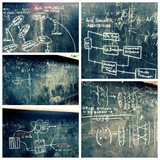
Back to ordinary Blackboard Adventures... We revisit some highlights of what sums up modern computing via an exploration of computing as the result of research, the application of processing and the formalism of dynamic state. Lecture delivered using a clandestine hand so the initiated glimpse of the finer gems more readily 🤞🤣
Today we reviewed another keynote delivered by a distinguished person in the ACM SLE community; Professor Martin Erwig. This 2009 presentation is quite important in the SLE field not just because of having occurred in the earliest years of the SLE field, but also because it touches on a topic not typical in most SLE literature; the software variation problem.
Blackboard Computing Adventures 💡
Today we reviewed another keynote delivered by a distinguished person in the ACM SLE community; Professor Martin Erwig. This 2009 presentation is quite important in the SLE field not just because of having occurred in the earliest years of the SLE field, but…
---[Brief Bio]:
Martin Erwig is a Professor of Computer Science in the School of Electrical Engineering and Computer Science at Oregon State University[1]. He has a rich academic background with degrees from the University of Dortmund and the University of Hagen in Germany[1]. His research interests include language design and domain-specific languages, functional programming, and visual languages[1].
In 2000 he immigrated from Germany into the United States. He lives now with his family in Corvallis, Oregon [2]. Prof. Erwig is also the author of the award-winning book "Once Upon an Algorithm: How Stories Explain Computing", which has been translated into several languages[1]. He has published over 160 peer-reviewed articles and received multiple best paper awards for his work[1].
Martin Erwig is a Professor of Computer Science in the School of Electrical Engineering and Computer Science at Oregon State University[1]. He has a rich academic background with degrees from the University of Dortmund and the University of Hagen in Germany[1]. His research interests include language design and domain-specific languages, functional programming, and visual languages[1].
In 2000 he immigrated from Germany into the United States. He lives now with his family in Corvallis, Oregon [2]. Prof. Erwig is also the author of the award-winning book "Once Upon an Algorithm: How Stories Explain Computing", which has been translated into several languages[1]. He has published over 160 peer-reviewed articles and received multiple best paper awards for his work[1].
Blackboard Computing Adventures 💡
Photo
---[About Paper]:
First, this 1-page paper was delivered as part of a keynote talk at the 3rd International SLE conference that took place in Eindhoven, Netherlands in 2010[3]. It touches on his work concerning the Choice Calculus (CC) meant to formalize as well as streamline future work relating to variability in software artefacts, systems or expressions[4]. It relates to popular work in the Programming Language Engineering field by its relation to the Lambda Calculus[4], and though not presented in this abstract paper, the CC's language syntax, semantics and potential applications are introduced; Choices & Dimensions that group Choices.
---[REFS]:
1. https://engineering.oregonstate.edu/people/martin-erwig
2. https://www.amazon.in/stores/author/B004575Y1O/about
3. https://www.sleconf.org/2010/
4. Erwig, M. (2010). A language for software variation research. ACM SIGPLAN Notices, 46(2), 3-12. URL: https://web.engr.oregonstate.edu/~erwig/papers/VariationLang_GPCE10.pdf
First, this 1-page paper was delivered as part of a keynote talk at the 3rd International SLE conference that took place in Eindhoven, Netherlands in 2010[3]. It touches on his work concerning the Choice Calculus (CC) meant to formalize as well as streamline future work relating to variability in software artefacts, systems or expressions[4]. It relates to popular work in the Programming Language Engineering field by its relation to the Lambda Calculus[4], and though not presented in this abstract paper, the CC's language syntax, semantics and potential applications are introduced; Choices & Dimensions that group Choices.
---[REFS]:
1. https://engineering.oregonstate.edu/people/martin-erwig
2. https://www.amazon.in/stores/author/B004575Y1O/about
3. https://www.sleconf.org/2010/
4. Erwig, M. (2010). A language for software variation research. ACM SIGPLAN Notices, 46(2), 3-12. URL: https://web.engr.oregonstate.edu/~erwig/papers/VariationLang_GPCE10.pdf