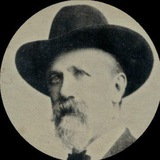
Jeremiah O'Donovan Rossa (September 11, 1831 – June 29, 1915) was an Irish Fenian leader. Born at Rosscarbery, County Cork, in 1858 Rossa established the Phoenix Society which would later evolve into the Irish Republican Brotherhood (IRB). He was jailed numerous times for connections with the Fenian movement, and was finally exiled in 1871, sailing to the United States on board the Cuba with his friend John Devoy and three other exiles. Together they were dubbed the "Cuba Five". Rossa organised the first ever bombings by Irish republicans of English cities in what was called the "dynamite campaign".
After his death his body was returned to Ireland for burial and a hero's welcome. The funeral at Glasnevin Cemetery on 1 August 1915 was a huge affair, garnering substantial publicity for the Irish Volunteers and the IRB at time when a rebellion (later to emerge as the Easter Rising) was being actively planned. The graveside oration, given by Patrick Pearse, remains one of the most famous speeches of the Irish independence movement stirring his audience to a call to arms. It ended with the lines:
"They think that they have pacified Ireland. They think that they have purchased half of us and intimidated the other half. They think that they have foreseen everything, think that they have provided against everything; but, the fools, the fools, the fools! — They have left us our Fenian dead, and while Ireland holds these graves, Ireland unfree shall never be at peace"
After his death his body was returned to Ireland for burial and a hero's welcome. The funeral at Glasnevin Cemetery on 1 August 1915 was a huge affair, garnering substantial publicity for the Irish Volunteers and the IRB at time when a rebellion (later to emerge as the Easter Rising) was being actively planned. The graveside oration, given by Patrick Pearse, remains one of the most famous speeches of the Irish independence movement stirring his audience to a call to arms. It ended with the lines:
"They think that they have pacified Ireland. They think that they have purchased half of us and intimidated the other half. They think that they have foreseen everything, think that they have provided against everything; but, the fools, the fools, the fools! — They have left us our Fenian dead, and while Ireland holds these graves, Ireland unfree shall never be at peace"
"There were forty men of my name and family in my native town when I was a boy; there is not a man or a boy or my name in it now. One woman of the name lives as heritor of the old family tomb in the Old Abbey field.
And that is the story of many another Irishman of the old stock. Families scattered in death as well as in life; a father buried in Ireland, a mother buried in Carolina, America; a brother buried in New York, a brother buried in Pennsylvania, a sister buried in Staten Island. The curse that scattered the Jews is not more destructive than this English curse that scatters the Irish race, living and dead. "
(Rossa's Recollections 1838 - 1898)
And that is the story of many another Irishman of the old stock. Families scattered in death as well as in life; a father buried in Ireland, a mother buried in Carolina, America; a brother buried in New York, a brother buried in Pennsylvania, a sister buried in Staten Island. The curse that scattered the Jews is not more destructive than this English curse that scatters the Irish race, living and dead. "
(Rossa's Recollections 1838 - 1898)
"Some say I have a 'brogue.' I have. I am proud I have, and I will never endeavour to have any other kind of tongue. "
(Rossa's Recollections 1838 - 1898)
(Rossa's Recollections 1838 - 1898)
"Every allowance is made by English-speaking society for the man of every other nationality on earth speaking broken English, except for the Irishman. The Dutchman, the German, the Frenchman, the Russian, the Italian, can speak broken English, and it won't be said he speaks it with a brogue, and is consequently, illiterate; But the Irishman who speaks it - a language as foreign to his nationality as it is to the nationality of any of the others - is met immediately with ridicule and contempt. But - 'tis part of the price or penalty of slavery, and until Irishmen have manhood to remove that slavery, the name of their language or their land will not have a respected place among the nations."
(Rossa's Recollections 1838 - 1898)
(Rossa's Recollections 1838 - 1898)
"We may bravely fight all the battles of all the peoples of the earth, but while Ireland's battle for Ireland's freedom remains unsuccessfully fought - while England continues to rule Ireland - all the historical bravery of our race in every land, and in every age will not save us from the slur of the unfriendly chronicler who writes that we fight well as 'mercenaries,' that we fight bravely the battles of every other land on earth, except the battle of our own land."
(Rossa's Recollections 1838 - 1898)
(Rossa's Recollections 1838 - 1898)
"There were fairies in Ireland then, and I grew up there, thinking that fairy life was something that was inseparable from Irish life. Fairy stories would be told that were to me and to those around me as much realities of Irish life as are the stories that I now read in books called 'Realities of Irish Life.' I grew up a boy, believing that there were 'good people' in this world, and I grew up in manhood, or grow down, believing there are bad people in it, too. When in was in Ireland lately the population wasn't half what it was when I was a boy. I asked if the fairies had been exterminated, too, for there seemed to be none of the life around that abounded in my time. Yes, English tyranny had killed out the 'good people' as well as the living people."
(Rossa's Recollections 1838 - 1898)
(Rossa's Recollections 1838 - 1898)
"A political lesson was graven on my mind by the Irish magpies that had their nests in the big skehory tree on the ditch opposite the kitchen door. I had permission to go through the tree to pick the skehories, but I was strictly ordered not to go near the magpies' nest, or to touch a twig or thorn belonging to it.
If the magpies' nest was robbed; if their young ones were taken away from them, they would kill every chicken and gosling that was to be found around the farmyard. That is the way my grandfather's magpies would have their vengeance for having their homes and their families destroyed; and it made every one in my grandfather's house 'keep the peace' toward them. I have often thought of my grandfather's magpies in connection with the destruction of the houses and families of the Irish people by the English landlords of Ireland. Those magpies seemed to have more manly Irish spirit than the Irish people themselves."
(Rossa's Recollections 1838 - 1898)
If the magpies' nest was robbed; if their young ones were taken away from them, they would kill every chicken and gosling that was to be found around the farmyard. That is the way my grandfather's magpies would have their vengeance for having their homes and their families destroyed; and it made every one in my grandfather's house 'keep the peace' toward them. I have often thought of my grandfather's magpies in connection with the destruction of the houses and families of the Irish people by the English landlords of Ireland. Those magpies seemed to have more manly Irish spirit than the Irish people themselves."
(Rossa's Recollections 1838 - 1898)
"I cannot get conceive how any Irishman can be considered an Irish patriot who will sing out to his people, either in prose or verse, that it is impossible to free Ireland from English rule...
That is what England wants the Irish people to learn. That is what she wants taught to them. And that is what she is willing to pay teachers of all kinds for teaching them - teaching them it is better to forget the evils they can never heal - better forget all about Irish freedom as they can never obtain it."
(Rossa's Recollections 1838 - 1898)
That is what England wants the Irish people to learn. That is what she wants taught to them. And that is what she is willing to pay teachers of all kinds for teaching them - teaching them it is better to forget the evils they can never heal - better forget all about Irish freedom as they can never obtain it."
(Rossa's Recollections 1838 - 1898)
"...he'd tell me those fields and grounds belonged to my people once; but they belonged to strangers now, who had no right to them, that they ought to be mine...
Sane or insane, he spoke the truth. He was called a madman...I'd regard him as a victim of England's plunder, who embraced the mission of preaching the true faith to the children of his plundered race."
(Rossa's Recollections 1838 - 1898)
Sane or insane, he spoke the truth. He was called a madman...I'd regard him as a victim of England's plunder, who embraced the mission of preaching the true faith to the children of his plundered race."
(Rossa's Recollections 1838 - 1898)
"I know how men get a bad name, and are called madmen, for speaking and acting in the true faith regarding Ireland's rights. I have myself been called a madman, because I was acting in a way that was not pleasing to England. The longer I live the more I come to believe that Irishmen will have to go a little mad my way, before they go the right way to get any freedom for Ireland."
(Rossa's Recollections 1838 - 1898)
(Rossa's Recollections 1838 - 1898)
"And why shouldn't an Irishman be mad; when he grows up face to face with the plunderers of his land and race, and sees them looking down upon him as if he were a mere thing of loathing and contempt! They strip him of all that belongs to him, and make him a pauper, and not only that, but they teach him to look upon the robbers as gentlemen, as beings entirety superior to him."
(Rossa's Recollections 1838 - 1898)
(Rossa's Recollections 1838 - 1898)
"the Irishman who is proud of his name and his family and his race, will rarely or never do anything to bring shame and disgrace upon himself or upon any one belonging to him."
(Rossa's Recollections 1838 - 1898)
(Rossa's Recollections 1838 - 1898)
"The priest had no other consolation to give, but the consolation of religion, and, very likely, it was through religion my father and mother learned - and tried - to lighten the load of life, by telling us that the poorer you are the nearer you are to God, and that the more your sufferings in this world the greater will be your reward in the next.
If that be the gospel of truth, and I hope it is, there are no people on earth nearer to heaven than the Irish people."
(Rossa's Recollections 1838 - 1898)
If that be the gospel of truth, and I hope it is, there are no people on earth nearer to heaven than the Irish people."
(Rossa's Recollections 1838 - 1898)