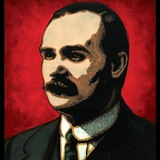
Connolly was, indeed, the most terrific expression in a personality of the modern revolutionary spirit that these islands have known. Pearse undoubtedly was the grandest incarnation in men of Irish blood of the ancient tradition of Irish nationhood, but these two men, unlike many of the disciples of either, knew better than to stick fast in a morass of phrases.
Connolly's influence on Pearse as before mentioned was considerable. The meeting of these two men of characters so diverse in many ways during the early months of 1914 was, indeed, historic. Until then neither had known the other intimately. Years before a speech delivered by Connolly before a students' debating society in defence of woman's suffrage had left an indelible impression on Pearse's memory. Since then both had worked in fields far apart, one striving to spread Socialist ideas in Ireland and America, to shake the general apathy as regards social issues, to build up an army of labour, to descend, as Mr. Robert Lynd has well said, into the hell of Irish poverty with a burning heart, the other squandering without regret the glorious years of his youth to re-create an Irish literature, to quicken with his idealist faith the dying national consciousness and bring an ancient chivalry and a new vision into the land. In due course the war in Europe threw them together. It would have required no bold prophet to foresee events must move hence- forward in unwonted ways.
(The Man Called Pearse, D. Ryan, Chapter VII)
Connolly's influence on Pearse as before mentioned was considerable. The meeting of these two men of characters so diverse in many ways during the early months of 1914 was, indeed, historic. Until then neither had known the other intimately. Years before a speech delivered by Connolly before a students' debating society in defence of woman's suffrage had left an indelible impression on Pearse's memory. Since then both had worked in fields far apart, one striving to spread Socialist ideas in Ireland and America, to shake the general apathy as regards social issues, to build up an army of labour, to descend, as Mr. Robert Lynd has well said, into the hell of Irish poverty with a burning heart, the other squandering without regret the glorious years of his youth to re-create an Irish literature, to quicken with his idealist faith the dying national consciousness and bring an ancient chivalry and a new vision into the land. In due course the war in Europe threw them together. It would have required no bold prophet to foresee events must move hence- forward in unwonted ways.
(The Man Called Pearse, D. Ryan, Chapter VII)
He announced his brotherly union with Connolly was a union of thought as well as deeds, and that the national freedom both strove for extended to a people's wealth and lands as well as to their liberties and Governmental systems. Once and for all, beyond a shadow of doubt, he recorded these convictions in written words before the storm broke and he knew now or never was the opportune moment to proclaim his social faith. Thereafter he had "no more to say."
- Desmond Ryan, The Man Called Pearse (1919)
- Desmond Ryan, The Man Called Pearse (1919)
This dissatisfaction with current ideals and institutions drove him to seek a new educational inspiration in a return to the Sagas. An heroic tale was more essentially a factor in education than all the propositions of Euclid ; the story of Joan of Arc more charged with meaning than a thousand algebras. He claimed, too, that had the old Irish. Sagas swayed Europe to the extent the Renaissance has that inspiration would have saved many a righteous and noble cause. By an easy transition Pearse passed from this mood to proclaim the thing that was coming, to salute with Connolly the risen people.
He announced his brotherly union with Connolly was a union of thought as well as deeds, and that the national freedom both strove for extended to a people's wealth and lands as well as to their liberties and Governmental systems. Once and for all, beyond a shadow of doubt, he recorded these convictions in written words before the storm broke and he knew now or never was the opportune moment to proclaim his social faith. Thereafter he had " no more to say."
LABOUR IN IRISH HISTORY, and in a smaller degree THE RE-CONQUEST OF IRELAND, have left their mark upon The Sovereign People. This pamphlet is an explicit statement of P. H. Pearse's social ideals, the concluding one of a series where he re-states the gospel of Nationalism as defined by Tone, Davis, Mitchel and Lalor. Therein he examines the lives and teachings of the two last. In the previous booklets he had insisted upon the spiritual fact of nationality, upon the separatist tradition in history, upon the necessity of physical freedom to preserve the spiritual fact and vindicate the tradition. His argument might have been expressed in Connolly's words :
He announced his brotherly union with Connolly was a union of thought as well as deeds, and that the national freedom both strove for extended to a people's wealth and lands as well as to their liberties and Governmental systems. Once and for all, beyond a shadow of doubt, he recorded these convictions in written words before the storm broke and he knew now or never was the opportune moment to proclaim his social faith. Thereafter he had " no more to say."
LABOUR IN IRISH HISTORY, and in a smaller degree THE RE-CONQUEST OF IRELAND, have left their mark upon The Sovereign People. This pamphlet is an explicit statement of P. H. Pearse's social ideals, the concluding one of a series where he re-states the gospel of Nationalism as defined by Tone, Davis, Mitchel and Lalor. Therein he examines the lives and teachings of the two last. In the previous booklets he had insisted upon the spiritual fact of nationality, upon the separatist tradition in history, upon the necessity of physical freedom to preserve the spiritual fact and vindicate the tradition. His argument might have been expressed in Connolly's words :
"Slavery is a thing of the soul before it embodies itself in the material things of the world. I assert that before a nation can be reduced to slavery its soul must have been cowed, intimidated or corrupted by the oppressor. Only when so cowed, intimidated or corrupted, does the soul of a nation cease to urge forward its body to resist the shackles of slavery ; only when the soul so surrenders does any part of the body consent to make truce with the foe of its national existence. When the soul is conquered the articulate expression of the voice of the nation loses its defiant accent and, taking on the whining colour of com- promise, begins to plead for the body. The unconquered soul asserts itself and declares its sanctity to be more important than the interests of the body ; the conquered soul ever pleads first that the body may be saved even if the soul be damned. For generations this conflict between the sanctity of the soul and the interests of the body has been waged in Ireland. ... In fitful moments of spiritual exaltation Ireland accepted that idea, and such men as O'Donovan Rossa becoming possessed of it, became thence- forth the living embodiment of that gospel."
(The Man Called Pearse, D. Ryan, Chapter VII)
(The Man Called Pearse, D. Ryan, Chapter VII)
...we shall have travelled far beyond enduring social unrighteousness because men and nations do not live by bread alone. Two men in Dublin knew that once before, when a manly figure in green grasped the other's hand beneath the Post Office porch, crying, "Thank God, Pearse, we have lived to see this day!"
- Desmond Ryan, The Man Called Pearse (1919)
- Desmond Ryan, The Man Called Pearse (1919)
What is Pearse's definition of a nation ? A Sovereign People ! His ideal was no mere political sovereignty, although he demanded this also in the fullest degree, but a sovereignty which extends to the soil and factories of Ireland that the stubborn and unterrified working class, the common people whom he hails with enthusiasm and pride, as the unpurchasable and unfaltering guardians of national liberties may say with truth of their nation that it is the family in large knit together by ties human and kindly. He salutes " the more virile labour organiza- tions of to-day " as heirs to Lalor's teaching, nor do vague accusations of anarchism or materialism prevent him from announcing himself as one who is heart to heart with them. In effect, he agrees with Lalor, who held separation valueless unless it placed, not certain rich men merely, but the actual people of Ireland in effectual possession of the soil and resources of their country.
Here may conclude this short sketch of the social ideals of P. H. Pearse, but this mere formal outline is of little use to those who do not recognize the democratic instinct behind every line Pearse wrote. Connolly recognized it and confessed to his friends that he had always been attracted towards Pearse, in whom he felt some quality above the average of Nationalist politicians.
[...]
It is not claimed here that Pearse saw eye to eye with James Connolly upon the question of Socialism, inasmuch as Pearse did not adhere to, nor had he indeed studied, the Socialist system that James Connolly spent a life-time in preaching...
...It is not even sought to establish whether Pearse was a Socialist or not. If Socialism be, as we hear often, the common ownership of the means of wealth-production, distribution and exchange by and in the interest of the whole community, then it should be difficult to refuse the designation to the man who wrote The Sovereign People.
(The Man Called Pearse, D. Ryan, Chapter VII)
Here may conclude this short sketch of the social ideals of P. H. Pearse, but this mere formal outline is of little use to those who do not recognize the democratic instinct behind every line Pearse wrote. Connolly recognized it and confessed to his friends that he had always been attracted towards Pearse, in whom he felt some quality above the average of Nationalist politicians.
[...]
It is not claimed here that Pearse saw eye to eye with James Connolly upon the question of Socialism, inasmuch as Pearse did not adhere to, nor had he indeed studied, the Socialist system that James Connolly spent a life-time in preaching...
...It is not even sought to establish whether Pearse was a Socialist or not. If Socialism be, as we hear often, the common ownership of the means of wealth-production, distribution and exchange by and in the interest of the whole community, then it should be difficult to refuse the designation to the man who wrote The Sovereign People.
(The Man Called Pearse, D. Ryan, Chapter VII)
Pearse himself refuses the designation in several places throughout his writings. He dreaded certain aspects of modern Socialist teachings, and would no doubt have damned them with the rest of modern evil. Many Socialists will be no doubt equally prompt to find evasions and unorthodoxies in his statement of his social creed. They will prefer to misunder- stand the idealistic and nationalist inspiration which swayed him. They will, unlike Connolly, continue to emphasise the phrases in the Republican Proclamation anent the right of the Irish people to the ownership of Ireland, and deem Irish destines un- fettered and uncontrolled a mere rhetorical phrase until another Pearse rises to confuse them. Perhaps the war will avert the need for another Pearse to confute them. Certainly they would never convert the idiots who babble about Connolly's materialism and Pearse's idealism without tremendous emphasis indeed. In Pearse they will find that breath of freedom's eternal spirit which has moulded all their systems and creeds.
In any case, let us have no more foolish comparisons or sickly idealisms which have been greater cloaks for evil than all the materialisms in history. Let us, in short, remember what Pearse's social ideals were, or we shall misunderstand his greatness. For even when we have returned to the Sagas and burned our rent-books as Pearse advised us, it is, at least, problematical whether we shall all dismiss Karl Marx as quite so finished an instrument of the devil as Pearse dismissed Adam Smith. But, assuredly we shall have travelled far beyond enduring social unrighteousness because men and nations do not live by bread alone. Two men in Dublin knew that once before, when a manly figure in green grasped the other's hand beneath the Post Office porch, crying, "Thank God, Pearse, we have lived to see this day!"
(The Man Called Pearse, D. Ryan, Chapter VII)
In any case, let us have no more foolish comparisons or sickly idealisms which have been greater cloaks for evil than all the materialisms in history. Let us, in short, remember what Pearse's social ideals were, or we shall misunderstand his greatness. For even when we have returned to the Sagas and burned our rent-books as Pearse advised us, it is, at least, problematical whether we shall all dismiss Karl Marx as quite so finished an instrument of the devil as Pearse dismissed Adam Smith. But, assuredly we shall have travelled far beyond enduring social unrighteousness because men and nations do not live by bread alone. Two men in Dublin knew that once before, when a manly figure in green grasped the other's hand beneath the Post Office porch, crying, "Thank God, Pearse, we have lived to see this day!"
(The Man Called Pearse, D. Ryan, Chapter VII)
Austen Morgan, author of James Connolly: A Political Biography, describes how Connolly became increasingly more nationalistic and closer to Pearse's views in the final years of his life. This is in contrast to what Ryan described in his book (covered in the last number of posts on the channel) where Pearse leaned more towards Connolly's views. In any case, it is clear that Pearse and Connolly shared very similar outlooks, likely influencing and reinforcing each other's thoughts, and, as we have been pointing out repeatedly, Connolly was as much a nationalist as he was a socialist.
Morgan outlines how Connolly's political life is broken into periods; beginning as more of an international socialist, shifting to syndicalist and finally a fenian nationalist. In the last year's of his life "There were many opportunities to articulate a socialist project, but there is no substantial evidence that he sought to do so."
In one review of Morgan's book, Joe Larragy goes on to say "[Connolly] seriously compromised his socialism to the extent that he subordinated his politics to the propaganda and the conspiracy for revolution", noting that "there is no expression whatever of distinct working-class interests in the proclamation of the Rising."
The Proclamation is often pointed to by those on the Left as an example of a "progressive" document, inferring that certain phrases have a meaning that they obviously do not when the time and circumstances under which it was written are considered.
Morgan outlines how Connolly's political life is broken into periods; beginning as more of an international socialist, shifting to syndicalist and finally a fenian nationalist. In the last year's of his life "There were many opportunities to articulate a socialist project, but there is no substantial evidence that he sought to do so."
In one review of Morgan's book, Joe Larragy goes on to say "[Connolly] seriously compromised his socialism to the extent that he subordinated his politics to the propaganda and the conspiracy for revolution", noting that "there is no expression whatever of distinct working-class interests in the proclamation of the Rising."
The Proclamation is often pointed to by those on the Left as an example of a "progressive" document, inferring that certain phrases have a meaning that they obviously do not when the time and circumstances under which it was written are considered.
"Gaelic culture of the Irish chieftainry was rudely broken off in the seventeenth century, and the continental Schools of European despots implanted in its place in the minds of the Irish students, and sent them back to Ireland to preach a fanatical belief in royal and feudal prerogatives, as foreign to the genius of the Gael as was the English ruler to Irish soil."
#gaelic
#gaelic
"The English slanderer never did as much harm as did these self-constituted delineators of Irish characteristics. The English slanderer lowered Irishmen in the eyes of the world, but his Irish middle-class teachers and writers lowered him in his own eyes by extolling as an Irish virtue every sycophantic vice begotten of generations of slavery."
#slander #slavery
#slander #slavery
"The seventeenth, eighteenth and nineteenth centuries were, indeed, the Via Dolorosa of the Irish race. In them the Irish Gael sank out of sight, and in his place the middle-class politicians, capitalists and ecclesiastics laboured to produce a hybrid Irishman, assimilating a foreign social system, a foreign speech, and a foreign character."
#Gael #foreign
#Gael #foreign
"Fortunately the Irish character has proven too difficult to press into respectable foreign moulds, and the recoil of that character from the deadly embrace of capitalist English conventionalism, as it has already led to a revaluation of the speech of the Gael, will in all probability also lead to a re-study and appreciation of the social system under which the Gael reached the highest point of civilisation and culture in Europe."
#gaelic #civilisation
#gaelic #civilisation
"In the re-conversion of Ireland to the Gaelic principle of common ownership by a people of their sources of food and maintenance, the worst obstacles to overcome will be the opposition of the men and women who have imbibed their ideas of Irish character and history from Anglo-Irish literature. That literature, as we have explained, was born in the worst agonies of the slavery of our race; it bears all the birth-marks of such origin upon it, but irony of ironies, these birth-marks of slavery are hailed by our teachers as ‘the native characteristics of the Celt’."
#celt#gaelic
#celt#gaelic
"the Irishman frees himself from such a mark of slavery when he realises the truth that the capitalist system is the most foreign thing in Ireland."
#slavery #foreign #capitalism
#slavery #foreign #capitalism
All of the above are taken from the Foreword of Labour In Irish History (1910), one of Connolly's most important works. I would encourage everyone to read it in its entirety.
Cartlann
Labour in Irish History
PDF Chapters Author’s Foreword Chapter I: The Lessons of History Chapter II: The Jacobites and the Irish people Chapter III: Peasant Rebellions [...]