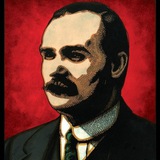
"In 1847, our people died by thousands of starvation, though every ship leaving an Irish port was laden with food in abundance. The Irish people might have seized that food, cattle, corn and all manner of provisions before it reached the seaports, have prevented famine and saved their country from ruin, but did not do so, believing such action to be sinful, and dreading to peril their souls to save their bodies. In this belief we know now they were entirely mistaken. The very highest authorities in the doctrine of the church agree that no human law can stand between starving people and their right to food, including their right to take that food whenever they find it, openly or secretly, with or without the owner's permission."
[...]
For Connolly, Kerry was but one more illustration of the depth of betrayal of the parliamentary leaders... The poison of constitutionalism had been injected just at a time when the countryside could have been fanned into revolt.
(Pages 65-66)
[...]
For Connolly, Kerry was but one more illustration of the depth of betrayal of the parliamentary leaders... The poison of constitutionalism had been injected just at a time when the countryside could have been fanned into revolt.
(Pages 65-66)
'... the I.S.R.P. [in Salford]... must not compete with either the I.L.P. or S.D.F. In order to prevent this, it would be confined exclusively to those of Irish birth or descent '
"Connolly was one of the most convincing speakers I ever heard in my life, a man with great passion for the cause of the labouring classes, and probably a greater passion for the cause of Ireland".
"Connolly was one of the most convincing speakers I ever heard in my life, a man with great passion for the cause of the labouring classes, and probably a greater passion for the cause of Ireland".
"The population of Ireland is only 4,000,000 and, as there is an annual emigration of 40,000, it is becoming quite a serious question as to how long the Irish nation will exist at this rate of deportation."
"...the emigrant sacrifices his future for his present for the sake of a few extra dollars."
(The Life and Times of James Connolly, pg. 100)
"...the emigrant sacrifices his future for his present for the sake of a few extra dollars."
(The Life and Times of James Connolly, pg. 100)
"Fellow-workers – the employers are determined to starve you into submission, and if you resist, to club you, jail you, and kill you. We defy them! If they think they can carry on their industries without you, we will, in the words of the Ulster Orangeman, “Take steps to prevent it.”
It is your duty to find the ways and means. Be men now, or be for ever slaves."
It is your duty to find the ways and means. Be men now, or be for ever slaves."
“These men have sold you. Sold you? No, by God, given you away. Whether my speech is pro-German or pro-Irish, I don’t know. As an Irish worker I owe a duty to our class; counting no allegiance to the Empire; I’d be glad to see it back in the bottomless pit. The Irish workers hold themselves ready to bargain with whoever can make a bargain. England has been fighting Germany. If it were not for the Russians, French and Japanese, the British would not have made a mouthful for the Germans. The Germans are in Boulogne, where Napoleon projected an invasion of Britain. To Ireland is only a twelve hours’ run. If you are itching for a rifle, itching to fight, have a country of your own; better to fight for our own country than for the robber empire. If ever you shoulder a rifle, let it be for Ireland. Conscription or no conscription, they will never get me or mine. You have been told you are not strong, that you have no rifles. Revolutions do not start with rifles; start first and get your rifles after. Our curse is our belief in our weakness. We are not weak, we are strong. Make up your mind to strike before your opportunity goes.”
#revolution
#revolution
Final Dispatch From The GPO
ARMY OF THE IRISH REPUBLIC, Headquarters (Dublin Command), 28th April, 1916.
To Soldiers.
This is the fifth day of the establishment of the Irish Republic, and the flag of our country still floats from the most important buildings in Dublin, and is gallantly protected by the Officers and Irish Soldiers in arms throughout the country. Not a day passes without seeing fresh postings of Irish Soldiers eager to do battle for the old cause. Despite the utmost vigilance of the enemy we have been able to get in information telling us how the manhood of Ireland, inspired by our splendid action, are gathering to offer up their lives if necessary in the same holy cause. We are here hemmed in because the enemy feels that in this building is to be found the heart and inspiration of our great movement.
Let us remind you what you have done. For the first time in 700 years the flag of a free Ireland floats triumphantly in Dublin City. The British Army, whose exploits we are for ever having dinned into our ears, which boasts of having stormed the Dardanelles and the German lines on the Marne, behind their Artillery and Machine Guns are afraid to advance to the attack or storm any positions held by our forces. The slaughter they suffered in the first few days has totally unnerved them and they dare not attempt again an Infantry attack on our position.
Our Commandants around us are holding their own. Commandant Daly’s splendid exploit in capturing Linen Hall Barracks we all know. You must know also that the whole population both Clergy and Laity of this district are united in his praises. Commandant MacDonagh is established in an impregnable position reaching from the walls of Dublin Castle to Redmond’s Hill, and from Bishop Street to Stephen’s Green.
(In Stephen’s Green, Commandant Mallin holds the College of Surgeons, one side of the square, a portion of the other side, and dominates the whole Green and all its entrances and exits.) Commandant De Valera stretches in a position from the Gas Works to Westland Row holding Bolands Bakery, Bolands Mills, Dublin South Eastern Railway Works and dominating Merrion Square. Commandant Kent holds the South Dublin Union and Guinness’s buildings to Marrow Bone Lane and controls Jamieson St. and district. On two occasions the enemy effected a lodgement and were driven out with great loss.
The men of North County Dublin are in the field, have occupied all the Police Barracks in the district, destroyed all the telegraph system on the Great Northern Railway up to Dundalk, and are operating against the trains of the Midland and Great Western. Dundalk has sent 200 men to march upon Dublin and in the other parts of the North our forces are active and growing.
In Galway Captain Mellows fresh after his escape from an Irish Prison is in the field with his men. Wexford and Wicklow are strong and Cork & Kerry are equally acquitting themselves creditably. (We have every confidence that our Allies in Germany and kinsmen in America are straining every nerve to hasten matters on our behalf.)
As you know, I was wounded twice yesterday and am unable to move about, but have got my bed moved into the firing line and with the assistance of your Officers will be just as useful to you as ever. Courage boys, we are winning and in the hour of our victory let us not forget the splendid women who have everywhere stood by us and cheered us on. Never had man or woman a grander cause, never was a cause more grandly served.
Signed,
James Connolly,
Commandant General,
Dublin Division.
ARMY OF THE IRISH REPUBLIC, Headquarters (Dublin Command), 28th April, 1916.
To Soldiers.
This is the fifth day of the establishment of the Irish Republic, and the flag of our country still floats from the most important buildings in Dublin, and is gallantly protected by the Officers and Irish Soldiers in arms throughout the country. Not a day passes without seeing fresh postings of Irish Soldiers eager to do battle for the old cause. Despite the utmost vigilance of the enemy we have been able to get in information telling us how the manhood of Ireland, inspired by our splendid action, are gathering to offer up their lives if necessary in the same holy cause. We are here hemmed in because the enemy feels that in this building is to be found the heart and inspiration of our great movement.
Let us remind you what you have done. For the first time in 700 years the flag of a free Ireland floats triumphantly in Dublin City. The British Army, whose exploits we are for ever having dinned into our ears, which boasts of having stormed the Dardanelles and the German lines on the Marne, behind their Artillery and Machine Guns are afraid to advance to the attack or storm any positions held by our forces. The slaughter they suffered in the first few days has totally unnerved them and they dare not attempt again an Infantry attack on our position.
Our Commandants around us are holding their own. Commandant Daly’s splendid exploit in capturing Linen Hall Barracks we all know. You must know also that the whole population both Clergy and Laity of this district are united in his praises. Commandant MacDonagh is established in an impregnable position reaching from the walls of Dublin Castle to Redmond’s Hill, and from Bishop Street to Stephen’s Green.
(In Stephen’s Green, Commandant Mallin holds the College of Surgeons, one side of the square, a portion of the other side, and dominates the whole Green and all its entrances and exits.) Commandant De Valera stretches in a position from the Gas Works to Westland Row holding Bolands Bakery, Bolands Mills, Dublin South Eastern Railway Works and dominating Merrion Square. Commandant Kent holds the South Dublin Union and Guinness’s buildings to Marrow Bone Lane and controls Jamieson St. and district. On two occasions the enemy effected a lodgement and were driven out with great loss.
The men of North County Dublin are in the field, have occupied all the Police Barracks in the district, destroyed all the telegraph system on the Great Northern Railway up to Dundalk, and are operating against the trains of the Midland and Great Western. Dundalk has sent 200 men to march upon Dublin and in the other parts of the North our forces are active and growing.
In Galway Captain Mellows fresh after his escape from an Irish Prison is in the field with his men. Wexford and Wicklow are strong and Cork & Kerry are equally acquitting themselves creditably. (We have every confidence that our Allies in Germany and kinsmen in America are straining every nerve to hasten matters on our behalf.)
As you know, I was wounded twice yesterday and am unable to move about, but have got my bed moved into the firing line and with the assistance of your Officers will be just as useful to you as ever. Courage boys, we are winning and in the hour of our victory let us not forget the splendid women who have everywhere stood by us and cheered us on. Never had man or woman a grander cause, never was a cause more grandly served.
Signed,
James Connolly,
Commandant General,
Dublin Division.
Cartlann
Final Dispatch From The GPO
Originally transcribed by No Other Law ARMY OF THE IRISH REPUBLIC, Headquarters (Dublin Command), 28th April, 1916. To Soldiers. This is the fifth day of [...]
"Connolly's influence upon Pearse was profound and marked. He could have summed Pearse up as one of those real prophets who carve out the future they announce, and he might have felt some pardonable pride that upon national and social fundamentals the accents of the prophet were not at all dissimilar to his own."
- Desmond Ryan, The Man Called Pearse (1919)
- Desmond Ryan, The Man Called Pearse (1919)
...some misguided persons delight in drawing comparisons between the alleged materialism of James Connolly and the incontestable spirituality of Pearse. Moreover, Pearse has defined his social gospel almost as specifically as he has defined his nationalist gospel, it is a gospel startlingly similar to James Connolly's own, a fact of which these very misguided persons are most likely to remain ignorant...
...Men and women, however, devoted to the memories of both men, have fallen into this error of confusing a difference between philosophies of history into a clash of ideals. In reality, no poorer tribute could be paid to Pearse in so far as this comparison betrays a remarkable misunderstanding of his social ideals and outlook....
...It would be easy indeed to prove that however firmly Connolly planted his feet upon the earth, his gaze was ever turned towards the stars. The two great causes of his heart were the ideals he worshipped with a religious fervour. In him love of freedom burned with the intensity of fanaticism, and were lip-service to the things of the spirit all that is needed to constitute a man an idealist many a page from his writings would demonstrate his claim beyond yea or nay. Only a mental snobbery goes in search of such a proof...
... I prefer to consider what Pearse's views were concerning the bread nations no less than men require if they are to live at all. To do so will be to recognize that a great idealist and a true poet considered the physical welfare of a people ranked equally with the firing of their minds or the care of their souls. Nor will it remain longer in doubt whether Pearse's views on social matters shall remain as obscure as were James Fintan Lalor's until Connolly rescued them from newspaper files, libraries, and deliberate neglect.
(The Man Called Pearse, D. Ryan, Chapter VII)
...Men and women, however, devoted to the memories of both men, have fallen into this error of confusing a difference between philosophies of history into a clash of ideals. In reality, no poorer tribute could be paid to Pearse in so far as this comparison betrays a remarkable misunderstanding of his social ideals and outlook....
...It would be easy indeed to prove that however firmly Connolly planted his feet upon the earth, his gaze was ever turned towards the stars. The two great causes of his heart were the ideals he worshipped with a religious fervour. In him love of freedom burned with the intensity of fanaticism, and were lip-service to the things of the spirit all that is needed to constitute a man an idealist many a page from his writings would demonstrate his claim beyond yea or nay. Only a mental snobbery goes in search of such a proof...
... I prefer to consider what Pearse's views were concerning the bread nations no less than men require if they are to live at all. To do so will be to recognize that a great idealist and a true poet considered the physical welfare of a people ranked equally with the firing of their minds or the care of their souls. Nor will it remain longer in doubt whether Pearse's views on social matters shall remain as obscure as were James Fintan Lalor's until Connolly rescued them from newspaper files, libraries, and deliberate neglect.
(The Man Called Pearse, D. Ryan, Chapter VII)
Connolly's influence upon Pearse was profound and marked. He could have summed Pearse up as one of those real prophets who carve out the future they announce, and he might have felt some pardonable pride that upon national and social fundamentals the accents of the prophet were not at all dissimilar to his own. Pearse himself esteemed Connolly as one or the greatest and most forceful men that he had known, while those of us who knew both men are aware of the great affection which existed between them. Emphatically there was no essential clash between their respective ideals although each had travelled by different paths to discover that the sole authentic nationalism is one which seeks to enthrone the Sovereign People. A sentence in the Republican Proclamation reveals a common faith :
" We declare the right of the people of Ireland to the ownership of Ireland and to the unfettered control of Irish destinies to be sovereign and indefeasible."
Partisans may choose to stress either part of that declaration but in a hundred other equally unmistakable and unequivocal utterances Pearse and Connolly will rise to confute them.
(The Man Called Pearse, D. Ryan, Chapter VII)
" We declare the right of the people of Ireland to the ownership of Ireland and to the unfettered control of Irish destinies to be sovereign and indefeasible."
Partisans may choose to stress either part of that declaration but in a hundred other equally unmistakable and unequivocal utterances Pearse and Connolly will rise to confute them.
(The Man Called Pearse, D. Ryan, Chapter VII)
James Connolly's views upon the social question are too well known to fall into obscurity. Pearse's social creed is equally clear and unambigious, but circumstances may very well tend to obscure its similarity in essentials with Connolly's teachings.
... The works of Lalor together with close observation of conditions of life in Connacht and Dublin assisted this development considerably. Undoubtedly the Dublin Strike of 1913, whatever glimpses he caught (by no means few) of the great Labour upheavals which shook these countries from 1911 onward, and Connolly's personal influence urged him more and more insistently to consider the issue.
... Misgivings troubled him, no doubt. Internationalism was to him a word of omen as ill as it is still to many Sinn Feiners and Republicans, not to mention the A.O.H. Pacificism which seems to many inseparable from a Labour movement never appealed to him, and to the last he found no use for Tolstoy or other apostles of peace, not even appreciating their chief as an artist. Connolly's militancy was more to his liking. " Even the Socialists," Pearse writes somewhere, " who want universal peace, propose to reach it by universal war ; and so far they are sensible! " The pre-war solidarity of the workers seemed to him to threaten to obliterate the lines of national demarcation, and in such an obliteration he feared another imperialist triumph. While Connolly cried scornfully that his quarrel was with the British Government in Ireland...
(The Man Called Pearse, D. Ryan, Chapter VII)
... The works of Lalor together with close observation of conditions of life in Connacht and Dublin assisted this development considerably. Undoubtedly the Dublin Strike of 1913, whatever glimpses he caught (by no means few) of the great Labour upheavals which shook these countries from 1911 onward, and Connolly's personal influence urged him more and more insistently to consider the issue.
... Misgivings troubled him, no doubt. Internationalism was to him a word of omen as ill as it is still to many Sinn Feiners and Republicans, not to mention the A.O.H. Pacificism which seems to many inseparable from a Labour movement never appealed to him, and to the last he found no use for Tolstoy or other apostles of peace, not even appreciating their chief as an artist. Connolly's militancy was more to his liking. " Even the Socialists," Pearse writes somewhere, " who want universal peace, propose to reach it by universal war ; and so far they are sensible! " The pre-war solidarity of the workers seemed to him to threaten to obliterate the lines of national demarcation, and in such an obliteration he feared another imperialist triumph. While Connolly cried scornfully that his quarrel was with the British Government in Ireland...
(The Man Called Pearse, D. Ryan, Chapter VII)
Forwarded from Archiving Irish Diversity Stuff (AIDS)
Person I know started a project of narrating Irish nationalist texts to create audio books for people too busy to sit down and read.
They've already uploaded the first two articles of the Murder Machine and hopefully will have more coming out over the next few days
Give them a follow if you're interested:
Youtube Channel Here
Check out Telegram Channel Here
They've already uploaded the first two articles of the Murder Machine and hopefully will have more coming out over the next few days
Give them a follow if you're interested:
Youtube Channel Here
Check out Telegram Channel Here
YouTube
1 The Broad Arrow
We begin the narration of The Coming Revolution with the series of articles penned by Padraig Pearse known as "The Murder Machine."
We begin with the first article "The Broad Arrow."
#pearse #nationalism #1916 #comingrevolution #ireland #irish
We begin with the first article "The Broad Arrow."
#pearse #nationalism #1916 #comingrevolution #ireland #irish
"Pearse and Connolly, much as they may have differed upon questions of philosophy, were not given to cant about the one's spirituality and the other's materialism. As their writings bear witness, they knew how amusingly superficial such a comparison is. Connolly worshipped at different shrines of the goddess freedom in two continents, and spent his life at last as he would have wished in Ireland. Pearse served freedom in Ireland alone, but had fate brought him elsewhere, I dare believe his story would have been much the same. The ideal of both had different manifestations, but in the end it was one and the same."
(The Man Called Pearse, D. Ryan, Chapter VII)
(The Man Called Pearse, D. Ryan, Chapter VII)
Forwarded from Cartlann.org
We just launched 8 new additions to our James Connolly collection. A personal thanks to @MacGhW for his help in transcribing them. Go take a peak!
https://cartlann.org/authors/james-connolly/
https://cartlann.org/authors/james-connolly/
Cartlann
James Connolly
James Connolly (1868-1916) was the foremost Irish socialist republican of his time. He was the leader of the Irish Citizen Army (ICA), founder and leader [...]