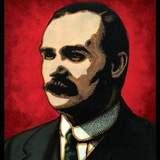
I have never been able to understand how it was that the authorities did not become aware that some- thing untoward was afoot. There were two dozen policemen detailed to attend the Citizen Army march and they hung around Beresford Place waiting for the march to begin. Surely they should have been able to sense the difference in the feeling of the crowds that were thronged around Liberty Hall all the day. There was no disguising by the people that they expected a different ending to this march than to all the other marches. Else why the haversacks filled with food, the bandoliers filled with ammunition, and the supply wagons piled high with supplies? The men and women were under military orders. They were no longer a volunteer organization, they were a nation's army. Their fathers and, mothers, their wives and children, their sisters and brothers, and their sweethearts knew that from that day forth their lives were no longer their own, but belonged to Ireland.
Pg.99
Pg.99
"Connollyism -- like Connolly's politics -- has a complicated structure, having developed, in several historical stages"
Austen Morgan is the author of James Connolly: A Political Biography. The following article, Connolly and Connollyism: The Making of a Myth appeared in Irish Review in 1988 and summarises Morgan's views on James Connolly and his political development. In short, he maintains that Connolly's ideology evolved over time, particularly after his time in America, ranging from internationalist, syndicalist and ultimately nationalist.
Austen Morgan is the author of James Connolly: A Political Biography. The following article, Connolly and Connollyism: The Making of a Myth appeared in Irish Review in 1988 and summarises Morgan's views on James Connolly and his political development. In short, he maintains that Connolly's ideology evolved over time, particularly after his time in America, ranging from internationalist, syndicalist and ultimately nationalist.
"In his first Irish period, he theorized a socialist revolution for Ireland... Connolly assumed that a nationalist answer was inevitable, at a time when the constitutional question was dormant. His socialist vision had its moments of nationalism, but he never articulated national independence as a completion of the bourgeois revolution, and it is a travesty to try to tease out a theory of permanent revolution from his writings."
" Connolly attempted to establish an Irish socialist tradition, only to retreat to the politics of the international sect...
...he became a syndicalist...And he remained one for the rest of his socialist life; Connolly stopped being a syndicalist when he set aside socialism...There was no talk of socialist revolution in Ireland from 1910, when he returned from the United States. "
"Connolly's nationalism had hardly dominated his twenty-five years of his political commitment; from August 1914 it would increasingly command his very being. His last twenty months are a matter of historical record. He became a Germanophile, and collaborated with a wartime imperialist state. "
"The Irish Citizen Army secured his admission to the Irish Republican Brotherhood's military council, and Connolly went to his death an unapologetic Fenian. There were many opportunities to articulate a socialist project, but there is no substantial evidence that he sought to do so."
" Connolly attempted to establish an Irish socialist tradition, only to retreat to the politics of the international sect...
...he became a syndicalist...And he remained one for the rest of his socialist life; Connolly stopped being a syndicalist when he set aside socialism...There was no talk of socialist revolution in Ireland from 1910, when he returned from the United States. "
"Connolly's nationalism had hardly dominated his twenty-five years of his political commitment; from August 1914 it would increasingly command his very being. His last twenty months are a matter of historical record. He became a Germanophile, and collaborated with a wartime imperialist state. "
"The Irish Citizen Army secured his admission to the Irish Republican Brotherhood's military council, and Connolly went to his death an unapologetic Fenian. There were many opportunities to articulate a socialist project, but there is no substantial evidence that he sought to do so."
Forwarded from Archiving Irish Diversity Stuff (AIDS)
Some Brilliant books on this site. I'll probably be picking up a few. I recommended to them to put up James Connolly's collected works (as well as others) so hopefully they put that on the site as they have Pearse's (as the only place selling Connolly's collected works is some shitlib place).
https://www.antelopehillpublishing.com/
https://www.antelopehillpublishing.com/
"The I.R.S.P. was founded in Dublin by a few working men while the writer had succeeded in interesting in his proposition that the two currents of revolutionary thought in Ireland, the socialist and the national, were not antagonistic but complementary, and that the Irish socialist was in reality the best patriot, but in order to convince the Irish people of that fact he must first learn to look inward upon Ireland for his justification, rest his arguments upon the facts of Irish history, and be a champion against the subjection of Ireland and all that it implies. That the Irish question was at bottom an economic question, and that the economic struggle must first be able to function nationally before it could function internationally, and as socialists were opposed to all oppression, so should they ever be foremost in the daily battle against all its manifestations, social and political."
Connolly quote taken from Greaves' Life and Times of James Connolly
Connolly quote taken from Greaves' Life and Times of James Connolly