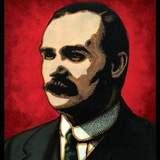
"Have you seen the Socialist papers?"
"No," said she, "why do you ask?"
"Because they will not understand why I am here. They all forget that I am an Irishman."
These are precious words for those of Irish blood in the socialist movement to ponder. They are the last words of a patriot, words of regret that the comrades he worked with for economic betterment could not understand. And why? Because in the mind and heart of Connolly there lived the patriotism of a David, but related to Ireland; in the minds and hearts of real Socialists there abides the treason of Marx and Engels. The contrasting sentiments are here presented in parallel columns for the benefit of Irish Socialists.
Psalm 136
"If I forget thee, Jerusalem, let my right hand be forgotten. Let my tongue cleave to my jaws if I do not remember thee: If I make not Jerusalem the beginning of my joy."
The Communist Manifesto
"The Communists are further reproached with desiring to abolish countries and nationalities-- The working men have no country. We cannot take from them what they have not got."
Right you are, James Connolly, they could not understand that you were an Irishman, for love of country is not in the philosophy of socialism. Ireland was your country, while they who have the whole wide world for their country have no country, they are traitors to every country that flies not the Red Flag of Revolution.
(David Goldstein, Autobiography of a Campaigner For Christ, pg. 191-192)
"No," said she, "why do you ask?"
"Because they will not understand why I am here. They all forget that I am an Irishman."
These are precious words for those of Irish blood in the socialist movement to ponder. They are the last words of a patriot, words of regret that the comrades he worked with for economic betterment could not understand. And why? Because in the mind and heart of Connolly there lived the patriotism of a David, but related to Ireland; in the minds and hearts of real Socialists there abides the treason of Marx and Engels. The contrasting sentiments are here presented in parallel columns for the benefit of Irish Socialists.
Psalm 136
"If I forget thee, Jerusalem, let my right hand be forgotten. Let my tongue cleave to my jaws if I do not remember thee: If I make not Jerusalem the beginning of my joy."
The Communist Manifesto
"The Communists are further reproached with desiring to abolish countries and nationalities-- The working men have no country. We cannot take from them what they have not got."
Right you are, James Connolly, they could not understand that you were an Irishman, for love of country is not in the philosophy of socialism. Ireland was your country, while they who have the whole wide world for their country have no country, they are traitors to every country that flies not the Red Flag of Revolution.
(David Goldstein, Autobiography of a Campaigner For Christ, pg. 191-192)
There have been many attempts to explain the revolution which took place in Ireland during Easter Week, 1916. And all of them give different reasons. Some have it that it was caused by the resentment that grew out of the Dublin Strike of 1912-13; others, that it was the threatened Ulster rebellion, and there are many other equally wrong explanations. All these writers ignore the main fact that the Revolution was caused by the English occupation of Ireland.
...as a nation Ireland has never recognized England as her conqueror, but as her antagonist, as an enemy that must be fought. And this attitude has succeeded in keeping the soul of Ireland alive and free.
For the conquest of a nation is never complete till its soul submits, and the submission of the soul of a nation to the conqueror makes its slavery and subjection more sure. But the soul of Ireland has never submitted. And sometimes when the struggle seemed hopeless and sacrifice useless, and there was thought to make truce with the foe, the voice of the soul of Ireland spoke and urged the nation once more to resist. And the voice of the soul of Ireland has the clangor of battle.
There have been many attempts to drown the voice of the soul of Ireland ever since the coming of the English into our country...
For in Ireland we have the unbroken tradition of struggle for our freedom. Every generation has seen blood spilt, and sacrifice cheerfully made that the tradition might live.
Our songs call us to battle, or mourn the lost struggle; our stories are of glorious victory and glorious defeat. And it is through them the tradition has been handed down till an Irish man or woman has no greater dream of glory than that of dying
"A Soldier's death so Ireland's free."
- Nora Connolly O'Brien, The Unbroken Tradition.
...as a nation Ireland has never recognized England as her conqueror, but as her antagonist, as an enemy that must be fought. And this attitude has succeeded in keeping the soul of Ireland alive and free.
For the conquest of a nation is never complete till its soul submits, and the submission of the soul of a nation to the conqueror makes its slavery and subjection more sure. But the soul of Ireland has never submitted. And sometimes when the struggle seemed hopeless and sacrifice useless, and there was thought to make truce with the foe, the voice of the soul of Ireland spoke and urged the nation once more to resist. And the voice of the soul of Ireland has the clangor of battle.
There have been many attempts to drown the voice of the soul of Ireland ever since the coming of the English into our country...
For in Ireland we have the unbroken tradition of struggle for our freedom. Every generation has seen blood spilt, and sacrifice cheerfully made that the tradition might live.
Our songs call us to battle, or mourn the lost struggle; our stories are of glorious victory and glorious defeat. And it is through them the tradition has been handed down till an Irish man or woman has no greater dream of glory than that of dying
"A Soldier's death so Ireland's free."
- Nora Connolly O'Brien, The Unbroken Tradition.
Towards the end of 1915 the hearts of the Irish Citizen Army beat high, when they were summoned one night for special business. One by one they were called into a room where their Commandant, James Connolly, and his Chief of Staff, Michael Mallin, we're seated at a table. They were not d on their word not to reveal anything they should hear until the time came. Something like the following conversation took place:
"Are you willing to fight for Ireland?"
"Yes. "
"It might mean your deah."
"No matter."
"Are you ready to fight to-morrow of asked?"
"Whenever I'm wanted. "
"Do you think we ought to fight with the few arms we've got?"
"Why wait? England can get millions to our one."
"It might mean a massacre."
"In God's name let us fight, we've been waiting long enough."
"The Irish Volunteers might not come out with us. Are you ready?"
"What matter? We can put up a good fight."
"Then in God's name hold yourself ready. The Day is very near."
(The Unbroken Tradition, Nora Connolly O'Brien, pg. 28-29)
"Are you willing to fight for Ireland?"
"Yes. "
"It might mean your deah."
"No matter."
"Are you ready to fight to-morrow of asked?"
"Whenever I'm wanted. "
"Do you think we ought to fight with the few arms we've got?"
"Why wait? England can get millions to our one."
"It might mean a massacre."
"In God's name let us fight, we've been waiting long enough."
"The Irish Volunteers might not come out with us. Are you ready?"
"What matter? We can put up a good fight."
"Then in God's name hold yourself ready. The Day is very near."
(The Unbroken Tradition, Nora Connolly O'Brien, pg. 28-29)
Irish Citizen Army marching tune:
"We've got our guns and ammunition, we know how to use them well,
And when we meet the Saxon we'll drive them all to Hell.
We've got to free our country, and avenge all those who fell,
And our cause is marching on.
Glory, glory to old Ireland,
Glory, glory to old Ireland,
Glory to the memory of those who fought and fell,
And we still keep marching on."
"We've got our guns and ammunition, we know how to use them well,
And when we meet the Saxon we'll drive them all to Hell.
We've got to free our country, and avenge all those who fell,
And our cause is marching on.
Glory, glory to old Ireland,
Glory, glory to old Ireland,
Glory to the memory of those who fought and fell,
And we still keep marching on."
Nora Connolly attached herself to the forces of the North for the planned Easter Rising, part of the First Aid corps as a leader, combatant and field nurse. Upon hearing that the Commmandant of North had ordered the gathered forces to stand down, that he had received demobilization orders, she travelled to Dublin to meet her father. The following is part of their interaction:
I walked along the corridor till I found the room and knocked on the door.
"Who is there?" called my father.
"Nora," I answered.
"What are you doing here? I thought you were with the North men."
"Let me in, father," I said. "I am afraid there is something wrong."
He opened the door and I entered the room. It was rather a small room, square and slightly furnished. There were but two chairs, a table, a cupboard and an army cot. My father was lying on the cot and looking at me in surprise. I went over to him and knelt down beside the cot to tell him why I was there.
"What does it mean, father? Are we not going to fight?" I asked him when I had fin- ished.
"Not fight!" he said in amazement. "Nora, if we don't fight now, we are disgraced for- ever; and all we'll have left to hope and pray for will be, that an earthquake may come and swallow Ireland up."
(The Unbroken Tradition, Nora Connolly O'Brien, pg. 91)
I walked along the corridor till I found the room and knocked on the door.
"Who is there?" called my father.
"Nora," I answered.
"What are you doing here? I thought you were with the North men."
"Let me in, father," I said. "I am afraid there is something wrong."
He opened the door and I entered the room. It was rather a small room, square and slightly furnished. There were but two chairs, a table, a cupboard and an army cot. My father was lying on the cot and looking at me in surprise. I went over to him and knelt down beside the cot to tell him why I was there.
"What does it mean, father? Are we not going to fight?" I asked him when I had fin- ished.
"Not fight!" he said in amazement. "Nora, if we don't fight now, we are disgraced for- ever; and all we'll have left to hope and pray for will be, that an earthquake may come and swallow Ireland up."
(The Unbroken Tradition, Nora Connolly O'Brien, pg. 91)
I have never been able to understand how it was that the authorities did not become aware that some- thing untoward was afoot. There were two dozen policemen detailed to attend the Citizen Army march and they hung around Beresford Place waiting for the march to begin. Surely they should have been able to sense the difference in the feeling of the crowds that were thronged around Liberty Hall all the day. There was no disguising by the people that they expected a different ending to this march than to all the other marches. Else why the haversacks filled with food, the bandoliers filled with ammunition, and the supply wagons piled high with supplies? The men and women were under military orders. They were no longer a volunteer organization, they were a nation's army. Their fathers and, mothers, their wives and children, their sisters and brothers, and their sweethearts knew that from that day forth their lives were no longer their own, but belonged to Ireland.
Pg.99
Pg.99
"Connollyism -- like Connolly's politics -- has a complicated structure, having developed, in several historical stages"
Austen Morgan is the author of James Connolly: A Political Biography. The following article, Connolly and Connollyism: The Making of a Myth appeared in Irish Review in 1988 and summarises Morgan's views on James Connolly and his political development. In short, he maintains that Connolly's ideology evolved over time, particularly after his time in America, ranging from internationalist, syndicalist and ultimately nationalist.
Austen Morgan is the author of James Connolly: A Political Biography. The following article, Connolly and Connollyism: The Making of a Myth appeared in Irish Review in 1988 and summarises Morgan's views on James Connolly and his political development. In short, he maintains that Connolly's ideology evolved over time, particularly after his time in America, ranging from internationalist, syndicalist and ultimately nationalist.
"In his first Irish period, he theorized a socialist revolution for Ireland... Connolly assumed that a nationalist answer was inevitable, at a time when the constitutional question was dormant. His socialist vision had its moments of nationalism, but he never articulated national independence as a completion of the bourgeois revolution, and it is a travesty to try to tease out a theory of permanent revolution from his writings."
" Connolly attempted to establish an Irish socialist tradition, only to retreat to the politics of the international sect...
...he became a syndicalist...And he remained one for the rest of his socialist life; Connolly stopped being a syndicalist when he set aside socialism...There was no talk of socialist revolution in Ireland from 1910, when he returned from the United States. "
"Connolly's nationalism had hardly dominated his twenty-five years of his political commitment; from August 1914 it would increasingly command his very being. His last twenty months are a matter of historical record. He became a Germanophile, and collaborated with a wartime imperialist state. "
"The Irish Citizen Army secured his admission to the Irish Republican Brotherhood's military council, and Connolly went to his death an unapologetic Fenian. There were many opportunities to articulate a socialist project, but there is no substantial evidence that he sought to do so."
" Connolly attempted to establish an Irish socialist tradition, only to retreat to the politics of the international sect...
...he became a syndicalist...And he remained one for the rest of his socialist life; Connolly stopped being a syndicalist when he set aside socialism...There was no talk of socialist revolution in Ireland from 1910, when he returned from the United States. "
"Connolly's nationalism had hardly dominated his twenty-five years of his political commitment; from August 1914 it would increasingly command his very being. His last twenty months are a matter of historical record. He became a Germanophile, and collaborated with a wartime imperialist state. "
"The Irish Citizen Army secured his admission to the Irish Republican Brotherhood's military council, and Connolly went to his death an unapologetic Fenian. There were many opportunities to articulate a socialist project, but there is no substantial evidence that he sought to do so."