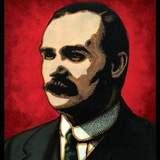
"The Irish situation is two-fold, political and economic. Politically the people of Ireland are under the rule of another country, and even if the Irish were to resolve to effect important economic changes, they could not, because of the political domination of this other country ...
No person can be economically free who is not politically free and no person can be politically free who is not economically free...
...political dependence destroys the racial and other characteristics of the Irish, economic dependence destroys the people themselves."
- James Connolly, Speech in New York 1902
(James Connolly and the United States: The Road to the 1916 Irish Rebellion, pg. 28-29)
The above quote is in reference to Daniel De Leon of the SLP, who had put all his resources and manpower to work undermining the election campaign of another Socialist candidate, Morris Hillquit of the SPA. Hillquit was targeted because he was openly and repeatedly opposed to immigration on the grounds "that workingmen of backwards races (Chinese, Negroes, etc.) are often imported by capitalists in order to keep down the native workingmen by means of cheap labor".
'In a letter written to Matheson November 8, 1908, Connolly at some length criticized De Leon's activities in the current election campaign...
...he answered Matheson's questions about Hillquit's candidacy for the Socialist Party: "You ask me about the probable effect of Dan's campaign upon Hillquit...Dan's whole campaign was directed at Hillquit. I am informed that he scarcely ever referred to the capitalist candidate."
The SLP vote fell off in the 1908 election. "How could it be otherwise when the very few men they did have were withdrawn from the work of attacking capitalism to work on knifing Hillquit. Let Hillquit be what he may, and I do not know him at all, he was at least the representative of Socialism fighting capitalism."
...Connolly, who had suffered unfair political blows at the hands of De Leon, now was moved to deal one of his own: "The belief is slowly forming in my mind that Dan has fooled me all along and that he really is purposely doing the work of the capitalist class".'
(James Connolly and the United States: The Road to the 1916 Irish Rebellion, pg. 102-103)
This is not to suggest that Connolly was a racist or that he held any animosity to immigrants on a personal level. However, it does highlight that even while in America, where much of the labour force was made up of immigrants who Connolly fought to help, he understood that the greater cause of Socialism/Anti-Capitalism was more important than denying that in immediate practical terms immigration harms the native working class, as Hillquit pointed out. His view was the priority should have been with supporting an anti-immigration socialist rather than fighting against him, essentially dying on the hill of solidarity with the international proletariat before admitting distinction or accepting division.
'In a letter written to Matheson November 8, 1908, Connolly at some length criticized De Leon's activities in the current election campaign...
...he answered Matheson's questions about Hillquit's candidacy for the Socialist Party: "You ask me about the probable effect of Dan's campaign upon Hillquit...Dan's whole campaign was directed at Hillquit. I am informed that he scarcely ever referred to the capitalist candidate."
The SLP vote fell off in the 1908 election. "How could it be otherwise when the very few men they did have were withdrawn from the work of attacking capitalism to work on knifing Hillquit. Let Hillquit be what he may, and I do not know him at all, he was at least the representative of Socialism fighting capitalism."
...Connolly, who had suffered unfair political blows at the hands of De Leon, now was moved to deal one of his own: "The belief is slowly forming in my mind that Dan has fooled me all along and that he really is purposely doing the work of the capitalist class".'
(James Connolly and the United States: The Road to the 1916 Irish Rebellion, pg. 102-103)
This is not to suggest that Connolly was a racist or that he held any animosity to immigrants on a personal level. However, it does highlight that even while in America, where much of the labour force was made up of immigrants who Connolly fought to help, he understood that the greater cause of Socialism/Anti-Capitalism was more important than denying that in immediate practical terms immigration harms the native working class, as Hillquit pointed out. His view was the priority should have been with supporting an anti-immigration socialist rather than fighting against him, essentially dying on the hill of solidarity with the international proletariat before admitting distinction or accepting division.
"If Nationalism means that the people shall own the land of the country, as they formerly did, [under an early Irish primitive communist society] and also the factories, machines, railways, shipping and all else necessary to the carrying on and maintenance of social welfare and an Irish civilization, then Socialism is not opposed to Nationalism. If Nationalism means the cultivation of national characteristics merely, such as language, literature, history... then though Socialism is not by any means opposed to these, it is opposed to such a shallow understanding of the national idea, excluding as it does, the conception of an economically free people.”
Connolly’s writings were often illuminated by trenchant and dramatically simple expressions of his concepts. His next sentence was a case in point, “In the world of action and thought,” he wrote, “there is no good cause that has not a friendly relation to Socialism — there is no good cause it will not assist.”
Connolly’s writings were often illuminated by trenchant and dramatically simple expressions of his concepts. His next sentence was a case in point, “In the world of action and thought,” he wrote, “there is no good cause that has not a friendly relation to Socialism — there is no good cause it will not assist.”
In this article, he remarked: “Some innocent people cannot see what the rise of a modern labor movement in Ireland has to do with the question of freedom for Ireland. Poor souls, they never paused to consider what is meant by the word, ‘Ireland.’ They never paused to ask themselves which of the classes in Ireland were interested in freeing the country; which is keeping it in subjection... a class that is interested in having a plentiful supply of Irish cheap labor cannot be expected to do anything to abolish the cheapness of that labor...the oppression of Ireland keeps labor plentiful and cheap. The Irish capitalist and the English government are in entire agreement upon the proposition that the Irish worker should be skinned; they only disagree as to which of them should have the biggest piece of skin.”
He described socialism, in July, 1909, as leading to “the highest, the purest, the holiest form of nationality.” To obtain it -- political action (the ballot). But “if they fail,” he admonished, again demonstrating the flexibility of his approach, “they must resort to the methods of the men of 98 and ‘67.” [Insurrectionary force, used by Wolfe Tone and the Fenians.]
“Nationality,” he said, “is reflected in our music, in our language, in our literature, in our customs, in our games and pastimes...”. Under capitalism, he noted, only the rich have the opportunity to cultivate the arts; under socialism, it would be vastly different. “Our nationality is not even half developed. Only under socialism, will Irish culture be developed to its fullest extent.”
...Several years later, Connolly’s daughter, Ina, had an experience which exemplified the respect held for Connolly and the acceptance by a number of leading militant middle-class nationalists of his theories. A few came close to understanding his politics.
Ina, out of work in Belfast, received an invitation to stay with Countess Markievicz in Dublin. She was met at the station by the legendary Sir Roger Casement (later hanged by the British). He shook her hand and asked: “Is this the little Northern warrior that is going to set Ulster ablaze? What is it you want?”
Ina answered: “An Irish Republic.” Casement gazed at her. “I don’t think that would satisfy your father, ” he said. As Ina recalled: “At once I corrected myself and said: ‘An Irish Workers’ Republic.”
(James Connolly and the United States: The Road to the 1916 Irish Rebellion, pg. 266-268)
He described socialism, in July, 1909, as leading to “the highest, the purest, the holiest form of nationality.” To obtain it -- political action (the ballot). But “if they fail,” he admonished, again demonstrating the flexibility of his approach, “they must resort to the methods of the men of 98 and ‘67.” [Insurrectionary force, used by Wolfe Tone and the Fenians.]
“Nationality,” he said, “is reflected in our music, in our language, in our literature, in our customs, in our games and pastimes...”. Under capitalism, he noted, only the rich have the opportunity to cultivate the arts; under socialism, it would be vastly different. “Our nationality is not even half developed. Only under socialism, will Irish culture be developed to its fullest extent.”
...Several years later, Connolly’s daughter, Ina, had an experience which exemplified the respect held for Connolly and the acceptance by a number of leading militant middle-class nationalists of his theories. A few came close to understanding his politics.
Ina, out of work in Belfast, received an invitation to stay with Countess Markievicz in Dublin. She was met at the station by the legendary Sir Roger Casement (later hanged by the British). He shook her hand and asked: “Is this the little Northern warrior that is going to set Ulster ablaze? What is it you want?”
Ina answered: “An Irish Republic.” Casement gazed at her. “I don’t think that would satisfy your father, ” he said. As Ina recalled: “At once I corrected myself and said: ‘An Irish Workers’ Republic.”
(James Connolly and the United States: The Road to the 1916 Irish Rebellion, pg. 266-268)
At midnight, on May 11th, a military motor drove up to the O’Brien home, where they were staying. The family was informed, according to the affidavit: “The prisoner, James Connolly, was very weak and wished to see his wife and eldest daughter.”
They were driven to Dublin Castle and directed up a flight of stairs. At the landing, and at the top of the stairs stood soldiers, with fixed bayonets. Soldiers, with fixed bayonets, too, guarded the door through which they entered to see James Connolly.
“My father was lying in the bed with his head turned to the door.” As soon as he saw them, he said:
“Well, I suppose you know what this means.”
Lillie said: “Not that, James, not that.”
Nora continued her narrative: “My father said, ‘Yes, for the first time, I dropped off to sleep and they wakened me to tell me that I was to be shot at dawn.’
“My mother cried out: ‘Your life, James. Your beautiful life.’ “
‘Well, Lillie,’ he answered, ‘Hasn’t it been a full life, and isn’t this a good end?’
“I told him of the execution of Padraic Pearse, Thomas MacDonagh and all the others. He was silent for a while. I think he thought he was the first to be executed. Then he said: ‘Well, I am glad that I am going with them’.” Before they left him, he took Nora’s hand and secretly slipped a paper into it.
(“Affadavit of Discovery, Statement by Nora Connolly." Signed by Nora and Lillie Connolly)
They were driven to Dublin Castle and directed up a flight of stairs. At the landing, and at the top of the stairs stood soldiers, with fixed bayonets. Soldiers, with fixed bayonets, too, guarded the door through which they entered to see James Connolly.
“My father was lying in the bed with his head turned to the door.” As soon as he saw them, he said:
“Well, I suppose you know what this means.”
Lillie said: “Not that, James, not that.”
Nora continued her narrative: “My father said, ‘Yes, for the first time, I dropped off to sleep and they wakened me to tell me that I was to be shot at dawn.’
“My mother cried out: ‘Your life, James. Your beautiful life.’ “
‘Well, Lillie,’ he answered, ‘Hasn’t it been a full life, and isn’t this a good end?’
“I told him of the execution of Padraic Pearse, Thomas MacDonagh and all the others. He was silent for a while. I think he thought he was the first to be executed. Then he said: ‘Well, I am glad that I am going with them’.” Before they left him, he took Nora’s hand and secretly slipped a paper into it.
(“Affadavit of Discovery, Statement by Nora Connolly." Signed by Nora and Lillie Connolly)
According to The Communist Manifesto of Karl Marx, "the supremacy of the proletariat will efface all national distinctions." Communists, therefore, will take part in a national struggle only as a matter of tactics . Logically, nationality can be for them only a pretence, for nationality supposes the possession of an immortal soul. If the Communist State grants entire lingual autonomy it emphatically does not recognise cultural autonomy and liberty. The national cultures are allowed to remain national in form, but they must be proletarian in content. Little by little the logic of materialism will tend to wipe out national ideas, but there will come a reaction against this as against the other anti-human elements of Marxism.
That the acceptance of Marxism means logically the annihilation of nationality should be always kept in view when we read appeals to James Connolly's nationalism. Connolly came under the influence of Daniel de Leon, one of the Jews engaged in the task of harnessing the workers of the world to the chariot of Karl Marx's Neo-Messianism. Needless to say, James Connolly did not recognise the implications of Marx's ideas. The leading article of The Worker's Republic, 29th January, 1916, in which he said that he "accepted the family as the true type of human society," and insisted upon the fundamental agreement between his own views and those expressed by Father Laurence in the Trades Hall a few days before, is ample proof of this fact. As James Connolly never had the chance of studying the philosophy or rather the theology of history from the point of view of the Mystical Body of Christ, he could not fully grasp that the one hope of realization of that solidarity of the members of a nation, about which he spoke so touchingly in the leading article already quoted, was through the Mystical Body. Neither was he aware that the naturalistic revolutionary attack on the Mystical Body which began in 1789 is being pushed forward everywhere, now by Communism, now by Masonry, in the attempt to wipe out our Lord and His Church once and for all. Would James Connolly knowingly consent to have his country serve as a mere pawn in the Marxian effort for Jewish world-domination?
That the acceptance of Marxism means logically the annihilation of nationality should be always kept in view when we read appeals to James Connolly's nationalism. Connolly came under the influence of Daniel de Leon, one of the Jews engaged in the task of harnessing the workers of the world to the chariot of Karl Marx's Neo-Messianism. Needless to say, James Connolly did not recognise the implications of Marx's ideas. The leading article of The Worker's Republic, 29th January, 1916, in which he said that he "accepted the family as the true type of human society," and insisted upon the fundamental agreement between his own views and those expressed by Father Laurence in the Trades Hall a few days before, is ample proof of this fact. As James Connolly never had the chance of studying the philosophy or rather the theology of history from the point of view of the Mystical Body of Christ, he could not fully grasp that the one hope of realization of that solidarity of the members of a nation, about which he spoke so touchingly in the leading article already quoted, was through the Mystical Body. Neither was he aware that the naturalistic revolutionary attack on the Mystical Body which began in 1789 is being pushed forward everywhere, now by Communism, now by Masonry, in the attempt to wipe out our Lord and His Church once and for all. Would James Connolly knowingly consent to have his country serve as a mere pawn in the Marxian effort for Jewish world-domination?
David Goldstein was an American Christian Apologist who converted from Judaism to Catholicism and founded the Catholic Campaigners for Christ in the early 1900s. Goldstein was also a former organizer for the Socialist Labor Party of America who later became disenchanted with Marxism and worked against the spread of Socialism in the United States, due to the irreligious & immoral implications of a Marxist society. Goldstein believed strongly in family values which conflicted with Marx's critique of family/marriage. As a result, he and his allies resigned from the Socialist movement and became a fervent anti-Marxist.
The following is a chapter from his autobiography dedicated to his dealings with Irish socialists, including a large section about James Connolly, and the moral and racial characteristics he noted causing issues with the Irish becoming doctrinaire Marxists. This is a fascinating first hand description of the Irish reconciling their socialism with their inherent nationalism.
The following is a chapter from his autobiography dedicated to his dealings with Irish socialists, including a large section about James Connolly, and the moral and racial characteristics he noted causing issues with the Irish becoming doctrinaire Marxists. This is a fascinating first hand description of the Irish reconciling their socialism with their inherent nationalism.
A few interesting points to highlight, but the whole thing is well worth a read.
- [The Irish] "have also the strength of character that keeps their heads from being filled with the clap-trap of the Red Irish. "They have, as a race, a moral sense so highly developed," said I, " that even the unlettered among them, generally speaking, have hearts unpolluted by those Socialist immoralities that logically flow from the application of Marxianism to the conduct of man."
- "...it riled, the Lehanes, Larkins, Connollys, Gurley Flynns and other Hibernians to have a man with a Yiddisher name tell them that socialism is the deadly enemy of things Catholic, and to do so while speaking under Catholic auspices."
- The Irish Socialists were, "enmeshed in something foreign to their inheritance."
- "Connolly had taken Marxian Socialism and whittled it down to his shillalah proportions. This he did by cutting out its anti-God and free-family philosophy, what he called its excrescences."
- "James Connolly, who had come from Ireland full of enthusiasm and ready to rally the Irish for socialism, finally came to the end of his socialistic tether. He was taught something in our country that all too many sincere Socialists have yet to learn: It is what I have said a dozen times already, that socialism is something more than a political and economic movement in the superficial sense of the term, that it's economics mean a revolution in every department of human activity."
- Connolly, "dealt with Socialism in the same manner as the man who separated water into its component parts, oxygen and hydrogen, consuming the oxygen and imagining he was drinking water. Connolly separated the oxygen of socialism -- its economics -- from the hydrogen of socialism -- it's Marxian philosophy -- and imagined he had real socialism."
- "To James Connolly was due the organisation of this racial group into the Irish Socialist Fellowship. Like Connolly, it held Socialism to be economic and nothing but economic...Therefore it adopted the following resolutions...
Socialism as we hold it is not synonymous with atheism...
...does not advocate 'free love,' the abolition of parental authority, or of marriage, or the destruction of the family.
... is purely and absolutely an economic theory...
... We emphatically repudiate the attempt of any individual or publication to identify the Socialist movement with the dissemination of agnosticism, atheism, race suicide, free love, dietetics, ideas concerning marriage, etc."
- In 1921 Goldstein was worried about being accused of "connecting the Irish with Lenin, which would have been an offense."
I'll do a few more summary points later.
- [The Irish] "have also the strength of character that keeps their heads from being filled with the clap-trap of the Red Irish. "They have, as a race, a moral sense so highly developed," said I, " that even the unlettered among them, generally speaking, have hearts unpolluted by those Socialist immoralities that logically flow from the application of Marxianism to the conduct of man."
- "...it riled, the Lehanes, Larkins, Connollys, Gurley Flynns and other Hibernians to have a man with a Yiddisher name tell them that socialism is the deadly enemy of things Catholic, and to do so while speaking under Catholic auspices."
- The Irish Socialists were, "enmeshed in something foreign to their inheritance."
- "Connolly had taken Marxian Socialism and whittled it down to his shillalah proportions. This he did by cutting out its anti-God and free-family philosophy, what he called its excrescences."
- "James Connolly, who had come from Ireland full of enthusiasm and ready to rally the Irish for socialism, finally came to the end of his socialistic tether. He was taught something in our country that all too many sincere Socialists have yet to learn: It is what I have said a dozen times already, that socialism is something more than a political and economic movement in the superficial sense of the term, that it's economics mean a revolution in every department of human activity."
- Connolly, "dealt with Socialism in the same manner as the man who separated water into its component parts, oxygen and hydrogen, consuming the oxygen and imagining he was drinking water. Connolly separated the oxygen of socialism -- its economics -- from the hydrogen of socialism -- it's Marxian philosophy -- and imagined he had real socialism."
- "To James Connolly was due the organisation of this racial group into the Irish Socialist Fellowship. Like Connolly, it held Socialism to be economic and nothing but economic...Therefore it adopted the following resolutions...
Socialism as we hold it is not synonymous with atheism...
...does not advocate 'free love,' the abolition of parental authority, or of marriage, or the destruction of the family.
... is purely and absolutely an economic theory...
... We emphatically repudiate the attempt of any individual or publication to identify the Socialist movement with the dissemination of agnosticism, atheism, race suicide, free love, dietetics, ideas concerning marriage, etc."
- In 1921 Goldstein was worried about being accused of "connecting the Irish with Lenin, which would have been an offense."
I'll do a few more summary points later.