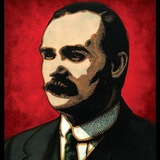
"Out of all this turmoil and fighting the Irish working-class movement has evolved, is evolving, amongst its members a higher conception of mutual life, a realisation of their duties to each other and to society at large; and are thus building for the future in a way that ought to gladden the hearts of all lovers of the race. In contrast to the narrow, restricted outlook of the capitalist class, and even of certain old-fashioned trade unionists, with their perpetual insistence upon ‘rights’, it insists, almost fiercely, that there are no rights without duties, and the first duty is to help one another. This is indeed revolutionary and disturbing, but not half as much as would be a practical following out of the moral precepts of Christianity."
#irishrace #duty
#irishrace #duty
"Since the great development of transatlantic and cross-sea competition, and the supplanting or curbing of the landlord, the chief problem for the Irish farmer is to find a good market where the balance will not be weighted against him. He can only find this by creating a market amongst a sympathetic and prosperous Irish working class. His products are not fancy products, they only appeal to the needs of the human stomach, and not to the whims, passions or fantasies of the imagination. A millionaire, having only one stomach, can only consume what one stomach requires, he cannot consume more of the staple products of our Irish farms than a well-paid tradesman would require and demand.
The dainties, delicacies, wines, &c., which go to make the dinner of the millionaire more costly than that of the tradesman are imported, and hence the greater cost of his dinner does not represent a greater demand for Irish agricultural products.
Thus the Irish farmer cannot increase the demand for his products by any support of the well-to-do, the millionaire, or the budding millionaire. On the contrary, every upward move of Labour in Ireland which adds to the income of the working class, and transforms its members from semi-starved slaves into well-paid toilers able to purchase a sufficiency of food, creates thousands or tens of thousands of new customers. Every defeat of Labour, accompanied by a reduction of purchasing power, lessens the demand for the products of Irish farmers; every victory of Labour increases the purchasing power of the working class and thus sends fresh customers into the Irish market. And if that victory for the Irish working class was won by the support of the co-operative farmers of Ireland, then every constituent of the Irish Labour movement would be morally bound to give preference to the commodities produced by their agricultural allies.
To that moral obligation the establishment and popularisation of co-operative stores under the aegis of the Labour movement would add another, that of self-interest.
Stocking the products of the agricultural co-operative societies in time of industrial peace, the workers would enjoy their credit in time of war; then the trades union in time of peace could invest its funds in the co-operative societies; in time of lock-outs or strikes it would fight with food guaranteed to its members by such societies which, for the food required, would be able to pledge their credit to the organised co-operative farming community.
Trade union funds, instead of being deposited in banks to be let out by those institutions to capitalist exploiters, could be placed to the credit of soundly conducted co-operative enterprises, developing the farmers and aiding the resources of the toilers in town and country. In so doing the urban workers would know that, in helping to make life in the rural districts less unbearable, they were also helping to stem the flow of labour into the towns, thus increasing the security of their own position.
The idea is capable of almost infinite expansion, and not least amongst its attractions is the hope that the minds of Irish men and women, once set thus definitely in the direction of common work, common ownership, and democratically conducted industry, their thought would not cease from travelling that path until they had once more grasped the concept of an Ireland of whose powers, potentialities and gifts each should be an equal heir, in whose joys and cultures all should be sharers...
...If, to that combination of agriculturalists and urban labourers we have just hinted at as a possibility of co-operation upon the economic field, we add the further possible development of an understanding upon the political field between these two groups of co-operators, we begin to realise the great and fundamental change now slowly maturing in our midst...
The dainties, delicacies, wines, &c., which go to make the dinner of the millionaire more costly than that of the tradesman are imported, and hence the greater cost of his dinner does not represent a greater demand for Irish agricultural products.
Thus the Irish farmer cannot increase the demand for his products by any support of the well-to-do, the millionaire, or the budding millionaire. On the contrary, every upward move of Labour in Ireland which adds to the income of the working class, and transforms its members from semi-starved slaves into well-paid toilers able to purchase a sufficiency of food, creates thousands or tens of thousands of new customers. Every defeat of Labour, accompanied by a reduction of purchasing power, lessens the demand for the products of Irish farmers; every victory of Labour increases the purchasing power of the working class and thus sends fresh customers into the Irish market. And if that victory for the Irish working class was won by the support of the co-operative farmers of Ireland, then every constituent of the Irish Labour movement would be morally bound to give preference to the commodities produced by their agricultural allies.
To that moral obligation the establishment and popularisation of co-operative stores under the aegis of the Labour movement would add another, that of self-interest.
Stocking the products of the agricultural co-operative societies in time of industrial peace, the workers would enjoy their credit in time of war; then the trades union in time of peace could invest its funds in the co-operative societies; in time of lock-outs or strikes it would fight with food guaranteed to its members by such societies which, for the food required, would be able to pledge their credit to the organised co-operative farming community.
Trade union funds, instead of being deposited in banks to be let out by those institutions to capitalist exploiters, could be placed to the credit of soundly conducted co-operative enterprises, developing the farmers and aiding the resources of the toilers in town and country. In so doing the urban workers would know that, in helping to make life in the rural districts less unbearable, they were also helping to stem the flow of labour into the towns, thus increasing the security of their own position.
The idea is capable of almost infinite expansion, and not least amongst its attractions is the hope that the minds of Irish men and women, once set thus definitely in the direction of common work, common ownership, and democratically conducted industry, their thought would not cease from travelling that path until they had once more grasped the concept of an Ireland of whose powers, potentialities and gifts each should be an equal heir, in whose joys and cultures all should be sharers...
...If, to that combination of agriculturalists and urban labourers we have just hinted at as a possibility of co-operation upon the economic field, we add the further possible development of an understanding upon the political field between these two groups of co-operators, we begin to realise the great and fundamental change now slowly maturing in our midst...
...Then, when to the easily organised labourers of the towns is added the immense staying power of the peasantry, and when representatives appear in the Halls of Legislature voicing their combined demands, the Party of Labour which will thus manifest itself will speak with a prophetic voice, when it proclaims its ideal for a regenerated Ireland – an Ireland re-conquered for its common people.
For the only true prophets are they who carve out the future which they announce."
For the only true prophets are they who carve out the future which they announce."
Extract taken from The Re-Conquest of Ireland Chapter VIII Labour and Co-operation in Ireland.
I have included this as it touches on something that today's nationalists have begun to realise is an essential step towards our progress, that of a parallel society/culture. Connolly here outlines the basic idea of co-operation in an economic sense, something which can and should be adapted to modern Ireland.
I have included this as it touches on something that today's nationalists have begun to realise is an essential step towards our progress, that of a parallel society/culture. Connolly here outlines the basic idea of co-operation in an economic sense, something which can and should be adapted to modern Ireland.
www.marxists.org
James Connolly: The Re-Conquest of Ireland - Chap. 8
"We have no doubt that it will be found in Ireland, as it has already been found in Italy, that the co-operation of the wage labourers and their intellectual comrades will create an uplifting atmosphere of social helpfulness of the greatest benefit in the work of national regeneration. We have in Ireland, particularly outside of the industrial districts of the North, a greater proportion of professional, literary and artistic people than is to be found in any European country...
This, historically speaking, will mean the enthronement of the Irish nation as the supreme ruler and owner of itself, and all things necessary to its people – supreme alike against the foreigner and the native usurping ownership, and the power dangerous to freedom that goes with ownership."
#foreign #native #irishpeople
This, historically speaking, will mean the enthronement of the Irish nation as the supreme ruler and owner of itself, and all things necessary to its people – supreme alike against the foreigner and the native usurping ownership, and the power dangerous to freedom that goes with ownership."
#foreign #native #irishpeople
" I have long been of opinion that the Socialist movement elsewhere was to a great extent hampered by the presence in its ranks of faddists and cranks, who were in the movement, not for the cause of Socialism, but because they thought they saw in it a means of ventilating their theories on such questions as sex, religion, vaccination, vegetarianism, etc., and I believed that such ideas had or ought to have no place in our programme or in our party."
"we were as a body concerned only with the question of political and economic freedom for our class. We could not claim to have a mission to emancipate the human mind from all errors, for the simple reason that we were not and are not the repositories of all truth. These simple propositions, as they appear to me, I saw to be neglected by the tendency on the part of the European Socialists as a whole to make their press and platform the stumping ground for every idea that had the distinction of being unconventional or in any manner a protest against established ideas."
"...the Irish Volunteers of our time have that great quality the want of which betrayed their predecessors. That quality is: complete faith in their own country, complete confidence in her destiny to be a nation, and complete reliance upon the power of Ireland to survive all the shocks an adverse fate may bring upon her."
#country #nation
#country #nation
"We accept the family as the true type of human society. We say that as in that family the resources of the entire household are at the service of each; as in the family the strong does not prey upon and oppress the weak; as in the family the least gifted mentally and the weakest physically share equally the common store of all with the most gifted and the physically strongest; as in the family the true economy consists in utilising and conserving the heritage of all for the good of all, so in like manner the nation should act and be administered. Every man, woman, and child of the nation must be considered as an heir of all the property of the nation, and the entire resources of the nation should stand behind all individuals guaranteeing them against want, and multiplying their individual powers with all the powers of the organised nation."
#family #nation
#family #nation
"Recognising that the proper utilisation of the nation’s energies requires control of political power, we propose to conquer that political power through a working class political party; and recognising that the full development of national powers requires complete national freedom we are frankly and unreservedly prepared for whatever struggle may be necessary to conquer for Ireland her place among the nations of the earth."
#nation
#nation
"The Irish Race is an old race – perhaps the oldest in Europe. But in its individual members the Irish Race is ever young. Amongst no other people do the old so readily sympathise with and share in the hopes, the joys, and the spirit of the young. The Irish Race rises responsive to the call of battle; the beat of the drums seems to set its blood tingling through its veins to feel its feet once more set upon adventurous paths. A thousand times defeated the Irish Race once more pants to challenge its destiny.
And this is the spirit in which we hear the Call to the Great Adventure of our generation."
#irishrace
And this is the spirit in which we hear the Call to the Great Adventure of our generation."
#irishrace
"The trenches in Flanders have been the graves of scores of thousands of young Irishmen, scores of thousands of the physically strongest of the Irish race have met their death there in desperate battle with a brave enemy who bore them no malice and only wished well for their country."
#irishrace
#irishrace
"When at last the common-sense of the people of Dublin reasserts itself, and men and women begin to protest against this suicidal destruction of the Irish race in a war that is not of their making, and for an Empire that they abhor, the cheap wits of the recruiters sneeringly tell them that there is more danger of death in a Dublin slum than in a trench in the line of battle."
#irishrace
#irishrace
"there were men and women in Ireland who with all the wealth, power, and influence of the country against them, took their stand on the side of England’s enemies, and held by that faith to the last, despite poverty, hunger and want, despite imprisonment, torture and exile, despite death by the bullet, the bayonet and the hangman. These men and women held to the creed that England has no right in Ireland, never had any right in Ireland, never can have any right in Ireland, and so holding they believed that whilst England so holds Ireland – whilst England is here at all – every enemy whose blows hurt England is a natural ally to Ireland, every blow which weakens England, loosens a link of the chain that binds Ireland in slavery."
#irishpeople
#irishpeople
"They are the heroes and the heroines of the popular mind – the demigods of modern Irish history. Scarcely more than a century is gone and already they are enshrined in the memories of the Irish race, whilst all who fought for England are forgotten, or repudiated when remembered."
#irishrace
#irishrace