WHICH IS THE 4TH MOST MASSIVE BLACK HOLE?{PLEASE REFER THE PDF SENT BEFORE....}
Anonymous Quiz
19%
TON 618
49%
HOLMBERG 15-A
21%
IC 1101
11%
NGC 1600
Astronomers and scientists pinned «WHICH IS THE 4TH MOST MASSIVE BLACK HOLE?{PLEASE REFER THE PDF SENT BEFORE....}»
ff97d8015ebfd5f9dac29db52324b470.jpg
55.4 KB
MARS OUR FRIEND😁
“Imagination is more important than knowledge. For knowledge is limited, whereas imagination embraces the entire world, stimulating progress, giving birth to evolution.” – Albert Einstein
Wave function illustrated by :
Anonymous Quiz
20%
Planck
19%
Maxwell
10%
Hawking
11%
Heisenberg
27%
Shrödinger
13%
Einstein
@astronomersgrp join our discuss group and
-make friends
-know more about astronomy
-and discuss astronomy together.
Have fun
Merry Christmas ❤️❤️ to you and your family.
We wish you good day
Team astronomy
@astronomers2021
-make friends
-know more about astronomy
-and discuss astronomy together.
Have fun
Merry Christmas ❤️❤️ to you and your family.
We wish you good day
Team astronomy
@astronomers2021
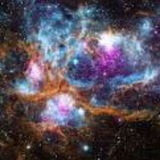
Spot the stellar snowflakes on the cosmic Christmas tree
About 2,500 light-years from Earth, stars are being born in a region of space known as the Christmas Tree Cluster. Seen in the infrared (just beyond the range of visible light) by NASA's Spitzer Space Telescope, these infant stars (less than 100,000 years old) appear as pink and red specks near the center of this photo, evenly-spaced in a spoke-like pattern that gives them the name of the Snowflake Cluster.
About 2,500 light-years from Earth, stars are being born in a region of space known as the Christmas Tree Cluster. Seen in the infrared (just beyond the range of visible light) by NASA's Spitzer Space Telescope, these infant stars (less than 100,000 years old) appear as pink and red specks near the center of this photo, evenly-spaced in a spoke-like pattern that gives them the name of the Snowflake Cluster.
❤1
THE SPITZER SPACE TELESCOPE DETECTS WHICH PART OF THE EM SPECTRUM?
Anonymous Quiz
14%
MICROWAVE
12%
RADIO WAVE
22%
INFRARED
18%
X RAYS
15%
GAMMA RAYS
7%
VISIBLE LIGHT
12%
ULTRA VIOLET RAYS
What a fact!
How far is Pluto? 🧐
The distance between Jupiter and Pluto is 35 times the distance between the earth and the sun.
The distance between
Uranus and Pluto is 20 times the distance between Earth and the Sun.
The distance between Neptune and Pluto is 10 times the distance between Earth and the Sun.
https://t.me/astronomers2021
How far is Pluto? 🧐
The distance between Jupiter and Pluto is 35 times the distance between the earth and the sun.
The distance between
Uranus and Pluto is 20 times the distance between Earth and the Sun.
The distance between Neptune and Pluto is 10 times the distance between Earth and the Sun.
https://t.me/astronomers2021
Telegram
Astronomers and scientists
Do you want to be astronomer or scientist
Then you are at right place
You get -:
-daily facts
-science things
-astronomy things
Sister channels -:
@astromersandscientist
@sciencetists2021
Cross-: @SONGOKU_KUN
Then you are at right place
You get -:
-daily facts
-science things
-astronomy things
Sister channels -:
@astromersandscientist
@sciencetists2021
Cross-: @SONGOKU_KUN
Hi there like you see we are posting facts.
The real question is are you sharing? If u have any channel for cross contact @songoku_kun
Also if u have the group send our link for more subscribers.
We need to hit 1.2k subscribers this week. Who do we it say me.😁😊
The real question is are you sharing? If u have any channel for cross contact @songoku_kun
Also if u have the group send our link for more subscribers.
We need to hit 1.2k subscribers this week. Who do we it say me.😁😊
👍1