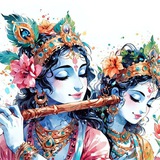
अद्वैत में भक्ति कैसे होती है, बताता हूँ। हम लोग भगवान को भजते हैं जो यह संसार है, जो सब कुछ है, सब कुछ (अद्वैत - non-duality) उसके अलावा कुछ नहीं है। उस भगवान को मैं भजता हूँ। मेरे माता-पिता सब भगवान हैं।
त्वमेव माता च पिता त्वमेव,
त्वमेव बन्धुश्च सखा त्वमेव।
त्वमेव विद्या च द्रविणं त्वमेव,
त्वमेव सर्वम् मम देवदेवम्।।
त्वमेव सर्वम् (अद्वैत केवल एक) यानी वह सब कुछ है, मैं उस भगवान को भजता हूँ। जब मैं अपनी माता का सेवा करता हूँ, तब मैं यह सोचता हूँ कि मैं भगवान की सेवा कर रहा हूँ, क्योंकि वह भी भगवान हैं (अद्वैत - he is the only one)। सब कुछ भगवान है, सब कुछ। जब मैं अपने दोस्त के साथ खेल रहा होता हूँ, तब मैं यह देखता हूँ कि यह मेरा दोस्त स्वयं भगवान है। मैं कृष्ण के साथ ही खेल रहा हूँ। जब मैं आपसे बात कर रहा हूँ, तब भी मैं आपको भगवान के रूप में देखता हूँ। मेरा यह शरीर भगवान नहीं है। मेरी चेतना भगवान है। मेरी चेतना ही आप हो। भगवान मेरी चेतना है, सबकी चेतना। वह मुझसे अलग नहीं है। वह हम सब से अलग नहीं है क्योंकि वह हमारी चेतना है। उस भगवान को मैं भजता हूँ। उस भगवान को मैं भजता हूँ। जय श्री कृष्ण। हर हर महादेव। जय माँ आदि शक्ति। 🙏🙏 सत्यमेव जयते 🙏🙏
#Explainers@advaitikreference
त्वमेव माता च पिता त्वमेव,
त्वमेव बन्धुश्च सखा त्वमेव।
त्वमेव विद्या च द्रविणं त्वमेव,
त्वमेव सर्वम् मम देवदेवम्।।
त्वमेव सर्वम् (अद्वैत केवल एक) यानी वह सब कुछ है, मैं उस भगवान को भजता हूँ। जब मैं अपनी माता का सेवा करता हूँ, तब मैं यह सोचता हूँ कि मैं भगवान की सेवा कर रहा हूँ, क्योंकि वह भी भगवान हैं (अद्वैत - he is the only one)। सब कुछ भगवान है, सब कुछ। जब मैं अपने दोस्त के साथ खेल रहा होता हूँ, तब मैं यह देखता हूँ कि यह मेरा दोस्त स्वयं भगवान है। मैं कृष्ण के साथ ही खेल रहा हूँ। जब मैं आपसे बात कर रहा हूँ, तब भी मैं आपको भगवान के रूप में देखता हूँ। मेरा यह शरीर भगवान नहीं है। मेरी चेतना भगवान है। मेरी चेतना ही आप हो। भगवान मेरी चेतना है, सबकी चेतना। वह मुझसे अलग नहीं है। वह हम सब से अलग नहीं है क्योंकि वह हमारी चेतना है। उस भगवान को मैं भजता हूँ। उस भगवान को मैं भजता हूँ। जय श्री कृष्ण। हर हर महादेव। जय माँ आदि शक्ति। 🙏🙏 सत्यमेव जयते 🙏🙏
#Explainers@advaitikreference
❤1🙏1
Formless God is known as Brahm.
Brahm has internal Shakti from which it does actions and also creates universe. This Shakti is known as Maya.
Nirgun Brahm + Vidya(Shudda) Maya = Sagun Brahm (Ishwar).
This includes sagun gods like Shiva, Vishnu, Krishna, Adi Shakti etc.
Nirgun Brahm + Avidya Maya = Jeeva
This includes all of us human beings, animals, plants etc.
#Explainers@advaitikreference
Brahm has internal Shakti from which it does actions and also creates universe. This Shakti is known as Maya.
Nirgun Brahm + Vidya(Shudda) Maya = Sagun Brahm (Ishwar).
This includes sagun gods like Shiva, Vishnu, Krishna, Adi Shakti etc.
Nirgun Brahm + Avidya Maya = Jeeva
This includes all of us human beings, animals, plants etc.
#Explainers@advaitikreference
So what's the difference between Ishwar and Jeeva?
The difference is that ishwar is not restricted by maya. He can do anything. He can create anything and also he knows that he is the all pervading god. He knows that he is the self of all.
While jeeva is restricted by Maya. We can't do anything in this state now. We can't lift govardhan parvat now. And we think ourself limited only to our body.
While Ishwar (saguna brahm) came in this world just like a man wears a blanket by his own will. Here man is sagun brahm and blanket is Vidya maya. He is not a slave of maya but actually he is the owner here.
Avidya Maya is made from tamsik nature while Vidya maya is made from Shuddha satva
#Explainers@advaitikreference
The difference is that ishwar is not restricted by maya. He can do anything. He can create anything and also he knows that he is the all pervading god. He knows that he is the self of all.
While jeeva is restricted by Maya. We can't do anything in this state now. We can't lift govardhan parvat now. And we think ourself limited only to our body.
While Ishwar (saguna brahm) came in this world just like a man wears a blanket by his own will. Here man is sagun brahm and blanket is Vidya maya. He is not a slave of maya but actually he is the owner here.
Avidya Maya is made from tamsik nature while Vidya maya is made from Shuddha satva
#Explainers@advaitikreference
❤2👍2
Media is too big
VIEW IN TELEGRAM
You are not just a tiny drop of the ocean, you are the whole ocean. You are the creator as well as the creation. You just have to realise.
#Explainers@advaitikreference
#Explainers@advaitikreference
Path of Knowledge - Seeing Yourself Everywhere and in everything
Path of Bhakti – Seeing your ishta/krishna everywhere and in everything
If you look carefully, it's the same thing. Because there's no one other than krishna/ you himself. Upanishad says ekamev advityam. He is the only one in this world without a second one that's called advait(non duality)
#Explainers@advaitikreference
Path of Bhakti – Seeing your ishta/krishna everywhere and in everything
If you look carefully, it's the same thing. Because there's no one other than krishna/ you himself. Upanishad says ekamev advityam. He is the only one in this world without a second one that's called advait(non duality)
#Explainers@advaitikreference
🙏1
1. Now let's learn about Hinduism. So first we need to learn about the basic principles of Hinduism. Hinduism or Sanatana Dharma or Vedic dharma roots its foundations from its scriptures. Hinduism has several scriptures but the topmost authority of the scriptures in it and the most sacred among them are known as "Shruti" which literally means as "what had been heard". It is believed that Shruti mantras had been revealed by the ancient Rishis and Rishikas (Female Rishis are known as Rishikas) in the state of deep meditation. Vedas are called Shruti. Some philosophers also say that agama shastra also came in shruti but not yet considered more authorative than vedas.
👍1
2. Now we need to learn about what is Vedanta? You might have probably heard this term. Vedanta is derived from the two words VEDA + ANTA(end). Vedanta literally means the end of the vedas. Upanishads are known as vedantic texts. Because they are the final message of the vedas. Upanishads are also part of the vedas which deals with the questions and answer of our existence that who we are in this universe and why we are?
अगर आप योग दर्शन सीखना चाहते हैं तो इस playlist के videos देखें।
https://youtube.com/playlist?list=PLgiYC40Ul9jpFr-FwN-4vmgXVArBJ7QHM&si=GSXIu5WeP9iO8cYM
https://youtube.com/playlist?list=PLgiYC40Ul9jpFr-FwN-4vmgXVArBJ7QHM&si=GSXIu5WeP9iO8cYM
3. Now let's see who we are? So it is little bit complicated to explain. So I am sending you all a video link. See this video. The video is very interesting. It has great editing and cinematic music effects. You will love to watch it. You will feel like if you are watching a movie.
Link - https://youtu.be/YXqaKMM0xE8?si=R5LKCproOZrKzNvB
Link - https://youtu.be/YXqaKMM0xE8?si=R5LKCproOZrKzNvB
4. Now we know that we are actually the whole universe. The whole creation. We are literally 'God'. But we have limited ourselves to this body. And we forgot our true self. So let's understand why did this happened. Why we have limited ourselves. We are the creator as well as the creation but we are considering ourselves only to a little fragment in the universe despite of being the whole universe. So the answer to this question is given in this video. See this. The video is very interesting. It has great editing and cinematic music effects. You will love to watch it. You will feel like if you are watching a movie.
Link - https://youtu.be/J8AadYvos3A?si=50scrNubBwgl22OV
Link - https://youtu.be/J8AadYvos3A?si=50scrNubBwgl22OV
5. Now some people may ask "How can we claim that we are god?" It's like increasing our ego. Ravan considered himself as God due to his ego. Even many rakshas claimed them as god in the past and you know the consequences. The answer to this question is simple. Ravan and other rakshas claimed only themselves as God. But here in Advait Vedant, Vedas (the topmost scriptures in Hinduism) claim everything is god. You and I everything even non living things all are Krishna. As lord Krishna says in the Bhagvat Gita 7.19 that after the spiritual practice of many births, tattvagyani sees everthing as Krishna (Vasudevam Sarvam iti). I would suggest you to watch this video to further know about this topic. As usual, the video is very interesting. It has great editing and cinematic music effects. You will love to watch it. You will feel like if you are watching a movie.
Link - https://youtu.be/-3fBb6xm8rM?si=YmuGlV7RkFdZKXQn
#Explainers@advaitikreference
Link - https://youtu.be/-3fBb6xm8rM?si=YmuGlV7RkFdZKXQn
#Explainers@advaitikreference
6. Now let's learn about some of the basic terminologies used in Hinduism.
7. Aatma/Soul
Atma is your true identification. You are not this body. You are Atma. You just don't know that you are Atma. So what is Aatma. A broader description of Aatma is given in the Bhagvat Gita Chapter 2.
Gita 2.17
अविनाशि तु तद्विद्धि येन सर्वमिदं ततम् |
विनाशमव्ययस्यास्य न कश्चित्कर्तुमर्हति ||
(O Arjuna!) Know that Atma by which the whole universe is pervaded is indestructible. No one can cause the destruction of the imperishable.
Translation by vivekavani.com
https://vivekavani.com/b2v17/
Gita 2.24
अच्छेद्योऽयमदाह्योऽयमक्लेद्योऽशोष्य एव च |
नित्य: सर्वगत: स्थाणुरचलोऽयं सनातन: ||
The Atma cannot be cut, cannot be burnt, cannot be wetted, and also cannot be dried up. It is eternal, all-pervading, firm, immovable, and ancient.
Translation by vivekavani.com
https://vivekavani.com/b2v24/
In the above two verses you can see that there are not many Aatma. Some people think that in every body there is a unique aatma. No this is not correct. There is only one soul in this universe, which is everywhere. The size of Aatma is infinite. It is both inside the body as well as outside the body. It is in living things as well as in non-living things. It is pervading all the universe. I know this is a little tough to digest so for scriptural references please checkout this link https://t.me/advaitikreference/21
Now some people may think that in Hinduism it is said that when a person dies its soul never dies. It goes into another body known as reincarnation(punar janm) but here we are saying that the soul is omnipresent then how it can go in another body. Actually soul doesn't go to another body. How can soul goes to another body as it is present everywhere? We will get answer to this question in the next post.
#Explainers@advaitikreference
Atma is your true identification. You are not this body. You are Atma. You just don't know that you are Atma. So what is Aatma. A broader description of Aatma is given in the Bhagvat Gita Chapter 2.
Gita 2.17
अविनाशि तु तद्विद्धि येन सर्वमिदं ततम् |
विनाशमव्ययस्यास्य न कश्चित्कर्तुमर्हति ||
(O Arjuna!) Know that Atma by which the whole universe is pervaded is indestructible. No one can cause the destruction of the imperishable.
Translation by vivekavani.com
https://vivekavani.com/b2v17/
Gita 2.24
अच्छेद्योऽयमदाह्योऽयमक्लेद्योऽशोष्य एव च |
नित्य: सर्वगत: स्थाणुरचलोऽयं सनातन: ||
The Atma cannot be cut, cannot be burnt, cannot be wetted, and also cannot be dried up. It is eternal, all-pervading, firm, immovable, and ancient.
Translation by vivekavani.com
https://vivekavani.com/b2v24/
In the above two verses you can see that there are not many Aatma. Some people think that in every body there is a unique aatma. No this is not correct. There is only one soul in this universe, which is everywhere. The size of Aatma is infinite. It is both inside the body as well as outside the body. It is in living things as well as in non-living things. It is pervading all the universe. I know this is a little tough to digest so for scriptural references please checkout this link https://t.me/advaitikreference/21
Now some people may think that in Hinduism it is said that when a person dies its soul never dies. It goes into another body known as reincarnation(punar janm) but here we are saying that the soul is omnipresent then how it can go in another body. Actually soul doesn't go to another body. How can soul goes to another body as it is present everywhere? We will get answer to this question in the next post.
#Explainers@advaitikreference
👍1
8. Types of bodies (Introduction)
So now the question arises, if the soul is omnipresent and everywhere, what leaves the body when someone dies? I will answer this below.
Our body is made up of three types of bodies:
1. Gross body (Sthul Sharir)
2. Subtle body (Sukshm Sharir)
3. Causal body (Karan Sharir)
When a person dies, the causal body and subtle body leave, but the soul does not go anywhere. Because the soul is everywhere and immovable, as mentioned in the Gita 2.24 and many other scriptures.
The soul merely imparts consciousness to the body.
The soul is present everywhere but we think that we are limited to only this body. How does this thinking arises. This arises due to the causal body. The causal body generates ignorance due to which the soul thinks that it is only limited to his body. At that time, it is called Jivatma. That is, when the soul resides with the body it is called Jivatma. Jivatma = Jiv (body/living beings with individual consciousness) + Atma (soul).
#Explainers@advaitikreference
So now the question arises, if the soul is omnipresent and everywhere, what leaves the body when someone dies? I will answer this below.
Our body is made up of three types of bodies:
1. Gross body (Sthul Sharir)
2. Subtle body (Sukshm Sharir)
3. Causal body (Karan Sharir)
When a person dies, the causal body and subtle body leave, but the soul does not go anywhere. Because the soul is everywhere and immovable, as mentioned in the Gita 2.24 and many other scriptures.
The soul merely imparts consciousness to the body.
The soul is present everywhere but we think that we are limited to only this body. How does this thinking arises. This arises due to the causal body. The causal body generates ignorance due to which the soul thinks that it is only limited to his body. At that time, it is called Jivatma. That is, when the soul resides with the body it is called Jivatma. Jivatma = Jiv (body/living beings with individual consciousness) + Atma (soul).
#Explainers@advaitikreference
9.
Gross Body (Sthul Sharir) - The body that we can see right now is the gross body. This is the body that dies.
Subtle Body (Sukshm Sharir) - Inside the gross body of all beings, there is a subtle body. This body is destroyed during the great dissolution (Maha Pralay). Through this body, we experience happiness, sorrow, and emotions. All the karmas and impressions (sanskar) from our past lives are stored in this body.
The subtle body (sūkṣma śarīra) is composed of 19 elements, which are derived from the five subtle elements (tanmātras). These 19 elements are:
These 19 elements function together to form the subtle body, which carries karma and saṃskāras (past impressions) from one life to another.
Causal Body (Karan Sharir) - As the name suggests, this body is the cause of our entanglement in this world. This body binds beings in ignorance (avidya). If this body is destroyed, we attain liberation (mukti) and are freed from the cycle of birth and death. The existence of this body ensures the existence of the other two bodies. If this body is destroyed, the other two bodies will also be destroyed. This body can be destroyed through knowledge (Vidya/Gyan), which can be attained through practices like devotion (Bhakti), knowledge (Gyan), Ashtanga Yoga, and Karma Yoga.
These are the three bodies.
Note
Gross body is made up of 5 gross elements; Akash, Air, Fire, Water, Earth while subtle body is made up of 5 subtle elements; subtle akash, subtle air, subtle fire, subtle water. That's why we can't be able to see this body. While Casual body is Avyakt (Non manifested).
#Explainers@advaitikreference
Gross Body (Sthul Sharir) - The body that we can see right now is the gross body. This is the body that dies.
Subtle Body (Sukshm Sharir) - Inside the gross body of all beings, there is a subtle body. This body is destroyed during the great dissolution (Maha Pralay). Through this body, we experience happiness, sorrow, and emotions. All the karmas and impressions (sanskar) from our past lives are stored in this body.
The subtle body (sūkṣma śarīra) is composed of 19 elements, which are derived from the five subtle elements (tanmātras). These 19 elements are:
I. Five Organs of Perception (Jñānendriyas) – Related to acquiring knowledge
1. Śrotra (Ear) – Hearing
2. Tvak (Skin) – Touch
3. Chakṣus (Eye) – Sight
4. Jihvā (Tongue) – Taste
5. Ghrāṇa (Nose) – Smell
II. Five Organs of Action (Karmendriyas) – Related to performing actions
6. Vāk (Speech) – Speaking
7. Pāṇi (Hands) – Grasping, working
8. Pāda (Feet) – Movement
9. Upastha (Genitals) – Reproduction, pleasure
10. Guda (Anus) – Excretion
III. Five Prāṇas (Vital Energies) – Govern physiological functions
11. Prāṇa – Controls breathing, circulation
12. Apāna – Governs excretion
13. Vyāna – Circulates energy throughout the body
14. Udāna – Governs upward movement, speech, and departure of the soul at death
15. Samāna – Aids digestion and assimilation
IV. Four Antaḥkaraṇas (Inner Instruments) – Mind-related faculties
16. Manas (Mind) – Doubt, thoughts, emotions
17. Buddhi (Intellect) – Discrimination, decision-making
18. Ahaṅkāra (Ego) – Sense of individuality (thinking yourself different from others)
19. Chitta (Memory) – Retentive power, impressions (saṃskāras)
These 19 elements function together to form the subtle body, which carries karma and saṃskāras (past impressions) from one life to another.
Causal Body (Karan Sharir) - As the name suggests, this body is the cause of our entanglement in this world. This body binds beings in ignorance (avidya). If this body is destroyed, we attain liberation (mukti) and are freed from the cycle of birth and death. The existence of this body ensures the existence of the other two bodies. If this body is destroyed, the other two bodies will also be destroyed. This body can be destroyed through knowledge (Vidya/Gyan), which can be attained through practices like devotion (Bhakti), knowledge (Gyan), Ashtanga Yoga, and Karma Yoga.
These are the three bodies.
Note
Gross body is made up of 5 gross elements; Akash, Air, Fire, Water, Earth while subtle body is made up of 5 subtle elements; subtle akash, subtle air, subtle fire, subtle water. That's why we can't be able to see this body. While Casual body is Avyakt (Non manifested).
#Explainers@advaitikreference