Forwarded from Venice Rocks
📜Venice Celebrations Series. #21November, #LaSalute.
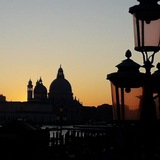
Today, like every 21 November, in Venice it's Festa di Santa Maria della Salute, maybe the most heartfelt celebration for Venetians. It's a Catholic feast in fact, a votive wooden bridge is built on the #GrandCanal to allow citizens to walk and pay tribute to the icon of Saint Mary of Health, kept in the Church of the same name: still today a true pilgrimage!
#VeniceHistory: in 1630 Venice experienced an unusually devastating plague. As a votive offering for the city's deliverance from the pestilence, the Republic of Venice vowed to build and dedicate a church to Our Lady of Health (Salute in Italian). The church was designed in the then fashionable baroque style by architect Baldassare #Longhena. Most of the works of art housed in the church bear references to the Black Death.
Needless to say the Church of Santa Maria della Salute is one of the most iconic image of Venice (and of Venice Rocks Channel too 😉) as you probably recognize 📸☝️
#VeniceEvents
🌊📜In Autumn and Winter high tides threaten Venice and the #Lagoon.
This happens for ages, since Venice was founded: the first reported Acqua Granda (Flood) dates back in January 1286 and, along with it, the idea of the construction of a dam to prevent Venice from being flooded.
An early example of dam were the so called Murazzi, still today visible at the #Alberoni in Venice #Lido, built in 1744 in various places where the "Lagoon meets the Sea": the Lido, Santa Maria Del Mare, Pellestrina, Sottomarina.
Today we have the MOSE, finally working since 2021, after the last Acqua Granda of November 2019 which devasted Venice. Yesterday it was activated and definitely saved the city!!!
An interesting video of how it works here👇
#Mose #VeniceFlood #HighWater #HighTide #VeniceHistory
https://www.youtube.com/watch?v=bYAysXU0r7o
YouTube
THE MOSE SYSTEM
This video shows how the Mose System can protect Venice and it's lagoon area from high tides.
The system consists of barriers made up of mobile gates able to temporarily separate the lagoon from the sea and protect Venice from both exceptional destructive…
The system consists of barriers made up of mobile gates able to temporarily separate the lagoon from the sea and protect Venice from both exceptional destructive…
👍1
Forwarded from Venice Rocks
🎼24 November 1941. Happy 80th Birthday 🥳🍾 to Giuseppe "Pino" Donaggio, born in #Burano island, Venice and longtime vacationeer in #myhometown Auronzo di #Cadore, #Dolomites.
His name won't tell much to the majority, but #PinoDonaggio was a singer, musician and above all prominent composer since the 1960s. Most of his career is characterized by film scores, having written soundtracks for horror icons such has #DarioArgento, #BrianDePalma, #LucioFulci, #JoeDante: to name a few more #PupiAvati, #TintoBrass and the music for Italian legendary comedy #NonCiRestaChePiangere by #RobertoBenigni and #MassimoTroisi.
However Donaggio will be forever remembered for writing many Italian 1960s hits, his biggest one went international in 1965 and sold 80 million records worldwide!!! 😳👏
The song was called "Io che non vivo", and was performed in English as "You Don't Have to Say You Love Me" by #DustySpringfield, #ElvisPresley, #PaulAnka among the others. In the Chat Room some of these versions👇
#24November #VeniceMusic
Forwarded from Venice Rocks
👨🎨26 November 1516. Giovanni Bellini (above his portrait☝️) passes away in his birthplace, Venice. He was one of the first Italian #Renaissance painters, the most important of the #Bellini family, although at the time his father Jacopo and his brother Gentile were more highly regarded: #GiovanniBellini was also brother-in-law of another absolute master 👉 Andrea Mantegna, who married his sister.
He revolutionized Venetian painting, moving it towards a more sensuous and colouristic style. Through the use of clear, slow-drying oil paints, Giovanni created deep, rich tints and detailed shadings. His influence on the Venetian painting school, especially on his pupils #Giorgione and #Tiziano is evident.
Bellini's most famous works are held in international museums; in Venice we can admire his frescoes and paintings in the Churches of SS. Giovanni e Paolo, Santa Maria Gloriosa dei Frari, San Zaccaria and San Francesco della Vigna.
In the ChatRoom👇 Bellini works in Venice Museums.
#VeniceArt #26November
👏1
Forwarded from Venice Rocks
🎥3 December 2004. Venice in Movie Series.
The Merchant of Venice, a 2004 romantic drama film based on William Shakespeare's 16th-century play of the same name, is released. It is the first full-length sound film in English of a Shakespeare's play, other versions are videotaped productions which were made just for television.
Entirely filmed in Venice, representing life and history in the Jewish Ghetto (some of you remember my #WalkingTour? 😉 The First Ghetto in the world!), it is directed by Michael Radford and stars 🔝 actors such as Jeremy Irons and Al Pacino.
The title character is the merchant Antonio (#JeremyIrons), not the Jewish moneylender Shylock who is the antagonist (#AlPacino) and the more prominent character. This adaptation follows the text, but omits much, the film Director believed that Shylock was #Shakespeare first great tragic hero who reaches a catastrophe due to his own flaws. The film begins with text and a montage of how the Jewish community is abused by the Christian population of Venice and brings attention to the fact that, as a convert, Shylock would have been cast out of the Jewish #Ghetto: as often happens in these cases the movie treatment of antisemitism has been object of controversies.
Have you seen this film?
#VeniceMovies #VeniceFilmFestival #3December
https://www.youtube.com/watch?v=mdbzRtxVtns
YouTube
The Merchant of Venice (2004) - Official Trailer
Forwarded from Venice Rocks
📜🎶1222. 800 years ago Leonardo Bonacci from #Pisa, #Italy, later worldwide known as Fibonacci, introduced his numbers sequence, still today one of the most used and referred formulas in mathematics.
#Fibonacci was son of the most important merchant in Pisa at the time, and he travelled for years in North Africa and Middle East countries for trading. His passion for numbers grew in those years and he is considered the main "responsible" for introducing the "Indo-Persian-Arabic" numbering system (1-9) in Europe and in the Western world.
He added to it the "0" which was unknown: 👉 Venice (another prominent Maritime Republic in the Mediterranean, longtime rival of Pisa) later named this figure as "zero".
The #FibonacciSequence (today denoted as "Fn") is a sequence of numbers in which each number is the sum of the two preceding ones (0, 1, 1, 2, 3, 5, 8, 13, 21, 34, 55, 89, 144...)
Later studies confirmed that this sequence can be found everywhere in nature 🌳 and applied in all fields of life, from physics, to medicine, to economy...
The Fibonacci Sequence was often applied in Cassical Music too, by "translating" numbers into notes which resulted in repeating the same sequence after 16 notes... uncountable examples can be found in modern music too, especially in Progressive Rock.
This track👇🎧 is presented as one of today examples, Lateralus by #Tool: I'm not a musician so I confess I don't quite get it, but I'm sure some musician here can help.
#VeniceHistory #MaritimeRepublic
https://youtu.be/Y7JG63IuaWs