
Seeking a fair and reliable gateway to digital asset markets?
Get easy access to professional trading services for crypto derivatives market with ZUBR.
Execute your strategies taking advantage of ZUBR infrastructure:
- Flat one basis point (0.01%) fee for ALL clients
- Microsecond order execution at any volatility
- ZUBR perpetual contracts with leverage up to 20x
- Reliable and friendly UI
- Professional trading services for ALL clients: high-speed network channels, points of presence to major exchanges, co-location in LD4 London
Trade on fair terms.
Risk Warning
Using ZUBR services and ZUBR Exchange Platform involves risks. Please refer to some of these risks as described in the Risk Disclosure Document https://zubr.io/public/docs/risk_disclosure.pdf
ZUBR is the service provided by 4Step Inc.
Santiment study: ETH price correlates strongly with active wallets
According to Santiment, ETH rate movements can be fairly accurately predicted based on the number of Ethereum active addresses.
In March, the number of active wallets is constantly growing, and this indicator began to grow especially sharply after a sharp drop in the cryptocurrency market on March 12-13. Soon after, the number of active wallets for several consecutive days was the largest over the past six months.
“Active ETH addresses have once again confirmed that they are a neat and effective indicator for determining future movements in the price of air,” Santiment analysts wrote on Twitter.
It is worth noting that on March 13, the second cryptocurrency exchange rate fell to $ 90, and at the time of publication of ETH, about $ 172 was being traded, that is, the asset almost doubled. Over the past 24 hours alone, ether has added more than 10%, and its market capitalization has reached $ 19 billion.
Interestingly, before the “cryptocurrency crisis” on March 12-13, large ETH holders began to increase coin holdings. Given that 17% of the total ETH is now stored on exchange wallets, stockpiling may not mean anything.
Some industry experts believe that such significant growth may be due to growing confidence in the planned upgrade of the blockchain to ETH 2.0, which is planned to be deployed in late July.
⚡️AAB Flash Sale starting from April 14th- From 50% off to completely FREE ⚡️
The platform token of AAX - the most trustworthy crypto exchange powered by London Stock Exchange Technologies; trusted by 100K users; institutional-level performance and security 💯
- 100% revenue daily buyback and burn
- Use AAX to enjoy up to 50% trading fee discount
⏰ Set up a reminder for the sales > https://bit.ly/2xWqQDS
Telegram group > https://t.me/aaxcommunity
Aax
AAB Token Sale - Stand a chance to win $1000 free crypto
AAX, the next generation crypto exchange that offers over-the-counter, spot and futures trading, is launching its native exchange token, AAB.
European Parliament favors large-scale expansion of cryptocurrency regulation in the EU
The expert group of the European Parliament introduced a new report in which it recommended expanding the concept of cryptocurrencies and the list of related regulated companies in the EU.
According to experts, the Fifth EU Anti-Money Laundering Directive (AMLD5), adopted in mid-2018, is outdated, as it does not meet the more stringent international standards established by the Financial Action Task Force on Money Laundering (FATF). To harmonize the European approach with the international, the European Parliament calls for a “series of regulatory measures.”
Spaces in the existing system
So, analysts discovered a “huge growth” of token-based platforms and suggested introducing “private tokens” as a subcategory of cryptocurrencies. Also, they note that some industry participants, including exchanges without Fiat support, are not covered by the current regulatory framework and should be forced to comply with anti-money laundering requirements.
It is also proposed to pay attention to the problem of cryptocurrency miners: “Today there are coins that do not always require large energy-consuming farm servers for mining. Such coins can be mined on several hardware installations at home. In these circumstances, such facilities may belong to anyone, including criminals. New coins are, by definition, “clean,” so if someone (such as a bank) is willing to convert them into fiat currency or another crypto asset, the funds received will also be clean. The first regulatory step may be to identify the methods used, and subsequently to take appropriate countermeasures. ”
At the same time, coin developers and non-custodian wallets are proposed to be released from liability, since they only provide technological infrastructure.
Investment risks
According to experts, cryptocurrencies are subject to increased volatility and do not always fit into existing financial law, which is why they carry increased risks for investors. Also, legally permissible interaction with the cryptocurrencies of financial institutions entails additional difficulties.
“At present, EU laws do not prohibit financial institutions from holding or gaining access to crypto assets, as well as providing related services. If a financial institution decides to acquire them and make it into its balance sheets, it can incur enormous losses, ”the authors of the report write. As one of the ways to solve the problem, they propose to exclude cryptocurrencies from their own assets of such institutions.
They also urge European regulators to directly rank unregulated cryptocurrencies as high-risk financial assets.
“Crypto assets are not financial instruments in accordance with the Second EU Financial Instrument Markets Directive (MiFID II) or electronic money according to the Second Electronic Money Directive (EMD2), which means they are outside of any EU financial regulation. The smallest thing the EU can do is to introduce appropriate risk disclosure requirements so that investors and / or consumers are aware of potential risks before they invest in these crypto assets, ”the document says.
Bitfinex completes $ 1.1 billion Bitcoin transaction for just 68 cents
On April 10, the attention of the cryptocurrency community was attracted by a huge transaction of 161,500 bitcoins, the commission on which amounted to only 68 cents.
According to data from the blockchain, the user has moved the amount slightly below $ 1.1 billion in bitcoins. 15,000 BTC of this amount was sent to the wallet, and the balance of 146,500 BTC was returned to the original address.
The transaction was first noticed by Twitter user KRMA_0. Bitfinex CTO Paolo Arduino said his stock exchange replenished a hot wallet:
“Yes, we replenished the hot wallet with 15,000 BTC, and the rest of the bitcoins returned to their previous address.”
It seems that this Bitfinex Bitcoin transaction has become one of the largest in history in terms of dollars.
In January, the same BitFinex exchange conducted a colossal bitcoin transaction of 124,946,622 coins with a commission of $ 83.
In early April, we talked about a $ 633 million bitcoin transaction, which cost the sender 26 cents.
Etherscan Added Ethereum Blockchain Suspicious Activity Tracking Tools
The popular Ethereum blockchain observer Etherscan has added tools to monitor suspicious activity. This is stated in the project blog.
From now on, Etherscan will automatically add dirty addresses to the blacklist. Every Transaction Hash Protect (ETHProtect) service will allow Etherscan users to check the origin of incoming funds, including possible hacks, phishing and other types of fraud. When a user encounters a blacklisted wallet, a warning message will appear on the screen in the form of a red banner with information that the funds being transferred are of doubtful origin.
After receiving a warning, the user will be able to track the transaction to the "source of pollution". Addresses from the blacklist will be accompanied by a special mark in the form of a red shield. When you click on it, the user will see complete information about the movements, including the address where the transaction was initially recognized as suspicious, the location of the assets before falling into a dubious scheme and the number of steps from the moment of assignment of the corresponding status.
According to the developers, the launch of ETHProtect was prompted by frequent requests from affected users and projects that asked to add a label stating that the assets being moved were obtained by dishonest means. In some cases, it may take up to one month to figure out the entire path for moving assets manually. Now, Etherscan will use its own engine with machine learning to determine suspicious activity.
“While the number of cases of fraud and hacking is growing, we strive to identify possible dirty addresses and make information about it available to the end-user. Although tracking dubious assets is not new and is often used by large commercial organizations such as cryptocurrency exchanges, such services can cost thousands of dollars and are usually not available to the end-user of open source projects, ”the developers write.
If the user believes that his address was blacklisted by mistake, he will need to contact the Etherscan team to solve the problem.
Earlier it became known that the Huobi exchange is launching its own service for detecting illegal transactions, which will automatically block suspicious accounts.
How has the price of leading cryptocurrencies changed in 2 years?
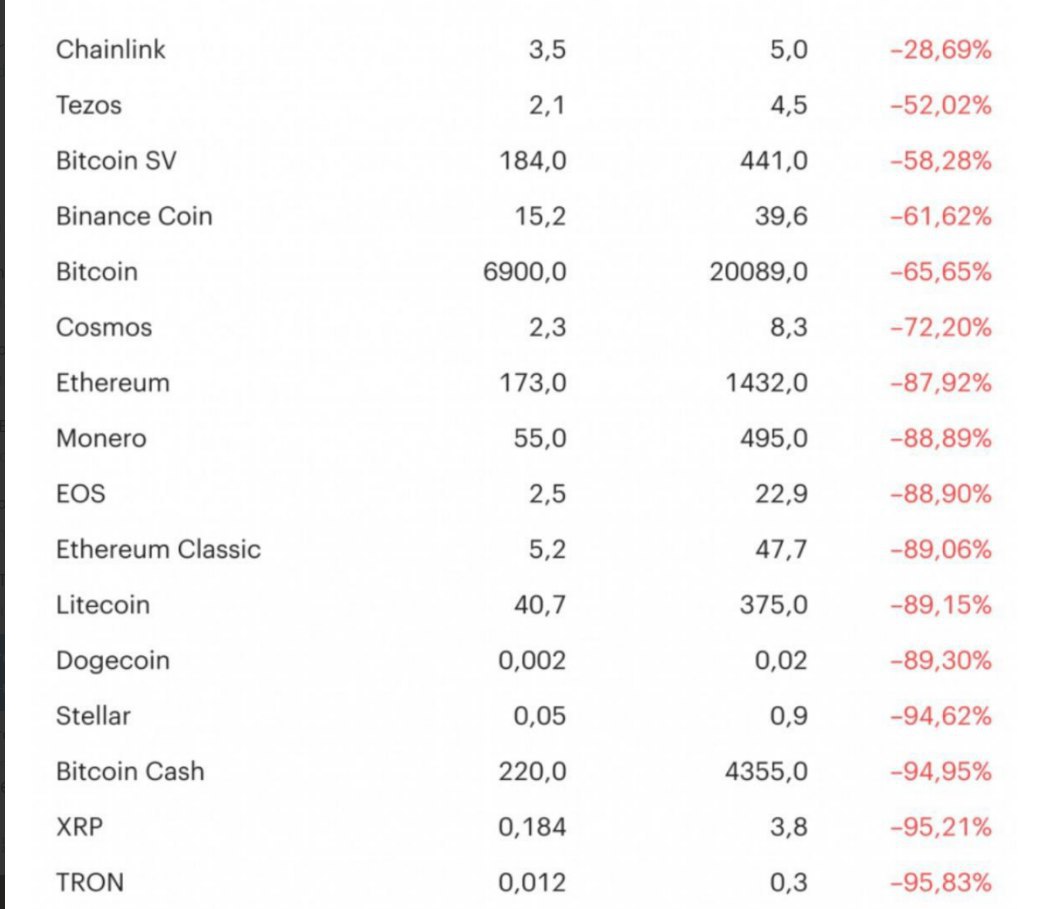
The price of bitcoin reached its historical maximum in December 2017. Then it briefly rose slightly above $ 20,000. However, since then the main digital coin has fallen in price by 65% and is now trading at around $ 6900, writes RBC Crypto.
XRP and Tron tokens, which occupy 3 and 16 positions in the top of cryptocurrencies by capitalization, lost even more in value. The exchange rate of both coins, after a historic maximum in January 2018, fell by more than 95%. Altcoins now cost $ 0.184 and $ 0.012 respectively.
Two years ago, the capitalization of the entire cryptocurrency market set a record. Then it rose to $ 833 billion. By the current moment, this figure has decreased by 77%, to $ 197 billion.
Of the leading cryptocurrencies by capitalization, the Link token, which now occupies the 11th line, is least affected. His rate hit a maximum of $ 4.97 six weeks ago. On March 13, the price of altcoin fell to $ 1.38, and on the Binance exchange it fell to $ 0.0001. Now the coin costs $ 3.5, which is 28% lower than the absolute record.
Crypto exchange Poloniex angered users with unexpected departure offline
This morning, the cryptocurrency exchange suddenly and without warning stopped working. Some traders suspected the platform of abuse. Although market conditions allow more innocent explanations of what happened.
Today, the American crypto exchange Poloniex went on unscheduled maintenance and for some time was unavailable to users. Despite the fact that by now all the problems have been fixed, some traders suspected the platform of abuse, because interruptions in work coincided with sharp price fluctuations of bitcoin.
The first time the exchange went offline at about 00:00 GMT (three in the morning Moscow time). Now all the functionality has been restored, but the GRIN / BTC market is still unavailable.
Traders are waiting for an explanation
First, the exchange reported a malfunction via Twitter. Here is the text of the post:
“The Poloniex exchange is currently unavailable due to an unexpected problem. We will study the problem and let you know as soon as we have more information. Thank you for your patience".
We must pay tribute, the company regularly reported on what was happening throughout the morning. Four hours after going offline, the platform began to gradually come to life.
One of the latest reports said that all markets resumed operation except for GRIN / BTC. The exchange tweeted:
“Initially, maintenance was associated with GRIN / BTC. After that, problems began with one of our service providers. ”
This update was published at 05:00 GMT (8 a.m. Moscow on April 24). Since then, no news has been received from the exchange.
Silence breeds suspicion
Disruptions in the operation of crypto exchanges are far from a rare occurrence. BeInCrypto has repeatedly reported such cases.
They are united by the fact that they often occur during a massive increase in market volatility. In this regard, traders have bad suspicions of manipulation. They claim that exchanges are deliberately shut off in order to forcefully stop the spontaneous movements of bitcoin.
There is another plausible explanation: sharp price fluctuations create high demand on exchanges, which leads to congestion at key nodes. Of course, this suggests that some exchanges are not ready for a lot of traffic, but it does not necessarily imply a dishonest game.
Today's sudden crash at Poloniex coincides with market volatility. The first cryptocurrency settled above the $ 7,500 mark after continuous consolidation in the range below $ 7,000.
However, conspiracy theory looks more convincing in falling markets. Exchanges are interested in maintaining activity, especially when prices rise.
But stopping work in a growing market does not make sense. Firstly, the exchange makes money on the transactions of its customers - leaving offline deprives it of profit. Secondly, it is beneficial for exchanges when bitcoin rises in price, because it attracts new participants to the market.
Thus, it is unlikely that today's disconnection is the result of the behind-the-scenes game of Poloniex. BeInCrypto editors asked for comments on Poloniex, as well as one of the most prominent representatives of the crypto community and investors of the exchange Justin Sun. At the time of publication, we did not receive a response to our request.
Argentines invest record pesos in bitcoin amid threat of default
Residents of Argentina convert record volumes of the national currency to Bitcoin. Such data in his Twitter leads the analytical firm Arcane Research, citing the peer-to-peer platform LocalBitcoins.
As can be seen in the chart below, the weekly trading volume of bitcoin paired with the Argentine peso since January 2018 shows a steady upward trend and during this time it has grown by more than 1,000%.
It is noteworthy that for most of this segment, the cryptocurrency market showed the opposite trend, losing in value of assets and trading volumes after reaching a historic maximum in December 2017.
Events are unfolding amid a continuing deterioration in the economic situation in Argentina. For many years, the Argentine peso is experiencing hyperinflation, and now the state is on the verge of default, the ninth in a row in its history. On April 22, the Argentinean government failed to pay $ 500 million in external debt. Argentina’s pandemic was aggravated by the coronavirus pandemic, which will result in a 5.7% drop in GDP in 2020, according to IMF forecasts.
It should be noted that inflation was not the only reason for the growth in trading volumes on the Argentinean LocalBitcoins market. When converted to bitcoins over the same period, the value increased by 407% and by 139% in US dollars.
As Arcane Research analysts note, these data confirm "substantial growth in real terms."
In the Russian segment of LocalBitcoins, the situation has remained stable since the second half of last year.
What is Bitcoin halving?
Halving (halving, halving) is the moment when the reward to miners in the Bitcoin network is halved. This happens every 210,000 blocks and is a key feature of BTC as part of ensuring the necessary shortage of coins, provided that the maximum emission of 21 million BTC is included in the protocol.
To date, more than 18 million coins have been mined in 11 years of cryptocurrency existence, and it would seem that those small balances of 3 million BTC are about to exhaust themselves. However, it is halving that it will provide miners with work for another 120 years.
How will this happen?
A total of 64 halving is planned, two are already behind (in November 2012 - then the reward decreased from 50 BTC to 25 BTC, and in June 2016 - a decrease from 25 BTC to the current 12.5 BTC), one is about to take place in May of this years and reduce the reward to miners from 12.5 to 6.25 BTC.
And each time the number of coins mined for a certain time period will decrease. Those. if at the current remuneration of 12.5 BTC over the past 4 years (210,000 blocks) 2,625 million BTC was mined, then after the upcoming halving over the next four years with a reward of 6.25 million BTC for each block, a total of 1 will be mined, 3,125 million coins.
Those. after each of the upcoming 62 halvings, the number of bitcoins generated over a 4-year period is decreasing, and the production time of the planned maximum is increasing. That is why until today, so much has been mined in a decade, and in the future, so little will be mined in a century.
Halving will continue every 210,000 blocks until the reward reaches 1 Satoshi, the smallest unit of measure equal to 0.00000001 BTC. After that, miners will only earn on transaction fees.
Why is halving important?
It creates a predictable deficit!
One of the key features of Bitcoin is that it is strictly limited by the maximum emission of 21 million coins (more precisely, 20,999,999.9796 BTC). There will never be 21,000,000,000,000,000 BTC without a consensus change to the protocol. The mechanism by which such conditions are ensured is halving, which is crucial for the predictable shortage and prosperity of cryptocurrency.
Coinbase and Gemini were the first of the cryptocurrency exchanges to open accounts at JPMorgan Chase
The American financial holding JPMorgan Chase has accepted the Coinbase and Gemini cryptocurrency exchanges among its customers. About it writes The Wall Street Journal, citing sources familiar with the situation.
According to them, the opening of accounts was approved in April, but transactions on them began to take place only now. The services provided to exchanges primarily consist in managing cash transactions and processing transactions of their American customers. Bank transfers and deposit / withdrawal operations will be carried out through the Automated Clearing House, which ensures the processing of cashless payments within one day.
According to WSJ, JPMorgan will not work with bitcoin, but has shown interest in working with companies from the cryptocurrency space. Coinbase and Gemini had to go through a lengthy approval process to get JPMorgan approval.
“What sets these exchanges apart from others is the extent to which they have become regulated institutions,” says WSJ. “The fact that both exchanges are regulated by numerous departments played a huge role in the process.”
Gemini received approval from the New York State Department of Financial Services in 2015. Coinbase is registered as a money transfer service provider on the U.S. Financial Crimes Network. Both companies also have licenses for processing money transfers in various states.
JPMorgan CEO James Dimon previously stated that he considers Bitcoin a hoax. At the same time, the bank itself is actively exploring the possibilities of the blockchain and last year introduced its own stablecoin for interbank payments JPM Coin.
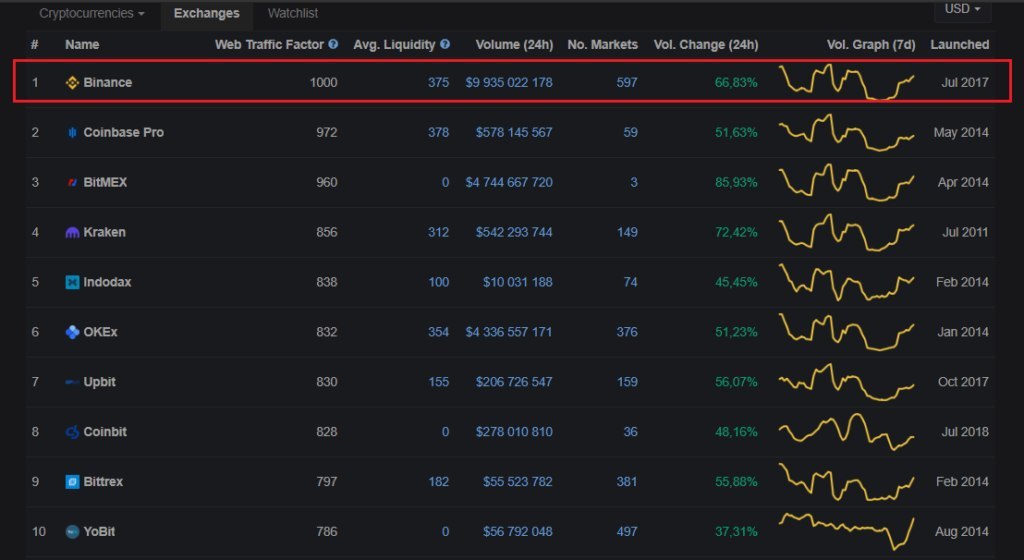
Binance has become the best exchange according to CoinMarketCap
In March of this year, Binance bought CoinMarketCap.
The popular cryptocurrency resource CoinMarketCap has updated its rating of exchanges - the first was the Binance trading platform. About it writes The Block.
The new ranking algorithm includes a metric for web traffic.
On its blog, CMC notes that exchanges with large volumes have a significant number of retail traders, so it was decided to include this factor in the current iteration. Everything is taken into account - the number of page views, unique visitors, rejection rate, time spent on the page, keywords in search engines, relative ranking, etc.
Algorithms for assessing liquidity have also been modernized - now instead of two pages (declared and corrected trading volume), only one works.
Recall that in March it became known that CEO Changpen Zhao bought CMC, and in April, Binance became the most visited exchange.
📃 The launch of bitcoin during the 2008 financial crisis was not accidental. Satoshi observed approximately the same processes that we have the opportunity to observe now, in the crisis of 2020. Let's trace the sequence of those events.
January - July: The Fed tries to stop the housing crisis and rescues Bear Sterns. Treasury Secretary Paulson also explains the need to help out Fannie Mae and Freddie Mac, two agencies that held 50% of $ 12 trillion. in American mortgages.
August 13: Satoshi registers with bitcoin.org.
September 15: Lehman Brothers announces largest bankruptcy in US history ($ 600 billion).
September 17: Investors withdrew a record $ 144 billion from their accounts. Over a typical week, only about $ 7 billion was withdrawn.
October 13: Paulson talks to 9 bank leaders. Total salvage package ~ $ 2.25 trillion.
October 21: The Fed provides $ 540 billion to save financial markets.
October 31: Satoshi publishes Bitcoin's White Paper.
As a result of the 2008 crisis, a financial world based on trust was undermined. Bitcoin was launched during an emergency, and Satoshi planted the seeds at the right time. The world needed an alternative to banks. Now everything is much worse, the size of the "aid" is many times larger, and the situation is much more serious. Everyone needs bitcoin as never before, I’m not afraid to even say how a haven.
Interesting, what we all can get uniting conventional money and cryptocurrency.
GEKKOIN - transparent and realible ecosystem that provide a bunch of solutions to invest effectively.
STRUCTURED DEPOSITS – a turn-key investment strategy, you can make in a specific asset(cryptocurrency), while having full or partial risks protection.
- Deposits from 3 months
- Capital protection up to 100%
- Return 4% per annum guaranteed
- Additional income up to 200% per annum in case of cryptocurreny asset growth
TRANSACTION UTILITIES – developed for our clients to stay in world you live in.
When money counts, time is the best investment in it.
GEKKARD mobile bank keeps you online with all your transactions round the clock. Get physical Mastercard or virtual version and enjoy simplicity and reability saving time for the most important things.
Gekkoin Wallet - ideal solution for individuals, investors, crypto holders.
- Open and earn using structured deposit
- Topping up conventional money, cryptocurrency, EURG token with Gekkard (physical or virtual card)
- Transfer your money between Gekkoin e-wallets immediately with no internal fees.
BANKING&CRYPTO SERVICES
- Purchase of cryptocurrencies in your account in partnership with AtlantEX OU a licenced Payment institution.
- Replenishing of funds using cryptocurrency.
- Withdrawal of cryptocurrency using fiat money.
Gekkoin – modern way to invest.

Tokens THETA, TFUEL, IOTX, and DREP show growth up to 650% in anticipation of the launch of major networks
The Bitcoin exchange rate has declined by 10% over the past week. At the same time, several altcoins have shown steady growth. All of them are united by the quick launch or update of the main networks.
The most noteworthy project in terms of price was Theta Network. Over the past week, its main THETA token has grown by 95%, and Theta Fuel token (TFUEL) used to pay transaction processing fees - by 650%.
Theta Network developers intend to launch the main network 2.0 on May 27. The second version includes support for full-fledged staking and other technical improvements. In early 2018, Theta Network raised $ 20 million to develop a decentralized network for the supply of video content.
The next mainnet in general mode should launch IoTeX. The event is scheduled for June 1. Over the week, IOTX grew by 115%.
IoTeX also conducted ICOs in early 2018, raising $ 14 million then, and specialize in the Internet of things.
By the end of the second quarter, the DREP developers promise to launch the main network. Their token has grown by 60% during the day, while holders continue to expect the announcement of specific dates.
DREP conducted an ICO in mid-2019 and raised about $ 20 million. The project is developing a solution for measuring and monetizing online reputation.
Gemini and Bitwage have opened the reception of American pension contributions to invest in bitcoin
Bitwage, a cryptocurrency remote payroll service provider, announced the launch of a retirement plan with the option of investing in bitcoin. The proposal was framed in accordance with Model 401 (k), the most popular private pension scheme in the United States.
According to Jonathan Chester, CEO of Bitwage, the public launch of the solution was carried out after 10 months of testing with the participation of employees of the company itself.
Under US Tax Code article 401 (k), from which the pension plan was named, employees can transfer part of their salary to their personal accumulative pension accounts before taxes. In addition, the number of contributions may be increased at the expense of the employer's own funds. Typically, such plans are based on a basket of assets, in particular stocks and bonds.
The cryptocurrency exchange Gemini, the custodial services provider Kingdom Trust and the company Leading Retirement Solutions also participated in the development of the solution. Gemini will do the conversion of dollars to bitcoin, the Kingdom Trust will manage the storage of assets, and the Leading Retirement Solutions will do the administrative work. Fiat currency will be converted to digital currency automatically in accordance with the payment period.
Bitwage expects its offer to help companies get the most out of their payroll program, in which authorities provide businesses with a line of credit to support amid a coronavirus pandemic. The state will free companies from the need to repay loans if they use at least 75% of the funds received to pay salaries, including pension contributions.
“Companies now have the opportunity to provide payments for accounts 401 (k) in order to fulfill the 75% condition. We help employers get the most out of this program while providing their employees with new and innovative investment solutions, ”Bitwage said.
Cryptoexchanges store 3.08 million bitcoins. Coinbase leads by a wide margin
According to a study by Larry Chermak of The Block, cryptocurrency exchanges store about 3.08 million bitcoins - 16.5% of the total offer of 21 million.
Coinbase, an American cryptocurrency company, stores 984,300 BTC on its wallets. Coinbase is followed by Huobi (413,000 BTC), Binance (318,000 BTC), OKEx (268,000 BTC) and BitMEX (217,000 BTC).
According to a LongHash study, as of early January 2020, 970,000 BTC were stored on Coinbase, and 966,230 BTC at the beginning of December 2019.
The analysis took into account data from various sources, including bitUniverse, chain. info, Glassnode, BitFury and BitcoinWhosWho.