
Cryptocurrencies are among the most sought after assets of Chinese investors
Bitcoin and other digital assets took fourth place among the most sought-after investments among residents of China, writes 8btc concerning Duxiaoman Financial, a fintech division of the Chinese search engine Baidu.
The company's report provides an overview of the preferences of local investors in 2019. As Duxiaoman Financial managed to find out, interest in investments remained at a high level, and the most popular assets were stocks, real estate and insurance products. It is noteworthy that gold and state funds in this list go after the assets associated with the blockchain.
According to the report, the category of “other investments”, which includes futures for commodities, foreign currencies and digital assets, experienced an increase in attention in May, when Bitcoin began its local rise, and in late October, when President Xi Jinping announced the importance of blockchain development.
With the transfer of capital into the hands of a generation born after 1995, its representatives begin to occupy an increasing share in such reports - Duxiaoman Financial estimates it at 15-29%. It is expected that this generation more than others believes in the potential of finance on the Internet and digital currencies. At the same time, people aged 25 to 34 years prefer “stability” and pay more attention to insurance assets, and the older generation - to stocks.
Last August, a survey among Chinese investors was conducted by BabelFinance. Then, 30% of respondents said they expect Bitcoin prices to rise above $ 30,000 over the next 12 months, and 84.3% said they believe in the prospects of cryptocurrency and want to keep it as a long-term investment.

South Korea plans to introduce 20% cryptocurrency income tax
The South Korean government plans to start charging a 20% tax on profits from cryptocurrency transactions. About it writes The Block concerning "numerous government sources."
The corresponding order obliging the local tax authorities to revise the taxation algorithms of the crypto industry was given by the Ministry of Economy and Finance of the country.
The government will henceforth consider the profit from crypto trading as “other income” (winnings in the lottery, for example), and not as “capital gains”.
“The Ministry of Finance has yet to finally decide on the final position regarding cryptocurrencies, but, of course, it is more logical to consider the income from the sale of digital assets in a slightly different way than as the income from the transfer of capital, such as real estate,” the sources of the publication familiar with the situation say.
Note that now other income in Korea is taxed at 20% of 40% of total income, and the remaining 60% is not taxed.
Over 1,000 cryptocurrency miners receive official permits in Iran
More than 1,000 cryptocurrency miners have received licenses to conduct their activities in the Ministry of Industry, Mineral Resources and Energy of Iran, the local edition of the Financial Tribune reports.
According to the representative of the trade union of information technology workers in Iran, cryptocurrency mining can help attract an additional $ 8.5 billion to the country's economy. "The high cost of electricity and tightening regulation have made this sector less attractive for small investors," he added.
Iran legalized cryptocurrency mining last June and has long been particularly popular among miners due to government subsidies for electricity. Following the latest amendments, the cost of electricity for miners is $ 0.11 per kWh and can reach $ 0.46 during peak periods in summer. The Financial Tribune notes that the measures taken by the authorities have led to the fact that a limited number of approved miners continue to operate in Iran.
Last year, local authorities seized about 1,000 miners for mining Bitcoin, which were placed in the buildings of two abandoned factories.
It is noteworthy that, despite the official status of mining, Iran does not recognize cryptocurrencies as such.
Australian Exchange ACX froze at least $ 1 million in cryptocurrency, citing an audit
Australian ACX crypto exchange from Melbourne suspended deposits and withdrawals, citing an audit.
Users say that for several weeks they can’t access their funds and even contact the exchange itself. There were also reports that the ACX office in Melbourne was closed.
ACX user Michael Whitehorn said it has been going on for about four weeks. Whitehorn has teamed up with a group of 25 users on Facebook, and they are trying to appeal ACX actions to the Australian Securities and Investments Commission (ASIC).
According to Whitehorn, ACX has blocked at least $ 1 million owned by this group of users. The reason for the incident, he said, is the financing problem and is not related to hacking or fraud.
ACX posted the following ad:
“Dear ACX customers, we are conducting an audit of hot and cold wallets. The functions of the deposit and withdrawal of funds will be temporarily disabled during the audit. ”
Twitter user David McCann in December complained that he could not withdraw funds for several months. Another user, Alex R, said that in mid-January, after numerous attempts to withdraw his funds and complaints to ASIC, he managed to return his funds.
The founder of Blockchain Global, the parent company of ACX, is Sam Lee, a well-known cryptocurrency community leader who has played an important role in the creation of the Blockchain Center and the Institute for Distributed Technologies in Australia. However, at the same time, there is speculation that Blockchain Global is just one of the shareholders of ACX.
ACX is also a member of Blockchain Australia (BA), which said it "contacted ACX to convince them to resolve this situation as quickly as possible." At the same time, BA said that they did not have any coercive means of influencing ACX other than “suspension of membership”.
MIT researchers introduced a new method for routing crypto transactions outside the blockchain
Researchers at the Massachusetts Institute of Technology (MIT) introduced an accelerated cryptocurrency transaction processing technology called “Spider”. According to them, it is an improved version of the network of payment channels, which is, for example, a solution for scaling the Bitcoin blockchain of the second level of the Lightning Network.
Such payment networks are not always highly efficient due to the use of non-optimal transaction flow schemes and can quickly empty the user's balance, forcing him to deposit funds again.
Spider, according to the inventors, offers a more efficient payment routing method. In addition, the technology allows you to record 4 times more transactions than using other networks of payment channels before you need to record events on the blockchain.
Spider splits transactions into smaller parts or “packages” and then processes them through many payment channels, the throughput of which may not be enough for larger payments. Unlike other systems of this kind, which first skip the full payment and only then reject it, thereby having a negative impact on network performance, Spider transactions are less likely to cause the same effect, the creators say.
Spider can also accumulate payments on accounts experiencing a high load at a particular moment, instead of rejecting them.
“It is important to have a balanced and high-throughput routing in the network of payment channels to ensure that the money that the user deposits into joint accounts is used efficiently. This business must be efficient and profitable. In other words, it is necessary to achieve the maximum number of transactions with the minimum amount of money spent, ”the developers said.
MicroBT, a competitor to Bitmain, continues to increase its market share in bitcoin mining
MicroBT, a Chinese mining company, quickly expanded its market share by selling more than 600,000 ASIC miners from its flagship WhatsMiner M20 series in 2019. This was reported to WeChat by the head of the sales department of the company Vincent Zhang, reports Coindesk.
MicroBT miners can generate on average about 60 terahash per second (TH / s) of computing power. This means that the sold miners could contribute more than 30 exams per second (EH / s) to the bitcoin network hash in 2019 (1 EH = 1 million TH). Against the backdrop of rising Bitcoin prices in 2019, the average Hershait of the network more than doubled: from 40 EH / s at the end of 2018 to almost 100 EH / s in December. This means that almost half of the bitcoin hash in 2019 may be due to MicroBT equipment.
The current computing power of the bitcoin network is about 110 EH / s. Thus, now MicroBT may account for about 30% of miners, which makes this company one of the largest and fastest growing manufacturers in the world.
According to a December 12 report by Coinshares, Bitmain’s market dominance was about 65% last year, while in 2018 this figure reached 75% (this data is no longer entirely relevant, since the bitcoin hash has since grown by another 20 %). Canaan, in its public report to the IPO at the end of last year, indicated that its equipment accounted for about 20% of the bitcoin hash in the first half of 2019.
However, Bitmain equipment still dominates the market, which is the result of successful sales of AntMiner S7 from 2015 to 2016, and then S9 models from 2017 to 2018. According to the Bitmain IPO application in September 2018, the company sold about 500,000 bitcoin miners in 2015 and 2016 and 3 million units from the beginning of 2017 to June 30, 2018 against the backdrop of the rapid growth of the cryptocurrency market.
And although S9s with a capacity of 14 TH / s are still the most popular miners, they can become obsolete after reducing the remuneration for a block (halving) on the bitcoin network in May of this year. According to CoinDesk, mining centers are now buying newer miners or replacing old models in preparation for this event.
Bitmain released its latest AntMiner S17 series last year to compete with the MicroBT's WhatsMiner M20, but the latter was significantly ahead of Bitmain in terms of production and supply.
In anticipation of halving, both companies plan to release even more powerful miners - AntMiner S19 and WhatsMiner M30. However, the number of products actually released is highly dependent on supplies from companies such as Samsung and TSMC, which, according to Zhang, are "very limited."
An outbreak of coronavirus in China also delays production and logistics.
Zhang says MicroBT has already returned to work: “Now the work of the logistics system has partially resumed ... So now the supply of miners is not a big problem, but not every mining farm is physically accessible,” he said.
Venture Capitalist Tim Draper Acquires 1 Million Aragon Tokens
Venture capitalist Tim Draper acquired 1 million ANT tokens ($ 850,000 at the time of publication) issued by the Aragon decentralized management system project. Draper's share in the total ANT issue was 2.5%.
The Swiss Aragon Association is currently launching a digital justice system for decentralized autonomous organizations (DAO). All users with at least 1,000 ANT in their accounts will be able to participate in Aragon Court hearings. The first such meeting was held on February 10. It dealt with a joke trial against Ethereum Classic developer Yaz Khoury.
According to Aragon Association Executive Director Luis Cuende, Draper decided to purchase tokens when he learned about the launch of Aragon Court.
“I think the recent launch of Aragon Court and the realization that Aragon for management can be the same as bitcoin is for money, prompted him to join,” Cuende said, adding that the venture capitalist’s previous investments in his projects could also have contributed to this .
According to Kuenda, Draper will be on the Aragon advisory board.
According to the Aragon blog, to date, the platform has been used to register over 1,000 DAOs that manage assets of $ 8 million.
Japanese messenger LINE closes crypto exchange in Singapore and opens a global platform
The developer of the Japanese messenger Line closed its cryptocurrency exchange in Singapore to launch the new global platform BITFRONT, writes The Block.
BITFRONT is registered in the USA and is serviced by LVC USA, a division of LVC Corporation, which, in turn, manages LINE's cryptocurrency and blockchain activities.
BITFRONT provides the ability to convert cryptocurrencies both among themselves and in exchange for traditional currencies. Currently, the exchange supports five assets: Bitcoin, Ethereum, Bitcoin Cash, USDT and its own LINE LINK token.
“This is a significant advance towards mass distribution of the blockchain,” commented Yonsu Co., CEO of LVC Corporation. “We will continue to make blockchain and cryptocurrencies more accessible to our users.”
LINE claims that its global user base is 186 million people per month. The company promises to use its many years of experience in the field of security in the operational activities of the new exchange.
Big exchanges roll back Steem community decision to freeze Justin Sun's vote
Steemit's decentralized blogging platform has leveraged resources on leading cryptocurrency exchanges, including Huobi and Binance, to roll back recent changes to the network. The last action caused widespread discontent in the community, notes The Block.
On February 14, Steemit entered into a “strategic partnership” with the Tron blockchain platform. Steemit chairman said he sold the project to Tron founder Justin Sun. Concerns over Tron’s excessive powers in the new asset allocation system led to the software fork of the Steem blockchain by validators or, as they are called, witnesses on February 24th. He allowed voices tied to the tokens held by Tron and Steemit to be invalidated.
One way hard fork
This, however, did not help avoid a “hostile takeover” on Monday, which nullified the community’s efforts. 42 million STEEM Power (SP) in Huobi, Binance and Poloniex wallets were used to get the vast majority of votes. With their help, the Steemit team, represented by “the guys from Tron and Steemit Inc,” unilaterally performed a hard fork to regain their voices.
“Soft fork 0.22.2 was structured out of malicious intent and aimed at freezing a very specific group of accounts and selecting their rights and belonging to their own assets. It can be considered illegal and criminal, says the Steemit blog. “They even threatened to make a hard fork and reset all existing STEEM tokens, jeopardizing the interests of all the respectable STEEM holders, developers and the community.”
Over the next 4-6 weeks, the Steemit team intends to use their voices to restore “order in the community.” Only after that they are ready to return control to the community "by mutual agreement."
STEEM Holders Have to Wait
According to the current rules, STEEM used in voting cannot be withdrawn within 13 weeks. In other words, all this time their owners will not be able to access their assets. To solve the problem, Steemit conducts an urgent hard fork, which will reduce the wait to 1-3 days.
Binance CEO Changpen Zhao said that he was aware of the planned hard fork, but his stock exchange may withdraw its votes depending on the community’s reaction. “I was aware of the update / hard fork in advance, and I approved it. Projects do this all the time, and we usually share their position, ”he wrote. Zhao later added: “We will probably remove the votes, depending on your opinion. This operation requires the participation of people in several places, so it can take a little longer. We didn’t take a cent, thinking it was a regular update / hard fork. ”
Community response
“This share was essentially a premine. It has always been said that it will be used to attract new users and develop the community, said community member jeffjagoe. “Witnesses decided to freeze it in an attempt to prevent a hostile network capture. But they forgot that Justin has a lot of money, and you can buy friends on exchanges for money. ”
Ethereum founder Vitalik Buterin commented on the situation: “Apparently, the DPoS mechanism in Steem was captured by large exchanges that voted with the help of depositors. It seems that this is the first actual case of an attack through bribes to vote using coins. ”
Some developers have decided to turn off applications based on the Steem blockchain. So, the SteemWallet team announced the removal of their wallet from the App Store, and the Steem Engine turned off its site in response to a “hostile blockchain takeover”.
ATOM cryptocurrency: bullish breakout will clear the path to resistance
ATOM has been trading inside the downward channel since mid-December last year. The price rebounded from the support line on March 1, but so far does not give clear signals of a reversal and a possible bullish breakout.
Cosmos (ATOM): main trends
Altcoin is trading inside the downward channel.
A 200-day moving average plays the role of resistance.
Price has broken down the resistance line.
Resistance is expected at 4400 Satoshi.
ATOM is trading within a short-term downward wedge pattern.
Well-known trader LSDinmycoffee is trying to determine whether the previous upward breakthrough was just a deviation. If so, the price remains inside the same downward wedge, which is considered a bullish pattern, which means that it implies a coin growth.
Does ATOM remain a downward wedge inside the figure? If so, when to expect a breakthrough? Below we will try to answer this question.
Downlink
Judging by the dynamics since mid-December, the price is rather inside the descending channel than the descending wedge. Support and resistance levels have been confirmed repeatedly, and these levels are parallel to each other, forming a reliable pattern.
Despite a rebound from the support line, technical indicators paint a bearish picture. The price is below the 200-day moving average, confirming it as resistance. In addition, the daily RSI is well below 50, indicating a bearish trend.
Future dynamics
Short-term dynamics indicates a bullish outlook. Price broke through the downward resistance line and confirmed it as support.
The nearest resistance is located at 4400 Satoshi, where the price formed a double peak before the fall and confirmed the resistance line.
On the hourly charts, it can be seen that the price can make another attempt to break through the resistance, given that the token is inside the short-term descending wedge figure, which is considered a bullish reversal pattern.
Thus, this combination of bullish signals indicates the prospect of a future breakthrough, as a result of which quotes may go to the resistance line of the downward channel, but at this stage we cannot speak with confidence about the potential of a channel breakthrough.
So, ATOM is inside the long-term downward channel and short-term downward wedge pattern. We expect a price breakout from the wedge pattern and the achievement of the resistance zone of 4400 Satoshi and, possibly, the resistance line of the channel.
BitMEX linked the interruptions in the background of a market crash with a botnet attack, partially compensated for the losses
Representatives of the BitMEX crypto-derivative exchange commented on the events of the past week, when the trading platform was unavailable at the same time as the market collapsed rapidly. Earlier, some members of the community suggested that the “hardware problems”, as the company itself called them, arose at this time by chance.
“I know about questions and doubts after the events that have occurred over the past 72 hours,” wrote Arthur Hayes, CEO of BitMEX. - We listened, and my team began to collect factual information. We will transparently and in detail answer these questions and doubts in the coming days. ”
BitMEX Technical Director Samuel Reed said in a comment that on March 13, BitMEX systems were twice attacked by a botnet. Attackers have been researching the platform for vulnerabilities for some time. They are also responsible for the February 15 attack, Reed added.
The February attack was recaptured by standard BitMEX defenses, but in the latter case a different strategy was used. The botnet found "the end point, which was constantly and guaranteed to be slow." For a long time, it was not subjected to automatic analysis and turned out to be vulnerable.
“After the second attack, we correctly identified the slow request and fixed it. We make system changes to the backend to ensure that this situation cannot be repeated, and once again study older systems to simplify, disconnect, isolate them and increase productivity, ”Reed explained.
Some of these changes have already been added to the system, while the rest are still being worked out. This applies to the protocols with which the user interacts during a decrease in productivity, suspension of trading, their restoration and communication. Reed promised in the coming days to publish detailed articles on the BitMEX blog with a technical analysis of what happened.
In addition, users “affected by one of the limiting cases when there was a jump in the last price on the ETHUSD market that triggered the triggering of stop orders” received a refund. Compensation was provided from the company's own assets and did not affect the insurance fund.
The number of bitcoin transactions has dropped to an annual minimum, but is everything so bad?
The number of transactions made during the day on the Bitcoin blockchain sharply dropped to the levels of March 2019. Coin Metrics founder Nick Carter tried to understand the observed dynamics and explain it with reasons other than the cryptocurrency fading that comes to mind.
As Carter notes, bitcoin transactions are heterogeneous in nature. Some of them are used to move cryptocurrencies, and some are used to fix the data of third-party services in the blockchain.
So, the Omni protocol works with the data, on which USDT stablecoin was originally based. Its issuer, the company Tether, has recently transferred more and more tokens to the Ethereum network, becoming the main consumer of its computing resources and reducing the load on the bitcoin blockchain.
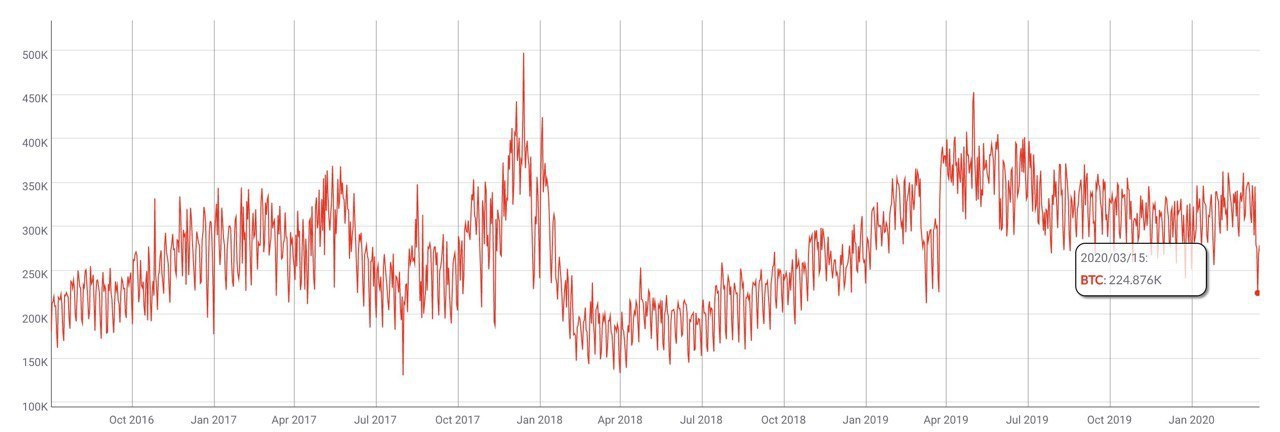
In addition, in the past, such transactions were demanded by the Veriblock project, which has also recently reduced its activity. The chart below shows the breakdown of transactions carried out with the function of fixing third-party data and without it, that is, to send assets.
There has also been an increase in transaction grouping over the past week. Last week, this feature was added by the major US cryptocurrency exchange Coinbase. She expects this to reduce the load on the bitcoin network by her side by about half. Thus, some transactions that are registered as having two exits actually include many exits.
This is also confirmed by the increase in average transaction size in bytes. It is too early to talk about the formation of a trend, but positive changes are being traced.
Carter, therefore, concludes that the primary factor in reducing the number of Bitcoin transactions is not a drop in the number of cryptocurrency transfers, but improvements on the blockchain level.
At the moment, the price has approached the level of 6800 - the last of the visible resistance levels for the price and is making attempts to break it. BTC added about 15% per day, altcoins are somewhat more modest.
I will consider the global perspective in one of the future videos, now I would like to focus on local deals. First of all, we see two strong support zones, near which the buyer works well - about 5400 and about 5800 (green areas on the chart). As for the resistance of 6800, the next level after it is only 7600, as the last strong drop went almost without stops.
Volumes in the current sideways are high, even higher than they were at the peak of 2019 growth at prices of about 14,000 per BTC. Investors' risk appetite is below average, but noticeably higher than at the peak of panic.
Results: 1) there are no very good deals for 5+ now, it’s better to relax, 2) if you make transactions, then local and, rather, long, 3) good zones for long - 5500 and 5900, not bad - 6200 and 6400, 4 ) see point 1.
Canadian Tax Service requests data from 115,000 QuadrigaCX cryptocurrency users
The audit company EY received a request from the Canadian Internal Revenue Service (CRA) to provide data to all users of the QuadrigaCX cryptocurrency exchange that has ceased to exist. In total, the request covers 750,000 documents and 115,000 customers. EY acts as a trustee after the bankruptcy of the exchange.
“The trustee notified CRA of its intention to provide a copy of the complete EDiscovery database, edited only to exclude non-public information,” the company said.
CRA wants to access the data that EY collected from internal and third-party sources, including personal user information, account balances and transaction history from 2016 to 2018.
Miller Thomson, the law firm representing QuadrigaCX users, has announced that they have decided to comply with the CRA request, as challenging it would require significant time and cost. Members of the board of creditors, however, expressed concerns about an "unprecedented violation of the privacy of private individuals." They doubted that the CRA request was aimed at calculating QuadrigaCX tax debt, which, according to EY, is "almost impossible."
It is estimated that QuadrigaCX owed to users after the sudden death of its founder at the end of 2018 amounted to $ 190 million.
Does the ban on the release of Gram apply to non-US investors: Telegram lawyers asked this question to the court
After the ban on the distribution of Gram in the framework of the ongoing confrontation between SEC vs TON, Telegram lawyers had a logical question for themselves - whether this restriction applies to non-US investors whose total investment exceeds 70% of the $ 1.7 billion collected in ICOs in 2018. For information to Finance Magnates, the lawyers of the messenger Pavel Durov filed a corresponding request with the American court.
“Please clarify the scope of the injunction. Namely, whether the order applies to non-residents of the United States, which, do not fall under American law, ”the request emphasizes.
Recall that Telegram appealed the court’s decision to ban the issuance of Gram tokens, and the TON community is considering launching a blockchain without the participation of an official developer.
Binance Opens Its OTC Trading Portal
Binance Cryptocurrency Exchange has announced the launch of an over-the-counter trading portal.
According to a blog post, “this portal is a Quotation Request (RFQ) platform where users can confirm transactions and receive prompt payments to their Binance accounts.” If the trader sees a suitable price, he can confirm the transaction and conduct a quick calculation directly on his Binance account.
The key advantage of using the portal is that it (as a rule) offers better prices for large transactions compared to buying/selling on the exchange.
Since transactions are made directly in the accounts of Binance users, transactions will not be displayed on the blockchain, and users will rely on the security of the exchange.
Initially, the Binance portal will support the trading of 25 cryptocurrencies and tokens (new coins will be added in the future).
The minimum transaction size on the portal is equivalent to 10,000 USDT. To use this platform, users need to pass verification (level 2) on Binance.
Thesis raised $ 7.7 million to launch tBTC-provided Ethereum token
Thesis raised $ 7.7 million in advance of the launch of its new tBTC token. Investraund led Paradigm Capital; Fenbushi Capital and Collaborative Funds also became its members.
tBTC will be the first major application based on the Thesis protocol Keep. Its launch is scheduled for April 27. tBTC is an ERC20 token fully secured by bitcoin and available for redemption at any time. If the user wants to pay with bitcoins on the Ethereum network, it is enough for him to deposit bitcoin to the address of the proposed contract with a threshold signature. After the transaction is completed, a deposit confirmation is sent to the Ethereum network, and the user receives tBTC tokens on his Ethereum wallet.
“Decentralized financial applications on the Ethereum blockchain are in obvious demand,” said Fred Ersam, co-founder of Paradigm Capital. - Bitcoin is the largest cryptocurrency in the world. Creating a bridge that allows Bitcoin to interact with DeFi makes a lot of sense, and tBTC serves as a credible attempt to do so. ”
To date, several tokens have already been issued that reflect Bitcoin coins on the Ethereum network, including Wrapped Bitcoin (WBTC), imBTC and sBTC. All of them, however, still do not have a reliable reverse conversion mechanism, which is the main competitive offer of tBTC.
Thesis CEO Matt Luongo said that shortly after launch, the company plans to integrate tBTC into landing platforms such as Compound and other DeFi applications. Outside the DeFi space, bitcoin on the Ethereum blockchain is unlikely to be very useful, developers acknowledge.
Seeking a fair and reliable gateway to digital asset markets?
Get easy access to professional trading services for crypto derivatives market with ZUBR.
Execute your strategies taking advantage of ZUBR infrastructure:
- Flat one basis point (0.01%) fee for ALL clients
- Microsecond order execution at any volatility
- ZUBR perpetual contracts with leverage up to 20x
- Reliable and friendly UI
- Professional trading services for ALL clients: high-speed network channels, points of presence to major exchanges, co-location in LD4 London
Trade on fair terms.
Risk Warning
Using ZUBR services and ZUBR Exchange Platform involves risks. Please refer to some of these risks as described in the Risk Disclosure Document https://zubr.io/public/docs/risk_disclosure.pdf
ZUBR is the service provided by 4Step Inc.