
Genesis Capital's crypto loan business grew 38% in Q3, experts are worried
Crypto-entrepreneur Barry Silbert, Genesis Capital, a lending company, has unveiled a third-quarter financial report. According to the document, over the specified period, the turnover of its loan products amounted to $ 870 million, which exceeds the previous record of $ 746 million recorded in the second quarter.
Compared with the previous quarter, the volumes grew by 38.1%, and the total amount of transactions reached $ 3.1 billion. At the time of writing the report, $ 450 million were placed in active loans.
Significant popularity among customers of Genesis Capital continues to use loans in USD or its equivalent, the share of which increased to 31.2%. At the same time, loans in bitcoin fell from 62.5% to 50.2%.
“Our loan portfolio has retained its value by increasing the issuance of fiat (USD and stablecoins) loans, which compensated for the decrease in the nominal value of cryptocurrency loans,” the company writes.
Genesis began 2019 with $ 20 million in active fiat loans, registered a moderate increase to $ 40 million towards the end of the second quarter, and in the third quarter, the value grew 4 times, reaching a maximum of $ 160 million in mid-September.
Altcoins also experienced a limited climb in the Genesis portfolio. Ethereum's share, for example, rose to 7.5% from less than 4% last quarter.
Earlier, a group of former Wall Street traders expressed concerns that the $ 5 billion crypto lending industry is growing too fast and could burst. They argue that cryptocurrency lending shares common problems with the traditional one: free standards, too much capital of lenders are looking for their borrowers, as well as increased risk appetite.
“I am not concerned about the spread, or even the regulatory uncertainty, of the credit risks. This is a torpedo that moves below water level and could lead to an event of the type MF Global or Lehman Brothers, ”said former trader DRW Holdings LLC and Goldman Sachs Group Inc., and now Jason Urban, CEO of DrawBridge Lending.
The founder of the Celsius Network crypto-credit platform Alex Mashinsky, however, argues that loans are provided almost exclusively to large customers who adhere to strict compliance and risk management policies, while the real danger is high-leverage derivatives sold by inexperienced retail investors.

China: digital renminbi will provide users with anonymity
The upcoming digital yuan will provide users with the necessary anonymity in transactions. This was stated by Mu Changchun, head of the Digital Currency Research Institute at the People's Bank of China (PBoC) at a conference in Singapore on Tuesday, The Block reports.
Halyk Bank will maintain a balance between controlled privacy and the fight against money laundering, terrorist financing, as well as tax issues, online gambling, and any virtual criminal activity. The Central Bank will not fully control the information of people and will provide them with the necessary anonymity in its operations.
“We are aware that modern society is oriented toward anonymity, and we will provide such people with appropriate privacy in transactions,” Changchun emphasized. “We do not strive for complete control over the information of the general public.”
Earlier this week, Mu said that Chinese digital yuan holders will not receive interest on payments, and therefore, the introduction of such a currency will not have negative consequences for inflation or the country's monetary policy.
The official also emphasized that the goal of digital currency is to create a new financial system in case of problems with the existing economic infrastructure of China, where two players - WeChat and Alipay - dominate electronic payments.
Also, he noted that the design of the digital renminbi will be similar to Facebook’s stable Libra, and the crypto-yuan can be used on WeChat and Alipay payment platforms.
ICO projects are alive and they have good news:
▪️ The developers of the Brave blockchain browser introduced the first official version of their product, before that they had to use beta. Supported on Windows, macOS, Linux, Android, and iOS 🦇
▪️ The blockchain platform for online games and social networks Loom Network has published a roadmap for 2020 and announced plans to add support for decentralized financial applications (DeFi).
▪️ Australian startup Power Ledger, which creates a decentralized electricity market, concluded partnership with a local energy company ⚡️
ClickZ
Brave releases 1.0 of new privacy-focused browser and private ad network
Today, Brave released a new 1.0 version of its privacy-focused browser and a new ad network that could dramatically reshape online advertising.
Top 5 main events of the past week
Bitcoin
The leading cryptocurrency at the beginning of the outgoing week again fell below $ 7000, fixing a minimum at around $ 6635, however, it was able to quickly recover and even get close to the psychological level of $ 8000. By the weekend, the weighted average cost of BTC is $ 7,800.
Hacks, intrigues, investigations
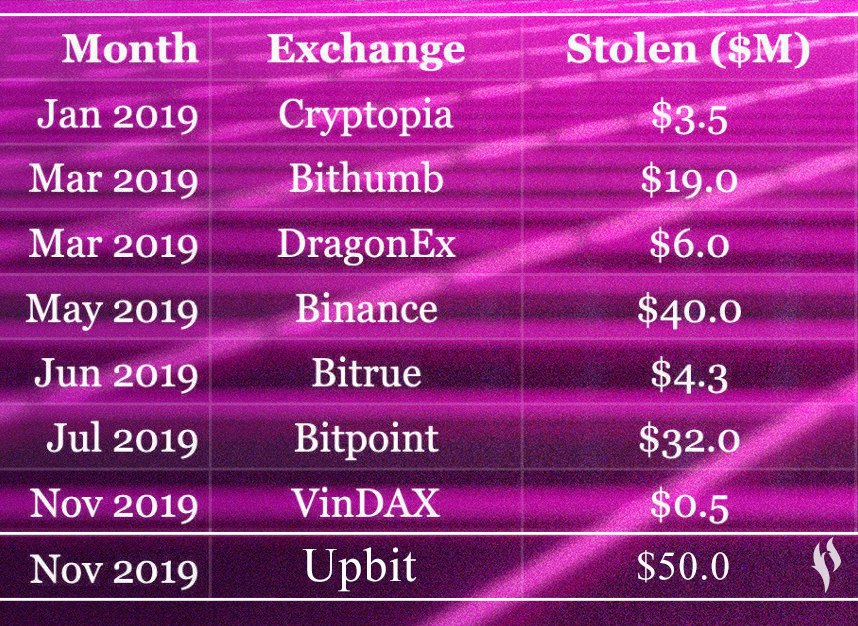
On Wednesday, the cryptocurrency exchange Upbit was hacked. About $ 50 million on air was stolen. Representatives of the South Korean platform officially confirmed the hack.
This hack was the eighth and largest in 2019.
And on Friday it became known that the CEO of the IDAX cryptocurrency exchange escaped with user bitcoins. Representatives of the platform admitted that their director disappeared along with access to cold wallets, where all the funds of traders were stored.
Passion around TON
Pavel Durov and two other Telegram representatives have been summoned to court to testify in the TON vs SEC case. All of them will appear in court on different dates in December in London.
Also this week, Telegram once again warned users against buying Gram from third-party sellers, noting that no one currently has coins, even early investors (they only have obligations to receive tokens after entering the market).
Progressive Bakkt
Two months after the debut of Bakkt, the volume of transactions on the platform reached a record level of 5670 contracts ($ 42 million) - this is almost 70% more than the previous maximum.
It’s also become known today that Bakkt CEO Kelly Loeffler will replace Republican Senator Johnny Isaacson from Georgia, who will vacate the chair at the end of the year amid health problems.
Contrast Germany
Germany permits
The German parliament adopted a draft law that officially allows banks in the country to carry out operations with cryptocurrencies and store them in their accounts.
The German Banking Association (BbD) is delighted with this venture. They say that now the country will become a "real paradise" for crypto enthusiasts. The industry will become as transparent as possible, and investors will be able to invest safely in digital assets.
🤔 Bitcoin price at the level of mining cost?
A “shelf” formed on the BTC hash chart from September to November, similar to the period from August to November 2018, when the bitcoin rate was slightly above $ 6,000. But after the market went even lower, the miners had to start turning off the equipment.
A “shelf” formed on the BTC hash chart from September to November, similar to the period from August to November 2018, when the bitcoin rate was slightly above $ 6,000. But after the market went even lower, the miners had to start turning off the equipment.
Complete nodes make bitcoin more centralizable
200 gigabytes. On many personal laptops, this is the maximum amount of memory. Approximately so much space and requires the Bitcoin blockchain.
The requirements for a large amount of memory are a long-standing community problem in the task of decentralization of bitcoin. The developers of Bitcoin Core, one of the most popular bitcoin storage software, are trying to make complete sites more accessible and simple for a wide audience, despite the enormous cost of data. Thus, bitcoin would become more resistant to centralization.
Installing a complete Bitcoin node with such a quantity of required data currently takes several days. This problem underlies many years of discussion. Increasing transaction throughput by increasing the block size could ease the cost of transactions on the network, but in turn would prevent a large number of users from starting and using the Bitcoin Core infrastructure.
And even when the block size is stable, centralized pressure remains. The main reason is the lack of full nodes, the creation of which requires too much time and memory.
The developers claim that launching a full node is the best way to use bitcoin (some are even sure that without it, users simply waste time, especially when checking transactions). When using full nodes, participants fully benefit from the benefits of the network, including protection from censorship and the negative influence of third parties.
“It is very important to use full nodes. They are the main, or at least significant reason to use bitcoin, ”the developers emphasize.“ If we refuse them, we will lose the most interesting of the features of bitcoin. ”
The developers of the project are sure that it is necessary to give people the opportunity to freely run full nodes.
Of course, it can be argued that about 15,000 previous updates in the Bitcoin network were precisely aimed at solving this problem - to make the network faster and more efficient.
But Bitcoin Core primarily focuses on the user interface, offering more creative ways to facilitate the launch of full nodes.
It is undesirable that the full nodes are tied to the place where they were installed. For example, on the user's home or office computer.
The ability to download multiple individual wallets when starting the software will help realize the mobility of full nodes.
Ethereum fell below the start of 2019
Ethereum fell below $ 130, having fallen in price over the past 24 hours by more than 8% - it was from this mark that the coin started such a promising 2019th.
At the same time, bitcoin retains 83% of annual growth on the eve of 2020.
The main loser of the Top 10 largest altcoin by capitalization remains Ripple, whose value has fallen by half compared with the first half of January of the outgoing year.
The total market value of cryptocurrencies also fell to April, when the BTC rate impulsively began to grow with the ultimate goal of $ 13,800 in July.
Hacked NULLS wallet
Another hack at the very end of 2019 - this time the wallet of the NULLS blockchain project was hacked - about $ 500,000 was withdrawn in the platform's tokens.
The developers decided to carry out an unplanned hard fork at block 87 800 and freeze the stolen 1,451,645 NULS.
The reason for the hacking has already been identified and eliminated - a vulnerability was found in version 2.2 of the wallet. As Nulls representatives emphasized, they have already contacted cryptocurrency exchanges where the token is supported, and the latter agreed to cooperate with the project to track and further block the stolen funds.
At the moment, the team is urgently preparing for a hard fork and urges users to update their nodes to avoid possible problems.
This hack was the eighth in 2019 - the VeChain wallet was previously compromised.
The study found that 43% of investors interested in bitcoin are women
Despite the generally accepted opinion that men dominate the bitcoin industry, Grayscale Investments researchers found that 43% of investors interested in the first cryptocurrency are women.
The company conducted a survey in the United States on the following criteria:
age from 25 to 64 years;
ownership of investment assets of $ 10,000 or more;
annual family income of at least $ 50,000.
From March 28 to April 3, 2019, 1,100 people participated in the survey, writes Cointelegraph.
56.2% of women surveyed and 56.4% of men consider bitcoin as a promising investment. At the same time, 49.8% of women and 49.9% of men are convinced that limited emissions will affect the price increase in the future.
China's first-ever blockchain ETF to be launched
The first-ever blockchain ETF in history may be launched in China - under the current policy of developing this technology in the country, approval of such a product is quite possible and logical.
A related application has been filed with the China Securities Regulatory Commission (CSRC) by the Shenzhen asset management company Penghua Fund. It is reported by CoinDesk.
It is assumed that this exchange-traded fund, using the blockchain stock index as its underlying asset, will reflect the quotes of firms operating in the blockchain industry and listed on the Shenzhen Stock Exchange (SZSE).
An application was submitted immediately after the launch of the Blockchain 50 index on the SZSE, which includes 50 blockchain companies listed on the stock exchange.
Recall that earlier, President Xi Jinping announced the need for the development and widespread introduction of blockchain in China.
11 years have passed since the launch of the Bitcoin network
January 3, 2009 the first genesis block in the Bitcoin network was mined
On January 3, the cryptocurrency community traditionally celebrates a special holiday - the day of the launch of the Bitcoin network and the extraction of the first genesis block with 50 coins in history.
For 11 years, Bitcoin has been working smoothly according to the algorithms originally laid down by Satoshi Nakamoto, although many fiat experts and analysts have repeatedly predicted the "death" of BTC.
For this relatively short period of time, the leading cryptocurrency, created in protest of the traditional world financial system, has come from an unknown asset to an investment instrument and means of payment of a global scale.
The blockchain, on the basis of which Bitcoin and all other cryptocurrencies operate, is recognized by the world powers as a technology of the future that can optimize state processes. Even China, which has universally forbidden until now any “vital products” of the crypto industry, in 2019 set a course for the development of the blockchain and its further implementation in all key industries in the country.
We admit that most participants in the modern community see bitcoin as an instrument of earning on the difference of pieces, however, Satoshi Nakamoto created something more for the average person than another investment asset for speculators.
The main values of BTC and altcoin followers:
decentralization
- uncensored
-anonymity of holders
lack of inflation
-the ability to send funds anywhere in the world without the bureaucracy of state institutions
-speed and low cost of transactions without the intervention and control of authorities and banks
11 years of excellent work means a lot. Ahead of 120 years of mining - and then - prosperity in conditions of limited emissions.
Cryptocurrencies are among the most sought after assets of Chinese investors
Bitcoin and other digital assets took fourth place among the most sought-after investments among residents of China, writes 8btc concerning Duxiaoman Financial, a fintech division of the Chinese search engine Baidu.
The company's report provides an overview of the preferences of local investors in 2019. As Duxiaoman Financial managed to find out, interest in investments remained at a high level, and the most popular assets were stocks, real estate and insurance products. It is noteworthy that gold and state funds in this list go after the assets associated with the blockchain.
According to the report, the category of “other investments”, which includes futures for commodities, foreign currencies and digital assets, experienced an increase in attention in May, when Bitcoin began its local rise, and in late October, when President Xi Jinping announced the importance of blockchain development.
With the transfer of capital into the hands of a generation born after 1995, its representatives begin to occupy an increasing share in such reports - Duxiaoman Financial estimates it at 15-29%. It is expected that this generation more than others believes in the potential of finance on the Internet and digital currencies. At the same time, people aged 25 to 34 years prefer “stability” and pay more attention to insurance assets, and the older generation - to stocks.
Last August, a survey among Chinese investors was conducted by BabelFinance. Then, 30% of respondents said they expect Bitcoin prices to rise above $ 30,000 over the next 12 months, and 84.3% said they believe in the prospects of cryptocurrency and want to keep it as a long-term investment.

South Korea plans to introduce 20% cryptocurrency income tax
The South Korean government plans to start charging a 20% tax on profits from cryptocurrency transactions. About it writes The Block concerning "numerous government sources."
The corresponding order obliging the local tax authorities to revise the taxation algorithms of the crypto industry was given by the Ministry of Economy and Finance of the country.
The government will henceforth consider the profit from crypto trading as “other income” (winnings in the lottery, for example), and not as “capital gains”.
“The Ministry of Finance has yet to finally decide on the final position regarding cryptocurrencies, but, of course, it is more logical to consider the income from the sale of digital assets in a slightly different way than as the income from the transfer of capital, such as real estate,” the sources of the publication familiar with the situation say.
Note that now other income in Korea is taxed at 20% of 40% of total income, and the remaining 60% is not taxed.
Over 1,000 cryptocurrency miners receive official permits in Iran
More than 1,000 cryptocurrency miners have received licenses to conduct their activities in the Ministry of Industry, Mineral Resources and Energy of Iran, the local edition of the Financial Tribune reports.
According to the representative of the trade union of information technology workers in Iran, cryptocurrency mining can help attract an additional $ 8.5 billion to the country's economy. "The high cost of electricity and tightening regulation have made this sector less attractive for small investors," he added.
Iran legalized cryptocurrency mining last June and has long been particularly popular among miners due to government subsidies for electricity. Following the latest amendments, the cost of electricity for miners is $ 0.11 per kWh and can reach $ 0.46 during peak periods in summer. The Financial Tribune notes that the measures taken by the authorities have led to the fact that a limited number of approved miners continue to operate in Iran.
Last year, local authorities seized about 1,000 miners for mining Bitcoin, which were placed in the buildings of two abandoned factories.
It is noteworthy that, despite the official status of mining, Iran does not recognize cryptocurrencies as such.
Australian Exchange ACX froze at least $ 1 million in cryptocurrency, citing an audit
Australian ACX crypto exchange from Melbourne suspended deposits and withdrawals, citing an audit.
Users say that for several weeks they can’t access their funds and even contact the exchange itself. There were also reports that the ACX office in Melbourne was closed.
ACX user Michael Whitehorn said it has been going on for about four weeks. Whitehorn has teamed up with a group of 25 users on Facebook, and they are trying to appeal ACX actions to the Australian Securities and Investments Commission (ASIC).
According to Whitehorn, ACX has blocked at least $ 1 million owned by this group of users. The reason for the incident, he said, is the financing problem and is not related to hacking or fraud.
ACX posted the following ad:
“Dear ACX customers, we are conducting an audit of hot and cold wallets. The functions of the deposit and withdrawal of funds will be temporarily disabled during the audit. ”
Twitter user David McCann in December complained that he could not withdraw funds for several months. Another user, Alex R, said that in mid-January, after numerous attempts to withdraw his funds and complaints to ASIC, he managed to return his funds.
The founder of Blockchain Global, the parent company of ACX, is Sam Lee, a well-known cryptocurrency community leader who has played an important role in the creation of the Blockchain Center and the Institute for Distributed Technologies in Australia. However, at the same time, there is speculation that Blockchain Global is just one of the shareholders of ACX.
ACX is also a member of Blockchain Australia (BA), which said it "contacted ACX to convince them to resolve this situation as quickly as possible." At the same time, BA said that they did not have any coercive means of influencing ACX other than “suspension of membership”.
MIT researchers introduced a new method for routing crypto transactions outside the blockchain
Researchers at the Massachusetts Institute of Technology (MIT) introduced an accelerated cryptocurrency transaction processing technology called “Spider”. According to them, it is an improved version of the network of payment channels, which is, for example, a solution for scaling the Bitcoin blockchain of the second level of the Lightning Network.
Such payment networks are not always highly efficient due to the use of non-optimal transaction flow schemes and can quickly empty the user's balance, forcing him to deposit funds again.
Spider, according to the inventors, offers a more efficient payment routing method. In addition, the technology allows you to record 4 times more transactions than using other networks of payment channels before you need to record events on the blockchain.
Spider splits transactions into smaller parts or “packages” and then processes them through many payment channels, the throughput of which may not be enough for larger payments. Unlike other systems of this kind, which first skip the full payment and only then reject it, thereby having a negative impact on network performance, Spider transactions are less likely to cause the same effect, the creators say.
Spider can also accumulate payments on accounts experiencing a high load at a particular moment, instead of rejecting them.
“It is important to have a balanced and high-throughput routing in the network of payment channels to ensure that the money that the user deposits into joint accounts is used efficiently. This business must be efficient and profitable. In other words, it is necessary to achieve the maximum number of transactions with the minimum amount of money spent, ”the developers said.
MicroBT, a competitor to Bitmain, continues to increase its market share in bitcoin mining
MicroBT, a Chinese mining company, quickly expanded its market share by selling more than 600,000 ASIC miners from its flagship WhatsMiner M20 series in 2019. This was reported to WeChat by the head of the sales department of the company Vincent Zhang, reports Coindesk.
MicroBT miners can generate on average about 60 terahash per second (TH / s) of computing power. This means that the sold miners could contribute more than 30 exams per second (EH / s) to the bitcoin network hash in 2019 (1 EH = 1 million TH). Against the backdrop of rising Bitcoin prices in 2019, the average Hershait of the network more than doubled: from 40 EH / s at the end of 2018 to almost 100 EH / s in December. This means that almost half of the bitcoin hash in 2019 may be due to MicroBT equipment.
The current computing power of the bitcoin network is about 110 EH / s. Thus, now MicroBT may account for about 30% of miners, which makes this company one of the largest and fastest growing manufacturers in the world.
According to a December 12 report by Coinshares, Bitmain’s market dominance was about 65% last year, while in 2018 this figure reached 75% (this data is no longer entirely relevant, since the bitcoin hash has since grown by another 20 %). Canaan, in its public report to the IPO at the end of last year, indicated that its equipment accounted for about 20% of the bitcoin hash in the first half of 2019.
However, Bitmain equipment still dominates the market, which is the result of successful sales of AntMiner S7 from 2015 to 2016, and then S9 models from 2017 to 2018. According to the Bitmain IPO application in September 2018, the company sold about 500,000 bitcoin miners in 2015 and 2016 and 3 million units from the beginning of 2017 to June 30, 2018 against the backdrop of the rapid growth of the cryptocurrency market.
And although S9s with a capacity of 14 TH / s are still the most popular miners, they can become obsolete after reducing the remuneration for a block (halving) on the bitcoin network in May of this year. According to CoinDesk, mining centers are now buying newer miners or replacing old models in preparation for this event.
Bitmain released its latest AntMiner S17 series last year to compete with the MicroBT's WhatsMiner M20, but the latter was significantly ahead of Bitmain in terms of production and supply.
In anticipation of halving, both companies plan to release even more powerful miners - AntMiner S19 and WhatsMiner M30. However, the number of products actually released is highly dependent on supplies from companies such as Samsung and TSMC, which, according to Zhang, are "very limited."
An outbreak of coronavirus in China also delays production and logistics.
Zhang says MicroBT has already returned to work: “Now the work of the logistics system has partially resumed ... So now the supply of miners is not a big problem, but not every mining farm is physically accessible,” he said.