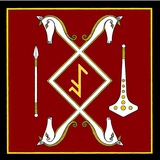
Saturday, from Roman Dies Saturni, Saturn’s Day. Saturn is the god of agriculture. When Rome moved into Germanic lands, the Teutons folk utilized Interpretatio germanica, the practice of replacing Roman names with Germanic names. A theory posits that Saturn replaced Ingwine-Fréa by means of Romano interpretato (the reverse of Interpretatio germanica). Bede, in his Ecclesiastical History of the English People, stated that the English were the Ingvæones, i.e. the children of Ing, so why isn’t one of the days of the week named after him, considering that Wóden, Þunor, and Ingwine-Fréa are the holy trinity of gods. Saturn is a God of fertility, crops, and frith; just like Ingwine-Fréa. After the forced conversion to Christianity, and it being too difficult to remove the peoples devotion to their founding god, the use of his name possibly became taboo. So, instead of making Saturday 'Ingedæġ', ‘Ingsday’, they used the Romano interpretato form of Saturn’s day, Saturday.
https://linktr.ee/TheFrithstead
https://linktr.ee/TheFrithstead
❤1
Forwarded from Hedera's Homestead
Feed Conversion Ratio
The feed conversion ratio (FCR) is the rate at which 1lb of meat is produced for however many pounds of feed.
It comes as no surprise that the little critters, with their fast turnaround rate, are proficient protein factories.
Chickens actually win out over rabbits in terms of efficiency, however, other traits of an animal can be a deciding factor over the FCR. The rabbit takes up much less space than the chicken and it's also a quiet animal, which can be its selling point to urban dwellers.
The pig is demanding, however it provides a vital resource that's hard to get on a scale any smaller: large amounts of precious fat.
Sheep and cows are quite high, yet provide still other valuable resources. If one has a suitable amount of pasture, these larger animals can definitely be worth it.
Goats, though not listed, have a similar FCR to sheep.
Note: FCRs are variable depending on breed, purpose, and quality of feed. These are high estimates for the hobby farmer.
The feed conversion ratio (FCR) is the rate at which 1lb of meat is produced for however many pounds of feed.
It comes as no surprise that the little critters, with their fast turnaround rate, are proficient protein factories.
Chickens actually win out over rabbits in terms of efficiency, however, other traits of an animal can be a deciding factor over the FCR. The rabbit takes up much less space than the chicken and it's also a quiet animal, which can be its selling point to urban dwellers.
The pig is demanding, however it provides a vital resource that's hard to get on a scale any smaller: large amounts of precious fat.
Sheep and cows are quite high, yet provide still other valuable resources. If one has a suitable amount of pasture, these larger animals can definitely be worth it.
Goats, though not listed, have a similar FCR to sheep.
Note: FCRs are variable depending on breed, purpose, and quality of feed. These are high estimates for the hobby farmer.
Kvasir, a poet and the wisest of all men; born of the saliva of two rival groups of Gods, the Ésa and the Wanas, when they performed the ancient peace ritual of spitting into a common vessel. He wandered around teaching and instructing, never failing to give the right answer to a question. Two Dweorgas, Fjalar and Galar, killed Kvasir and distilled his blood in Odhrǫrir, the magic cauldron. When mixed with honey by the giant Suttung, his blood formed mead that gave wisdom and poetic inspiration to those who drank it.
Kvasir appears in Gylfaginning and Skáldskaparmál.
https://linktr.ee/TheFrithstead
Kvasir appears in Gylfaginning and Skáldskaparmál.
https://linktr.ee/TheFrithstead
Forwarded from PRIMAL NOISE
Scotland's genetic landscape is remarkably similar to Dark Age populations, according to Scots researchers. The findings mean people still live in the same areas as their direct ancestors. Experts at Edinburgh University found six clusters of genetically-similar people dotted around the country. This is because people married and stayed locally, preserving their genetic identity. The experts said the DNA of Scottish people still reflected the country's ancient kingdoms, proving that people had not really moved around much. The findings show about six clusters of genetically-similar people in the Borders (angles), Strathclyde (britons), the Northeast (picts), the Hebrides (norse-gael), Orkney and Shetland (norse)
https://www.bbc.com/news/uk-scotland-49563887?fbclid=IwAR3cGJAeAUcSOvX0LC6dp3IaGDuNSSxs9RhAIGMzCbOr8EQ_Z1gX6OnNpl0
https://www.bbc.com/news/uk-scotland-49563887?fbclid=IwAR3cGJAeAUcSOvX0LC6dp3IaGDuNSSxs9RhAIGMzCbOr8EQ_Z1gX6OnNpl0
Dan Capp, of Wolcensmen, is a great artist. Check out his music.
Forwarded from Wolcensmen
In the run up to the release of Fire in the White Stone in 2019, we released a series of very short videos where I discussed aspects of the vision, the story, the symbolism and the process of making the album. I thought I'd provide links to them for those of you who didn't catch them at the time.
Part 1: The Concept Album
Part 2: Short Story
Part 3: Alchemy
Part 4: Artwork
Part 5: Producer
Part 6: Aims
Part 7: Guest Musicians
Part 8: The Swans of Gar's Edge
Part 1: The Concept Album
Part 2: Short Story
Part 3: Alchemy
Part 4: Artwork
Part 5: Producer
Part 6: Aims
Part 7: Guest Musicians
Part 8: The Swans of Gar's Edge
YouTube
Wolcensmen Part 1: The Concept Album
"Presenting the first in a series of short interviews where I discuss the making of the forthcoming full-length 'Fire in the White Stone'. Here I talk briefly about why I chose to make a concept album."
-Dan
Filmed and edited by Daniel Walmlsey & Becca Luck…
-Dan
Filmed and edited by Daniel Walmlsey & Becca Luck…
Anglo-Saxons: A Day in the Life
(Skills we should relearn)
https://youtu.be/Ht8HU9YTF9Q
https://linktr.ee/TheFrithstead
(Skills we should relearn)
https://youtu.be/Ht8HU9YTF9Q
https://linktr.ee/TheFrithstead
YouTube
Anglo-Saxon Daily Life
What would it have been like to live in Anglo-Saxon times? This video demonstrates the different tasks that people living in the past might have done.
This video has been made for illustration purposes and is not an instructional video.
Made in partnership…
This video has been made for illustration purposes and is not an instructional video.
Made in partnership…
Anglo-Saxons: A Day in the Life
(Skills we should re-learn)
https://youtu.be/gDxsg1YW620
https://linktr.ee/TheFrithstead
(Skills we should re-learn)
https://youtu.be/gDxsg1YW620
https://linktr.ee/TheFrithstead
YouTube
Weaving cloth the Anglo-Saxon way
How did people make cloth in Anglo-Saxon times? This video demonstrates the methods and techniques involved in weaving cloth, from preparing the wool to using a loom.
This video has been made for illustration purposes and is not an instructional video.
…
This video has been made for illustration purposes and is not an instructional video.
…
Ġeofon, ‘oft forgot goddess, whose name means sea, ocean, or flood. In Old Norse, she’s known as Gefjon. In Gylfaginning, she took four oxen and ploughed the land, drawing it out into the sea, naming the island Sjælland, meaning soul-land or sea-land. Sjæl is derived from *saiwalō (soul; life force), which in turn is derived from *saiwiz (sea; ocean). The concept of “soul” and ‘the sea’ are interconnected. There’s an ancient belief in sacred lakes inhabited by the dead and the unborn, cf. the Sami borrowing from Germanic, *sāvjë a realm of the dead believed to be under special double-bottomed lakes. Within Ġeofon, we have the connections of ‘sea’, and ‘soul’. Wyrd, the Old Norse Urðr, is the Goddess of fate and death, ruler over Hel and the Hellþing in Wyrdeburne, the well of fate and southernmost spring of Eormengrund, which water the roots of Eormensýl; adding ‘fate’ and ‘spring’ into the mix. Ġeofon is likely Wyrd, the premiere Norn and weaver of web’s wyrd.
https://linktr.ee/TheFrithstead
https://linktr.ee/TheFrithstead
Forwarded from Survive the Jive: All-feed
I have enjoyed the Germanic pagan neofolk music of Hagalaz Runedance for the last 12 years. I am sorry to hear that the artist Andrea Haugen was murdered by an Islamist in the recent attack in Kongsberg. May she be remembered https://youtu.be/TdvtXQrhsQw
Forwarded from ᛉᛟ Viðr ᛟᛉ
The rock carving area in Näsåker, Ångermanland, is one of the largest in Northern Europe. Spread out over several islands in Nämnforsen, there are at least 2500 shapes carved into the bedrock. The most common depictions are of moose, but salmon, birds, dogs, humans, ships, sun wheels, footprints and bowl pits are also prevalent.
The motifs confirm that a hunter gatherer community once lived in the area.
On the southern shore archeologists have found traces of a village, as well as arrowheads, iron knives and other tools made from slate and quartz.
The rock carvings are dated to the younger Stone Age and older Bronze Age and the finds indicate that this location has been inhabited for a very long time; from the Stone Age until at least the late Iron Age.
The motifs confirm that a hunter gatherer community once lived in the area.
On the southern shore archeologists have found traces of a village, as well as arrowheads, iron knives and other tools made from slate and quartz.
The rock carvings are dated to the younger Stone Age and older Bronze Age and the finds indicate that this location has been inhabited for a very long time; from the Stone Age until at least the late Iron Age.
The Anglo Saxon sceptre from the Sutton Hoo ship burial. Stone and metal. Interpreted as both a whetstone for sharpening swords and as a sceptre. The whetstone rod has four human faces carved into it at each end. One end was mounted with an iron ring with a bronze stag on top. A whetstone is linked to the idea of a powerful Lord providing swords as rewards to his loyal warriors.
https://linktr.ee/TheFrithstead
https://linktr.ee/TheFrithstead
William the Bastard’s legacy: The Harrying of the North
"There was such hunger that men ate the flesh of their own kind, of horses and dogs and cats. Others sold themselves into perpetual slavery that they might be able to sustain their miserable lives. It was horrible to look into the ruined farmyards and houses and see the human corpses dissolved into corruption, for there were none to bury them for all were gone either in flight, or cut down by the sword and famine. None dwelt there and travellers passed in great fear of wild beasts and savage robbers."
Simeon of Durham describing the Harrying of the North.
https://linktr.ee/TheFrithstead
"There was such hunger that men ate the flesh of their own kind, of horses and dogs and cats. Others sold themselves into perpetual slavery that they might be able to sustain their miserable lives. It was horrible to look into the ruined farmyards and houses and see the human corpses dissolved into corruption, for there were none to bury them for all were gone either in flight, or cut down by the sword and famine. None dwelt there and travellers passed in great fear of wild beasts and savage robbers."
Simeon of Durham describing the Harrying of the North.
https://linktr.ee/TheFrithstead