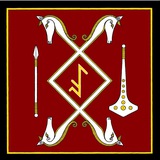
Rīgsþula 6-11
There he was for three nights together; then away he went in the middle of the path, nine months passed after that.
Great-grandmother had a baby, sprinkled him with water; dark-skinned, they called him Thrall.
He began to grow and to thrive well; on his hands there was wrinkled skin, knotted knuckles, thick fingers, he had an ugly face, a crooked back, long heels.
Then he began to use his strength, to bind bast-rope to make bundles; brushwood he carried home the whole day long.
Then there came to the farm a bandy-legged girl; she had mud on her soles, her arms were sunburned, her nose bent downwards, her name was Thrall-girl.
Then she sat in the middle of the bench; the son of the house sat next to her; they talked and they whispered, they went to bed together, Thrall and Thrall-girl, day after day.
https://linktr.ee/TheFrithstead
There he was for three nights together; then away he went in the middle of the path, nine months passed after that.
Great-grandmother had a baby, sprinkled him with water; dark-skinned, they called him Thrall.
He began to grow and to thrive well; on his hands there was wrinkled skin, knotted knuckles, thick fingers, he had an ugly face, a crooked back, long heels.
Then he began to use his strength, to bind bast-rope to make bundles; brushwood he carried home the whole day long.
Then there came to the farm a bandy-legged girl; she had mud on her soles, her arms were sunburned, her nose bent downwards, her name was Thrall-girl.
Then she sat in the middle of the bench; the son of the house sat next to her; they talked and they whispered, they went to bed together, Thrall and Thrall-girl, day after day.
https://linktr.ee/TheFrithstead
🔥3
Priesthood in the Indo-European Tradition & the Anglo-Saxon Polytheistic Revival.
Part 18
The Pontifex Maximus primary roles were to protect the Pax Deorum (Peace of the Gods) Libri Pontificales (Pontifical books). The Pax Deorum would only be maintained with correct religious practice, to not ensure this (vitium) or to allow impiety would lead to divine punishment for the city.
The Libri Pontificales included a list of the many names of the Deities, and the Annales maximi, the record of all magistrate appointments and important events. No one outside of the College of Pontiffs was allowed to touch or consult these books.
https://t.me/TheFrithstead
Part 18
The Pontifex Maximus primary roles were to protect the Pax Deorum (Peace of the Gods) Libri Pontificales (Pontifical books). The Pax Deorum would only be maintained with correct religious practice, to not ensure this (vitium) or to allow impiety would lead to divine punishment for the city.
The Libri Pontificales included a list of the many names of the Deities, and the Annales maximi, the record of all magistrate appointments and important events. No one outside of the College of Pontiffs was allowed to touch or consult these books.
https://t.me/TheFrithstead
Telegram
The Frithstead
An independent publishing & educational organization preserving & advancing the native Germanic faith of Sedianism & the American folcsida, serving as a hearth of study & cultural continuity shaping the spiritual, mental, emotional, & physical self.
Forwarded from Æhtemen
Woden in his role as Wish-Lord from 'The Saxons in England, Volume 1 by John Mitchell Kemble'
One of the names of Odin in the Old-Norse mythology is Osk, which by an etymological law is equivalent to the German Wunsch, the Anglo Saxon Wisc, and the English Wish. Grimm has shown in the most convincing manner that Wunsch may be considered as a name of Wuotan in Germany; and it is probable that Wúsc or Wísc may have had a similar power here. Among the names in the mythical genealogies we find Wúscfreá, the lord of the wish, and I am even inclined to the belief that Oisc, equivalent to Ésk, the founder of the Kentish line of kings, may be a Jutish name of Wóden in this form,—ésc, or in an earlier form óski, i. e. Wunsch, Wýsc. In Devonshire to this day all magical or supernatural dealings go under the common name of Wishtness: can this have any reference to Wóden’s name Wýsc? So again a bad or unfortunate day is a wisht day: perhaps a diabolical, heathen, accursed day. There are several places which appear to be compounded with this name; among them: Wishanger (Wíschangra or Wóden’s meadow), one, about four miles S.W. of Wanborough in Surrey, and another near Gloucester; Wisley (Wíscleáh) also in Surrey; Wisborough (probably Wíscbeorh) in Sussex; Wishford (probably Wíscford) in Wiltshire.
One of the names of Odin in the Old-Norse mythology is Osk, which by an etymological law is equivalent to the German Wunsch, the Anglo Saxon Wisc, and the English Wish. Grimm has shown in the most convincing manner that Wunsch may be considered as a name of Wuotan in Germany; and it is probable that Wúsc or Wísc may have had a similar power here. Among the names in the mythical genealogies we find Wúscfreá, the lord of the wish, and I am even inclined to the belief that Oisc, equivalent to Ésk, the founder of the Kentish line of kings, may be a Jutish name of Wóden in this form,—ésc, or in an earlier form óski, i. e. Wunsch, Wýsc. In Devonshire to this day all magical or supernatural dealings go under the common name of Wishtness: can this have any reference to Wóden’s name Wýsc? So again a bad or unfortunate day is a wisht day: perhaps a diabolical, heathen, accursed day. There are several places which appear to be compounded with this name; among them: Wishanger (Wíschangra or Wóden’s meadow), one, about four miles S.W. of Wanborough in Surrey, and another near Gloucester; Wisley (Wíscleáh) also in Surrey; Wisborough (probably Wíscbeorh) in Sussex; Wishford (probably Wíscford) in Wiltshire.
👍6🔥3
The Folcsida Ġerīmbōc: Observances (Part 45)
Herlaþing, or Herla’s Assembly (commonly known as the Wild Hunt (from the German Wilde Jagd)) takes place following the Winter Sunstead, when the nights are long & cold winter storms rage. It’s during this time when our forebears gathered to celebrate the lengthening of days, honor the gods, & seek their protection from harm, such as famine, misfortune, transgression, peril, war, spiritual concealment, poverty or hunger, infertility, & sickness or plague. With ghostly dogs, Herla (another name of Wōden) & his wife Erce (another name of Frīġe) would lead the Ése, Ylfe, & Anherġas on their holy ride, cleansing the air of evils, cp. Hávamál 155 “I know a tenth one if I see witches playing up in the air; I can bring it about that they wander astray from their shapes left at home, from their minds left at home”. Concluding on Yule, the folk gathered indoors during Herla’s Assembly, for seeing the Wild Hunt was thought to foreboding.
~ Folcweard
Herlaþing, or Herla’s Assembly (commonly known as the Wild Hunt (from the German Wilde Jagd)) takes place following the Winter Sunstead, when the nights are long & cold winter storms rage. It’s during this time when our forebears gathered to celebrate the lengthening of days, honor the gods, & seek their protection from harm, such as famine, misfortune, transgression, peril, war, spiritual concealment, poverty or hunger, infertility, & sickness or plague. With ghostly dogs, Herla (another name of Wōden) & his wife Erce (another name of Frīġe) would lead the Ése, Ylfe, & Anherġas on their holy ride, cleansing the air of evils, cp. Hávamál 155 “I know a tenth one if I see witches playing up in the air; I can bring it about that they wander astray from their shapes left at home, from their minds left at home”. Concluding on Yule, the folk gathered indoors during Herla’s Assembly, for seeing the Wild Hunt was thought to foreboding.
~ Folcweard
🔥2
Forwarded from Radical Paganism.
The Doer!
The Doer has become a heroic Archetype in itself within the broader Folk community.
The Doer is a man of action who doesn't wait for something beautiful to be built for him but sets out to build the foundation necessary to ensure a future for our folk.
Building local communities, starting businesses, acquiring wealth, establishing himself and those around him in a meaningful way are all deeds of a Doer.
Getting out, gathering the Folk and forming collective efforts towards a new age of order is what a Doer does.
A Doer seperates himself from the trappings of the modern world utilizing such things as Social media and Online presence as a means to generate real-life action.
Whereas most find themselves stuck in a mindset and cycle of inaction utilizing mostly unproductive means as an outlet for activism.
The Doer sets himself apart by putting into action his plan for victory!
Be a Doer!
Hail the Doers!
The Doer has become a heroic Archetype in itself within the broader Folk community.
The Doer is a man of action who doesn't wait for something beautiful to be built for him but sets out to build the foundation necessary to ensure a future for our folk.
Building local communities, starting businesses, acquiring wealth, establishing himself and those around him in a meaningful way are all deeds of a Doer.
Getting out, gathering the Folk and forming collective efforts towards a new age of order is what a Doer does.
A Doer seperates himself from the trappings of the modern world utilizing such things as Social media and Online presence as a means to generate real-life action.
Whereas most find themselves stuck in a mindset and cycle of inaction utilizing mostly unproductive means as an outlet for activism.
The Doer sets himself apart by putting into action his plan for victory!
Be a Doer!
Hail the Doers!
👍7🔥3
Folcsida Lorebook
The Original Age
I. Yawning Space
1. In the earliest age, what is was not, there was no sand, nor sea, nor cool waves. The earth did not exist, nor the sky above. There was a mighty chasm, Yawning Space; but grass grew nowhere.
2. It was many ages before the earth was created that the Deep Home was made, and in its midst lies a spring called the Roaring Cauldron, resting atop the Mountains of the Abyss. From there flow the rivers known as Burning Cold, Battle Trough, Rushing, the Great Rushing Sound, the Fearful, and the Snowstorm, Swill, the Swelling, the Wide, Lightening, and the Resounding. The Resounding river lies next to the Gates of Hell and the river Lightening is so holy sacred oaths are sworn upon it. All of these rivers are known collectively as the Ice Waves. The Roaring Cauldron flowed north of the Yawning Space, enveloping the Deep Home in mist and cold.
3. First, there was that world in the southern region which is called the Sunken Dales or Outer Yard, in Hell’s Home. It is bright and hot. That area is flaming and burning and was impassable for those that were foreigners there and were not native to it. Also in Hell’s Home, the fountain of warmth and strength giving liquids, called Wyrd’s Spring, is to be found. There was no sun to shine.
4. Between these two regions lies the well of wisdom, Mimor’s Spring, where the Yawning Space once was. When the Ice Wave rivers came so far from their source, the Life-Drops hardened like a slag of cinders running from a furnace, and became ice. When this ice began to solidify and no longer run, the Life-Drops spewed out and froze into icy rime. Then, layer by layer, the ice grew within the Yawning Space.
5. That part of the the Yawning Space, which reached into the northern regions, became filled with thick ice and rime. Inside the gap there was mist and wind-whipped rain. But the southern part of the Yawning Space grew light because of sparks and glowing embers flowing from Hell’s Home. Sparks flew from the south-world: the fire gave life to the ice.
6. Just as coldness and all things grim came from the Deep Home, the regions close to Hell’s Home in the south were hot and bright, but the Yawning Space was as mild as a windless sky. Thence in each direction there arose a holy fountain which would bring life into the worlds.
*Modern English translation of The Ásatrú Edda by The Norrœna Society by Folcweard Lárġyfa.
thefrithstead.com
The Original Age
I. Yawning Space
1. In the earliest age, what is was not, there was no sand, nor sea, nor cool waves. The earth did not exist, nor the sky above. There was a mighty chasm, Yawning Space; but grass grew nowhere.
2. It was many ages before the earth was created that the Deep Home was made, and in its midst lies a spring called the Roaring Cauldron, resting atop the Mountains of the Abyss. From there flow the rivers known as Burning Cold, Battle Trough, Rushing, the Great Rushing Sound, the Fearful, and the Snowstorm, Swill, the Swelling, the Wide, Lightening, and the Resounding. The Resounding river lies next to the Gates of Hell and the river Lightening is so holy sacred oaths are sworn upon it. All of these rivers are known collectively as the Ice Waves. The Roaring Cauldron flowed north of the Yawning Space, enveloping the Deep Home in mist and cold.
3. First, there was that world in the southern region which is called the Sunken Dales or Outer Yard, in Hell’s Home. It is bright and hot. That area is flaming and burning and was impassable for those that were foreigners there and were not native to it. Also in Hell’s Home, the fountain of warmth and strength giving liquids, called Wyrd’s Spring, is to be found. There was no sun to shine.
4. Between these two regions lies the well of wisdom, Mimor’s Spring, where the Yawning Space once was. When the Ice Wave rivers came so far from their source, the Life-Drops hardened like a slag of cinders running from a furnace, and became ice. When this ice began to solidify and no longer run, the Life-Drops spewed out and froze into icy rime. Then, layer by layer, the ice grew within the Yawning Space.
5. That part of the the Yawning Space, which reached into the northern regions, became filled with thick ice and rime. Inside the gap there was mist and wind-whipped rain. But the southern part of the Yawning Space grew light because of sparks and glowing embers flowing from Hell’s Home. Sparks flew from the south-world: the fire gave life to the ice.
6. Just as coldness and all things grim came from the Deep Home, the regions close to Hell’s Home in the south were hot and bright, but the Yawning Space was as mild as a windless sky. Thence in each direction there arose a holy fountain which would bring life into the worlds.
*Modern English translation of The Ásatrú Edda by The Norrœna Society by Folcweard Lárġyfa.
thefrithstead.com
❤5🔥4👍1
Forwarded from Beowulfsmal
Hrafna-Cyning
Iċ béo án cínan of Wódene;
Héah-ġeboren
And þearlwís.
Tíwes-Hand
In þæs Wulfes Múðan
Is mín sweord.
From se blæc more
Mid wanfáh fuglas
Iċ ġewealde.
Iċ béo se Hrafna-Cyning
And Iċ sceal ábǽdan wælhréownes
Tó þǽm wælhréowliċum.
Translation:
Raven King
I am a scion of Woden;
High born
And relentless.
Tiw's Hand
In the Wolf's Mouth
Is my sword.
From the black moor
With ebony birds
I rule.
I am the Raven King
And I shall exact cruelty
Upon the cruel.
Iċ béo án cínan of Wódene;
Héah-ġeboren
And þearlwís.
Tíwes-Hand
In þæs Wulfes Múðan
Is mín sweord.
From se blæc more
Mid wanfáh fuglas
Iċ ġewealde.
Iċ béo se Hrafna-Cyning
And Iċ sceal ábǽdan wælhréownes
Tó þǽm wælhréowliċum.
Translation:
Raven King
I am a scion of Woden;
High born
And relentless.
Tiw's Hand
In the Wolf's Mouth
Is my sword.
From the black moor
With ebony birds
I rule.
I am the Raven King
And I shall exact cruelty
Upon the cruel.
🔥7👍4
The Folcsida Ġerīmbōc: Observances (Part 46)
Following the Herlaþing, our forebears would celebrate Ġēol (Yule), when the birth of the light half of the year begins to show its face. Observing the moonly cycles, Ġēol is reckoned to fall on the first Full Moon after the New Moon after the Sunstead. The Sunstead being the marker that serves as the constant. This system easily fits within any timekeeping system, such as our modern Gregorian calendar. This moonly-sunly system allows reliability & predictability; placing Ġēol in the appropriate time of the year.
Following the Herlaþing, our forebears would celebrate Ġēol (Yule), when the birth of the light half of the year begins to show its face. Observing the moonly cycles, Ġēol is reckoned to fall on the first Full Moon after the New Moon after the Sunstead. The Sunstead being the marker that serves as the constant. This system easily fits within any timekeeping system, such as our modern Gregorian calendar. This moonly-sunly system allows reliability & predictability; placing Ġēol in the appropriate time of the year.
👍3❤2🔥2
The institution of the Priesthood
“The chief city in that land was called Ōsġeard. In that city was a chief called Wōden, and it was a great place for sacrifice. It was the custom there that twelve temple priests should both direct the sacrifices, and also judge the people. They were called Dryhtnas, and all the people served and obeyed them.”
“Wōden placed Nyord and Seaxnēat-Frēa as priests of the sacrifices, and they became Dryhtnas of the Ōsland people. Nyord’s daughter Frōwe was priestess of the sacrifices, and first taught the Ōsland people the magic art, as it was in use and fashion among the Wanaland people.”
~ Ynglinga Saga
(with Anglo-Saxon terms)
https://linktr.ee/TheFrithstead
“The chief city in that land was called Ōsġeard. In that city was a chief called Wōden, and it was a great place for sacrifice. It was the custom there that twelve temple priests should both direct the sacrifices, and also judge the people. They were called Dryhtnas, and all the people served and obeyed them.”
“Wōden placed Nyord and Seaxnēat-Frēa as priests of the sacrifices, and they became Dryhtnas of the Ōsland people. Nyord’s daughter Frōwe was priestess of the sacrifices, and first taught the Ōsland people the magic art, as it was in use and fashion among the Wanaland people.”
~ Ynglinga Saga
(with Anglo-Saxon terms)
https://linktr.ee/TheFrithstead
❤11👍1
The Beauty & Danger of a Double-Edged Sword, i.e. Men, Women, & Love 😉
A maiden's words no one ought to trust, nor what a woman says, because on a turning wheel their hearts were created, changeability placed in their breasts
v. 84
I now speak plain, because I know both, faithless are men's minds towards women; we speak fairest, where we think most false; that deceives the mind of the wise. v. 91
For his love, no one should blame another ever; ravishingly fair looks, when they do not capture the fool, often capture the wise man.
v. 93
Fault with another let no man find, to what happens to many a man. The wise become fools, are made by mighty love
V. 94
~ Sayings of the High One
https://linktr.ee/TheFrithstead
A maiden's words no one ought to trust, nor what a woman says, because on a turning wheel their hearts were created, changeability placed in their breasts
v. 84
I now speak plain, because I know both, faithless are men's minds towards women; we speak fairest, where we think most false; that deceives the mind of the wise. v. 91
For his love, no one should blame another ever; ravishingly fair looks, when they do not capture the fool, often capture the wise man.
v. 93
Fault with another let no man find, to what happens to many a man. The wise become fools, are made by mighty love
V. 94
~ Sayings of the High One
https://linktr.ee/TheFrithstead
👍2🔥2
Wynn
Bliss he enjoys who knows not suffering, sorrow nor anxiety,
and has prosperity and happiness and a good enough house.
We need to connect & awaken the awareness of the reality that lies deep within ourselves; to connect with our ancient forbears & gods. To breathe new life into our Folcsida; bringing forth what once was into the here & now. This world will be destroyed. Another created. Cycles of rebirth. We’re living in a world that one day will no longer be. We each need to prepare for the next cycle which could repetitively happen at any given moment. We need to learn ways and techniques to connect, so that we may carry this knowledge forward into the next cycle. We continue until we get it right. We continúe in order to help our future bloodlines. To help the future us. Connecting with the age old, in order to prepare for the age ahead. The gods await.
https://linktr.ee/TheFrithstead
Bliss he enjoys who knows not suffering, sorrow nor anxiety,
and has prosperity and happiness and a good enough house.
ᚹ Wynn bruceþ, ðe can weana lyt sares and sorge and him sylfa hæfþ blæd and blysse and eac byrga geniht. We need to connect & awaken the awareness of the reality that lies deep within ourselves; to connect with our ancient forbears & gods. To breathe new life into our Folcsida; bringing forth what once was into the here & now. This world will be destroyed. Another created. Cycles of rebirth. We’re living in a world that one day will no longer be. We each need to prepare for the next cycle which could repetitively happen at any given moment. We need to learn ways and techniques to connect, so that we may carry this knowledge forward into the next cycle. We continue until we get it right. We continúe in order to help our future bloodlines. To help the future us. Connecting with the age old, in order to prepare for the age ahead. The gods await.
https://linktr.ee/TheFrithstead
🔥6
Religious & Political Leaders
"Silence is then commanded by the priests, who on such occasions have power to enforce obedience. Then such hearing is given to the king or state-chief as his age, rank, military distinction, or eloquence can secure- more because his advice carries weight than because he has the power to command."
~ Germania, Tacitus
https://linktr.ee/TheFrithstead
"Silence is then commanded by the priests, who on such occasions have power to enforce obedience. Then such hearing is given to the king or state-chief as his age, rank, military distinction, or eloquence can secure- more because his advice carries weight than because he has the power to command."
~ Germania, Tacitus
https://linktr.ee/TheFrithstead
👍5❤1
Forwarded from The Jolly Reiver
NEW VIDEO: 25 Creatures in English Folklore
Here is the first part of my overview of creatures from English folklore. Despite it only being part 1, you won’t find a longer list on YouTube!
The folklore and myths of other countries have huge numbers of videos and attention, with England’s myths being too often overlooked. Hopefully this video can remedy that problem.
https://youtu.be/L7CzeMH4f_w
Here is the first part of my overview of creatures from English folklore. Despite it only being part 1, you won’t find a longer list on YouTube!
The folklore and myths of other countries have huge numbers of videos and attention, with England’s myths being too often overlooked. Hopefully this video can remedy that problem.
https://youtu.be/L7CzeMH4f_w
YouTube
25 Creatures in English Folklore and Myth 🏴
What creatures and ghouls can be found in England's folklore and mythology? Black Dogs, Ghosts, Goblins, Faeries, Sprites and Big Cats lurk in our forests, marshes and hills and lakes. This list of 25 creatures will give you a good overview of what the English…
👍3
Forwarded from The Jolly Reiver
Boggles/Boggarts (from which we get the term ‘bogeyman’) are a malevolent goblin-like creature that perplex farmers by hiding tools and souring milk. However the ones found living in holes or marshes are far more dangerous, doing things like abducting children and even murder.
I just visited the Boggle Hole on the Yorkshire coast, where one of these creatures was once known to live. I also slipped in the sea and spent the rest of the day wet and cold. No doubt this was down to the Boggle.
I just visited the Boggle Hole on the Yorkshire coast, where one of these creatures was once known to live. I also slipped in the sea and spent the rest of the day wet and cold. No doubt this was down to the Boggle.
👍16
Thorbjorn Hornklofe, 9th-century Norwegian skald & court poet of King Harald Fairhair, speaks on Ingwine-Frēa as a sun-god.
Snorri Sturluson writes in Harald Fairhair's saga that Harald Fairhair disputed the Swedish king Eric Eymundsson's hegemony in what is today southern Norway. He attacked and forced Viken to accept his rule and then plundered and burnt in Rånrike. Because of this the Norwegian skald Þorbjörn hornklofi boasted that the Swedes stayed indoors whereas the Norwegians were out on the sea.
The Norseman's king is on the sea,
Tho' bitter wintry cold it be.—
On the wild waves his Yule keeps he.
When our brisk king can get his way,
He'll no more by the fireside stay
Than the young sun; he makes us play
The game of the bright sun-god Frēa.
But the soft Swede loves well the fire
The well-stuffed couch, the doway glove,
And from the hearth-seat will not move.
ING by @thesaxonstoryteller (on Instagram)
https://linktr.ee/TheFrithstead
Snorri Sturluson writes in Harald Fairhair's saga that Harald Fairhair disputed the Swedish king Eric Eymundsson's hegemony in what is today southern Norway. He attacked and forced Viken to accept his rule and then plundered and burnt in Rånrike. Because of this the Norwegian skald Þorbjörn hornklofi boasted that the Swedes stayed indoors whereas the Norwegians were out on the sea.
The Norseman's king is on the sea,
Tho' bitter wintry cold it be.—
On the wild waves his Yule keeps he.
When our brisk king can get his way,
He'll no more by the fireside stay
Than the young sun; he makes us play
The game of the bright sun-god Frēa.
But the soft Swede loves well the fire
The well-stuffed couch, the doway glove,
And from the hearth-seat will not move.
ING by @thesaxonstoryteller (on Instagram)
https://linktr.ee/TheFrithstead
👍5