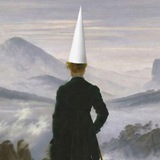
But what Raspail doesn’t say explicitly is that the beautiful oak door SHOULD burn. It needs to burn. Its beauty is idolatrous.
Why?
Examine the teleology of the door, why it was made beautifully. The door was made within the tradition of sacred syncretism, to unify the Universal divinity of God with the local spirit of the hearth.
But then the Frenchman stopped believing in God.
Then he stopped believing in the sacred hearth and family.
And now he just has an ornate door, sitting alone, unable to explain its beauty or purpose, trying to justify its existence to desperate people in a dying society.
In other words, it’s an idol to a dead god. And idols MUST BURN. No human can tolerate the existence of such manifest desecration and be fully alive spiritually. We want to destroy these false promises that can’t be made real.
The Frenchman doesn’t have the grit to destroy the false idols of the past. The migrants do. That might be the reason the Frenchman invited them in to his country to begin with.
All told, we looked at test and survey data from over 600,000 students. Our analysis found that philosophy majors scored higher than students in all other majors on standardized tests of verbal and logical reasoning, as well as on self-reports of good habits of mind, even after accounting for freshman-year differences. This suggests that their intellectual abilities and traits are due, in part, to what they learned in college.
https://theconversation.com/studying-philosophy-does-make-people-better-thinkers-according-to-new-research-on-more-than-600-000-college-grads-262681
The Conversation
Studying philosophy does make people better thinkers, according to new research on more than 600,000 college grads
Philosophers are fond of saying that their field boosts critical thinking. Two of them decided to put that claim to the test.
Forwarded from Western Chauvinist News Network
This media is not supported in your browser
VIEW IN TELEGRAM
You can see in this footage that the homeless junkie runs up and spits on Sewell. Sewell turns to face the parasite, who immediately begins throwing punches. I am not sure what the Australian laws around self-defense are, but had this happened to anyone but the WA guys, the junkie would've been arrested for assault. Because Tom Sewell is an NS leader, he gets arrested for defending himself. Stand with Sewell.
T.me/TheWesternChauvinist12
T.me/TheWesternChauvinist12
Western Chauvinist News Network
You can see in this footage that the homeless junkie runs up and spits on Sewell. Sewell turns to face the parasite, who immediately begins throwing punches. I am not sure what the Australian laws around self-defense are, but had this happened to anyone…
Remember Carl Schmitt here:
If you're the enemy of the state, they can simply decide to arrest you for anything. Paper and law do not actually protect you.
A negro approaches me, saying, "hand over your wallet," and gesturing towards his pocket, whether there's an outline of a gun. I reply, "that's against the law, sir. The law says that's my wallet." He pulls out his gun.
What is the difference between this and a similar interaction between you and the government?
In the former case, there's a higher authority that might enforce those laws against him. He might go to jail if he shoots me.
In the latter case, there's no such entity. The sovereign is that highest force. Nobody can enforce the laws upon it, for it has the biggest guns. You are asking it to enforce the rules against itself. It probably won't.
The sovereign is he who decided the exception.
If you're the enemy of the state, they can simply decide to arrest you for anything. Paper and law do not actually protect you.
A negro approaches me, saying, "hand over your wallet," and gesturing towards his pocket, whether there's an outline of a gun. I reply, "that's against the law, sir. The law says that's my wallet." He pulls out his gun.
What is the difference between this and a similar interaction between you and the government?
In the former case, there's a higher authority that might enforce those laws against him. He might go to jail if he shoots me.
In the latter case, there's no such entity. The sovereign is that highest force. Nobody can enforce the laws upon it, for it has the biggest guns. You are asking it to enforce the rules against itself. It probably won't.
Forwarded from Poor Reads
So molded, ritualized, and controlled, utopianism has served here as elsewhere to diffuse or deflect dissent, or actually to transmute it into a vehicle of socialization. Indeed, it is not too much to see this as ideology’s chief weapon. Ideology represses alternative or oppositional forms when these arise. But it seeks first of all to preempt them, and it does so most effectively by drawing out protest, by actively encouraging the contrast between utopia and the status quo. The method is as old as ideology itself. Any form of protest, utopian or other, threatens society most fundamentally when it calls into question the claims of that society to represent things as they ought to be (by divine right, natural law, the dictates of holy scripture, the forms of reason). Fundamental protest, that is, involves a historicist, relativistic perspective on the claims of ideology. And the immemorial response of ideology, what we might call its instinctive defense, has been to redefine protest in terms of the system, as a complaint about shortcomings from its ideals, or deviations from its myths of self and community. Thus the very act of identifying malfunction becomes an appeal for cohesion. To that end, ideology seeks to focus attention on the distance between vision and fact, theory and practice. To denounce a king through precepts derived from the divine right of kings is to define government itself as monarchical; just as to denounce immoral Christians by contrast with the sacred example of Christ is to Christianize morality. To define injustice through particular violations of free enterprise (or its constituent elements, such as equal opportunity and representative individualism) is to consecrate free enterprise as the just society.
Hence the enormous conservative, restraining power in the alliance between utopia and ideology. It allows the dominant culture not merely to enforce rules of conduct, but to circumscribe the bounds of perception, thought, and desire. And if that culture dominates not by coercion but by consent—if its rituals are not traditional but newly formed, and “new” as well by cultural fiat (new rituals of what Winthrop, Paine, and Reagan called a New People in a New World); if the population, moreover, is broadly heterogeneous (and again, heterogeneous as well by cultural fiat, the self-proclaimed nation of nations, culture of pluralism, and haven of the oppressed and uprooted); if its power, therefore, depends on myths and values to which all levels of society subscribe, especially the excluded or marginalized (since to subscribe thus seems the ready way to power); and if, finally, it is a culture founded on the principles of contract, voluntarism, and self-interest—a culture whose primary unit is the self, and whose primary rites, accordingly, encourage the potentially anarchic doctrine of individualism (with its insidious affinities to individuality and the subversive claims of independent selfhood)—if the culture, that is, combines the conditions of modernization with the principles of liberal democracy, then the need to preclude alternatives a priori, before they can become radical fact, assumes special urgency.
We might say that the American ideology was made to fill that need. It undertakes above all, as a condition of its nurture, to absorb the spirit of protest for social ends; and according to a number of recent critics, it has accomplished this most effectively through its rhetoric of dissent. In this view, America’s classic texts represent the strategies of a triumphant liberal hegemony. Far from subverting the status quo, their diagnostic and prophetic modes attest to the capacities of the dominant culture to absorb alternative forms, to the point of making basic change seem virtually unthinkable, except as apocalypse. This is not at all to minimize their protest. The point here is not that these classic writers had no quarrel with America, but that they seem to have had nothing but that to quarrel about.
Forwarded from Poor Reads
Having adopted the culture’s controlling metaphor—“America” as synonym for human possibility—and having made this tenet of consensus the ground of radical dissent, they redefined radicalism as an affirmation of cultural values. For the metaphor, thus universalized, does not transcend ideology. It portrays the American ideology, as all ideology yearns to be portrayed, in the transcendent colors of utopia. In this sense the antebellum literary renaissance was truly, as Matthiessen said, both American and “the age of Emerson and Whitman”; the conjunction is embodied in The American Scholar and Democratic Vistas, both of which, in the very act of chastising the nation, identify the American future as utopia, and utopia, by extension, as the American Way.
— Sacvan Bercovitch, The Rites of Assent: Transformations in the Symbolic Construction of America
In a comment below, explain the main point and key message of the passage from your point of view. Use specific details from the text to support your explanation. After you've submitted a summary, but not before then, you can engage with others who have contributed. Comments made by those who have not provided a summary will be deleted.
Follow us at Poor Reads for focused chats pertaining to your daily dose of the most prolix, labyrinthine, grandiloquent, sesquipedalian, and impenetrable prose on right-wing Telegram. Most rightoids can't read; but can you? Join us to find out.
Poor Reads
So molded, ritualized, and controlled, utopianism has served here as elsewhere to diffuse or deflect dissent, or actually to transmute it into a vehicle of socialization. Indeed, it is not too much to see this as ideology’s chief weapon. Ideology represses…
Have already got people sharing the new channel's posts claiming that the quotation is unreadable nonsense.
Remember that most people are functionally illiterate.
Remember that most people are functionally illiterate.
Forwarded from Poor Reads
PvmpGvng
Bold move banning people in a 5 subscriber channel
Standards are high here; this is a place for scholarly discussion among men of letters. Quality is preferable to quantity; quantity would signal that something has gone horrendously wrong. 7 high quality participants is preferable to 7,000 low quality ones.
Forwarded from Poor Reads
“Then do you see, Socrates,” he said, “how great the difficulty is if one marks things off as forms, themselves by themselves?”
“Quite clearly.”
“I assure you,” he said, “that you do not yet, if I may put it so, have an inkling of how great the difficulty is if you are going to posit one form in each case every time you make a distinction among things.”
“How so?” he asked.
“There are many other reasons,” Parmenides said, “but the main one is this: suppose someone were to say that if the forms are such as we claim they must be, they cannot even be known. If anyone should raise that objection, you wouldn’t be able to show him that he is wrong, unless the objector happened to be widely experienced and not ungifted, and consented to pay attention while in your effort to show him you dealt with many distant considerations. Otherwise, the person who insists that they are necessarily unknowable would remain unconvinced.”
“Why is that, Parmenides?” Socrates asked.
“Because I think that you, Socrates, and anyone else who posits that there is for each thing some being, itself by itself, would agree, to begin with, that none of those beings is in us.”
“Yes – how could it still be itself by itself?” replied Socrates.
“Very good,” said Parmenides. “And so all the characters that are what they are in relation to each other have their being in relation to themselves but not in relation to things that belong to us. And whether one posits the latter as likenesses or in some other way, it is by partaking of them that we come to be called by their various names. These things that belong to us, although they have the same names as the forms, are in their turn what they are in relation to themselves but not in relation to the forms; and all the things named in this way are of themselves but not of the forms.”
“What do you mean?” Socrates asked.
“Take an example,” said Parmenides. “If one of us is somebody’s master or somebody’s slave, he is surely not a slave of master itself – of what a master is – nor is the master a master of slave itself – of what a slave is. On the contrary, being a human being, he is a master or slave of a human being. Mastery itself, on the other hand, is what it is of slavery itself; and, in the same way, slavery itself is slavery of mastery itself. Things in us do not have their power in relation to forms, nor do they have theirs in relation to us; but, I repeat, forms are what they are of themselves and in relation to themselves, and things that belong to us are, in the same way, what they are in relation to themselves. You do understand what I mean?”
“Certainly,” Socrates said, “I understand.”
“So too,” he said, “knowledge itself, what knowledge is, would be knowledge of that truth itself, which is what truth is?”
“Certainly.”
“Furthermore, each particular knowledge, what it is, would be knowledge of some particular thing, of what that thing is. Isn’t that so?”
“Yes.”
“But wouldn’t knowledge that belongs to us be of the truth that belongs to our world? And wouldn’t it follow that each particular knowledge that belongs to us is in turn knowledge of some particular thing in our world?”
“Necessarily.”
“But, as you agree, we neither have the forms themselves nor can they belong to us.”
“Yes, you’re quite right.”
“And surely the kinds themselves, what each of them is, are known by the form of knowledge itself?”
“Yes.”
“The very thing that we don’t have.”
“No, we don’t.”
“So none of the forms is known by us, because we don’t partake of knowledge itself.”
“It seems not.”
“Then the beautiful itself, what it is, cannot be known by us, nor can the good, nor, indeed, can any of the things we take to be characters themselves.”
“It looks that way.”
“Here’s something even more shocking than that.”
“What’s that?”
“Surely you would say that if in fact there is knowledge – a kind itself – it is much more precise than is knowledge that belongs to us. And the same goes for beauty and all the others.”
“Yes.”
(Continued below.)
Forwarded from Poor Reads
Poor Reads
“Then do you see, Socrates,” he said, “how great the difficulty is if one marks things off as forms, themselves by themselves?” “Quite clearly.” “I assure you,” he said, “that you do not yet, if I may put it so, have an inkling of how great the difficulty…
(Continuing from above.)
In a comment below, explain the main point and key message of the passage from your point of view. Use specific details from the text to support your explanation. After you've submitted a summary, but not before then, you can engage with others who have contributed. Comments made by those who have not provided a summary will be deleted.
Follow us at Poor Reads for focused chats pertaining to your daily dose of the most prolix, labyrinthine, grandiloquent, sesquipedalian, and impenetrable prose on right-wing Telegram. Most rightoids can't read; but can you? Join us to find out.
“Well, whatever else partakes of knowledge itself, wouldn’t you say that god more than anyone else has this most precise knowledge?”— Plato, Parmenides
“Necessarily.”
“Tell me, will god, having knowledge itself, then be able to know things that belong to our world?”
“Yes, why not?”
“Because we have agreed, Socrates,” Parmenides said, “that those forms do not have their power in relation to things in our world, and things in our world do not have theirs in relation to forms, but that things in each group have their power in relation to themselves.”
“Yes, we did agree on that.”
“Well then, if this most precise mastery and this most precise knowledge belong to the divine, the gods’ mastery could never master us, nor could their knowledge know us or anything that belongs to us. No, just as we do not govern them by our governance and know nothing of the divine by our knowledge, so they in their turn are, for the same reason, neither our masters nor, being gods, do they know human affairs.”
“If god is to be stripped of knowing,” he said, “our argument may be getting too bizarre.”
“And yet, Socrates,” said Parmenides, “the forms inevitably involve these objections and a host of others besides – if there are those characters for things, and a person is to mark off each form as ‘something itself.’ As a result, whoever hears about them is doubtful and objects that they do not exist, and that, even if they do, they must by strict necessity be unknowable to human nature; and in saying this he seems to have a point; and, as we said, he is extraordinarily hard to win over. Only a very gifted man can come to know that for each thing there is some kind, a being itself by itself; but only a prodigy more remarkable still will discover that and be able to teach someone else who has sifted all these difficulties thoroughly and critically for himself.”
“I agree with you, Parmenides,” Socrates said. “That’s very much what I think too.”
In a comment below, explain the main point and key message of the passage from your point of view. Use specific details from the text to support your explanation. After you've submitted a summary, but not before then, you can engage with others who have contributed. Comments made by those who have not provided a summary will be deleted.
Follow us at Poor Reads for focused chats pertaining to your daily dose of the most prolix, labyrinthine, grandiloquent, sesquipedalian, and impenetrable prose on right-wing Telegram. Most rightoids can't read; but can you? Join us to find out.
Media is too big
VIEW IN TELEGRAM
When Mr. Poor says you can't swear in chat anymore
I’m not afraid to calmly assert today, at 60 years of age, after all my experiences with men and books, with speeches and situations, that the great speech by Donoso on dictatorship on January 4th, 1849 is the greatest speech in world literature. And with that I make no exceptions to Pericles and Demosthenes, nor for Cicero or Mirabeau or Burke.— Carl Schmitt, writing to Ernst Jünger.
Juan Donoso Cortés' masterfully describes the origin of revolution:
No, gentlemen, it is not in slavery, it is not in misery that the germ of revolutions lies, the germ of revolutions lies in the overexcited desires of the masses, caused by the politicians who exploit and benefit from them:
‘And you shall be like the rich.’ That is the formula of the socialist revolutions against the middle classes.
‘And you shall be like the nobles.’ That is the formula of the revolutions of the middle classes against the noble classes.
‘And you will be like kings.’ That is the formula of the revolutions of the noble classes against the kings.
Finally, gentlemen, ‘and you will be like Gods.’ That is the formula of the first rebellion of the first man against God. From Adam, the first rebel, to Proudhon, the last impious, that is the formula of all revolutions.
Throughout his masterful speech, Cortés builds an understanding of the modern choice between the revolution and the dictatorship; he works through historical examples of both, outlines the roles of countries like England and France within the modern stream of revolutions that has carried us to our present location, describes the relationship between religion and political repression, and argues that liberty came into the world with Jesus Christ, and as religious faith declines, despotism becomes inevitable. The speech ends with a choice not between dictatorship and liberty, which no longer exists in Europe, but "between the dictatorship of insurrection and the dictatorship of the Government, ... the dictatorship that comes from below and the dictatorship that comes from above." He favors the latter because it comes from a cleaner, more serene place; in short, he chooses order over chaos, finding that the dictatorship of the sword is more noble than the dictatorship of the dagger.
If the above interested you, check out the full speech:
https://t.me/PoorReads/31
Telegram
Poor Reads
I’m not afraid to calmly assert today, at 60 years of age, after all my experiences with men and books, with speeches and situations, that the great speech by Donoso on dictatorship on January 4th, 1849 is the greatest speech in world literature. And with…
Dull Academic Incessant Liturgical Yapping: Philosophical Orations on Order & Reaction
I’m not afraid to calmly assert today, at 60 years of age, after all my experiences with men and books, with speeches and situations, that the great speech by Donoso on dictatorship on January 4th, 1849 is the greatest speech in world literature. And with…
I have decided to make some high schoolers read this in its entirety.
Dull Academic Incessant Liturgical Yapping: Philosophical Orations on Order & Reaction
Who's ready for some good old fashioned American-born communist propaganda?
The question asked of Communists more frequently than any other, if we can judge from the Hearst newspapers, is this:
“If you don’t like this country, why don’t you go back where you came from?”
The truth is, if you insist on knowing, Mr. Hearst, we Communists like this country very much. We cannot think of any other spot on the globe where we would rather be than exactly this one. We love our country.
Hmmmm.