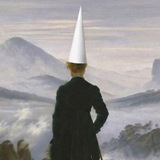
Lest we forget at least an over-the-shoulder acknowledgment to the very first radical: from all our legends, mythology, and history (and who is to know where mythology leaves off and history begins—or which is which), the first radical known to man who rebelled against the establishment and did it so effectively that he at least won his own kingdom—Lucifer.
— Saul Alinsky, Rules for Radicals
And I have always said, the first Whig was the Devil.
— Samuel Johnson
Forwarded from Rusty Shackleford
This media is not supported in your browser
VIEW IN TELEGRAM
This media is not supported in your browser
VIEW IN TELEGRAM
I finally banned Sweepy; he was on my corner too long. Here's footage of the event. He ain't comin' back.
My neighbor is outside putting the snow plow on his truck... I guess the time is here.. .
Frankly, England does not deserve pride. It has gone to the dogs, and that may be an insult to dogs. If England is to restore its sense of pride, it needs to start with its sense of shame. And the first thing it should be ashamed of is the pathetic excuse for a government that afflicts it at present, and will afflict it for the indefinite future until something drastic is done.
For example, according to official statistics, between 1900 and 1992 the crime rate in Great Britain, indictable offenses per capita known to the police, increased by a factor of 46. That’s not 46%. Oh, no. That’s 4600%. Many of the offenders having been imported specially, to make England brighter and more colorful. This isn’t a government. It’s a crime syndicate.
For example, according to official statistics, between 1900 and 1992 the crime rate in Great Britain, indictable offenses per capita known to the police, increased by a factor of 46. That’s not 46%. Oh, no. That’s 4600%. Many of the offenders having been imported specially, to make England brighter and more colorful. This isn’t a government. It’s a crime syndicate.
Forwarded from eternal classic
Among Protestant Christian sects there were several significant movements toward cooperation and even toward formal union. Many barriers between them were broken down, at least in part, by the Young Men’s Christian Association, which had been founded in the nineteenth century but which expanded very rapidly during and after the Great War. The Salvation Army, dating from about the year 1880, was another factor in the same process: it placed emphasis on spiritual earnestness, on evangelical work among the poor, and on charitable endeavors, rather than on sectarian controversies. There were also various “federations of churches,” and in Canada, after the Great War, several Protestant denominations were actually united. Such interdenominational and unifying movements were made easier by the fact that the original theological differences between the various sects were no longer regarded as very important by a large number of church members.
Some Protestants, reacting against the decline of dogma and the doubting of the miraculous and the supernatural, turned increasingly toward Christian Science or towards spiritualism or theosophy. In some countries, and especially in the United States, the current vogue of Darwinism and other theories of evolution caused a new outburst of opposition from stalwart groups of Protestants to the claims of “science,” and a stubborn reaffirmation of their fundamental faith in the literal inspiration of the Bible. These “Fundamentalists,” as they were called, were fairly numerous in several Protestant denominations, and they contested with their “Progressive” or “Modernist” brethren the control of Protestant churches, particularly the Presbyterian, Episcopalian, Baptist, and Methodist.
—Carlton J. H. Hayes, A Political and Social History of Modern Europe vol. 2