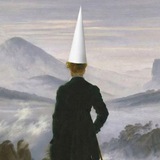
Participate in the most important vote of this year:
You have just heard Socrates' Apologia from Platon's text. You witness him being convicted of corruption and impiety. You vote for him to be punished via:
You have just heard Socrates' Apologia from Platon's text. You witness him being convicted of corruption and impiety. You vote for him to be punished via:
Anonymous Poll
8%
Death
5%
Fine of 3000 drachmae
4%
I'm not voting because voting is gay
2%
I'm not voting because voting is retarded
3%
I'm not voting because voting is sinful
18%
I'm not voting because voting is gay and retarded
0%
I'm not voting because voting is gay and sinful
1%
I'm not voting because voting is retarded and sinful
28%
I'm not voting because voting is gay, retarded, and sinful
32%
Free meals at the Prytaneum
Socrates was probably not a pure skeptic who thought that knowledge wasn't possible. If he were, Platon would not have compelled him to say the following in one of his earlier dialogues:
POLUS: What an absurd position you’re trying to maintain, Socrates!
SOCRATES: Yes, and I’ll try to get you to take the same position too, my good man, for I consider you a friend. For now, these are the points we differ on. Please look at them with me. I said earlier, didn’t I, that doing what’s unjust is worse than suffering it?
POLUS: Yes, you did.
SOCRATES: And you said that suffering it is worse.
POLUS: Yes.
SOCRATES: And I said that those who do what’s unjust are miserable, and was “refuted” by you.
POLUS: You certainly were, by Zeus!
SOCRATES: So you think, Polus.
POLUS: So I truly think.
SOCRATES: Perhaps. And again, you think that those who do what’s unjust are happy, so long as they don’t pay what is due.
POLUS: I certainly do.
SOCRATES: Whereas I say that they’re the most miserable, while those who pay their due are less so. Would you like to refute this too?
POLUS: Why, that’s even more “difficult” to refute than the other claim, Socrates!
SOCRATES: Not difficult, surely, Polus. It’s impossible. What’s true is never refuted.
Dull Academic Incessant Liturgical Yapping: Philosophical Orations on Order & Reaction
Socrates was probably not a pure skeptic who thought that knowledge wasn't possible. If he were, Platon would not have compelled him to say the following in one of his earlier dialogues: POLUS: What an absurd position you’re trying to maintain, Socrates!…
You don't speak well, O man, if you believe that someone worth anything at all would give countervailing weight to danger of life or death or give consideration to anything but this when he acts: whether his action is just or unjust, the action of a good or evil man.
- Socrates in Platon's Apologia, once again clearly believing in nothing, right? 100% a moral skeptic who believed he didn't have any knowledge worth teaching.
Dull Academic Incessant Liturgical Yapping: Philosophical Orations on Order & Reaction
You don't speak well, O man, if you believe that someone worth anything at all would give countervailing weight to danger of life or death or give consideration to anything but this when he acts: whether his action is just or unjust, the action of a good or…
It is living well that matters, however bad the consequences for the future welfare may be.
- Socrates stating one of his core messages clearly: the most important thing is whether you are living well, that is, living virtuously. All other concerns in human action are secondary to this.
You should do the right thing, Anon, even if it results in your physical anguish in the future.
Isle Royale National Park, a remote island cluster, comes in third on the list of the most unsafe national parks in America. With its stunning yet isolated landscapes and limited infrastructure, the park makes it harder for visitors in need of medical assistance to reach a hospital within an hour.
Maybe it's too dangerous... You guess shouldn't visit da UP
Don't blame me, I voted for Bigfoot
This media is not supported in your browser
VIEW IN TELEGRAM
"My money."
No such thing.
No such thing.
Dull Academic Incessant Liturgical Yapping: Philosophical Orations on Order & Reaction
I'm going to try to read one full book each day for the next month. Wish me luck.
Caterpillar: If I am to manifest a different form, does that not imply a change in my being?
Parmenides: Not necessarily. The alteration of form does not equate to an alteration of essence. Consider this: if Being and Oneness are distinct, and the One partakes of Being, it is not by its being one that the One is different from Being, nor by its being being that Being is other than the One. On the contrary, they are different from each other by difference and otherness.
Caterpillar: That is a profound assertion. Could you elucidate further?
Can someone please explain this? This book is too hard for me