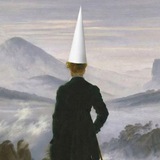
One of the essences of representative democracy is that it tries to trick you into being a worse person.
By viewing your fellow countrymen as enemies, you treat them worse, and this degrades your moral character over time. Consider also how little influence the "will of the people" actually carries in this system. Representative democracy wants you to degrade yourself and destroy the social fabric essentially for no real gain.
It's poisonous, a game you're better off not playing. The best thing about this system is that elections most people consider important only happen every 4 years.
Your fellows that vote for the other team? Oh, those are your enemies. And you should treat them worse because of that. Why would you treat your enemies well? Are you insane?
By viewing your fellow countrymen as enemies, you treat them worse, and this degrades your moral character over time. Consider also how little influence the "will of the people" actually carries in this system. Representative democracy wants you to degrade yourself and destroy the social fabric essentially for no real gain.
It's poisonous, a game you're better off not playing. The best thing about this system is that elections most people consider important only happen every 4 years.
This is why unpopular policies, such as mass immigration, can continue despite persistent majority public opposition. The public’s opinion does not matter—even if the powers that be cannot change the public’s mind. Though usually, they can change the public’s mind. This is called “change,” and is the most sacred kind of democracy.
Askesis signifies not simply a selfish quest for individual salvation but a service rendered to the total human family; not simply the cutting off or destroying of the lower but, much more profoundly, the refinement and illumination of the lower and its transfiguration into something higher. The same conclusion could be drawn from an examination of other key ascetic terms, such as hesychia (stillness, tranquillity, quietude). This too is affirmative rather than negative, a state of plenitude rather than emptiness, a sense of presence rather than absence. It is not just a cessation of speech, a pause between words, but an attitude of attentive listening, of openness and communion with the eternal: in the words of John Climacus, “Hesychia is to worship God unceasingly and to wait on him. . . . The Hesychast is one who says, ‘I sleep, but my heart is awake’” (Song 5.2). Interpreted in this positive way, as transfiguration rather than mortification, askesis is universal in its scope--not an elite enterprise but a vocation for all. It is not a curious aberration, distorting our personhood, but it reveals to us our own true nature. As Father Alexander Elchaninov observes, “Asceticism is necessary first of all for creative action of any kind, for prayer, for love: in other words, it is needed by each of us throughout our entire life. . . . Every Christian is an ascetic.'" Without asceticism none of us is authentically human.
Kallistos Ware, "The Way of the Ascetics"
This media is not supported in your browser
VIEW IN TELEGRAM
Anybody in the construction business have any commentary on this?
I love Ontonagon. Pretty little house. Would definitely be on my list if I were purchasing a home right now. https://redf.in/yUXxaG
Redfin
521 N 7th St, Ontonagon, MI 49953 - 4 beds/1 bath
(MiRealSource-MiMLS) For Sale: 4 beds, 1 bath ∙ 1100 sq. ft. ∙ 521 N 7th St, Ontonagon, MI 49953 ∙ $120,000 ∙ MLS# 50141380 ∙ Cute 4 bedroom home on almost 2 acres, just a short walk from Lake Superior public beach! N...
Guys, I crossed my maximum monthly earnings threshold. As such, I will be taking the next 6 days off. It's so hard to be poor.
Property values in Atlantic Mine expected to go down in the next year.... Looking to buy a home, anon?
Forwarded from The Park (𓂀 Shallow)
Forwarded from Disclose.tv
Media is too big
VIEW IN TELEGRAM
NOW - Michigan Muslims endorse Trump for president.
"We, as Muslims, stand with President Trump because he promises PEACE — NOT WAR!"
@disclosetv
"We, as Muslims, stand with President Trump because he promises PEACE — NOT WAR!"
@disclosetv
Disclose.tv
NOW - Michigan Muslims endorse Trump for president. "We, as Muslims, stand with President Trump because he promises PEACE — NOT WAR!" @disclosetv
This is not the most important election of our lifetimes, but it might be the most bizarre
Participate in the most important vote of this year:
You have just heard Socrates' Apologia from Platon's text. You witness him being convicted of corruption and impiety. You vote for him to be punished via:
You have just heard Socrates' Apologia from Platon's text. You witness him being convicted of corruption and impiety. You vote for him to be punished via:
Anonymous Poll
8%
Death
5%
Fine of 3000 drachmae
4%
I'm not voting because voting is gay
2%
I'm not voting because voting is retarded
3%
I'm not voting because voting is sinful
18%
I'm not voting because voting is gay and retarded
0%
I'm not voting because voting is gay and sinful
1%
I'm not voting because voting is retarded and sinful
28%
I'm not voting because voting is gay, retarded, and sinful
32%
Free meals at the Prytaneum
Socrates was probably not a pure skeptic who thought that knowledge wasn't possible. If he were, Platon would not have compelled him to say the following in one of his earlier dialogues:
POLUS: What an absurd position you’re trying to maintain, Socrates!
SOCRATES: Yes, and I’ll try to get you to take the same position too, my good man, for I consider you a friend. For now, these are the points we differ on. Please look at them with me. I said earlier, didn’t I, that doing what’s unjust is worse than suffering it?
POLUS: Yes, you did.
SOCRATES: And you said that suffering it is worse.
POLUS: Yes.
SOCRATES: And I said that those who do what’s unjust are miserable, and was “refuted” by you.
POLUS: You certainly were, by Zeus!
SOCRATES: So you think, Polus.
POLUS: So I truly think.
SOCRATES: Perhaps. And again, you think that those who do what’s unjust are happy, so long as they don’t pay what is due.
POLUS: I certainly do.
SOCRATES: Whereas I say that they’re the most miserable, while those who pay their due are less so. Would you like to refute this too?
POLUS: Why, that’s even more “difficult” to refute than the other claim, Socrates!
SOCRATES: Not difficult, surely, Polus. It’s impossible. What’s true is never refuted.