Forwarded from Wäinölä 🇫🇮
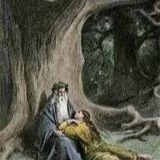
“Then the mistress of Northland
sent Jack Frost the evil one
on that Northland sea
upon the open expanse
and she put this into words
both told and declared:
‘Jack Frost, little boy
my own fair one I brought up:
go where I tell you—
tell and compel you!
Chill the rogue’s small boat
wanton Lemminkäinen’s craft
upon the high seas
upon the open expanse
and chill the master himself
freeze the rogue on the waters
so that he’ll never get out
never in this world be free
unless I get to letting him out
get round to relieving him!’”
— The #Kalevala: 30: 123 – 142
(Bosley translation)
Art: Illustration for the Kalevala by Björn Landström. 🇫🇮
sent Jack Frost the evil one
on that Northland sea
upon the open expanse
and she put this into words
both told and declared:
‘Jack Frost, little boy
my own fair one I brought up:
go where I tell you—
tell and compel you!
Chill the rogue’s small boat
wanton Lemminkäinen’s craft
upon the high seas
upon the open expanse
and chill the master himself
freeze the rogue on the waters
so that he’ll never get out
never in this world be free
unless I get to letting him out
get round to relieving him!’”
— The #Kalevala: 30: 123 – 142
(Bosley translation)
Art: Illustration for the Kalevala by Björn Landström. 🇫🇮
Forwarded from Wäinölä 🇫🇮
“He meant to chill Ahti too
to freeze the mighty fellow;
he asked for his nails
went for his toes from below.
Then Lemminkäinen
was angry, took it badly;
he thrust Jack Frost into fire
pushed him into a furnace.
He laid hands upon Jack Frost
seized the hard weather;
he says with this word
he spoke with this speech:
‘Jack Frost, son of Blast
winter’s slushy son:
do not chill my nails
don’t demand my toes
and don’t touch my ears
do not bite my head!
There’s enough for you to chill
a lot too to bite
without man’s skin, the body
of one borne by a mother:
chill swamps and chill lands
and chill chilly rocks
bite weeping willows
take gnarls of aspen
make bark of birch ache
nibble young spruces—
not man’s skin, the hairs
of one made by a woman!”
— The #Kalevala: 30: 173 – 202
(Bosley translation)
Art: Illustration for the Kalevala by Björn Landström. 🇫🇮
to freeze the mighty fellow;
he asked for his nails
went for his toes from below.
Then Lemminkäinen
was angry, took it badly;
he thrust Jack Frost into fire
pushed him into a furnace.
He laid hands upon Jack Frost
seized the hard weather;
he says with this word
he spoke with this speech:
‘Jack Frost, son of Blast
winter’s slushy son:
do not chill my nails
don’t demand my toes
and don’t touch my ears
do not bite my head!
There’s enough for you to chill
a lot too to bite
without man’s skin, the body
of one borne by a mother:
chill swamps and chill lands
and chill chilly rocks
bite weeping willows
take gnarls of aspen
make bark of birch ache
nibble young spruces—
not man’s skin, the hairs
of one made by a woman!”
— The #Kalevala: 30: 173 – 202
(Bosley translation)
Art: Illustration for the Kalevala by Björn Landström. 🇫🇮
Forwarded from Wäinölä 🇫🇮
Runic calendar. Photographed in 1898.
Keeping track of the time of year and specific dates was especially important in agrarian communities. Before printed almanacs became widely available and affordable, runic calendars and rune staffs were common in Finland and Sweden right up to the 18th century, and in some parts even later. They were also used in Norway, Lapland, and Estonia.
Not all the markings were actual runes, and indeed the Finnish word for rune (riimu) originally meant a cut or scratch. Some calendars of the staff type have much simpler markings.
Keeping track of the time of year and specific dates was especially important in agrarian communities. Before printed almanacs became widely available and affordable, runic calendars and rune staffs were common in Finland and Sweden right up to the 18th century, and in some parts even later. They were also used in Norway, Lapland, and Estonia.
Not all the markings were actual runes, and indeed the Finnish word for rune (riimu) originally meant a cut or scratch. Some calendars of the staff type have much simpler markings.
Forwarded from Wäinölä 🇫🇮
A man holding runic calendars somewhere in Norway, above Finnish Lapland.
Detail from Olaus Magnus' 1539 Carta marina et descriptio septentrionalium terrarum ('Marine map and description of the Northern lands').
Detail from Olaus Magnus' 1539 Carta marina et descriptio septentrionalium terrarum ('Marine map and description of the Northern lands').
Forwarded from Wäinölä 🇫🇮
Parents instructing their children in the use of rune staffs.
Woodcut from Olaus Magnus' Historia de gentibus septentrionalibus ('A Description of the Northern Peoples'), 1555.
Woodcut from Olaus Magnus' Historia de gentibus septentrionalibus ('A Description of the Northern Peoples'), 1555.
Forwarded from Wäinölä 🇫🇮
Tiburtius' Day on 14 April is marked on all calendar staffs, usually with a tree symbol. In Nordic countries the year was divided into two parts, summer and winter, and Tiburtius is the first day of summer. It's counterpart in the winter is Calixtus on 14 October, and it was also marked with a tree.
St. George's Day is traditionally when cattle was turned out to pasture, and it involved various rituals for safeguarding them and to ward off predators. Marcus' Day was when work in the fields began.
Above:
Rune staff TMM22538. It is read from right to left. Tiburtius' Day 14 April (tree), St. George's Day 23 April (trident), and Marcus' Day 25 April (plow).
Below:
The same dates represented differently on rune staff TMM1741.
St. George's Day is traditionally when cattle was turned out to pasture, and it involved various rituals for safeguarding them and to ward off predators. Marcus' Day was when work in the fields began.
Above:
Rune staff TMM22538. It is read from right to left. Tiburtius' Day 14 April (tree), St. George's Day 23 April (trident), and Marcus' Day 25 April (plow).
Below:
The same dates represented differently on rune staff TMM1741.
Forwarded from Native europeans 🌱 Back to our roots
Young mother in traditional norwegian dress 😊🇧🇻
Many women no longer view motherhood and the role of being a loving mother as desirable. They focus instead on achieving their own materialistic goals, and view motherhood as a barrier on their path of self-indulgence and decadence.
For more about native european people and culture follow @nativeeuropeans
Facebook: https://m.facebook.com/nativeeuropeans1
Many women no longer view motherhood and the role of being a loving mother as desirable. They focus instead on achieving their own materialistic goals, and view motherhood as a barrier on their path of self-indulgence and decadence.
For more about native european people and culture follow @nativeeuropeans
Facebook: https://m.facebook.com/nativeeuropeans1
Forwarded from • Hellas • Ελλάδα • Greece (Maria)
A Byzantine gold ring with Roman Jasper intaglio, circa 6th-7th century A.D. and 1st century A.D.
No empire had demonstrated a richer tradition in jewelry than the Byzantines.” For 1,000 years, the Eastern Roman Empire reigned supreme and made great strides in advancing art, architecture, public works, and more. This empire merged the greatness and richness of Greece, Egypt, the Near East, and parts of Russia and North Africa, creating an unparalleled and uniquely lavish style. @GreekLeague
No empire had demonstrated a richer tradition in jewelry than the Byzantines.” For 1,000 years, the Eastern Roman Empire reigned supreme and made great strides in advancing art, architecture, public works, and more. This empire merged the greatness and richness of Greece, Egypt, the Near East, and parts of Russia and North Africa, creating an unparalleled and uniquely lavish style. @GreekLeague