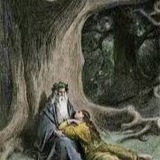
A little info on Slavic god Veles and his magic. Veles is the main god from the pagan pantheon of my Slavic ancestors that I most resonate with. Although I often look up at the stars and dream of the endless universe, I’ve always been more earthbound. I never understood those who wish to break away from the earthly realm in order to fly away to some abstract spiritual realm or heaven. To me earth is a spiritual realm, and it can be a heaven if humanity wanted to make it so, but unfortunately due to the fact that modern humans operate from a low-based consciousness, and ruled by evil and greed they continue to create hell on earth. The places that are still pure, sacred and divine are the areas still untouched by humans, still wild and untamed. All of the areas covered by modern civilization, and urban cities are hellish to me. That’s why I’m longing for the old ways, when humans still lived according to the laws of nature, in-tuned with Mother Earth, and aligned with her cycles.
https://youtu.be/ApISfsOAbjE
https://youtu.be/ApISfsOAbjE
YouTube
GOD OF WEALTH IS HERE -VELES
Contact email:
o.dimitrije111@gmail.com
Contact Facebook:
https://www.facebook.com/dimitrije.ostojic.9
Contact WhatsApp and Viber:
+33 751260386
Instagram:
https://www.instagram.com/o.dimitrije111
Pay Pall:
https://www.paypal.me/jovanleg
Pay…
o.dimitrije111@gmail.com
Contact Facebook:
https://www.facebook.com/dimitrije.ostojic.9
Contact WhatsApp and Viber:
+33 751260386
Instagram:
https://www.instagram.com/o.dimitrije111
Pay Pall:
https://www.paypal.me/jovanleg
Pay…
Forwarded from Western Heritage
Jarlshof (YARLZ-hof) is the best known prehistoric archaeological site in Shetland, Scotland. It lies in Sumburgh, Mainland, Shetland and contains remains dating from 2500 BC up to the 17th century AD.
Forwarded from Stam van de Vos🦊, hekserij en heidendom van de Lage Landen
Visiting the Museum of Antiquaties in the town of Leiden provides a good opportunity to have a closer look at altars dedicated to the goddess Nehalennia. It is actually the largest collection of Nehalennia-altars and they are beautifuly displayed. But it is also a nice opportunity to hang out with your heathen friends🙂. https://www.youtube.com/watch?v=7xW-D4pgLW8
YouTube
Nehalennia altars in the Museum of Antiquaties
The Museum of Antiquaties (Rijksmuseum van Oudheden) in the old universitytown of Leiden is home to the largest collection of altars dedicated to the goddess of the Northsea, Nehalennia.
Please join us on telegram (English): https://t.me/tribeofthefox
…
Please join us on telegram (English): https://t.me/tribeofthefox
…
Forwarded from • Hellas • Ελλάδα • Greece (Maria)
Head of Vajrapani-Herakles, protector of Buddha-from Gandhara [Pakistan] terracotta ca. 4th-5th c. AD- at Gandur Foundation for Art, Geneva
Buddhism expansion in C. Asia fused with Hellenistic influences into a Greco-Buddhism iconography, Herakles was adopted to represent Vajrapāni. @GreekLeague
Buddhism expansion in C. Asia fused with Hellenistic influences into a Greco-Buddhism iconography, Herakles was adopted to represent Vajrapāni. @GreekLeague
Forwarded from • Hellas • Ελλάδα • Greece (Maria)
Greco-Buddhism is the term given to refer to the cultural syncretism of Hellenistic and Buddhist culture in ancient Bactria and the India between the 4th century BC and 5th century CE. The style gave rise after the invasion of Bactria (present-day Afghanistan) and the Indus Valley by the Greek armies of Alexander the Great, and flourished under the subsequent Indo-Greek Kingdom and the Kushan Dynasty, who incorporated the Greek Alphabet and other aspects of Hellenistic culture into their own society. The result was an interesting combination of Greek artistic elements in the local Buddhist art. It is generally believed that the first anthropomorphic images of the Buddha emerged during the Greco-Buddhist period in the 1st century CE.
Picture: A reliquary known as the “Bimaran Casket.” The Buddha, pictured in the center, is depicted in a contrapposto pose. He is surrounded by two deities, Brahma and Śakra, inside Greco-Roman style arched niches. From Hadda, Afghanistan, 1st century CE @GreekLeague
Picture: A reliquary known as the “Bimaran Casket.” The Buddha, pictured in the center, is depicted in a contrapposto pose. He is surrounded by two deities, Brahma and Śakra, inside Greco-Roman style arched niches. From Hadda, Afghanistan, 1st century CE @GreekLeague
Forwarded from • Hellas • Ελλάδα • Greece (Maria)
Scholars credit many stylistic elements of the image of the Buddha, such as his halo, stylistic curls, and top bun style to Greco-Roman artistic influence. Interestingly, many standing images of the Buddha at this time also depict him in a Greek contrapposto. Many deities from the Hellenistic pantheon were also adopted into Buddhist religion. The most notable examples are the deities, Heracles, Tyche, and Boreas, who eventually became associated with the Buddhist deities, Vajrapani, Hariti, and Oado respectively. Aspects of Greco-Buddhism managed to filter into Buddhist art within the Indian subcontinent and Eastern Asia as the religion started to spread eastward. Greco-Buddhism is one of the greatest examples of long distance cultural and artistic exchange in the ancient world, spanning between two continents and adapting elements from countless different cultures, most notably, Greco-Roman, Persian, and Hindu.
Picture: Gandhara head of a man with lion, in Greco-Buddhist style, 305 BC - AD 450 @GreekLeague
Picture: Gandhara head of a man with lion, in Greco-Buddhist style, 305 BC - AD 450 @GreekLeague
Forwarded from • Hellas • Ελλάδα • Greece (Maria)
Greco-Buddhism particularly flourished in the ancient region of Gandhara which encompassed the land around the border of Afghanistan and Northern Pakistan. Excavations in the archaeological site of Hadda, located near the Kyber Pass in Afghanistan, recovered over 23,000 examples of Greco-Buddhist art. Many of these sites, unfortunately, were destroyed or heavily damaged through looting and vandalization by the Taliban in the 1990s. The artifacts that have survived are a testament of a very rich and diverse cultural syncretism.
Picture: A Greco-Buddhist sculpture of the Thinking Bodhisattva from the Hadda region in Afghanistan. 4th–6th century CE, Gandharan culture @GreekLeague
Picture: A Greco-Buddhist sculpture of the Thinking Bodhisattva from the Hadda region in Afghanistan. 4th–6th century CE, Gandharan culture @GreekLeague
Forwarded from • Hellas • Ελλάδα • Greece
The Olympic fire is ignited several months before the opening ceremony of the Olympic Games at the site of the ancient Olympics in Olympia, Greece.
Eleven women, representing the Vestal Virgins, perform a celebration at the Temple of Hera in which the first torch of the Olympic Torch Relay is kindled by the light of the Sun, its rays concentrated by a parabolic mirror.
At the beginning of the ceremony, the Olympic anthem was sung first followed by the national anthem of the country hosting the Olympics and the national anthem of Greece along with the hoisting of the flags.
https://youtu.be/rpj5HtXUd34
@GreekLeague
Eleven women, representing the Vestal Virgins, perform a celebration at the Temple of Hera in which the first torch of the Olympic Torch Relay is kindled by the light of the Sun, its rays concentrated by a parabolic mirror.
At the beginning of the ceremony, the Olympic anthem was sung first followed by the national anthem of the country hosting the Olympics and the national anthem of Greece along with the hoisting of the flags.
https://youtu.be/rpj5HtXUd34
@GreekLeague
Forwarded from Stam van de Vos🦊, hekserij en heidendom van de Lage Landen
The call of the demonic white witches
They who know
in bygone times,
fallen into mythical creatures.
under Christianity.
In folklore there is still an echo,
christianized, cursed,
banished in purgatory,
made into devils.
Thou our sorceresses,
our helpers in hard times,
our companions in birth and death.
Thou cloak of healing,
heart of knowledge,
telling the truth.
Your good deeds put to shame,
I exalt you and I honor you.
I call you back.
Our witches,
our white women,
our wise ancestors.
Dirkje
(art: Deviantart)
They who know
in bygone times,
fallen into mythical creatures.
under Christianity.
In folklore there is still an echo,
christianized, cursed,
banished in purgatory,
made into devils.
Thou our sorceresses,
our helpers in hard times,
our companions in birth and death.
Thou cloak of healing,
heart of knowledge,
telling the truth.
Your good deeds put to shame,
I exalt you and I honor you.
I call you back.
Our witches,
our white women,
our wise ancestors.
Dirkje
(art: Deviantart)
We are taught that urbanization, and industrialization was driven by the people themselves.
Eleven million people migrated from rural to urban areas between 1870 and 1920, and a majority of the twenty-five million immigrants who came to the United States in these same years moved into the nation’s cities. By 1920, more Americans lived in cities than in rural areas for the first time in US history.
Today most Americans live in cities or suburbs, but from colonial times into the early twentieth century a majority of Americans lived in the countryside and worked on farms. Only two percent of Americans live on farms or ranches today, but in 1790 ninety percent of the population did. What caused this shift?
We were told that the people wanted this. They call it “industrial revolution” and say it’s all part of the natural human evolution, but I’m not so sure it’s true.
I bet if we do thorough research, we will uncover that industrial revolution wasn’t driven by the people, but was a combination of both being forced on the people, and people being brainwashed to accept it believing it was a good thing, believing it was humanity making progress and moving forward.
From the little bits and pieces of info I found so far, it appears as though not all people wanted industrial revolution to happen. The government used different tactics to run the people off of their family farms, and herd them into the urban cities.
One of the ways they achieved this was by making it extremely difficult, or in some cases even impossible for the people to remain in the village/country working their family farms, and living a self-sufficient life, which was a lifestyle of their ancestors going back many generations.
The land which freely belonged to the people for many generations was suddenly seized by the ruling power, and the common people were forced to pay high taxes that they could not afford to pay, and so they ended up losing their land and moving to the city looking for work.
This was just one of the many methods the government used to bring about industrial revolution, and fill up urban cities with people.
Wars took all of the able bodied, younger men from the villages, leaving their old and frail fathers to work the farms. The old men were unable to work the land and keep up with the farms, and pay their taxes, and so the farms were abandoned, and remaining family members had to leave to the city looking for work.
Another successful method to drive people out of villages and into the cities was to make the urban city life sound alluring, very modern, interesting, full of opportunities, whilst the country life was deliberate made to look boring, backwards and dull, and completely without opportunity.
In reality I believe we were not told the truth about industrial revolution, and why so many people willingly left the country life to move to the urban cities. With so much poverty, hunger, child labor that we learn took place in urban cities for centuries, I don’t understand why people would willingly leave their family farms where they can be self-sufficient, and always have plenty of food and a roof over their head, and go move to urban cities, where there’s so much struggle starvation and poverty.
Country people are deliberately presented as backwards, ignorant, uneducated, when in reality they are intelligent, and highly skilled. An urban city citizen will not last more than few days without the system
Eleven million people migrated from rural to urban areas between 1870 and 1920, and a majority of the twenty-five million immigrants who came to the United States in these same years moved into the nation’s cities. By 1920, more Americans lived in cities than in rural areas for the first time in US history.
Today most Americans live in cities or suburbs, but from colonial times into the early twentieth century a majority of Americans lived in the countryside and worked on farms. Only two percent of Americans live on farms or ranches today, but in 1790 ninety percent of the population did. What caused this shift?
We were told that the people wanted this. They call it “industrial revolution” and say it’s all part of the natural human evolution, but I’m not so sure it’s true.
I bet if we do thorough research, we will uncover that industrial revolution wasn’t driven by the people, but was a combination of both being forced on the people, and people being brainwashed to accept it believing it was a good thing, believing it was humanity making progress and moving forward.
From the little bits and pieces of info I found so far, it appears as though not all people wanted industrial revolution to happen. The government used different tactics to run the people off of their family farms, and herd them into the urban cities.
One of the ways they achieved this was by making it extremely difficult, or in some cases even impossible for the people to remain in the village/country working their family farms, and living a self-sufficient life, which was a lifestyle of their ancestors going back many generations.
The land which freely belonged to the people for many generations was suddenly seized by the ruling power, and the common people were forced to pay high taxes that they could not afford to pay, and so they ended up losing their land and moving to the city looking for work.
This was just one of the many methods the government used to bring about industrial revolution, and fill up urban cities with people.
Wars took all of the able bodied, younger men from the villages, leaving their old and frail fathers to work the farms. The old men were unable to work the land and keep up with the farms, and pay their taxes, and so the farms were abandoned, and remaining family members had to leave to the city looking for work.
Another successful method to drive people out of villages and into the cities was to make the urban city life sound alluring, very modern, interesting, full of opportunities, whilst the country life was deliberate made to look boring, backwards and dull, and completely without opportunity.
In reality I believe we were not told the truth about industrial revolution, and why so many people willingly left the country life to move to the urban cities. With so much poverty, hunger, child labor that we learn took place in urban cities for centuries, I don’t understand why people would willingly leave their family farms where they can be self-sufficient, and always have plenty of food and a roof over their head, and go move to urban cities, where there’s so much struggle starvation and poverty.
Country people are deliberately presented as backwards, ignorant, uneducated, when in reality they are intelligent, and highly skilled. An urban city citizen will not last more than few days without the system
Forwarded from ȺηтнαѕGαтє
Typically in this society rural people have been looked down on. It's not surprising socially we've been programmed to aspire to be anything but rural people. Hillbillies, rednecks, hicks, whatever you wanna call them. People with chickens and goats and a garden, who work on their own cars and their homes, help their neighbors when they need it, do odd jobs when they can. Country bumbkins, woodsmen, yokels.. Call them what you want, but they will be the ones who come to the rescue.. If more people understood the value of just being down home folk people they'd realize we wouldn't have been able to be put in this mess.