Forwarded from BC Neanderthal Mindset
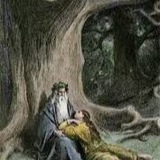
Illustrations for the Kalevala by Nikolai Kochergin
Forwarded from Celtic Folk and Culture
In Celtic and specifically Welsh tradition Bards were individuals trained in the art of storytelling and disseminating tribal wisdom. Among their tasks were to memorize countless tales, prose, poetry and songs. They then retained this information and knowledge and transmitted it via narration to the people.
Bards were highly regarded by the people and were seen as servants of the gods and keepers of spirit, culture and heritage.
One of the most famous Welsh Bards was Taliesin the boy who drank Cerridwen's potion. Taliesin was regarded as one of the greatest Bards and his poems contained prophecies and rich Welsh Lore. His poems also have many references to Cerridwen. The Bardic orders continued into Christian times.
#Taliesin
#Cerridwen
#Bards
Bards were highly regarded by the people and were seen as servants of the gods and keepers of spirit, culture and heritage.
One of the most famous Welsh Bards was Taliesin the boy who drank Cerridwen's potion. Taliesin was regarded as one of the greatest Bards and his poems contained prophecies and rich Welsh Lore. His poems also have many references to Cerridwen. The Bardic orders continued into Christian times.
#Taliesin
#Cerridwen
#Bards
Forwarded from • Hellas • Ελλάδα • Greece (Maria)
Artemis of Ephesus, 2nd century AD
In Greek myth, the birthplace of Artemis and Apollo was in a grove, called the Ortygia. According to Strabo, the Ephesians identified an area near the city with the same name, and claimed this was her birthplace. The Ephesian Artemis was a very different version of the deity than the usual goddess of the hunt; there she was worshipped for fertility. This depiction seems to mirror this. This copy was modeled after a statue at Ephesus, where Artemis' temple was a Wonder of the Ancient World.
Historically considered eggs or breasts, both symbols of fertility, a modern theory is that these are actually bull testicles. But the statue isn’t just about the bull testicles. This statue is covered with various images suggesting her role as goddess of fertility and nature, including a necklace of acorns, bees, lions, and deer. She also has a headdress shaped like an ancient city gate. It likely reminded people of Artemis’ role as protector of the city and its prosperity @GreekLeague
In Greek myth, the birthplace of Artemis and Apollo was in a grove, called the Ortygia. According to Strabo, the Ephesians identified an area near the city with the same name, and claimed this was her birthplace. The Ephesian Artemis was a very different version of the deity than the usual goddess of the hunt; there she was worshipped for fertility. This depiction seems to mirror this. This copy was modeled after a statue at Ephesus, where Artemis' temple was a Wonder of the Ancient World.
Historically considered eggs or breasts, both symbols of fertility, a modern theory is that these are actually bull testicles. But the statue isn’t just about the bull testicles. This statue is covered with various images suggesting her role as goddess of fertility and nature, including a necklace of acorns, bees, lions, and deer. She also has a headdress shaped like an ancient city gate. It likely reminded people of Artemis’ role as protector of the city and its prosperity @GreekLeague
Forwarded from Folk Wisdom & Ways
YouTube
Henbane in European Pagan Tradition: Uses, Magic, History, Benefits
Witches and seidr
https://www.youtube.com/watch?v=39xaxC_ufa4&t=296s
Berserkers and henbane
https://www.youtube.com/watch?v=h9ryjRS2jQE&t=423s
My online apparel/training gear shop
https://norse-combat-sportswear.myshopify.com/collections/wstl0011
Instagram…
https://www.youtube.com/watch?v=39xaxC_ufa4&t=296s
Berserkers and henbane
https://www.youtube.com/watch?v=h9ryjRS2jQE&t=423s
My online apparel/training gear shop
https://norse-combat-sportswear.myshopify.com/collections/wstl0011
Instagram…
Forwarded from Stam van de Vos🦊, hekserij en heidendom van de Lage Landen
I don't know how things will go economically and socially in the near future. Anyway, it is important, but also fun to grow your own food and to have a connection with nature. Soon I will show the medicinal herbs.
Forwarded from Æhtemen
The spider spinning a web and the Wyrd Sisters weaving our fate – it's easy to see how some superstitions regarding spiders invoke luck or involve fate – or even foretell a gift of clothing!
The words 'spider' and 'spinner' both come from the same root - *(s)pen – 'to spin' and the words 'web' and 'weave' also share the same origin - *(h)uebh- 'to weave'. So its no wonder how the two overlap.
But there is another element to the web – another beast who has eight legs! Sleipnir! Fathered by Loga (Loki) as Loki himself has a connection with the spider. According to Hilding Celander, writing in 1911, the name Locke meant 'spider'. This may be the meaning behind the name Loki.
The Faroese word Lokkanet (Lokke's web) meant cobweb, just as the Swedish word lokkanät does, from the Germanic root word *luk meaning locked, looped or knotted. Loki the tangler indeed.
The words 'spider' and 'spinner' both come from the same root - *(s)pen – 'to spin' and the words 'web' and 'weave' also share the same origin - *(h)uebh- 'to weave'. So its no wonder how the two overlap.
But there is another element to the web – another beast who has eight legs! Sleipnir! Fathered by Loga (Loki) as Loki himself has a connection with the spider. According to Hilding Celander, writing in 1911, the name Locke meant 'spider'. This may be the meaning behind the name Loki.
The Faroese word Lokkanet (Lokke's web) meant cobweb, just as the Swedish word lokkanät does, from the Germanic root word *luk meaning locked, looped or knotted. Loki the tangler indeed.