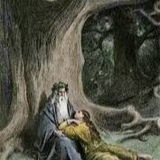
Forwarded from England 🏴
The Major Oak in Sherwood Forest is the biggest oak tree in Britain, with a canopy spread of 28 metres, a trunk circumference of 11 metres and an estimated weight of 23 tonnes. It is somewhere between 800 and 1100 years old. Legend has it Robin Hood and his Merry men used the Major Oak for Shelter. 🏹🏴
Forwarded from • Hellas • Ελλάδα • Greece (Maria)
"No one is fool enough to choose war instead of peace – in peace sons bury fathers, but in war fathers bury sons."
Herodotus, The Histories, ca. 440 BC. @GreekLeague
Herodotus, The Histories, ca. 440 BC. @GreekLeague
Forwarded from DukeOfDurham 🦌
New video on my folklore channel. Exploring the interesting history behind a standing stone in the Pennine Hills.
https://youtu.be/Yy8iXmKOIIU
https://youtu.be/Yy8iXmKOIIU
YouTube
The Butter Stone | Standing Stone in the Pennine Hills
Welcome to my channel! Here you'll find folklore from across the British Isles. This is just a short video about a standing stone found between Cotherstone and Bowes in the Pennine Hills in County Durham. It was used as a trading spot during the plague of…
Forwarded from DukeOfDurham 🦌
Words can’t describe how much I hate people like this.
Those who actually make campfires tend to be the most respectful people towards nature.
People who want to ban others from making fires because it might "hurt the environment" are themselves always neoliberal consumerist supporters of the techno-industrial system that don't blink an eye at deforestation if it results in more GDP from a new motorway or to build more houses for endless waves of migrants. They import avocadoes from across the world to eat on toast every day, and they’ll use all sorts of disposable plastic products and not think twice about where they’ll end up when they’re finished with them. They’ll use toxic chemicals in their bathrooms and kitchens and not care that they end up in the rivers and the sea. They would rather die than lose their lifestyles of comfort and consumerism.
So I’ll take no lectures from people like this on why my campfires are killing the earth.
Those who actually make campfires tend to be the most respectful people towards nature.
People who want to ban others from making fires because it might "hurt the environment" are themselves always neoliberal consumerist supporters of the techno-industrial system that don't blink an eye at deforestation if it results in more GDP from a new motorway or to build more houses for endless waves of migrants. They import avocadoes from across the world to eat on toast every day, and they’ll use all sorts of disposable plastic products and not think twice about where they’ll end up when they’re finished with them. They’ll use toxic chemicals in their bathrooms and kitchens and not care that they end up in the rivers and the sea. They would rather die than lose their lifestyles of comfort and consumerism.
So I’ll take no lectures from people like this on why my campfires are killing the earth.
Forwarded from Stam van de Vos🦊, hekserij en heidendom van de Lage Landen
White privilege? I do not think so. The ancestors of this land worked hard to survive. In a house like this, often 6 children were raised. The man worked digging canals or cutting peat. In this little hut also lived an animal, usually a goat for milk. If we'll have difficulties with hard times, maybe it is good to think about our ancestors, who were strong enough to survive despite everything. This strenght is in our genes! My direct ancestors were farmers and fishermen, they also worked their ass off and lived in very small houses. I honour my ancestors who survived in tough times!
This information is interesting to me personally, because it mentions my motherland where I was born and raised Rostov-on-Don/Rostov on river Don. My mother’s kin lived there for generations going back no one knows how far.
Forwarded from Survive the Jive: All-feed
Amazing how many rivers in Europe share the same exact name or are derived from the same name. In England we have the River Don, just like the Don river in Russia, both are derived from the Proto-Indo-European *dānu - the former comes via Brythonnic Dānā, from a root dān-, meaning "water" or "river", which is also the root of the name of the river Danube. Other European river names from the same root include the Dunaj, Dzvina/Daugava, Donets, Dnieper, Dniestr, Dysna in the Baltic and Tana/Deatnu in Fennoscandia.
Hydronomy is not known for being an innovative practice! In the Rigveda, Dānu once appears as the mother of Vrtra, "a dragon blocking the course of the rivers" yet the most famous river of the Rigveda is Saraswati, actually a goddess, but was associated with a physical river, in the oldest texts of the Rig Veda she is described as a "great and holy river in north-western India," but in the middle and late Rig Vedic books she is described as a small river ending in "a terminal lake (samudra)." Saraswati is Sanskrit from saras (सरस्) meaning "pooling water" and the name means "she who has ponds, lakes, and pooling water" It is also a Sanskrit composite word of surasa-vati (सरसु+अति) which means "one with plenty of water"
Indian nationalists who deny the Aryan theory will point to the Saraswati in these texts and say "how can the aryans have come from without if they knew this river so well?" - Of course the name Saraswati was not limited to one river any more than the name Danu or Don was! There is a Sarasvati Afghanistan now known as the Haraxvati river and there were no doubt many other rivers named after this goddess in the former territories of the Aryans before they invaded India.
Hydronomy is not known for being an innovative practice! In the Rigveda, Dānu once appears as the mother of Vrtra, "a dragon blocking the course of the rivers" yet the most famous river of the Rigveda is Saraswati, actually a goddess, but was associated with a physical river, in the oldest texts of the Rig Veda she is described as a "great and holy river in north-western India," but in the middle and late Rig Vedic books she is described as a small river ending in "a terminal lake (samudra)." Saraswati is Sanskrit from saras (सरस्) meaning "pooling water" and the name means "she who has ponds, lakes, and pooling water" It is also a Sanskrit composite word of surasa-vati (सरसु+अति) which means "one with plenty of water"
Indian nationalists who deny the Aryan theory will point to the Saraswati in these texts and say "how can the aryans have come from without if they knew this river so well?" - Of course the name Saraswati was not limited to one river any more than the name Danu or Don was! There is a Sarasvati Afghanistan now known as the Haraxvati river and there were no doubt many other rivers named after this goddess in the former territories of the Aryans before they invaded India.
Interesting. I’ve also seen a Russian documentary where they were talking about the parallels between Vedic knowledge, language and traditions, and native pagan Slavic faith, traditions and language, and I remember them mentioning a certain Hindu wedding tradition that dates back to the Vedic times, and how this tradition didn’t originate in India, but somewhere in the North Pole, or close to it. I don’t remember the specifics of this ancient Hindu wedding tradition, but it was something in the sacred words that the groom says to the bride. Among the different things that the groom tells his bride according to this wedding tradition, the groom also asks his bride if she can see the polar star in the sky, and she has to say yes to him. The documentary was pointing out that the polar star is either invisible from Indian sky, or it’s very difficult to see it, which according to them means that this wedding tradition must have originated somewhere else where you can clearly see the polar star, a place where this star is significant. That’s the one thing I remember from that documentary. I’ll try to look at it again to learn some more information.
I’ve also mentioned before that old Slavic language, and even some words in modern Russian language are very similar to archaic Sanskrit language. I know that Veda means knowledge in Russia even now. The Russian word for witch is Vedma.
I’ve also mentioned before that old Slavic language, and even some words in modern Russian language are very similar to archaic Sanskrit language. I know that Veda means knowledge in Russia even now. The Russian word for witch is Vedma.
Forwarded from ᚪOLK CINEᛗA
Slavic and Vedic
As in India, divinity for Slavs is nebo (Skt. नभ nabha, sky; Kashmiri nab, sky), and div is a point of light that can be used variously. The generic name of God is bog (Skt bhag भग or भगवान्). Some important Slavic religious notions are faith, vera (Skt. parā, परा, going beyond, which signifies faith), holy and sacred, svet (Skt. śveta श्वेत् for bright), peace and agreement, mir (Skt. maitri मैत्रि) and paradise, rai (Skt. rayi).
Some terms in Slavic are closer to Iranian forms of Sanskrit words, but that is to be expected since the Iranians were the immediate neighbors of the Slavs. We see this most strikingly in the Slavic divinity Simargl, which is clearly close in linguistic terms to the Iranian winged monster, Sīmorg (Skt. Śyena-mṛga, श्येन मृग, falcon bird). But its usage amongst the Slavs as divinity is quite like in the great Vedic Agnicayana fire altar, where it symbolizes time.
Apart from the usage of Vedic terms for a variety of philosophical and religious concepts, the Slavic conception of divinity as impersonal is identical to the Vedic. The Slavic religion must be seen as representing a description of the inner space of the mind, which is consistent with its conception as a mystical tradition based on contemplation.
The One Reality in the Vedic religion has an expression in triplicate in various sets of polarities together with the process between the two, as in examples of light, activity, and darkness and God, Goddess, and attributes.
The common Slavic polarities are:
Rod-Rozanica like Skt. Rudra-Rudrāṇī रुद्र-रुद्राणी (Rod, by itself, could also be Ṛta, the Law)
Sud-Sudenica like Skt. Siddha, सिद्ध् (Kashmiri sĕd, for Śiva)
Belobog-Chernbog (white god- black god, Skt. bhadra-bhaga and cherun-bhaga, भद्र-भग छेरुन-भग, auspicious and inauspicious gods (Kashmiri cherun छेरुन् means Skt. मलिनित)
Zhibog-Zhiva (Skt. Śivabhaga-Śivā, शिवभग, शिवा)
Khors Dazhbog and Jutrobog. This is Skt. Svar (स्वर् Sun or Light), Dakṣabhag दक्षभग for the Sun and Candrabhag चन्द्रभग for the Moon.
The triplicateness of reality is represented by Triglav, Tribog (Skt. tribhaga, त्रिभग). The three-headed divinity encompassing the three divisions of the universe into heaven, movement, and earth, or past, present, and future, and so on. Triglav is interpreted as the equivalent of Skt. Trimurti.
Svarog (Skt. svarga स्वर्ग) represnting heaven, which is where heroes go.
Ognebog (Skt. Agnibhaga, अग्निभग, Fire God.) He is equated with Simargl, since the fire ritual took place on the Falcon altar.
From: https://subhashkak.medium.com
As in India, divinity for Slavs is nebo (Skt. नभ nabha, sky; Kashmiri nab, sky), and div is a point of light that can be used variously. The generic name of God is bog (Skt bhag भग or भगवान्). Some important Slavic religious notions are faith, vera (Skt. parā, परा, going beyond, which signifies faith), holy and sacred, svet (Skt. śveta श्वेत् for bright), peace and agreement, mir (Skt. maitri मैत्रि) and paradise, rai (Skt. rayi).
Some terms in Slavic are closer to Iranian forms of Sanskrit words, but that is to be expected since the Iranians were the immediate neighbors of the Slavs. We see this most strikingly in the Slavic divinity Simargl, which is clearly close in linguistic terms to the Iranian winged monster, Sīmorg (Skt. Śyena-mṛga, श्येन मृग, falcon bird). But its usage amongst the Slavs as divinity is quite like in the great Vedic Agnicayana fire altar, where it symbolizes time.
Apart from the usage of Vedic terms for a variety of philosophical and religious concepts, the Slavic conception of divinity as impersonal is identical to the Vedic. The Slavic religion must be seen as representing a description of the inner space of the mind, which is consistent with its conception as a mystical tradition based on contemplation.
The One Reality in the Vedic religion has an expression in triplicate in various sets of polarities together with the process between the two, as in examples of light, activity, and darkness and God, Goddess, and attributes.
The common Slavic polarities are:
Rod-Rozanica like Skt. Rudra-Rudrāṇī रुद्र-रुद्राणी (Rod, by itself, could also be Ṛta, the Law)
Sud-Sudenica like Skt. Siddha, सिद्ध् (Kashmiri sĕd, for Śiva)
Belobog-Chernbog (white god- black god, Skt. bhadra-bhaga and cherun-bhaga, भद्र-भग छेरुन-भग, auspicious and inauspicious gods (Kashmiri cherun छेरुन् means Skt. मलिनित)
Zhibog-Zhiva (Skt. Śivabhaga-Śivā, शिवभग, शिवा)
Khors Dazhbog and Jutrobog. This is Skt. Svar (स्वर् Sun or Light), Dakṣabhag दक्षभग for the Sun and Candrabhag चन्द्रभग for the Moon.
The triplicateness of reality is represented by Triglav, Tribog (Skt. tribhaga, त्रिभग). The three-headed divinity encompassing the three divisions of the universe into heaven, movement, and earth, or past, present, and future, and so on. Triglav is interpreted as the equivalent of Skt. Trimurti.
Svarog (Skt. svarga स्वर्ग) represnting heaven, which is where heroes go.
Ognebog (Skt. Agnibhaga, अग्निभग, Fire God.) He is equated with Simargl, since the fire ritual took place on the Falcon altar.
From: https://subhashkak.medium.com
Forwarded from Scotland 🏴
This media is not supported in your browser
VIEW IN TELEGRAM
Beautiful Edinburgh and its centuries old buildings 🏴