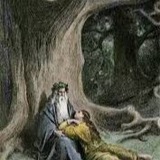
Some of Elena Kukanova’s other illustrations of Tolkien’s characters I’ve already shared before
Forwarded from • Hellas • Ελλάδα • Greece (Maria)
Greek girls wearing the traditional Tsakonian costume/The traditional costume from Tsakonia, Peloponnese.
The jumpsuit is the traditional women's costume of the wider area of Tsakonia. In the past, the nobility of Prastos, the first Tsakonian capital, used to wear the costume as a sign of financial comfort and superior origin. This costume, which was used as a wedding dress, was characterized by Doric simplicity. Free from gold embroidered ornaments and coins, it combined the colors of red, yellow and green. @GreekLeague
The jumpsuit is the traditional women's costume of the wider area of Tsakonia. In the past, the nobility of Prastos, the first Tsakonian capital, used to wear the costume as a sign of financial comfort and superior origin. This costume, which was used as a wedding dress, was characterized by Doric simplicity. Free from gold embroidered ornaments and coins, it combined the colors of red, yellow and green. @GreekLeague
Forwarded from Scotland 🏴
This media is not supported in your browser
VIEW IN TELEGRAM
The Wailing Widow Falls is a spectacular waterfall in the Scottish Highlands that can be viewed from both above and below. The 50ft falls spill out over the cliff from Loch na Gainmhich. 🏴
You can’t use a blanket statement when talking about Slavs. Even officially Slavs are broken up in 3 groups West, East, and South Slavs. There are 13 Slavic countries. I don’t believe there is a reliable study done on early Slavic tribes. I don’t trust the official sources. When it comes to Slavic native spirituality, traditions, customs, practices, celebrations, worldview, and way of life, I think it’s pretty much the same for all Slavic groups. I’m not sure if the DNA, genetic studies will be the same for all Slavic groups. If you go visit the West, East, and South Slavs, the majority of people living there will be distinctly different in appearance. Some look very fair with light eyes and hair, others have darker complexion with brown hair and brown eyes. Although over the centuries there was some mixing going on between all of the Slavic groups..
Forwarded from Stam van de Vos🦊, hekserij en heidendom van de Lage Landen
YouTube
The Ancient Origins of Halloween | Bronze Age Folklore
In early bronze age Europe, the youths of the koryos warbands embodied their ancestors in a pagan cult of the dead. So how did the ancient Indo-Europeans perceive the nature of death and their relationship with their ancestors?
The folk story of the Wild…
The folk story of the Wild…
Forwarded from Wäinölä 🇫🇮
Mari priests bowing to Oš Kugu Jumo (Great White God), the chief God of the Mari pantheon, who takes the form of a birch tree. Mer Oto sacred grove in the village of Шоруньжа (Shorunzha), Mari-El Republic.
Photo: Heiko Kruusi (2018)
Photo: Heiko Kruusi (2018)
Forwarded from Western Heritage
The ruins of the 13th century Castle Coeffin built on the former site of a Viking fortress, located in Scotland.
Mongol Golden horde invasion of Kievan Rus' is considered to be an important part of Russian history, but I learned a while back that official history cannot be trusted.
There are some major facts that contradict the official history of Mongolians conquering Russia, and maintaining control off it for 300 years.
For example:
1. No mongolian written sources. It is no surprise, because mongols acquired their own writing system only in 20th century (before that they borrowed various alphabets of more developed nations). But in Russian chronicles mongols are not mentioned.
2. No architecture heritage
3. No linguistic borrowing: there are no Mongolian words in Russian language and visa versa (prior to 20th century)
4. No cultural and judicial borrowings: Russian traditions do not show anything possibly borrowed from that region and visa versa.
5. No economical leftovers: Mongols pillaged 2/3 of Eurasia, they were supposed to bring something home. At least gold from temples they destroyed in the process. But no, nothing.
6. No numismatic signs: world doesn't know Mongolian coins
7. No achievements in weaponry
8. No folklore, Mongolians don't have any mentions of their "great" past in their folklore.
9. Population genetics doesn't find any signs of presence of Asian nomads in Eurasian territories which they supposedly conquered.
I suspect that the real history was very different from the one we’ve read in our history books. I think the fabricators of official history didn’t write down true history, and the true names of all of the tribes, kingdoms, cultures, ruling dynasties, armies, battles, invasions, conquests, etc… I really doubt that the Golden horde invaders were really the ancestors of modern day Mongolian people who are till this day considered to be the most peaceful people on earth who still live like nomads.
I think when it comes to Russian history, the part about Mongolian invasion is one of the most important things to re-examine, and investigate.
There are some major facts that contradict the official history of Mongolians conquering Russia, and maintaining control off it for 300 years.
For example:
1. No mongolian written sources. It is no surprise, because mongols acquired their own writing system only in 20th century (before that they borrowed various alphabets of more developed nations). But in Russian chronicles mongols are not mentioned.
2. No architecture heritage
3. No linguistic borrowing: there are no Mongolian words in Russian language and visa versa (prior to 20th century)
4. No cultural and judicial borrowings: Russian traditions do not show anything possibly borrowed from that region and visa versa.
5. No economical leftovers: Mongols pillaged 2/3 of Eurasia, they were supposed to bring something home. At least gold from temples they destroyed in the process. But no, nothing.
6. No numismatic signs: world doesn't know Mongolian coins
7. No achievements in weaponry
8. No folklore, Mongolians don't have any mentions of their "great" past in their folklore.
9. Population genetics doesn't find any signs of presence of Asian nomads in Eurasian territories which they supposedly conquered.
I suspect that the real history was very different from the one we’ve read in our history books. I think the fabricators of official history didn’t write down true history, and the true names of all of the tribes, kingdoms, cultures, ruling dynasties, armies, battles, invasions, conquests, etc… I really doubt that the Golden horde invaders were really the ancestors of modern day Mongolian people who are till this day considered to be the most peaceful people on earth who still live like nomads.
I think when it comes to Russian history, the part about Mongolian invasion is one of the most important things to re-examine, and investigate.
These are just a few more contradictions to Mongolian invasion of Russia history:
How was it possible for the ancestors of modern day Mongolian people to gather such a large army when Mongolia always been very scarcely populated. Just two centuries ago Mongolian population was only half a million. According to mainstream sources Mongolian population during Genghis Khan‘s time was only a couple of thousand people, and this included women and children.
Modern Mongolian people are one of the most peaceful people on the planet, until this very day they live a peaceful, nomadic life. And in terms of natural resources, Mongolia is deprived of metals. There aren’t any records, or any tradition in terms of making metal weaponry.
How was it possible for the ancestors of modern day Mongolian people to gather such a large army when Mongolia always been very scarcely populated. Just two centuries ago Mongolian population was only half a million. According to mainstream sources Mongolian population during Genghis Khan‘s time was only a couple of thousand people, and this included women and children.
Modern Mongolian people are one of the most peaceful people on the planet, until this very day they live a peaceful, nomadic life. And in terms of natural resources, Mongolia is deprived of metals. There aren’t any records, or any tradition in terms of making metal weaponry.
There’s nothing wrong with questioning parts of history. I think it’s actually necessary to re-examine official history.
Поганые язычники / Статьи / Newslab.Ru
This is written in Russian. My translation of this is not so great, but I believe it’s saying that the Russian word pagan is язычник/yazychnik, and that it came with Christianity. calque says it came from the Greek ethnikos “national, pagan” from ethnos - “the people, tongue/language”.
The Greeks had their own name for villager/country dweller & followers of pantheistic faith which was paganus from pagus - district, region. From where the Russian negative swear words «погань/pogan» and «поганый/poganyy» meaning trash or bad come from. These words are still used in modern Russia and still have a negative meaning
This is written in Russian. My translation of this is not so great, but I believe it’s saying that the Russian word pagan is язычник/yazychnik, and that it came with Christianity. calque says it came from the Greek ethnikos “national, pagan” from ethnos - “the people, tongue/language”.
The Greeks had their own name for villager/country dweller & followers of pantheistic faith which was paganus from pagus - district, region. From where the Russian negative swear words «погань/pogan» and «поганый/poganyy» meaning trash or bad come from. These words are still used in modern Russia and still have a negative meaning
newslab.ru
Поганые язычники
Если христиане почитают Иисуса Христа, а буддисты – Будду, то значит ли это, что язычество – культ языка? Да и какого языка – говяжьего или свиного, а то,...
Forwarded from ᚪOLK CINEᛗA
Njörðr and Skaði
In the Poetic Edda, Skadi (the goddess of bowhunting, skiing, winter, and mountains), in order to avenge the death of her father, takes up arms and goes to attack the rival tribe of the gods (the Aesir) in Asgard. The Aesir, wanting to appease her anger, offered her the choice of one of their number for a husband, with the stipulation that she choose a god by his legs (or feet) alone. She chooses Njörd (the god of wind and of the sea), thinking that he is the fair god Balder; their marriage fails as Njörd prefers to live by the sea, and Skadi is happier in her father’s home in the mountains. Some sources say Skadi later married the god Odin and bore him sons.
Scandinavia is said to take its name from the goddess.
👉🏻(Listen to the Poetic Edda audio book)
In the Poetic Edda, Skadi (the goddess of bowhunting, skiing, winter, and mountains), in order to avenge the death of her father, takes up arms and goes to attack the rival tribe of the gods (the Aesir) in Asgard. The Aesir, wanting to appease her anger, offered her the choice of one of their number for a husband, with the stipulation that she choose a god by his legs (or feet) alone. She chooses Njörd (the god of wind and of the sea), thinking that he is the fair god Balder; their marriage fails as Njörd prefers to live by the sea, and Skadi is happier in her father’s home in the mountains. Some sources say Skadi later married the god Odin and bore him sons.
Scandinavia is said to take its name from the goddess.
👉🏻(Listen to the Poetic Edda audio book)
Forwarded from Scotland 🏴
This media is not supported in your browser
VIEW IN TELEGRAM
The Old man of Storr
According to legend, the Old Man of Storr was a giant who lived on the Trotternish Ridge. When he was laid to rest upon his death, his thumb—the “Old Man”—remained partially above ground.🏴
According to legend, the Old Man of Storr was a giant who lived on the Trotternish Ridge. When he was laid to rest upon his death, his thumb—the “Old Man”—remained partially above ground.🏴
Unfortunately this will be hard for me to do here in north Florida. I don’t think there are many ethnic Europeans here who are trying to reconnect with their ethnic pagan roots. That’s why I keep to myself.
Forwarded from Europa Invicta 🏛️
The time for classical activism is over. The real European people must come together and become a community again.
Create local groups, get together and help each other.
Cultivate and pass on our European values to your children.
This is the only alternative we have left.
Create local groups, get together and help each other.
Cultivate and pass on our European values to your children.
This is the only alternative we have left.