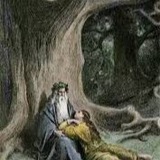
Forwarded from Old and New European Art and Aesthetics
From An Absent One (1871). Lawrence Alma-Tadema (Dutch, 1836-1912).
Forwarded from Αρυολογία☀️ (The Indo-Europeans)
Coin of Indo-Greek King Agathocles
c. 190 BCE
Depicted are the Deities Vāsudeva-Krishna and Saṃkarṣaṇa. There are also inscriptions in both the Greek and Brāhmī scripts.
c. 190 BCE
Depicted are the Deities Vāsudeva-Krishna and Saṃkarṣaṇa. There are also inscriptions in both the Greek and Brāhmī scripts.
Forwarded from Αρυολογία☀️ (The Indo-Europeans)
Who were the Indo-Greeks?
After the death of Alexander and the subsequent break-up of his Macedonian-Greek Empire, various territories in Bactria & Northern India remained under Greek control. They were independent kingdoms with local Greek rulers, where a synthesis of Greek, Hindu & Buddhist ideas was quickly established. The predominant Greek territory, Yavanarajya ("Kingdom of Yavanas"), was established in the 2nd century BCE, spanning parts of modern Afghanistan as well as the greater Punjab region. It survived until the first decade of the Common Era, where it was disestablished around the year 10 CE.
After the death of Alexander and the subsequent break-up of his Macedonian-Greek Empire, various territories in Bactria & Northern India remained under Greek control. They were independent kingdoms with local Greek rulers, where a synthesis of Greek, Hindu & Buddhist ideas was quickly established. The predominant Greek territory, Yavanarajya ("Kingdom of Yavanas"), was established in the 2nd century BCE, spanning parts of modern Afghanistan as well as the greater Punjab region. It survived until the first decade of the Common Era, where it was disestablished around the year 10 CE.
Forwarded from ODAL
Замок Эгль (фр. Château d'Aigle) – исторический замок в городе Эгль в Швейцарии в кантоне Во 🇨🇭
Ph: leodwen.
#ODAL_фото
Ph: leodwen.
#ODAL_фото
Forwarded from ODAL
Svarog in Slavic Mythology
There are very few traces of pre-Christian Slavic mythology which have survived to present day, but apparently Svarog's name is derived from Sanskrit ("Sur" or "shine") and Vedic "Svar," which means "shines" or "gleams" and "svarg" which means "heaven." It may have been an Iranian loan word, rather than direct from India.
There are very few traces of pre-Christian Slavic mythology which have survived to present day, but apparently Svarog's name is derived from Sanskrit ("Sur" or "shine") and Vedic "Svar," which means "shines" or "gleams" and "svarg" which means "heaven." It may have been an Iranian loan word, rather than direct from India.
Forwarded from Celtic Folk and Culture
The Celtic Goddess Airmid is the Celtic Irish Goddess of Herbalism and Healing.
#Airmid
#TuathaDeDannan
#CelticGoddesses
#Airmid
#TuathaDeDannan
#CelticGoddesses