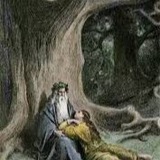
Forwarded from Old and New European Art and Aesthetics
Tannhauser in the Venusberg (1896). Jacques Clément Wagrez (French, 1850-1908).
Forwarded from Αρυολογία☀️ (The Indo-Europeans)
#Swastika Coin, Kuninda Kingdom (Himalayas)
c. 1st Century BCE
c. 1st Century BCE
Inspired by the magic and wisdom of Russian fairy tales, Tarot of the Golden Wheel interprets traditional tarot through the prism of colorful Slavic folk culture. In this radiant deck the Golden Wheel, a sacred symbol of karma, the sun, and the infinite cycles of life conveys the Fool on his journey through the Major and Minor Arcana.
https://www.usgamesinc.com/tarot-of-the-golden-wheel.html
https://www.usgamesinc.com/tarot-of-the-golden-wheel.html
U.S. Games Systems, Inc.
Tarot of the Golden Wheel
Inspired by the magic and wisdom of Russian fairy tales, Tarot of the Golden Wheel interprets traditional tarot through the prism of colorful Slavic folk culture.
It upsets me to think of all those billions of superficial, shallow, easily manipulated humans, who are so eager to throw away the old ways, and disconnect from their ethnic roots. Those who are happy to destroy organic nature, and transform the earth from her natural state, into some futuristic alien world. Those who don’t see the beauty in the natural world, and don’t understand the vital importance of keeping things organic, and simple. People like that don’t see the value in natural living, and don’t mind to live each day inside an artificial environment of an urbanized anthill surrounded by grey rectangular buildings and endless toxic traffic. Unfortunately, majority of humans are those people. Only a tiny minority still respects their ancestors, and remains loyal to nature, and the old ways. The issue I take with the majority that seems to be racing forward towards futuristic transhumance, is that they will devour everything in their way like parasites, and leave no place for us in this world.
Forwarded from Stam van de Vos🦊, hekserij en heidendom van de Lage Landen
Iduna, Iðunn
This apple is not forbidden,
if magic needs a spark,
because you are there,
when the blossom blooms.
You are there
when there is renewal,
for the young
and for the old.
Vital life, vital force,
golden eternity.
Lieve groet, Dirkje
This apple is not forbidden,
if magic needs a spark,
because you are there,
when the blossom blooms.
You are there
when there is renewal,
for the young
and for the old.
Vital life, vital force,
golden eternity.
Lieve groet, Dirkje
Forwarded from Folk Wisdom & Ways
A bit of Irish lore - As a young boy, the great warrior Fionn mac Cumhaill (pronounced Fee-un Mack Cool) was sent to live with the celebrated poet Finnegas. Fionn acted as an apprentice and learned from the old eccentric’s immense wisdom. The two settled along the banks of the beautiful River Boyne in Leinster.
One day Finnegas recounted the ancient tale of the bradán feasa (bra-dawn fassa), also known as the Salmon of Knowledge, to Fionn. The druids of old had told of a salmon that had eaten the nuts of the magical hazel trees that lined the bank of the river. In eating the nuts, the salmon had gained all the knowledge of the world. According to the druids, the one who ate the Salmon would gain all this knowledge for themselves.
Finnegas had spent years of his life by the edge of the river trying to catch the Salmon. After years of waiting, one-day Finnegas managed to catch the legendary fish. Without a second’s delay, he passed it into Fionn’s hands and ordered the boy to cook it but not to eat a single morsel. Ever obedient, Fionn did exactly as he was instructed.
After a while, Finnegas returned to the camp but the second he saw the expression in Fionn’s eye his heart sank. Finnegas asked the young boy if he had indulged in the forbidden fish. Fionn responded that while cooking the fish he had burned his finger and started sucking his thumb to ease the pain.
Disheartened, the old man instructed Fionn to eat all of the Salmon. However, upon finishing Fionn didn’t feel any wiser than before. Finnegas suggested that he try sucking his thumb again. Fionn did as he was told and the moment he placed his thumb in his mouth all the knowledge of the world rushed into his head.
It was this incredible knowledge and wisdom gained from the Salmon of Knowledge that allowed Fionn to become the leader of the Fianna, the famed heroes of Irish myth
One day Finnegas recounted the ancient tale of the bradán feasa (bra-dawn fassa), also known as the Salmon of Knowledge, to Fionn. The druids of old had told of a salmon that had eaten the nuts of the magical hazel trees that lined the bank of the river. In eating the nuts, the salmon had gained all the knowledge of the world. According to the druids, the one who ate the Salmon would gain all this knowledge for themselves.
Finnegas had spent years of his life by the edge of the river trying to catch the Salmon. After years of waiting, one-day Finnegas managed to catch the legendary fish. Without a second’s delay, he passed it into Fionn’s hands and ordered the boy to cook it but not to eat a single morsel. Ever obedient, Fionn did exactly as he was instructed.
After a while, Finnegas returned to the camp but the second he saw the expression in Fionn’s eye his heart sank. Finnegas asked the young boy if he had indulged in the forbidden fish. Fionn responded that while cooking the fish he had burned his finger and started sucking his thumb to ease the pain.
Disheartened, the old man instructed Fionn to eat all of the Salmon. However, upon finishing Fionn didn’t feel any wiser than before. Finnegas suggested that he try sucking his thumb again. Fionn did as he was told and the moment he placed his thumb in his mouth all the knowledge of the world rushed into his head.
It was this incredible knowledge and wisdom gained from the Salmon of Knowledge that allowed Fionn to become the leader of the Fianna, the famed heroes of Irish myth
Forwarded from Old and New European Art and Aesthetics
From An Absent One (1871). Lawrence Alma-Tadema (Dutch, 1836-1912).
Forwarded from Αρυολογία☀️ (The Indo-Europeans)
Coin of Indo-Greek King Agathocles
c. 190 BCE
Depicted are the Deities Vāsudeva-Krishna and Saṃkarṣaṇa. There are also inscriptions in both the Greek and Brāhmī scripts.
c. 190 BCE
Depicted are the Deities Vāsudeva-Krishna and Saṃkarṣaṇa. There are also inscriptions in both the Greek and Brāhmī scripts.
Forwarded from Αρυολογία☀️ (The Indo-Europeans)
Who were the Indo-Greeks?
After the death of Alexander and the subsequent break-up of his Macedonian-Greek Empire, various territories in Bactria & Northern India remained under Greek control. They were independent kingdoms with local Greek rulers, where a synthesis of Greek, Hindu & Buddhist ideas was quickly established. The predominant Greek territory, Yavanarajya ("Kingdom of Yavanas"), was established in the 2nd century BCE, spanning parts of modern Afghanistan as well as the greater Punjab region. It survived until the first decade of the Common Era, where it was disestablished around the year 10 CE.
After the death of Alexander and the subsequent break-up of his Macedonian-Greek Empire, various territories in Bactria & Northern India remained under Greek control. They were independent kingdoms with local Greek rulers, where a synthesis of Greek, Hindu & Buddhist ideas was quickly established. The predominant Greek territory, Yavanarajya ("Kingdom of Yavanas"), was established in the 2nd century BCE, spanning parts of modern Afghanistan as well as the greater Punjab region. It survived until the first decade of the Common Era, where it was disestablished around the year 10 CE.
Forwarded from ODAL
Замок Эгль (фр. Château d'Aigle) – исторический замок в городе Эгль в Швейцарии в кантоне Во 🇨🇭
Ph: leodwen.
#ODAL_фото
Ph: leodwen.
#ODAL_фото