Forwarded from Hyperborean Radio (The Final Episodes)
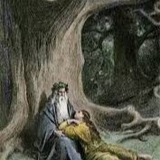
The Bear & The Maiden Fair
One of the oldest and most widespread elements of Hyperborean faith is the Bear cult. While this can often be traced to a bear mother progenitor there is also a male Bear god, sometimes depicted as a Hairy Wildman.
Found in Fairy Tales, Legends, Myths, and even Wilder Mann customs, the marriage of the Maiden Fertility goddess and the Bear is seen across our lands. The Bear Tsar in Slavia is often seen trying to find a young bride, in the tales of White Bear King Valemon & Snow White and Rose Red where Earth's fertility is connected to the marriage of the Bear and the Maiden Fair. In both the entrance to the Otherworld or the Underworld is implied much as when a bear will go hibernate only to emerge when life returns.
Through these ancient times to modern day this connection echoes, until recently the belief bears would kidnap women and sire Half Bear Supermen was widespread, while women were believed to be drawn to the most bearlike of men.-TLK
Hyperborean Radio (Uncensored)
One of the oldest and most widespread elements of Hyperborean faith is the Bear cult. While this can often be traced to a bear mother progenitor there is also a male Bear god, sometimes depicted as a Hairy Wildman.
Found in Fairy Tales, Legends, Myths, and even Wilder Mann customs, the marriage of the Maiden Fertility goddess and the Bear is seen across our lands. The Bear Tsar in Slavia is often seen trying to find a young bride, in the tales of White Bear King Valemon & Snow White and Rose Red where Earth's fertility is connected to the marriage of the Bear and the Maiden Fair. In both the entrance to the Otherworld or the Underworld is implied much as when a bear will go hibernate only to emerge when life returns.
Through these ancient times to modern day this connection echoes, until recently the belief bears would kidnap women and sire Half Bear Supermen was widespread, while women were believed to be drawn to the most bearlike of men.-TLK
Hyperborean Radio (Uncensored)
Forwarded from ODAL
Forwarded from Stam van de Vos🦊, hekserij en heidendom van de Lage Landen
Donar or Thor is a well known god of thunder. He is also a deity of balance and lifeforce. But how about Hludana? She is the female counterpart of Donar when it comes to balance. Almost like yin and yang to make a compasrison. Perhaps it comes as a surprise that there is another god who is associated with thunder, lighting and lifegiving energy? Who? Farbauti is his name. It was not possible to find an image for this post that is acurate. Farbauti is a jotnar from the Ironwood and appeared as a massive column of orange fire when journeying to Him. Farbauti is a very ancient deity and i noticed He communicated with imagery instead of words. The Tribe of the Fox loves going beyond just having bookknowledge and therefore we search for first hand knowledge. We do this by trancejourneying using oldskool and newskool ways. The Tribe of the Fox started experimenting with giving heathen and non heathen folks first hand experience of the ancestors and deities. Succesfully🙂! Let's bring back the old knowledge🦊!
Forwarded from Survive the Jive: All-feed
An ancient British skeleton called Beachy head lady which was supposedly black and which the BBC listed as one of the greatest black Britons, turned out to be a white person from Southern Europe when they DNA tested it!
https://youtu.be/pt1RQsiPx0w
https://youtu.be/pt1RQsiPx0w
YouTube
How the myth of Britain’s ancient and multicultural history is exploded by science
In the last ten years or so, there has been a conscious effort to revise Britain’s history to show that black people have lived in this country for thousands of years. It is a complete falsehood, but that does not stop authors like David Olushoga still trying…
THE OLD WAYS pinned «This information on Baba Yaga you did not know/how they flipped the character image of the Russian people. Turns out the Slavic mythological character Baba Yaga we all know, is not the real Baba Yaga. Below I’ve translated this video from Russian into…»
I want to re-share an old post of mine. A different perspective through which to view the Slavic mythological baba Yaga
Forwarded from THE OLD WAYS
This information on Baba Yaga you did not know/how they flipped the character image of the Russian people.
Turns out the Slavic mythological character Baba Yaga we all know, is not the real Baba Yaga.
Below I’ve translated this video from Russian into English. My translation isn’t perfect.
Baba Yaga was known as the goddess Yoga, or Yaginya matushka/mother. Supreme deity of Slavic people. Always kind-hearted, loving and wonderful, patron of orphan children. She traveled through Midgard world either on sky fire wheel, or by horse on lands where lived the ancestors of the great race, and the descendants of God Rod.
She collected orphan children from villages and cities. People recognized her by her tenderness, motherly kindness, and her golden boots, and would point her to where the orphans lived. She brought the orphan children to her skete/settlement at the foothills of the mountains. For protection it was surrounded by skulls of various animals. It was located in the thickest of the forest in what is today known as Altai republic Russia.
In mountain foothills settlement where goddess Yaginya was performing this ancient fire rite of passage ceremony on orphan children, there was a temple of god Rod carved from within the mountain. Near the temple in the rock there was a special deepening that Slavic Volkhvs (Slavic Pagan priests) referred to as “Pesh Ra”. From this name came the Russian word “bake” (petch/petsh). As well as the word “cave” (Peshera).
From this special deepening in the stone called (Pesh Ra) sticks out a stone-platform separated by a ledge into two equal deepenings called “Lapat” which was later called “Lapata” (Peel/ shovel-like tool)
In one corner closer to Pesh Ra, Goddess Yaga placed sleeping children dressed in traditional white costumes. In another corner Goddess Yaga placed dry brushwood. After which Lapata/lopata was pushed back into Pesh Ra, and Yaginya would light the brushwood. As Lapata/Peel was pushed back inside the Pesh-Ra, a special mechanism lowered the stone-slab on ledge of lopata, and would separate the deepening with the children in it from the fire. Basically the children were unharmed.
To all those who beared witness to this fire rite of passage meant that the orphaned children were dedicated to ancient Slavonic gods, and for the most part no one will see these children again in worldly life. These children were separated from regular society, and taken to be raised in the temple by Slavic Volkvhs.
Turns out the Slavic mythological character Baba Yaga we all know, is not the real Baba Yaga.
Below I’ve translated this video from Russian into English. My translation isn’t perfect.
Baba Yaga was known as the goddess Yoga, or Yaginya matushka/mother. Supreme deity of Slavic people. Always kind-hearted, loving and wonderful, patron of orphan children. She traveled through Midgard world either on sky fire wheel, or by horse on lands where lived the ancestors of the great race, and the descendants of God Rod.
She collected orphan children from villages and cities. People recognized her by her tenderness, motherly kindness, and her golden boots, and would point her to where the orphans lived. She brought the orphan children to her skete/settlement at the foothills of the mountains. For protection it was surrounded by skulls of various animals. It was located in the thickest of the forest in what is today known as Altai republic Russia.
In mountain foothills settlement where goddess Yaginya was performing this ancient fire rite of passage ceremony on orphan children, there was a temple of god Rod carved from within the mountain. Near the temple in the rock there was a special deepening that Slavic Volkhvs (Slavic Pagan priests) referred to as “Pesh Ra”. From this name came the Russian word “bake” (petch/petsh). As well as the word “cave” (Peshera).
From this special deepening in the stone called (Pesh Ra) sticks out a stone-platform separated by a ledge into two equal deepenings called “Lapat” which was later called “Lapata” (Peel/ shovel-like tool)
In one corner closer to Pesh Ra, Goddess Yaga placed sleeping children dressed in traditional white costumes. In another corner Goddess Yaga placed dry brushwood. After which Lapata/lopata was pushed back into Pesh Ra, and Yaginya would light the brushwood. As Lapata/Peel was pushed back inside the Pesh-Ra, a special mechanism lowered the stone-slab on ledge of lopata, and would separate the deepening with the children in it from the fire. Basically the children were unharmed.
To all those who beared witness to this fire rite of passage meant that the orphaned children were dedicated to ancient Slavonic gods, and for the most part no one will see these children again in worldly life. These children were separated from regular society, and taken to be raised in the temple by Slavic Volkvhs.