Forwarded from Stam van de Vos🦊, hekserij en heidendom van de Lage Landen
Today I did a ceremony with 2 dear friends in the dunes along the North Sea coast. For privacy reasons I won't say anything about the content of this ceremony, but after we made our sacrifices we took the time to settle in.
During the beginning of the ritual a butterfly came to our place which I managed to photograph. (see photo above). As our celebration continued and of course I stopped taking a photo, more and more butterflies came to our place to circle. They kept circling until we ended our celebration again. It was a wonderful experience with a deeper meaning.
During the beginning of the ritual a butterfly came to our place which I managed to photograph. (see photo above). As our celebration continued and of course I stopped taking a photo, more and more butterflies came to our place to circle. They kept circling until we ended our celebration again. It was a wonderful experience with a deeper meaning.
Forwarded from Folk Wisdom & Ways
The Floralia was an ancient Roman religious festival observed in honor of the goddess Flora, held April 27 during the Republican era, or April 28 in the Julian calendar.
The colorful festival had a licentious, pleasure-seeking atmosphere & included Ludi Florae, the "Games of Flora" which lasted for six days under the empire.
Juvenal writes that prostitutes danced naked & fought in mock combat.
Ovid tells us that hares & goats—animals considered fertile & salacious—were ceremonially released as part of the festivities.
Persius says that revelers were pelted with vetches, beans, & lupins, all symbols of fertility.
Flora is one of the most ancient goddesses of Roman religion. A goddess of flowers, vegetation, & fertility, she received offerings in the sacred grove of an archaic priesthood. Her altar at Rome was said to have been established by Titus Tatius during the semi-legendary Regal period.
Artwork: Floralia, by Hobbe Smith, c. 1898
The colorful festival had a licentious, pleasure-seeking atmosphere & included Ludi Florae, the "Games of Flora" which lasted for six days under the empire.
Juvenal writes that prostitutes danced naked & fought in mock combat.
Ovid tells us that hares & goats—animals considered fertile & salacious—were ceremonially released as part of the festivities.
Persius says that revelers were pelted with vetches, beans, & lupins, all symbols of fertility.
Flora is one of the most ancient goddesses of Roman religion. A goddess of flowers, vegetation, & fertility, she received offerings in the sacred grove of an archaic priesthood. Her altar at Rome was said to have been established by Titus Tatius during the semi-legendary Regal period.
Artwork: Floralia, by Hobbe Smith, c. 1898
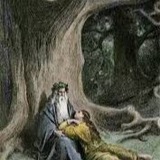
An illustration in Beowulf of the queen pouring wine for the warrior.
• Marshall, Henrietta Elizabeth (1908) Stories of Beowulf, T.C. & E.C. Jack, p. 29
• Marshall, Henrietta Elizabeth (1908) Stories of Beowulf, T.C. & E.C. Jack, p. 29
Forwarded from The Frithstead (Folcweard)
-The Æfinrúnar Book 1-
The Æfinrúnar are the runes of earthly life, the sacred practices handed to us by the divine. In the Rigsþula, Heimdallr bestowed gifts to the classes of men. He gave them the tools of civilization, the Æfinrúnar, & Aldrrúnar.
This book is reconstructing the ancestral Norse religion using source material to piece together our ancestral ways. Our goal is to establish a religious standard for our people rooted in the traditions found in our lore. For far too long we have been told our ways were destroyed with no hopes of rebuilding a truly authentic system. The Æfinrúnar Book part 1 gives us the tools to reforge local communities & establish a sacred space, build a stalli, celebrate the holy tides, & honor the gods & our ancestors in a traditional way. This book covers rituals including creating statues, sacrifice, home rituald, & rites of passage, et al. We offer an orthopraxy for those wanting to dive deeper.
https://t.me/TheNorroenaSociety
https://linktr.ee/TheFrithstead
The Æfinrúnar are the runes of earthly life, the sacred practices handed to us by the divine. In the Rigsþula, Heimdallr bestowed gifts to the classes of men. He gave them the tools of civilization, the Æfinrúnar, & Aldrrúnar.
This book is reconstructing the ancestral Norse religion using source material to piece together our ancestral ways. Our goal is to establish a religious standard for our people rooted in the traditions found in our lore. For far too long we have been told our ways were destroyed with no hopes of rebuilding a truly authentic system. The Æfinrúnar Book part 1 gives us the tools to reforge local communities & establish a sacred space, build a stalli, celebrate the holy tides, & honor the gods & our ancestors in a traditional way. This book covers rituals including creating statues, sacrifice, home rituald, & rites of passage, et al. We offer an orthopraxy for those wanting to dive deeper.
https://t.me/TheNorroenaSociety
https://linktr.ee/TheFrithstead
Forwarded from Stam van de Vos🦊, hekserij en heidendom van de Lage Landen
Wolves are a big part of Northern- or Northwest European culture. Odin is accompanied by 2 wolves named Geri and Freki. Angrboda, The Wise One of the Ironwood, is mother to many wolves. But the greatest of all wolves is Fenris. In this era He is bound but when unleashed He will destroy this era so a new one can begin. This is crucial for the cyclic existence that is a law of nature. Yesterday i visited Fenris using a modern methode based on morphic resonance (systemic constallations). It was a beautiful and deep experience to meet this magnificient deity🐺. Hail Fenris and the deities of the Ironwood.
Veles Bastion is the ice-covered buttress of elevation 1223 m[1] forming the southwest extremity of Stribog Mountains on Brabant Island in the Palmer Archipelago, Antarctica. It has steep and partly ice-free north, west and southwest slopes, and surmounts Zlatiya Glacier to the east and south
Location of Brabant Island in the Antarctic Peninsula region.
The peak is named after the Slavic god of wisdom and knowledge Veles.
Location of Brabant Island in the Antarctic Peninsula region.
The peak is named after the Slavic god of wisdom and knowledge Veles.
This deep connection to the wild has always been, and still remains a big part of indigenous European people, and no one can take that away from us.
Forwarded from ᛉᛟ Viðr ᛟᛉ
This media is not supported in your browser
VIEW IN TELEGRAM
All I want is to be left alone