Forwarded from Hyperborean Radio (The Final Episodes)
Simona Kossak
Simona Kossak was a Polish biologist, and animal advocate. She was said to have lived in a house in the forest with a lynx that slept in her bed and a pet crow named Korasek that would often terrorize and steal from people. Taking card keys, money, permits, and attacking people walking or riding bikes. Her interactions and care for animals would lead to many of them being loyal friends with her. One such animal was Żabka a rather large female boar Simona had raised since she was a day old, and that walked beside her and guarded her not unlike a dog. Even asking for pets and rubs. She also had a herd or "Pack" of deer that she cared for and would follow her around. She was a staunch advocate of animals and fought to defend the Lynxes and Wolves of Poland's oldest forests. This odd life style led many to call her a witch. Though perhaps in the oldest terms of the word they were not far off, as there is something magical about the way in which she lived.
Simona Kossak was a Polish biologist, and animal advocate. She was said to have lived in a house in the forest with a lynx that slept in her bed and a pet crow named Korasek that would often terrorize and steal from people. Taking card keys, money, permits, and attacking people walking or riding bikes. Her interactions and care for animals would lead to many of them being loyal friends with her. One such animal was Żabka a rather large female boar Simona had raised since she was a day old, and that walked beside her and guarded her not unlike a dog. Even asking for pets and rubs. She also had a herd or "Pack" of deer that she cared for and would follow her around. She was a staunch advocate of animals and fought to defend the Lynxes and Wolves of Poland's oldest forests. This odd life style led many to call her a witch. Though perhaps in the oldest terms of the word they were not far off, as there is something magical about the way in which she lived.
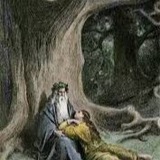
I don’t know the name of the artist, but I can tell he/she was definitely Slavic
Forwarded from Αρυολογία☀️ (The Indo-Europeans)
Viking-age decorated ax (Scandinavia)
11th century CE
11th century CE
Forwarded from Hyperborean Radio (The Final Episodes)
Illustration for Sleeping Beauty by Heinrich Lefler 1905
Forwarded from BC Neanderthal Mindset
In French folklore onions are used to predict the weather.
If the onions had especially thick skins then it is said to predict that there will be an especially cold, harsh winter ahead.
If the onions had especially thick skins then it is said to predict that there will be an especially cold, harsh winter ahead.
Forwarded from BC Neanderthal Mindset
The "Barbegazi" (from French "barbe-glacée", "frost-beard") hailing from Alpine folklore is a type of gnome fond of the snowy summits and mountainous terrain.
Hiding in their caves or cottages during summer, they emerge during the winter using their enormous feet as skis to traverse the mountainsides.
Hiding in their caves or cottages during summer, they emerge during the winter using their enormous feet as skis to traverse the mountainsides.
Forwarded from BC Neanderthal Mindset
Fimbulvetr, which means "great winter," is the prelude to Ragnarök, also known as “The twilight of the gods” which concludes with the great apocalyptic battle of the Norse gods.
This years-long snowfall will end all life on Earth, paving the way for the gods to wage war, and as the dust settles, new life is born marking the dawn of a new age.
Afterward, the world will resurface anew and fertile, the surviving and returning gods will meet, and the world will be repopulated by two human survivors… Lif and Lifthrasir.
This years-long snowfall will end all life on Earth, paving the way for the gods to wage war, and as the dust settles, new life is born marking the dawn of a new age.
Afterward, the world will resurface anew and fertile, the surviving and returning gods will meet, and the world will be repopulated by two human survivors… Lif and Lifthrasir.
Forwarded from • Hellas • Ελλάδα • Greece
Miniature Greek Gold Column Capital, 4th-3rd Century BC. In the shape of a Corinthian capital, the base with a ring of beads and two rows of acanthus leaves, volute support at each of the four corners of the abacus with granulation.
Forwarded from • Hellas • Ελλάδα • Greece
Greek geometric pottery, 8th century BC. Pelicans in swastika. Archaeological Museum of Argos.
Forwarded from Stam van de Vos🦊, hekserij en heidendom van de Lage Landen
But nothing beats this Mjolnir 😄
(Thor by Guterrez)
(Thor by Guterrez)
Forwarded from Stam van de Vos🦊, hekserij en heidendom van de Lage Landen
Nehalennia is the Goddess of the Northsea and the rivers that flow into the Northsea. Therefore Nehalennia is a very important deity in Dutch heathenism/paganism. Nehalennia brings protection, joy and prosperity. Her energy is young and playful altough she is an ancient goddess. This morning i visited Her at the river Nieuwe Maas and made an offering to Her. That reminded me of a video Dirkje made about Nehalennia. In this video Dirkje reads a beautiful poem she wrote for our Goddess of the Northsea and talks about Nehalennia. https://www.youtube.com/watch?v=qPO7DLJEpRI
YouTube
Nehalennia, ancient but not forgotten
Nehalennia, the goddess of the North Sea, ancient but not forgotten. She has gained increasing attention within pagan and heathen groups these days. If you want to know more about Nehalennia, please watch Martijn's video : https://youtu.be/Zwmn0DLyGzA
And…
And…
Forwarded from Countrymen
Kulgam, the 'Land of Streams', still has traditional waterwheels which can be found in it's beautiful countryside.