Forwarded from BC Neanderthal Mindset
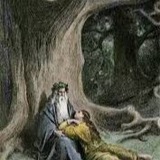
Echo was an Oread (mountain nymph) who tried to warn Zeus that Hera was coming to catch him being unfaithful to her.
For that act, Hera punished her by only allowing her to repeat things instead of speak her own mind
For that act, Hera punished her by only allowing her to repeat things instead of speak her own mind
Forwarded from BC Neanderthal Mindset
Mari (Mother) is considered the Mother Goddess of Basque Mythology.
She controls nature, winds and storms, and lives in the mountains.
Her most well known dwelling is the Cave of Anboto Mountain.
Adorned in red that looks like "fire" or appears as a thunderbolt, her departures from her cave are accompanied by storms or droughts, and which cave she lives in at different times will determine dry or wet weather.
Wet when she is in Anboto, and dry when she is elsewhere.
She controls nature, winds and storms, and lives in the mountains.
Her most well known dwelling is the Cave of Anboto Mountain.
Adorned in red that looks like "fire" or appears as a thunderbolt, her departures from her cave are accompanied by storms or droughts, and which cave she lives in at different times will determine dry or wet weather.
Wet when she is in Anboto, and dry when she is elsewhere.
Forwarded from Hyperborean Radio (The Final Episodes)
The Cornucopia
The Cornucopia AKA "The Horn of Plenty" is an ancient European symbol of abundance. It may have found its origins in goats or Aurochs horns. The Modern image is known from the myth of Infant Zeus being cared for by Amalthea a nourishing Goat goddess. Who broke off one of her horns which provided unlimited nourishment. However the image of the Cornucopia is much older appearing in a 13K year old stone carving in France alongside a goddess figure. Or the Thousands year old depiction of the god Svetovid. Indicating that it is much older than it first appears. Other goddesses such as Abundantia and Fortuna are also depicted with the Cornucopia and the symbol has grown a life of its own. Being depicted in all manners of forms including as a coat of arms. Medieval Monks would often depict Mother Earth with a Cornucopia in Illuminations, The personification of Summer often holds one, and in America it is one of the symbols of Thanksgiving. A time of gratitude for kin and the time of plenty. -TLK
The Cornucopia AKA "The Horn of Plenty" is an ancient European symbol of abundance. It may have found its origins in goats or Aurochs horns. The Modern image is known from the myth of Infant Zeus being cared for by Amalthea a nourishing Goat goddess. Who broke off one of her horns which provided unlimited nourishment. However the image of the Cornucopia is much older appearing in a 13K year old stone carving in France alongside a goddess figure. Or the Thousands year old depiction of the god Svetovid. Indicating that it is much older than it first appears. Other goddesses such as Abundantia and Fortuna are also depicted with the Cornucopia and the symbol has grown a life of its own. Being depicted in all manners of forms including as a coat of arms. Medieval Monks would often depict Mother Earth with a Cornucopia in Illuminations, The personification of Summer often holds one, and in America it is one of the symbols of Thanksgiving. A time of gratitude for kin and the time of plenty. -TLK
Forwarded from Hyperborean Radio (The Final Episodes)
Simona Kossak
Simona Kossak was a Polish biologist, and animal advocate. She was said to have lived in a house in the forest with a lynx that slept in her bed and a pet crow named Korasek that would often terrorize and steal from people. Taking card keys, money, permits, and attacking people walking or riding bikes. Her interactions and care for animals would lead to many of them being loyal friends with her. One such animal was Żabka a rather large female boar Simona had raised since she was a day old, and that walked beside her and guarded her not unlike a dog. Even asking for pets and rubs. She also had a herd or "Pack" of deer that she cared for and would follow her around. She was a staunch advocate of animals and fought to defend the Lynxes and Wolves of Poland's oldest forests. This odd life style led many to call her a witch. Though perhaps in the oldest terms of the word they were not far off, as there is something magical about the way in which she lived.
Simona Kossak was a Polish biologist, and animal advocate. She was said to have lived in a house in the forest with a lynx that slept in her bed and a pet crow named Korasek that would often terrorize and steal from people. Taking card keys, money, permits, and attacking people walking or riding bikes. Her interactions and care for animals would lead to many of them being loyal friends with her. One such animal was Żabka a rather large female boar Simona had raised since she was a day old, and that walked beside her and guarded her not unlike a dog. Even asking for pets and rubs. She also had a herd or "Pack" of deer that she cared for and would follow her around. She was a staunch advocate of animals and fought to defend the Lynxes and Wolves of Poland's oldest forests. This odd life style led many to call her a witch. Though perhaps in the oldest terms of the word they were not far off, as there is something magical about the way in which she lived.
I don’t know the name of the artist, but I can tell he/she was definitely Slavic
Forwarded from Αρυολογία☀️ (The Indo-Europeans)
Viking-age decorated ax (Scandinavia)
11th century CE
11th century CE
Forwarded from Hyperborean Radio (The Final Episodes)
Illustration for Sleeping Beauty by Heinrich Lefler 1905