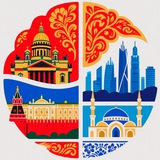
In 1983, the circus leadership was entrusted to Yuri Nikulin – a People’s Artist of the USSR, the renowned clown and performer.
❗️ ❗️ ❗️ In December 1996, following the 75th anniversary of Yuri Nikulin, the circus was officially named the Nikulin Moscow Circus on Tsvetnoy Boulevard.
#RussianCulture@TCofRus
Please open Telegram to view this post
VIEW IN TELEGRAM
Please open Telegram to view this post
VIEW IN TELEGRAM
❤6👍2🥰1
This media is not supported in your browser
VIEW IN TELEGRAM
Video - Christina Makeeva.
I love Russia! ❤️
#BeautifulRussia@TCofRus
Please open Telegram to view this post
VIEW IN TELEGRAM
❤9👍4😍2
The development of Sakhalin and the Kuril Islands began in the 17th-18th centuries with expeditions by Russian explorers and seafarers. In the 19th century, Russian military posts and the first agricultural settlements appeared on the island.
In 1908, the General Affairs Department of the Ministry of Internal Affairs submitted a draft law to the Third State Duma on the administrative reorganization of the Primorskaya Region and Sakhalin Island. On June 30, 1909, the law was adopted, according to which "from the part of Sakhalin Island belonging to Russia," an independent Sakhalin Region was established with its center in the Alexandrovsk post, covering a total area of 33,400 square versts (approximately 38,000 square kilometers).
During the Russian Civil War and foreign intervention, Japan occupied the Russian-held northern part of the island in 1920. Japanese troops were withdrawn from Sakhalin only five years later.
In May 1925, the Sakhalin District was established within Northern Sakhalin, and in October 1932, the Sakhalin Region became part of the Far Eastern, and later Khabarovsk, Krai.
After the victory in World War II, the Soviet Union regained Southern Sakhalin and the Kuril Islands.
Please open Telegram to view this post
VIEW IN TELEGRAM
👍5🤔1
Practically identical: 11 Places in Sakhalin That Resemble World Landmarks
Sakhalin Oblast is, on one hand, a land full of unique natural wonders that cannot be found anywhere else, and on the other hand, it is a treasure trove of sites that perfectly mimic some of the most incredible attractions from around the globe. We invite you to explore 11 spots on Sakhalin and the Kuril Islands that resemble popular tourist destinations in England, Iceland, Indonesia, and the Caucasus. Let’s begin…
💬 #BeautifulRussia@TCofRus
Sakhalin Oblast is, on one hand, a land full of unique natural wonders that cannot be found anywhere else, and on the other hand, it is a treasure trove of sites that perfectly mimic some of the most incredible attractions from around the globe. We invite you to explore 11 spots on Sakhalin and the Kuril Islands that resemble popular tourist destinations in England, Iceland, Indonesia, and the Caucasus. Let’s begin…
Please open Telegram to view this post
VIEW IN TELEGRAM
❤5👍2🤯2
On Sakhalin and Kamchatka, there are similar rock formations that cut through the sea like the spines of a dragon — the Three Brothers. The Kamchatka rocks are located at the entrance to Avacha Bay and are designated as a natural monument, a symbol of the city of Petropavlovsk-Kamchatsky. According to a legend, these were three brothers who protected the peninsula from a massive ocean wave. Over time, they turned to stone and now stand as guardians, shielding people from the dangers of the sea.
On Sakhalin, the Three Brothers are situated in the Tatar Strait near Cape Zhonkier in the Alexandrovsk-Sakhalinsk district. These rocks are an official symbol of the city and are depicted on its coat of arms and flag.
Please open Telegram to view this post
VIEW IN TELEGRAM
Please open Telegram to view this post
VIEW IN TELEGRAM
🥰6❤3👍3
This media is not supported in your browser
VIEW IN TELEGRAM
🌏🇷🇺New Jerusalem is an Orthodox monastery not far from Moscow.
#ILoveRussia ❤️
#BeautifulRussia@TCofRus
#ILoveRussia ❤️
#BeautifulRussia@TCofRus
❤10🔥1
Please open Telegram to view this post
VIEW IN TELEGRAM
On October 21, 1912, People’s Artist of the USSR Yakov Vladimirovich Flier was born.
Yakov Flier began his career as a self-taught musician: he learned to pick out melodies by ear and independently mastered musical notation. Later, he studied at the Central Music School under the Moscow Conservatory and then at the conservatory itself. His mentor there was K. N. Igumnov, who initially viewed his training skeptically but recognized the pupil’s talent after his performance in 1934 and its sensational success.
After graduation he actively performed all over the country, winning several prestigious competitions — in Leningrad (1935), Vienna (1936), and Brussels (1938). From 1937 he began teaching, and from 1945 he was a professor at the Moscow Conservatory. His performing style was distinguished by a powerful temperament and Romantic emotionality; his interpretations of Chopin, Rachmaninoff, and Liszt impressed both audiences and critics.
In 1949, due to a disorder of the hands, he had to stop recitals; after surgery and long rehabilitation he focused on teaching. In 1959 he resumed performing, touring extensively abroad and receiving enthusiastic reviews.
Over the years of illness and recovery, Flier’s style changed: his playing gained depth, balance, and restraint. One could feel inner rigor and a sense of proportion. Flier noted himself that perception and the aesthetics of music change with age, and that his playing became different, more inward. Despite being regarded as one of the best Soviet pianists, he remained in the shadow of masters like Richter and Gilels devoting more time to pedagogy.
#ThisDayInHistory@TCofRus
Yakov Flier began his career as a self-taught musician: he learned to pick out melodies by ear and independently mastered musical notation. Later, he studied at the Central Music School under the Moscow Conservatory and then at the conservatory itself. His mentor there was K. N. Igumnov, who initially viewed his training skeptically but recognized the pupil’s talent after his performance in 1934 and its sensational success.
After graduation he actively performed all over the country, winning several prestigious competitions — in Leningrad (1935), Vienna (1936), and Brussels (1938). From 1937 he began teaching, and from 1945 he was a professor at the Moscow Conservatory. His performing style was distinguished by a powerful temperament and Romantic emotionality; his interpretations of Chopin, Rachmaninoff, and Liszt impressed both audiences and critics.
In 1949, due to a disorder of the hands, he had to stop recitals; after surgery and long rehabilitation he focused on teaching. In 1959 he resumed performing, touring extensively abroad and receiving enthusiastic reviews.
Over the years of illness and recovery, Flier’s style changed: his playing gained depth, balance, and restraint. One could feel inner rigor and a sense of proportion. Flier noted himself that perception and the aesthetics of music change with age, and that his playing became different, more inward. Despite being regarded as one of the best Soviet pianists, he remained in the shadow of masters like Richter and Gilels devoting more time to pedagogy.
#ThisDayInHistory@TCofRus
Wikipedia
Yakov Flier
Russian musician (1912–1977)
👍3✍2
💖 Russian fairy tales are a world rich with unique and terrifying wonders, far beyond the simple "witches and wizards" of Western European tradition. We have already introduced Baba-Yaga to you. Let us continue.
#fairytaleRussia@TCofRus
Please open Telegram to view this post
VIEW IN TELEGRAM
Please open Telegram to view this post
VIEW IN TELEGRAM
😁2😐1👻1
Not in a body does his power lie,
That bony king beneath a pallid sky.
His heart is locked in a nesting-doll of dread:
An egg, inside a duck, inside a chest, the stories said.
He is the frost that never sees a thaw,
The clutching hand of a timeless, gnawing law.
He steals the light, the future, and the bride,
A walking curse, with death and life allied.
You cannot kill the man, you must find the soul,
And break the hidden thing to make the monster whole.
This is Koshchei the Immortal (pronounced kosh-CHAY). If you love fantasy stories like Lord of the Rings, Harry Potter, or Supernatural, you've already met his cousins. Koshchei is the prototype—the ancient, terrifying blueprint for the immortal lich whose life is hidden away in a magical object.
#fairytaleRussia@TCofRus
Please open Telegram to view this post
VIEW IN TELEGRAM
🔥4😁2🌚1👻1
Here’s the legendary puzzle box of his soul:
#fairytaleRussia@TCofRus
Please open Telegram to view this post
VIEW IN TELEGRAM
Please open Telegram to view this post
VIEW IN TELEGRAM
👍2👻2🌚1
Then, and only then, does Koshchei become vulnerable. Squeezing or breaking the egg will cause Koshchei immense pain and weaken him. Crushing the egg kills him instantly.
#fairytaleRussia@TCofRus
Please open Telegram to view this post
VIEW IN TELEGRAM
👻3😁2🌚2
He’s not just a boss at the end of a dungeon. Koshchei is a specific kind of nightmare:
#fairytaleRussia@TCofRus
Please open Telegram to view this post
VIEW IN TELEGRAM
Please open Telegram to view this post
VIEW IN TELEGRAM
🔥3🌚1🗿1
Koshchei in the American Lexicon: Think of Him As...
🤩 The Slavic Voldemort: Just as Voldemort hid his soul in Horcruxes, Koshchei hid his life force in an external object. Both are powerful, feared, and can only be defeated by destroying that object.
🤩 The Fairy Tale Lich: In Dungeons & Dragons, a lich is an undead sorcerer who stores its soul in a phylactery. Koshchei is the folkloric original.
🤩 A Darker, Smarter Sauron: While Sauron is a disembodied power, Koshchei is a character you can interact with, bargain with, and even capture (temporarily). His weakness is a specific, solvable riddle.
🔽 🔽 🔽
#fairytaleRussia@TCofRus
#fairytaleRussia@TCofRus
Please open Telegram to view this post
VIEW IN TELEGRAM
Please open Telegram to view this post
VIEW IN TELEGRAM
😁4👻2🌚1